
When Innovation from Indore Went Global
In late 2017, a quiet milestone from central India made global news:
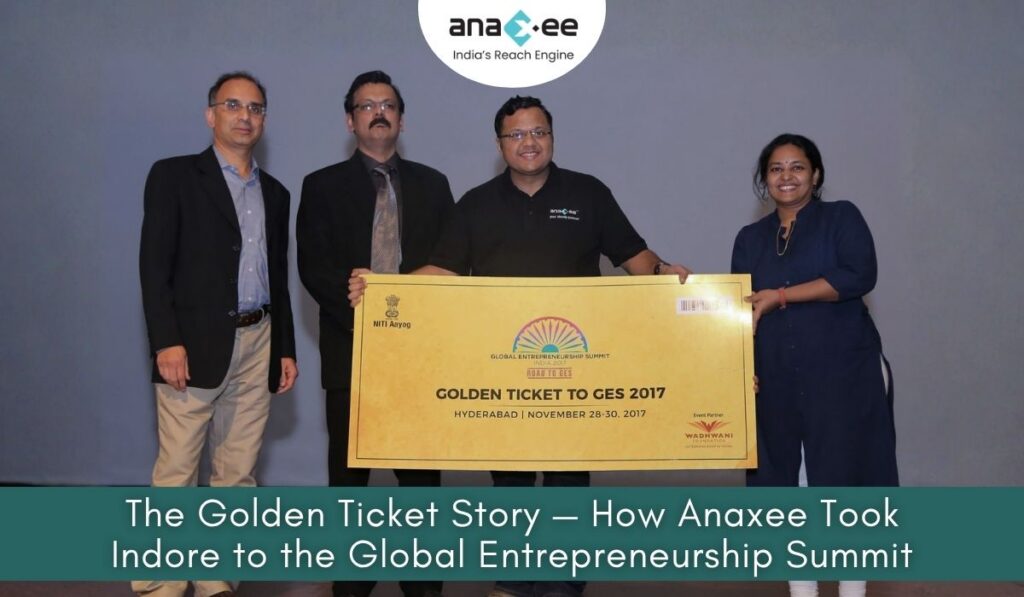
Anaxee Digital Runners Pvt. Ltd., a startup from Indore, won the Golden Ticket to participate in the Global Entrepreneurship Summit (GES) 2017, co-hosted by the Government of India and the U.S. State Department.
For a company that was barely five years old, headquartered far from Bengaluru or Gurgaon, this wasn’t just an award — it was validation.
It signaled that innovation for India’s next billion users doesn’t need to emerge from glass towers; it can come from the small offices of Indore, rooted in the realities of Bharat.
As WF Global’s press release put it:
“Anaxee’s unique Digital Runner model was recognized as a scalable solution that combines technology and human networks to solve India’s last-mile access challenge.”
(Read the official release here)
2. Road to GES — A Nationwide Hunt for India’s Next Big Innovators
The “Road to GES” series, organized by WF Global in partnership with NITI Aayog, Government of India, and the U.S. State Department, was not a typical startup pitch event.
It was part of India’s official lead-up to the Global Entrepreneurship Summit (GES) hosted in Hyderabad under the theme “Women First, Prosperity for All.”
Hundreds of startups across India competed through regional rounds to secure a place at GES.
From Indore, Anaxee emerged as the top startup, winning the Golden Ticket to represent the region at the global event.
The selection jury included prominent investors, entrepreneurs, and mentors evaluating startups on scalability, innovation, and impact.
WF Global’s announcement emphasized that the winners were chosen for their potential to “create tangible social and economic change through technology.”
Anaxee fit that brief perfectly.
3. What Made Anaxee Stand Out
At a time when most startups were chasing convenience-driven urban markets, Anaxee was quietly building a digital infrastructure for rural reach — a human-tech hybrid model that could execute digital tasks anywhere in India through local youth known as Digital Runners.
Each runner was trained, geo-tagged, and managed through Anaxee’s proprietary app — turning India’s scattered villages into a connected workforce.
This model allowed companies, NGOs, and government partners to scale outreach programs — from data collection to product verification and social campaigns — without the typical cost or complexity barriers.
The idea impressed the GES jury for its dual impact:
- Economic: Generating micro-jobs and livelihoods for rural youth.
- Operational: Delivering reliable digital reach for clients across India.
As Free Press Journal reported:
“The Indore-based start-up will showcase its unique concept at the Global Summit, highlighting how Digital Runners can bridge India’s rural-urban divide.”
(Free Press Journal article link)
4. The Global Entrepreneurship Summit (GES) 2017 — India’s Global Showcase
The GES 2017 was a landmark global event — the first time India co-hosted the summit with the United States.
It brought together over 1,500 entrepreneurs, investors, and thought leaders from 150 countries under the theme “Women First, Prosperity for All.”
The summit was inaugurated by Prime Minister Narendra Modi and Ivanka Trump, Advisor to the U.S. President, symbolizing a joint commitment to inclusive entrepreneurship.
Anaxee’s participation at this level placed Indore’s innovation ecosystem on the world map.
The official GES website release listed Anaxee as one of the semi-finalists of the GIST Catalyst Pitch Competition organized by the U.S. Department of State’s Global Innovation through Science and Technology (GIST) initiative.
(GES official announcement)
5. Representing Tier-2 India on a Global Platform
For Anaxee, this recognition wasn’t just about pitching to investors — it was about representing an entire class of startups from India’s smaller cities.
As co-founder Arti Agrawal later described in interviews:
“Most people assume innovation only happens in metros. We wanted to prove that real innovation can come from Tier-2 India, especially when it’s built around the needs of Bharat.”
That authenticity stood out. Anaxee wasn’t a copy of a Western model; it was an Indian solution for an Indian challenge — scaling digital participation beyond cities.
The Golden Ticket thus symbolized something larger: a shift in how the world perceives where innovation happens.
6. Indore’s Startup Moment — A Ripple Effect
The victory had a symbolic impact on Indore’s startup ecosystem.
Coverage by The Times of India (Indore edition) and Free Press Journal helped spotlight the city’s emerging tech scene.
Indore’s reputation as a “cleanest city” was already national; this win added another identity — “a city of scalable innovation.”
Anaxee’s success inspired local founders to look beyond service models and explore scalable products addressing real-world problems.
For the ecosystem, the message was clear: global exposure is not reserved for startups from metros — discipline and originality travel farther than geography.
7. Inside GES: Pitching the Digital Runner Vision to the World
At GES 2017, Anaxee’s pitch introduced global investors and policymakers to a simple, powerful idea:
that India’s digital inclusion can’t be built only on infrastructure; it needs people-powered networks to make technology usable and trustworthy.
Arti Agrawal and the Anaxee team showcased how their platform connected:
- Over 10,000 trained Digital Runners at that time (later expanding beyond 50,000).
- A tech layer that allowed enterprises to manage rural operations like an on-demand service.
- A social dimension that created jobs while improving digital literacy.
For the GES audience — a mix of investors, policy experts, and entrepreneurs — this represented a model of “inclusive scalability” that aligned perfectly with the summit’s theme: women-led, impact-driven growth.
8. Why GES Recognition Mattered Beyond the Event
Recognition at the Global Entrepreneurship Summit carries both symbolic and strategic benefits:
- Credibility with global investors: It validates a startup’s model and leadership quality.
- Visibility with policymakers: It opens doors for collaborations with public programs.
- Networking leverage: It connects founders to global mentors and partners.
For Anaxee, the aftermath was tangible. The startup attracted partnerships that allowed it to expand its network faster and pilot social programs at larger scales.
It also reaffirmed its mission to remain headquartered in Indore — to prove that scale and geography are not inversely related.
9. The Broader Message: Innovation Without Proximity
GES 2017 was, in many ways, an early preview of what India’s innovation geography would look like a few years later — when Tier-2 and Tier-3 cities began producing credible, investment-worthy startups.
Anaxee’s presence in that cohort made an argument that has since become obvious: proximity to Delhi or Bangalore isn’t a prerequisite for building globally relevant solutions.
In fact, distance can be a strategic advantage — it keeps founders close to the real problem, the real users, and the real India.
That ethos — building in Bharat, for Bharat — has since evolved into Anaxee’s brand philosophy: India’s Reach Engine.
10. Legacy of the Golden Ticket — More Than a Milestone
Looking back, the Golden Ticket was a turning point. But it wasn’t an endpoint — it was a launchpad.
The event’s exposure accelerated three things for Anaxee:
- Strategic partnerships: It began attracting collaborations from CSR and social organizations that wanted to use its runner network.
- Operational confidence: Validation from a global platform reinforced internal discipline on process and quality.
- Mission clarity: It strengthened Anaxee’s identity as a tech-for-impact company, not just another data platform.
In later years, those lessons guided how Anaxee executed nationwide projects like Project Swaraksha and evolved into Tech for Climate operations.
11. GES’s Enduring Symbolism for Anaxee
Today, when Anaxee describes itself as India’s Reach Engine, the roots of that phrase can be traced back to GES 2017.
It was there that the company articulated — in front of global peers — that technology in India must be designed around accessibility, affordability, and accountability.
GES gave Anaxee a platform to demonstrate how that philosophy works in practice:
- Accessibility: Digital Runners take technology to people who can’t access it themselves.
- Affordability: The gig-model keeps execution costs low and outcomes measurable.
- Accountability: Data-backed monitoring ensures every activity is verifiable.
These three pillars continue to underpin Anaxee’s current operations — from digital inclusion to carbon project monitoring.
12. Voices from the Media
A few excerpts from contemporaneous coverage capture the mood of that moment:
“Startups like Anaxee show that innovation from small cities can make a global mark.” — The Times of India (Indore edition, Nov 2017)
“Anaxee will showcase its concept at the Global Summit, highlighting how Digital Runners can bridge India’s rural-urban divide.” — Free Press Journal
“Recognized by WF Global and NITI Aayog, Anaxee exemplifies technology for inclusion.” — WF Global Press Release
These weren’t just compliments — they were early recognition of a shift India was about to witness.
13. The Takeaway — Building Locally, Scaling Globally
The Golden Ticket Story is, at its core, a story about mindset.
It’s about building where the problem is, not where the hype is.
For Anaxee, every subsequent milestone — national-scale vaccination awareness, carbon project implementation, or data-driven CSR execution — is built on that same foundation.
When the world talks about “Digital Public Infrastructure” today, Anaxee’s model already embodies it: a human-powered, technology-enabled framework for inclusion.
Closing: From Indore to the World — and Back Again
Anaxee’s journey from a regional pitch stage in Indore to a global entrepreneurship summit in Hyderabad captures a deeper truth:
India’s next big infrastructure companies won’t just build roads or data centers — they’ll build networks of trust.
The Golden Ticket wasn’t a trophy. It was a symbol of what’s possible when local insight meets global visibility.
As the company continues to expand its Tech-for-Climate and Tech-for-Impact initiatives, the GES story stands as an early testament that vision, not location, defines scale.