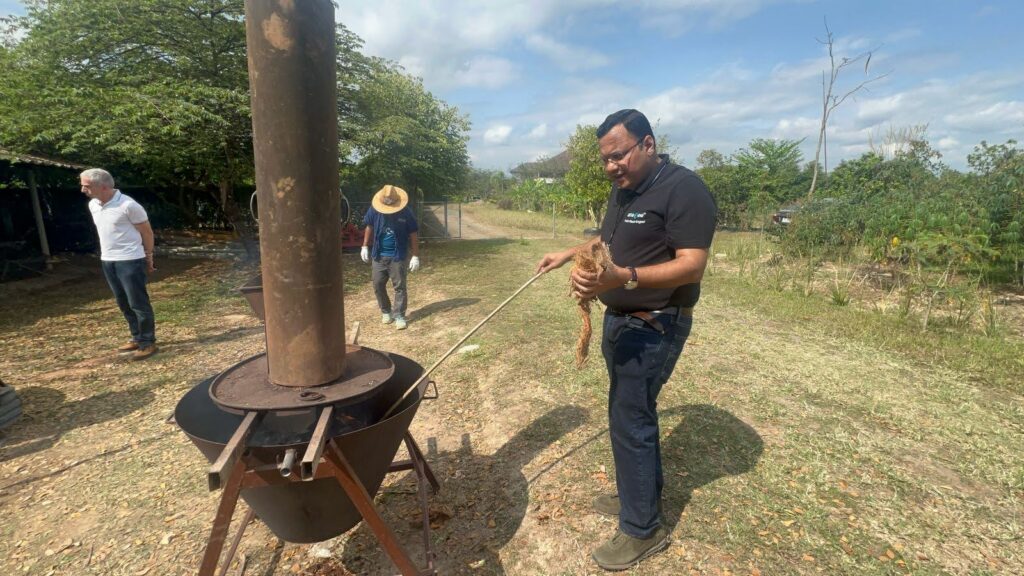

Biochar has the rare distinction of being scientifically proven, operationally deployable, and climate-relevant right now — not in 2030, not in 2050. It’s one of the few carbon removal solutions that can scale without waiting for breakthrough chemistry, billion-dollar synthetic fuels investments, or massive breakthroughs in DAC sorbents.
It works. It sequesters carbon for hundreds to thousands of years. It enriches soil. It helps crops. It enables land restoration. And it can be manufactured using waste streams that would otherwise emit carbon — or worse, methane.
So why, despite its potential, does biochar still face a funding bottleneck?
Why is it not attracting the same level of capital that solar, wind, or even frontier direct air capture does?
The answer isn’t scientific. It’s financial. Biochar is stuck at the stage where the projects are ready, the technology is proven, but the money refuses to move at the scale required. And the world doesn’t have time for climate solutions that sit idle because investors still view them as “too early.”
This is no longer a science problem. It’s a bankability problem.
And if developers don’t fix it soon, biochar will lose its early-mover advantage.
The Investment Paradox: High Interest, Low Capital
Investors love the idea of biochar. They see its permanence, its low energy footprint, and its co-benefits. They recognize the enormous opportunity — a sector projected to triple in value to over $2 billion by 2031.
They also know big-name buyers like Microsoft, Shopify, Google, and Meta have already placed large orders — often locked in through multi-year forward contracts.
But financiers still hesitate to deploy serious money. Not because they doubt the science — but because they doubt the financial operating model.
Investors are used to infrastructure logic:
High upfront cost, reliable long-term returns.
Biochar is almost there — but cracks show under scrutiny.
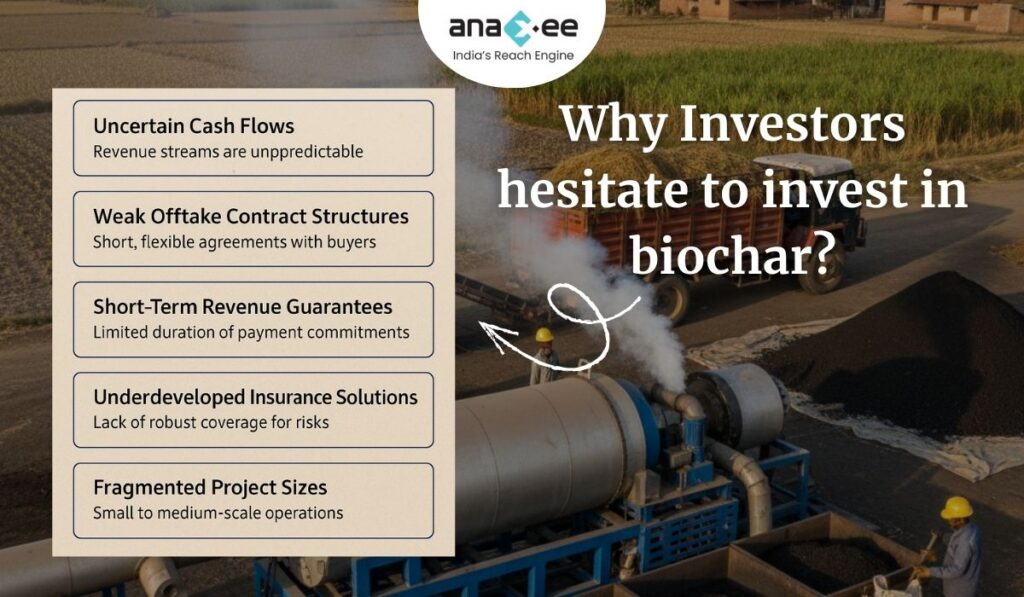
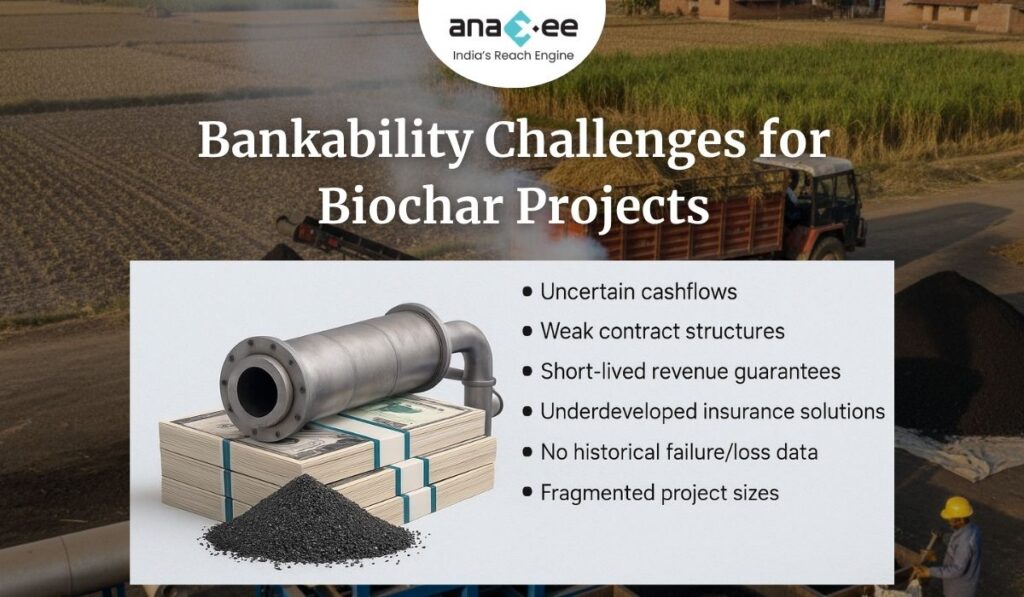
The biggest ones are these:
- Uncertain cashflows
- Weak offtake contract structures
- Too-short revenue guarantees
- Underdeveloped insurance solutions
- No historical failure/loss data
- Fragmented project sizes
It isn’t enough for the project to make sense.
It must prove it can return capital.
And right now, many can’t.
The Offtake Contract Problem: A Hidden Weak Link
Most biochar projects depend on carbon credit offtake agreements to prove future revenue.
On paper, this makes sense.
But here’s the truth: most of these contracts are not actually bankable.
They’re short, flexible, and loosely framed. Buyers can walk away. Developers bear the entire risk. Prices can shift. Delivery schedules can be changed or cancelled. And in many cases, there’s no legal or financial consequence if the project isn’t paid.
Imagine trying to finance a solar farm if the energy buyer could say:
“We’ll see how it goes — we might not pay in year 3.”
No bank on earth would finance that.
Yet that’s exactly what biochar developers are forced to accept today — because it’s still a buyer’s market.
The Duration Gap: A Serious Misalignment
This is a structural mismatch.
Biochar projects need:
- 7–10 years to repay capital and stabilize
Credit buyers offer:
- 3–5 years at best
Developers are stuck trying to scale permanent infrastructure on temporary financial commitments.
It doesn’t work.
Solar didn’t take off until Power Purchase Agreements (PPAs) matured
Wind didn’t grow until long-term purchase contracts stabilized
Electric vehicles didn’t scale until financing models evolved
Biochar needs the same financial evolution.
Insurance Is Quietly Becoming the Gatekeeper
Banks don’t just want revenue today. They want to know revenue is safe in the future.
Insurance is often the difference between whether a project is considered financeable or not.
But in biochar, traditional insurers are wary:
- No long-term performance data
- No standard baseline
- No mass-scale project history
This is starting to change — slowly.
Companies like Kita are pioneering carbon credit insurance designed specifically for biochar, protecting against:
- Natural disasters
- Methodology changes
- Delivery failure
- Non-payment risk
When insurance becomes standard, financing becomes easier.
It happened in solar. It will happen here too.
What a Bankable Biochar Contract Actually Looks Like
It’s not complicated — it’s just rare.
A bankable contract includes:
- A fixed volume commitment
- Guaranteed payment timelines
- Clear legal consequences for non-delivery
- A contract life that matches payback timelines
- Credible MRV and third-party certification
- Defined exit mechanisms
- No vague language
- No “buyer optionality” loopholes
That still isn’t common.
But every project that achieves it unlocks capital.
The Developer Mindset Must Evolve
This is the hard truth:
Biochar has outgrown the startup phase.
What worked at 2,000 tons doesn’t work at 50,000 tons.
Developers must act less like carbon product sellers —
and more like infrastructure operators:
- solid technology risk planning
- predictable cashflow modeling
- credible multi-year contracts
- risk transfer mechanisms
- insurance coverage
- legal enforcement clauses
- standardized documentation
- investor-grade reporting discipline
Biochar doesn’t need hype.
It needs finance-grade structure.
The Path Forward: Serious Projects Will Win
The developers who solve the financing puzzle now will dominate the market later.
That means:
- Structuring offtake contracts like PPAs
- Offering predictability instead of potential
- Using insurance as a financing lever
- Negotiating longer-term commitments
- Standardizing documentation to reduce investor DD time
- Proving clear operational discipline
Once capital starts moving, it will move fast.
Because in truth, every ingredient is already in place:
- the science
- the technology
- the global demand
- the climate urgency
Only the financial architecture is missing.
And that’s exactly where the next wave of biochar leaders will differentiate themselves.
Final Word
Biochar does not have a climate problem.
It has a credibility problem — in the eyes of capital.
But this is solvable.
The developers who embrace long-term thinking, bankable structures, and risk-aware contract models won’t just survive — they’ll scale faster than the market expects.
The world needs millions of tons of biochar.
The bottleneck isn’t the technology.
It’s the financing framework.
And the teams that fix this — win.
About Anaxee:
Anaxee drives large-scale, country-wide Climate and Carbon Credit projects across India. We specialize in Nature-Based Solutions (NbS) and community-driven initiatives, providing the technology and on-ground network needed to execute, monitor, and ensure transparency in projects like agroforestry, regenerative agriculture, improved cookstoves, solar devices, water filters and more. Our systems are designed to maintain integrity and verifiable impact in carbon methodologies.
Beyond climate, Anaxee is India’s Reach Engine- building the nation’s largest last-mile outreach network of 100,000 Digital Runners (shared, tech-enabled field force). We help corporates, agri-focused companies, and social organizations scale to rural and semi-urban India by executing projects in 26 states, 540+ districts, and 11,000+ pin codes, ensuring both scale and 100% transparency in last-mile operations. Connect with Anaxee atsales@anaxee.com