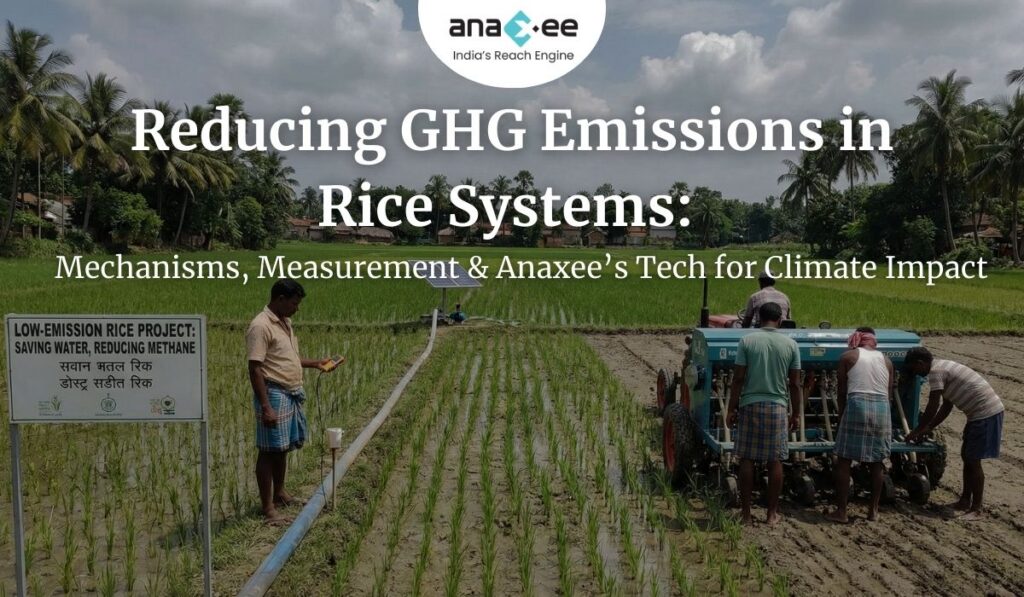

Rice is a staple food for more than half of the world’s population, and in countries like India it underpins food security, rural livelihoods and national-agricultural strategy. At the same time, however, rice cultivation-particularly in flooded paddy systems-represents a disproportionately large source of greenhouse gases (GHGs). In short: while we must grow rice, we also must manage the climate-cost of how we grow it.
In the Indian context – where smallholder farms, institutional pledges, and emerging carbon markets are converging – the need to understand, monitor and reduce GHG emissions from rice systems is urgent. That’s where the technology-enabled, last-mile execution capability of Anaxee Digital Runners Pvt Ltd (Anaxee) becomes highly relevant. We help agronomic projects scale, deliver measurable emission reductions, and link them to credible carbon-credit frameworks.
In this blog we’ll explain: the mechanisms by which rice systems emit GHGs; the standards and measurement frameworks for those emissions; mitigation practices that work; and how Anaxee integrates technology and field execution to help projects deliver real impact.
Understanding the Mechanisms of GHG Emissions in Rice Systems
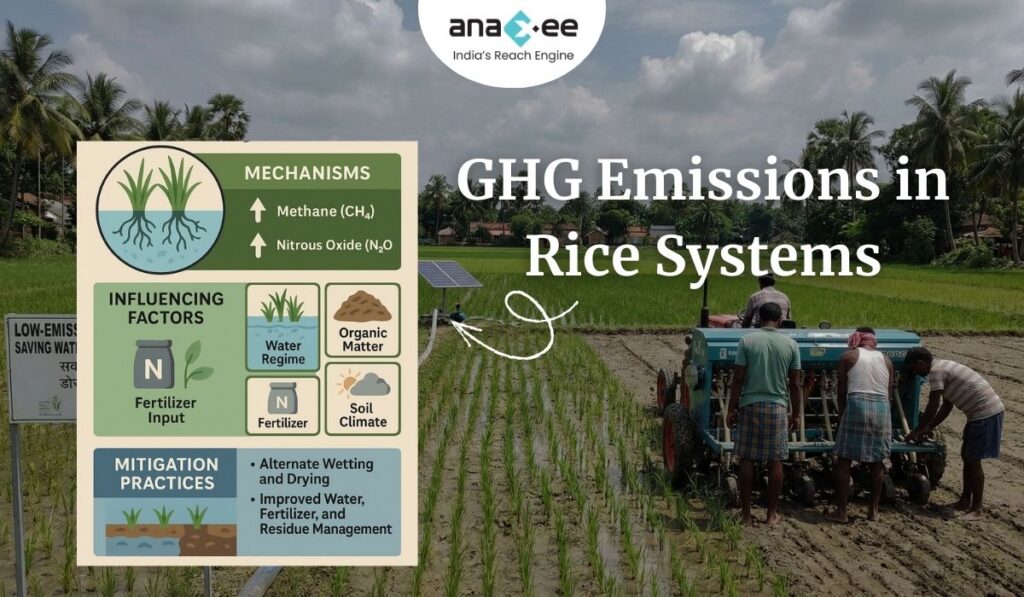
Why is rice cultivation so challenging from a climate perspective? Two of the main GHGs in rice systems are methane (CH₄) and nitrous oxide (N₂O).
Methane (CH₄)
In continuously flooded rice paddies, the soil becomes anaerobic (lacking oxygen). In such conditions, methanogenic microorganisms break down organic matter and release methane, which then diffuses through the soil or is transported via the rice plants into the atmosphere. Numerous field studies show that continuously flooded systems are major sources of CH₄. The work of International Rice Research Institute (IRRI) and partners highlights this mechanism. IRRI Education+2ghgmitigation.irri.org+2
Nitrous Oxide (N₂O)
While CH₄ dominates in flooding regimes, when soil redox-conditions shift (e.g., when paddies dry intermittently, when fertiliser nitrogen is applied, when organic residues decompose under alternating aerobic/anaerobic conditions), nitrous oxide emissions rise. Though typically smaller in absolute volume compared to CH₄ in flooded rice, N₂O is far more potent per unit of mass in terms of global warming potential. For example, recent global assessments of rice-based cropping systems show methane contributed 50-80 % of total GHG emissions while N₂O played a growing role as water or cropping patterns changed. Nature+1
Influencing Factors
Key factors that govern emission levels include:
- Water regime (continuous flooding vs alternate wetting and drying).
- Organic matter inputs (crop residues, manures).
- Fertiliser nitrogen rates and timing.
- Soil type, temperature, pH, redox potential, microbial communities.
- Rice cultivar root traits and soil aeration.
Take a notable figure from IRRI’s resource: methane emissions from rice systems in major producing countries (South/Southeast Asia) can account for more than 50 % of total methane emissions in those systems. IRRI Education
Therefore, rice systems present both a problem (high GHG source) and an opportunity (significant mitigation potential) if managed correctly.
Measurement Standards and Monitoring Frameworks
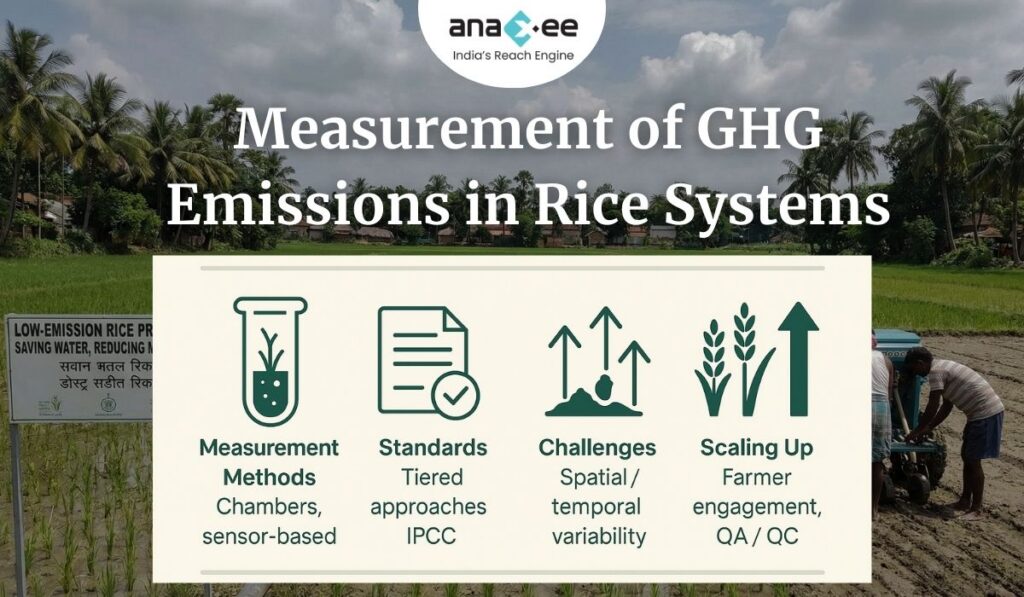
Mitigation without measurement is just guesswork. For a project developer, corporate offtaker, or investor to trust a rice-system GHG reduction project, robust measurement, reporting and verification (MRV) is essential.
Measurement Methods
The IRRI “GHG Mitigation in Rice” portal outlines typical measurement tools: closed chamber techniques (manual sampling), eddy-covariance systems, sensor-based monitoring. ghgmitigation.irri.org+1 Manual closed chambers remain the most widely used method globally for plot-level measurement. ghgmitigation.irri.org
For example, the Vietnamese handbook developed with IRRI provides step-by-step guidance on sampling design, equipment, transport and lab analysis. ghgmitigation.irri.org
Standards & Emission Factors
The international standard frameworks (such as the Intergovernmental Panel on Climate Change—IPCC) provide tiered approaches: Tier 1 uses global default emission factors; Tier 2 and Tier 3 develop region- or field-specific factors. The more locally tailored the data, the more credible the emissions inventory. The training course by IRRI titled “GHG Emissions in Rice Systems: Basics …” emphasises these inventory-approaches, from field sampling through to calculation. IRRI Education
Challenges in Scaling Up
It’s one thing to measure emissions on a trial plot; it’s another to scale such monitoring across thousands of smallholder rice fields, ensure data integrity, and integrate into a project-level carbon-credit scheme. Key practical hurdles include: spatial/temporal variability, labour-intensive sampling, maintenance of quality assurance/quality control (QA/QC), farmer-engagement and data traceability.
Mitigation Practices in Rice Systems
What works in the field to reduce GHG emissions from rice? Below are some tested practices.
Alternate Wetting and Drying (AWD)
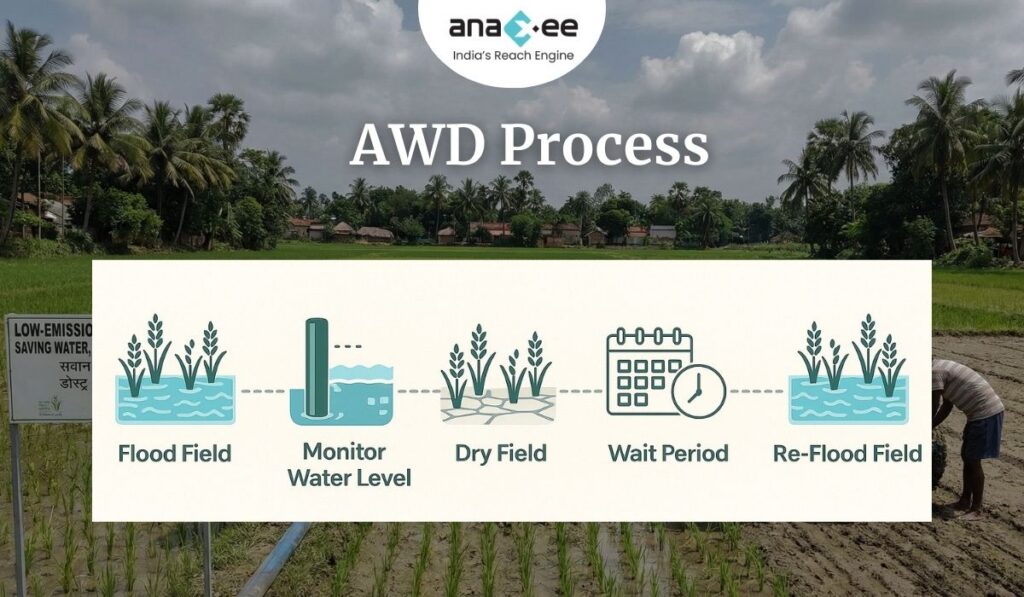
One of the most widely studied mitigation practices is letting the paddy field dry periodically (rather than keeping it continuously flooded). This interrupts methanogenesis by introducing oxygen to the soil. In many instances, AWD has produced CH₄ reductions of up to 40-60 % or more without sacrificing yield. arXiv+1
Nitrogen Management and Residue Handling
Optimising fertiliser rates, using nitrification inhibitors, aligning fertiliser timing with crop uptake, and managing crop-residue returns all help reduce N₂O emissions or reduce the nitrogen substrate for emission-pathways. Research shows that rice systems with improved nitrogen and water management had much lower carbon footprints. Nature+1
Crop and Water System Innovations
Beyond AWD, innovations include direct-seeded rice (DSR) methods, alternate cropping systems, crop-residue incorporation strategies, and introduction of rice varieties with favourable root structures that reduce CH₄ transport. These are increasingly important in Asia’s rice landscapes. ghgmitigation.irri.org
Linking to Carbon-Credit Eligibility
For a rice system to be credible as a GHG-reduction project (for voluntary credits or compliance markets), the mitigation must be measurable, additional (i.e., beyond business-as-usual), tracked over time, verified and reported. That means the measurement frameworks and on-farm practices must align with project-design standards (e.g., MRV tools, auditing, verification).
This is precisely where the combination of agronomic practice + digital monitoring + field-level verification delivers value.
Anaxee’s Value: Bridging Tech, Last-Mile Field Execution & Credible Measurement
Here’s how Anaxee adds value in the specific context of rice-system GHG mitigation.
End-to-End Implementation
Anaxee supports carbon project developers, agribusinesses and corporates by designing and delivering rice-based GHG reduction projects: from farmer recruitment, training, field-deployment of sustainable practices (like AWD, improved nitrogen management), through to measurement, monitoring and verification.
Tech-Enabled Monitoring & Traceability
Anaxee’s stack includes remote-sensing, IoT field sensors, mobile field-data capture (via local “digital runners”), and dashboards that visualise GHG-reduction progress. This ensures transparency, traceability and scalability — critical for smallholder-rich contexts in India.
Smallholder Inclusion & Last-Mile Workforce
In a sector often challenged by data gaps and farmer heterogeneity, Anaxee’s ground-force of trained digital-runners ensure high-quality on-farm data collection, farmer engagement, QA/QC checks. This human layer bridges the “pilot-plot” and “whole-farm-landscape” gap many projects struggle with.
Corporate & Investor Ready Reporting
For corporates seeking credible rice-system offsets, or for project developers seeking issuance of carbon credits, Anaxee delivers audit-ready data and dashboards that integrate agronomic performance (yield, water use, residue management) with GHG- metrics, linking them to the carbon-market narrative.
India-Focused, Scalable Execution
Given India’s scale of rice production, and Anaxee’s base in India, the company is well-placed to deploy projects across rice belts, smallholder systems and corporate offtakes. The value proposition: credible GHG emissions reduction from rice systems in a complex landscape, with tech and field execution integrated.
Implications for India’s Carbon Market & Smallholding Rice Systems
India is one of the world’s largest rice producers, and thus the mitigation opportunity in rice systems is significant. However, turning that opportunity into investable projects requires credible measurement, scalable execution and link-ages to carbon markets.
For corporates seeking high-quality offsets, rice-system projects offer a relatively under-exploited bucket — when done correctly. Projects backed by rigorous monitoring and last-mile tech have higher credibility and lower risk. Anaxee’s role is to convert the technical and operational complexity (farmer heterogeneity, measurement, traceability) into scalable projects.
For smallholder farmers, participation in rice-system GHG reduction projects delivers co-benefits: improved water-use efficiency, potentially lower input costs (via better fertiliser/N-management), resilience via sustainable practices, and income streams linked to carbon credits.
The combination of tech + last-mile execution + smallholder inclusion is critical. Without it, many rice-system mitigation efforts stay at pilot scale or fail to deliver strong audit-ready results.
Conclusion & Call to Action
Rice systems present both a climate challenge and a mitigation opportunity. The science is clear: flooded paddies emit methane and nitrous oxide; the latest agronomic practices and measurement frameworks offer a way forward. What matters now is that the mitigation is credible, measurable and scalable.
That’s where Anaxee comes in. If you are a corporate, project developer, agricultural business or investor looking at rice-system emission reductions in India, Anaxee provides the tech, ground-force, monitoring and verification system that turns ambition into delivery.
Let’s connect to explore how you can develop rice-system GHG-reduction projects that are measurement-robust, farmer-inclusive and market-ready. Reach out to us at Anaxee to discuss your next-generation climate strategy.
About Anaxee:
Anaxee drives large-scale, country-wide Climate and Carbon Credit projects across India. We specialize in Nature-Based Solutions (NbS) and community-driven initiatives, providing the technology and on-ground network needed to execute, monitor, and ensure transparency in projects like agroforestry, regenerative agriculture, improved cookstoves, solar devices, water filters and more. Our systems are designed to maintain integrity and verifiable impact in carbon methodologies.
Beyond climate, Anaxee is India’s Reach Engine- building the nation’s largest last-mile outreach network of 100,000 Digital Runners (shared, tech-enabled field force). We help corporates, agri-focused companies, and social organizations scale to rural and semi-urban India by executing projects in 26 states, 540+ districts, and 11,000+ pin codes, ensuring both scale and 100% transparency in last-mile operations. Connect with Anaxee atsales@anaxee.com