
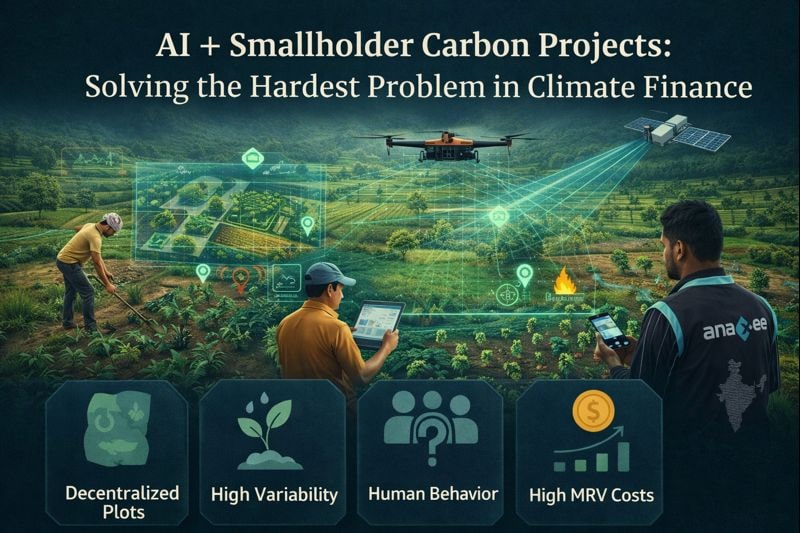

Most discussions about AI in carbon markets talk about forests, satellite imagery, LiDAR scans, biomass models, leakage detection — the high-tech, big-landscape stuff.
But here’s the truth nobody in the industry likes to say out loud:
The future of carbon markets is not in giant, 50,000-hectare REDD+ projects.
It’s in messy, scattered, smallholder landscapes.
Why?
Because that’s where:
✔ the largest reforestation potential exists
✔ community benefits are real
✔ climate finance creates livelihoods
✔ agricultural emissions can be reduced at scale
✔ adaptation and mitigation overlap
But it’s also where carbon projects become most difficult to execute.
Smallholder MRV is the final frontier — and AI has a huge role to play only if it is paired with reliable field execution.
This blog dives into:
- Why smallholder carbon is the hardest category
- Why most AI systems fail here
- The exact gaps AI cannot fill
- How hybrid AI + field networks can finally unlock massive supply
- Why Anaxee is uniquely positioned to make smallholder carbon “investible”
Let’s break this down without sugar-coating it.
1. The Harsh Reality: Smallholder Carbon Is Harder Than Anyone Admits
On paper, smallholder agroforestry and regenerative agriculture look perfect:
- Highly scalable
- Socially impactful
- Carbon-rich
- Policy-aligned (India, ASEAN, Africa, LATAM)
- Climate-resilient
But in practice?
The MRV is brutal.
Here’s why:
(1) Thousands of decentralized plots
We’re talking about farmers with:
- 0.3 acre
- 0.7 acre
- 1.5 acre
- scattered non-contiguous parcels
- mixed crop varieties
- inconsistent management practices
Satellites can’t identify individual trees with reliable accuracy at this scale.
(2) High variability in planting
Different farmers = different choices:
- spacing
- species
- mortality
- irrigation
- pest control
- pruning cycles
Carbon predictability becomes extremely complex.
(3) No two villages behave the same
Human behaviour determines carbon outcomes in small farms. AI can’t predict:
- Who will water the saplings
- Who will skip maintenance
- Who allows grazing
- Who abandons the land
(4) MRV costs grow exponentially
Instead of one forest block, you have:
5,000 farmers × multiple plots × multiple visits × multiple conditions
Traditional MRV collapses under this pressure.
(5) Carbon buyers distrust smallholder data
They fear:
❌ over-reporting
❌ unverifiable claims
❌ weak documentation
❌ inconsistent monitoring
Smallholder carbon has the highest impact potential but the lowest trust.
AI alone cannot fix this.
2. Why Most AI Systems Fail in Smallholder Projects
AI is powerful — but only when the input data is:
- consistent
- structured
- frequent
- reliable
- ground-verified
Smallholder landscapes break all these assumptions.
Let’s be blunt:
(A) Satellite + AI cannot detect early-stage survival
1–2 year saplings are:
- tiny
- obscured
- under canopy
- mixed with crops
AI can’t distinguish them at scale.
(B) AI models get confused by mixed land use
Small farms have:
- crops
- boundaries
- farm trees
- scattered planting
- agroforestry rows
- kitchen gardens
Most ML models are trained on forests — not this.
(C) Ground-truth data is irregular
If farmers don’t upload data consistently, AI models decay.
(D) Plot-level traceability fails without humans
Geotagging alone isn’t enough.
You need:
- physical verification
- farmer consent capture
- pruning evidence
- mortality count
- soil condition logs
AI cannot visit the field.
AI cannot talk to a farmer.
AI cannot verify if the sapling is alive.
(E) Smallholder environments produce too much noise
Drones struggle with dense crop cover.
Satellites struggle with 3–5m resolution gaps.
AI struggles with mixed pixels.
This is where every “AI-only MRV” company collapses.
3. The Solution: Hybrid MRV — AI + Human Networks
The future is not:
❌ AI replaces humans
❌ satellite-only MRV
❌ fully automated verification
The future is:
AI + satellite analytics + structured field data + large human networks
A hybrid model where:
- AI handles scale
- Humans handle truth
- AI detects anomalies
- Humans validate them
- AI predicts risks
- Humans intervene
This approach delivers a level of integrity no single system can match.
4. What AI Can Do Brilliantly in Smallholder Projects
Let’s give AI credit where it deserves it.
In smallholder carbon, AI can:
(1) Predict mortality clusters
AI can detect areas likely to fail based on patterns like:
- rainfall consistency
- soil moisture
- NDVI drops
- farmer behaviour proxies
(2) Identify growth anomalies
AI compares expected vs actual canopy development.
(3) Estimate biomass over time
Once trees cross ~2–3m height, AI models become powerful.
(4) Detect leakage from land use change
AI monitors:
- farm expansion
- grazing pressure
- boundary shifts
- tree removal
(5) Simplify verification
AI generates structured datasets ready for VVB audits.
AI is not the solution.
AI is the accelerator.
The solution is the hybrid system that combines:
✔ AI’s scale
✔ ground truth’s reliability
✔ human monitoring’s accuracy
✔ digital MRV’s transparency
This is the system Anaxee is building.
5. Why India Is the Best Place to Build Smallholder Carbon at Scale
India has:
- 100+ million smallholder farmers
- massive agroforestry potential
- one of the world’s largest rural networks
- strong digital infrastructure
- government support for tree-based programs
But without structured MRV, none of this potential becomes carbon finance.
This is where Anaxee’s model stands out globally.
6. How Anaxee Unlocks Smallholder Carbon Markets
Anaxee solves the hardest part of the entire carbon supply chain:
Last-mile execution and primary data integrity.
Here’s how.
(A) India’s Largest Distributed Field Network
Anaxee’s Digital Runners operate across:
- villages
- forest-edge settlements
- tribal belts
- remote agricultural regions
They provide field data at:
✔ high frequency
✔ high accuracy
✔ low cost
✔ large scale
This is the foundation AI requires.
(B) Digital MRV System Built for Ground Realities
The platform captures:
- geo-tagged evidence
- timestamped photos
- survival tracking
- pruning and maintenance logs
- farmer agreements
- species-level planting data
Every datapoint is:
structured → traceable → audit-ready
(C) AI-Ready Structured Data
Anaxee’s data formats seamlessly plug into:
- biomass models
- survival prediction models
- baseline algorithms
- leakage models
- remote sensing workflows
No messy PDFs.
No WhatsApp photos.
No unstructured metadata.
Just clean, verifiable, machine-readable truth.
(D) Ability to Execute Across Millions of Small Plots
This is the real differentiator.
Most players run 10–50 pilot plots.
Anaxee runs tens of thousands simultaneously — with consistency.
Smallholder carbon becomes investible only when execution risk drops.
Anaxee de-risks it.
(E) Hybrid Verification Loop: The New Gold Standard
The future of smallholder MRV looks like this:
- AI predicts risk areas
- Anaxee teams verify on ground
- AI updates survival/growth models
- Anaxee captures corrective actions
- AI re-estimates carbon impact
- VVB audits structured MRV outputs
This is the world buyers want — continuous, credible, low-cost, high-frequency MRV.
And it’s already happening.
**7. Final Thought: AI Can Scale Carbon.
But Anaxee Makes It Real.**
AI can estimate biomass.
AI can interpret satellite imagery.
AI can detect anomalies.
AI can automate reporting.
But AI cannot walk into a village
and check whether a sapling is alive.
Carbon markets will only scale when:
AI provides intelligence
+
Human networks provide truth
This is exactly where Anaxee sits — at the intersection of technology and ground execution.
AI is the multiplier.
Anaxee is the enabler.
And together, they make smallholder carbon the next trillion-dollar climate opportunity.