
Most automotive brands talk about “the automotive market” as if it’s one category.
It isn’t.
Tyres don’t sell like lubricants.
Lubricants don’t sell like batteries.
Accessories don’t sell like any of them.
Yet GTM strategies are often copied across categories with minor tweaks.
That’s why execution fails quietly.
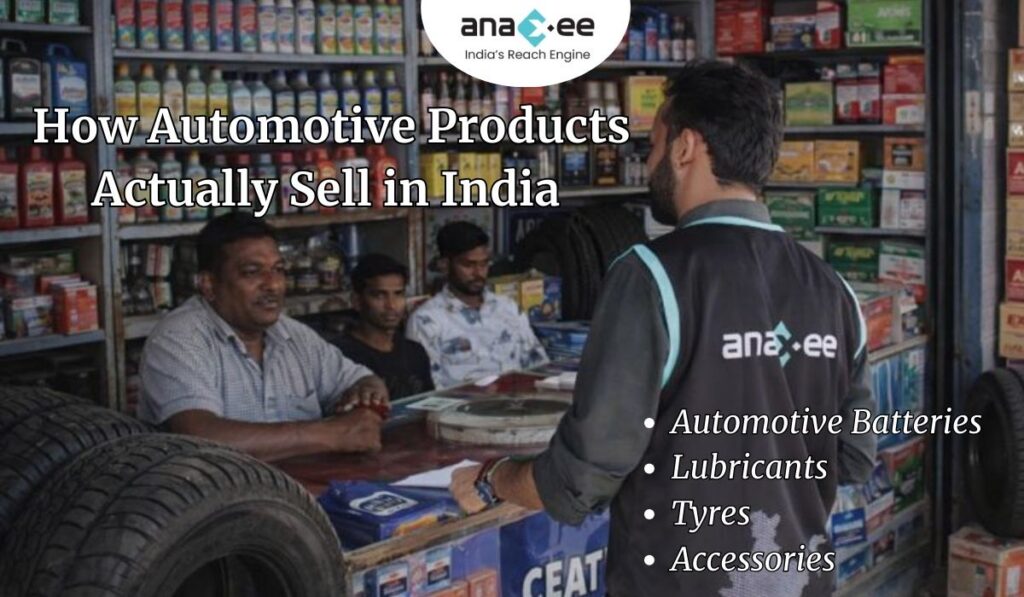
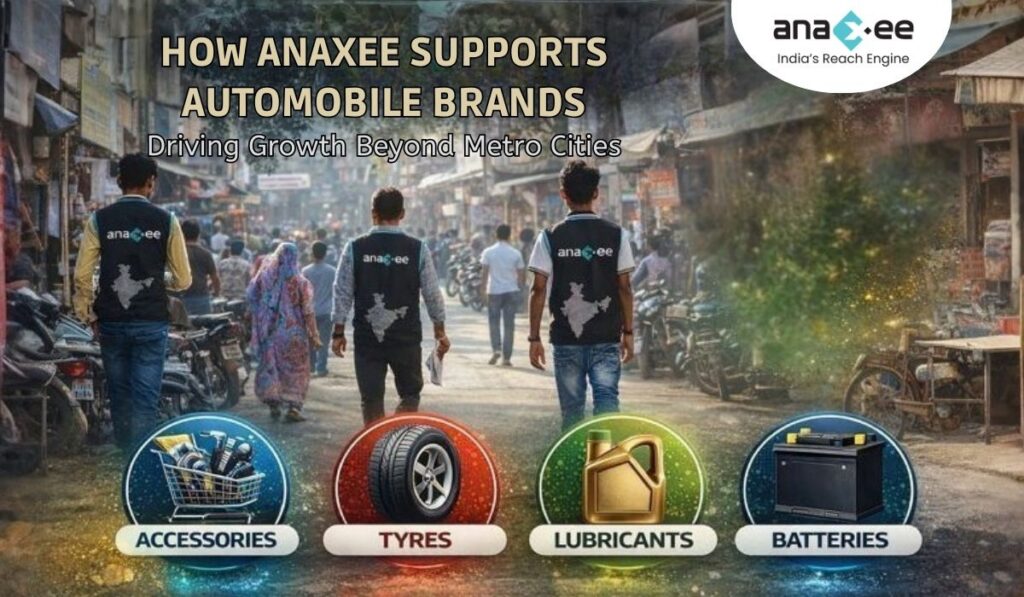
This blog breaks down how each automotive product category actually sells on the ground in India—and where Anaxee fits in enabling category-specific execution.
Why Product-Level GTM Matters More Than Brand-Level GTM
At retail, no one sells “brands”.
They sell products that solve immediate problems.
Retailers and mechanics ask:
- Will this product move fast?
- Will it create complaints?
- Will it lock working capital?
GTM success depends on how well brands adapt to product-level buying behaviour, not brand ambition.
1. Tyres: Trust, Risk & Inventory Gravity
How Tyres Actually Sell
Tyres are:
- High-ticket
- Low-frequency
- High-risk for retailers
Retailers hesitate to:
- Experiment with unknown brands
- Stock slow-moving SKUs
- Push brands with weak replacement support
GTM Reality for Tyre Brands
- One unsold tyre blocks shelf space
- One claim issue kills recommendations
- Distributor assurance matters more than ads
How Anaxee Supports Tyre GTM
Anaxee enables:
- Retailer confidence-building through repeated presence
- Local feedback on price resistance and SKU mismatch
- Early detection of claim and supply friction
Tyre GTM succeeds when risk perception drops locally—not when branding gets louder.
2. Lubricants: Habit, Mechanics & Silent Switching
How Lubricants Actually Sell
Lubricants are:
- Habit-driven
- Mechanic-influenced
- Easy to substitute
Once a mechanic trusts a lubricant, switching is rare—even with incentives.
GTM Reality for Lubricant Brands
- Loyalty schemes don’t change habits
- Trial doesn’t guarantee repeat
- Retailers follow mechanic preference
How Anaxee Enables Lubricant Execution
Anaxee focuses on:
- Mechanic mapping and influence tracking
- Retailer-mechanic relationship intelligence
- Ground-level understanding of switching barriers
This helps brands answer:
- Why trials failed
- Where habits are strongest
- Which markets need education vs incentives
Lubricant GTM is behavioural, not promotional.
3. Automotive Batteries: Availability, Claims & Control
How Batteries Actually Sell
Batteries sell when:
- Stock is available immediately
- Replacement is hassle-free
- Warranty claims are trusted
Retailers avoid brands that:
- Delay replacements
- Create paperwork friction
- Fail during peak seasons
GTM Reality for Battery Brands
- One bad warranty experience spreads fast
- Fake reporting hides real failures
- Rapid expansion increases execution risk
How Anaxee Supports Battery Brands
Anaxee provides:
- Retailer verification and audit trails
- Claim feedback visibility
- Stock and branding validation
This creates control at scale, not just reach.
4. Automotive Accessories: Visibility, Impulse & Margins
How Accessories Actually Sell
Accessories are:
- Impulse-driven
- Margin-sensitive
- Retailer-pushed
What’s visible and profitable sells—not what’s advertised nationally.
GTM Reality for Accessory Brands
- Poor display kills new SKUs
- Retailer education is inconsistent
- Schemes leak without verification
How Anaxee Strengthens Accessory GTM
Anaxee enables:
- SKU presence and visibility audits
- Retailer onboarding and education
- Local competitor and pricing intelligence
Accessory GTM is about in-store execution density, not awareness.
Why One GTM Model Cannot Serve All Automotive Products
Most GTM failures happen because brands assume:
- One distributor strategy fits all products
- One scheme design works across categories
- One reporting format shows reality
In truth:
- Tyres need risk reduction
- Lubricants need habit disruption
- Batteries need operational trust
- Accessories need visibility control
Anaxee adapts execution by product logic, not by category name.
The Role of Anaxee Across Automotive Products
Across tyres, lubricants, batteries, and accessories, Anaxee consistently provides:
- Persistent local presence
- Product-specific execution workflows
- Verified, geo-tagged intelligence
- Early warning signals for GTM failure
This allows brands to:
- Scale without losing control
- Adjust category strategies regionally
- Stop relying on filtered reporting
What This Means for Automotive Leadership Teams
If your GTM treats all automotive products the same, you will:
- Over-invest in the wrong levers
- Underestimate category friction
- Lose retailer confidence quietly
Product-level GTM clarity is no longer optional in India’s fragmented markets.
Closing Thought
Automotive growth doesn’t fail because brands lack ambition.
It fails because products are misunderstood at the last mile.
Anaxee helps brands align GTM execution with how tyres, lubricants, batteries, and accessories actually sell.
CTA
If you’re responsible for a specific automotive product category—and want GTM execution designed around how that product truly moves at retail—
write to sales@anaxee.com.