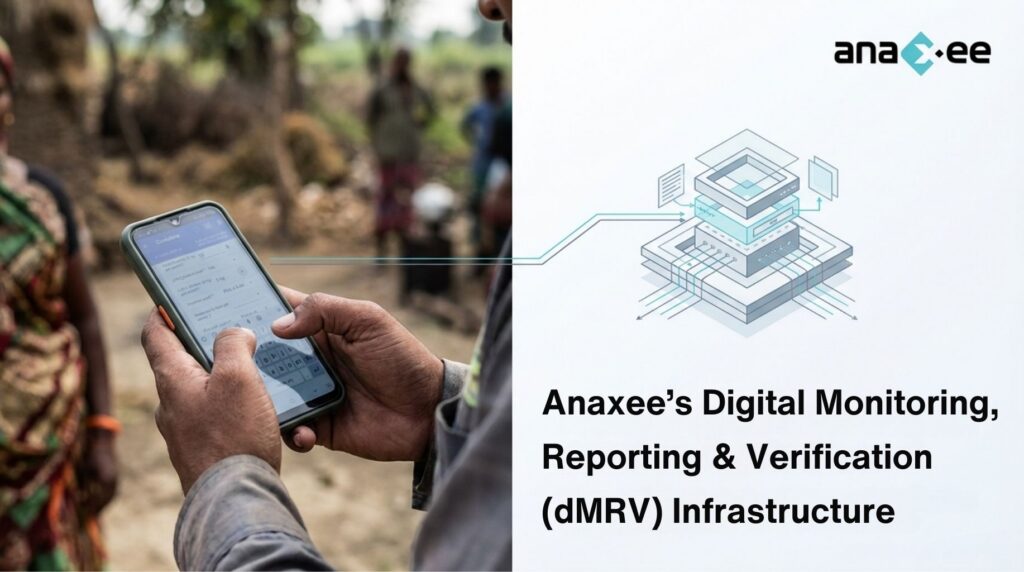

Why dMRV Needed to Be Rebuilt From the Ground Up
Monitoring, Reporting, and verification have quietly become the bottleneck of climate action. Not because standards are unclear, or because methodologies don’t exist—but because the real world refuses to behave like a spreadsheet.
Most MRV systems today are designed backward. They assume clean data, predictable geographies, cooperative stakeholders, and stable infrastructure. That assumption may hold in pilot projects or controlled environments. It collapses the moment you move into rural India, fragmented landholdings, informal retail, smallholder farmers, or last-mile execution at scale.
At Anaxee, our work has always started at the edge—villages, farms, forests, semi-urban markets, and non-metro retail. We didn’t come into climate tech as software-first builders. We came in as operators who had already run thousands of on-ground workflows, with real humans, real incentives, and real failure modes.
So when the conversation around digital MRV (dMRV) intensified—especially in carbon markets, nature-based solutions (NbS), and compliance-linked reporting—we saw a gap that software alone could not fill. What the market called “dMRV” was often just dashboards layered on weak data.
We decided to build something different.
The Core Problem: MRV Breaks at the Last Mile
Most MRV failures do not happen at the verification stage. They happen much earlier.
- Data is collected inconsistently
- Field teams interpret protocols differently
- Evidence is incomplete or unverifiable
- GPS, time, and identity signals don’t align
- Manual fixes creep in to “make data usable”
By the time verification starts, teams are already negotiating with compromised datasets.
From our perspective, this wasn’t a tooling issue. It was a system design issue.
If MRV is meant to produce decision-grade, auditable truth, then the system must be designed around:
- Human behavior at the field level
- Operational constraints in non-ideal environments
- Methodology rigidity vs ground reality
- Audit defensibility, not internal comfort
That framing shaped everything we built.
What We Set Out to Build (and What We Explicitly Avoided)
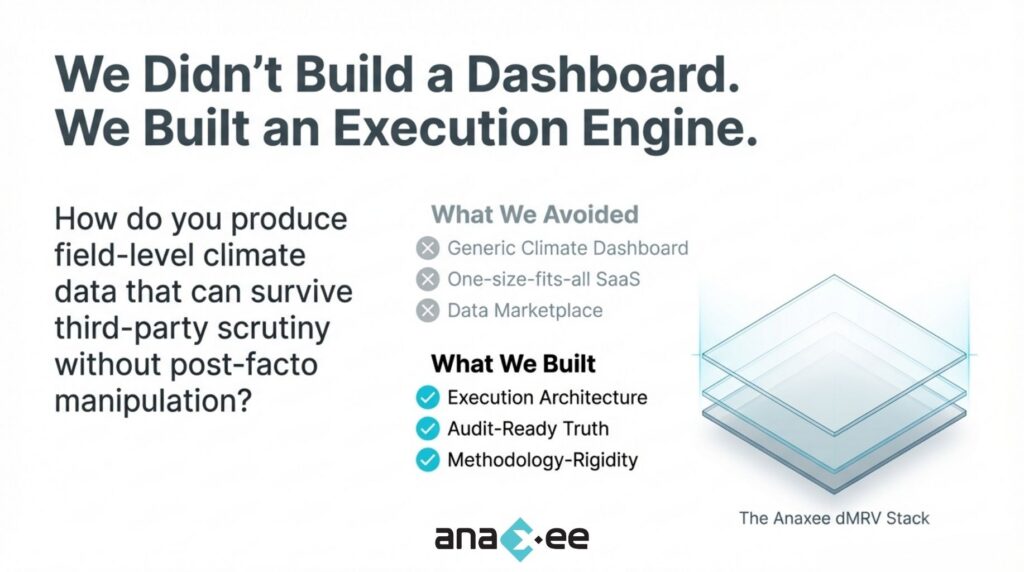
We did not try to build:
- A generic climate dashboard
- A one-size-fits-all MRV SaaS
- A data marketplace
- A verification substitute
Instead, we focused on one question:
How do you produce field-level climate data that can survive third-party scrutiny without post-facto manipulation?
The answer was not “more analytics.” It was better execution architecture.
The Anaxee dMRV Stack: Designed From the Field Inward
Our dMRV product is not a single tool. It is a tightly integrated system that connects people, protocols, and proof.
1. Execution-Led Data Capture
At the base of the stack is Anaxee’s Digital Runner network—trained, salaried, and accountable field professionals operating with standardized workflows.
Every data point captured is:
- Mapped to a predefined activity
- Linked to a specific executor
- Bound by geo-fencing and time rules
- Supported by multi-layer evidence (photos, videos, metadata)
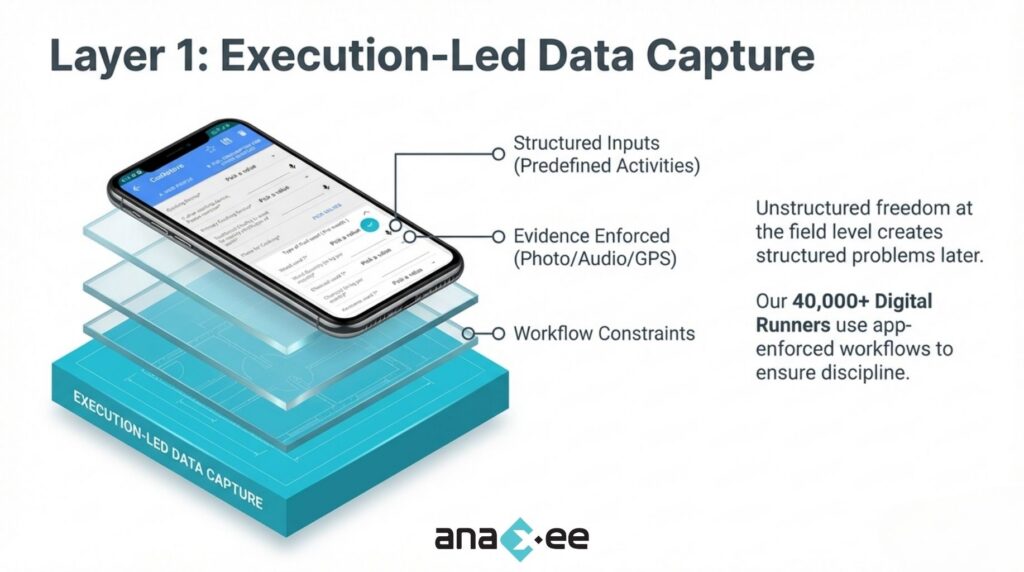
This reduces ambiguity before it enters the system.
We learned early that unstructured freedom at the field level creates structured problems later. Our dMRV enforces discipline without slowing execution.
2. Methodology-Aligned Workflow Engines
Instead of forcing methodologies to adapt to our product, we designed workflow engines that map directly to methodology requirements—especially for:
- Agroforestry (including census-based approaches)
- ARR and bund plantations
- Community-led NbS projects
- Retail and supply-chain linked climate interventions
Each workflow defines:
- What must be collected
- When it must be collected
- Acceptable evidence formats
- Validation rules at capture-time, not after
This dramatically reduces rework and audit risk.
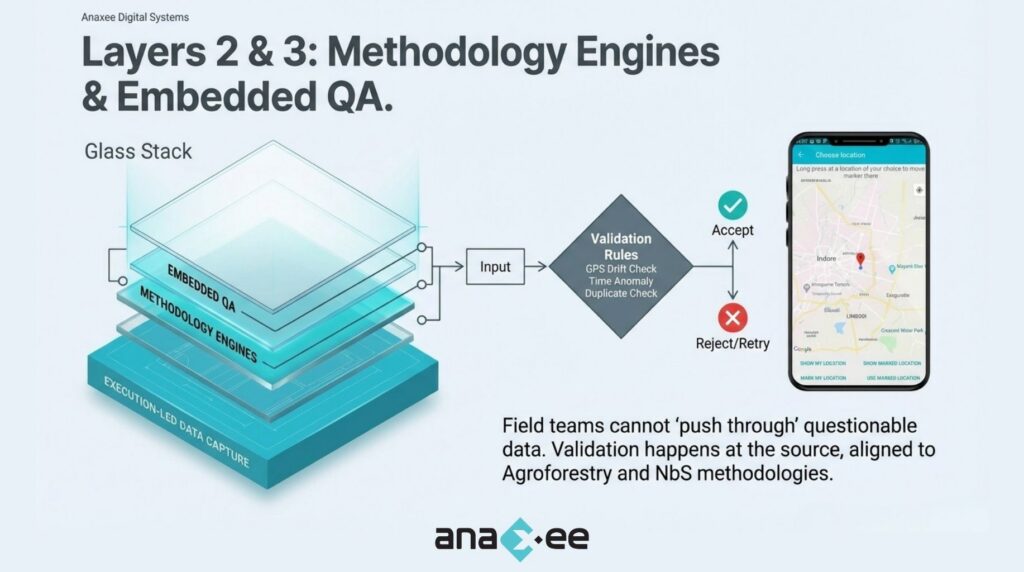
3. Embedded Quality Assurance, Not Post-Processing
Traditional MRV systems treat QA as a downstream activity. We embedded QA into the execution flow itself.
Our system flags:
- Duplicate or suspicious entries
- GPS drift and inconsistencies
- Time anomalies
- Evidence mismatches
Field teams cannot “push through” questionable data. It must be resolved at the source.
This is uncomfortable. It also works.
4. Transparent Data Lineage
Every data point in Anaxee’s dMRV system carries a full lineage:
- Who collected it
- Under which protocol
- On which device
- At what time and location
- With what supporting evidence
This lineage is non-negotiable. It is what allows independent auditors, validators, and internal teams to trust the output without trusting the operator.
5. Audit-Ready Outputs, Not Just Dashboards
Dashboards are easy. Audit trails are hard.
Our dMRV produces:
- Structured datasets aligned to verification requirements
- Evidence bundles linked to individual records
- Change logs and exception reports
- Export-ready formats for standards bodies and registries
The goal is not visual comfort—it is audit survivability.
Why This Matters for Carbon Markets and NbS
As carbon markets mature—especially in India—the tolerance for weak MRV is shrinking.
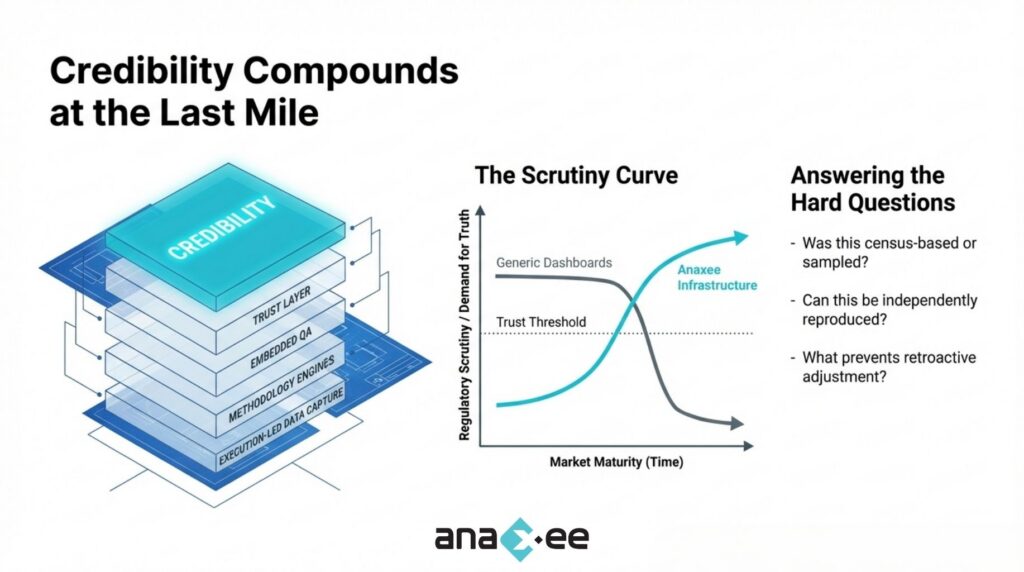
Regulators, registries, and buyers are asking harder questions:
- Was this data census-based or sampled?
- Can this claim be independently reproduced?
- How were field teams incentivized?
- What prevents retroactive data adjustment?
Anaxee’s dMRV is built for that future, not the last credit issuance cycle.
It supports:
- Large-scale smallholder projects
- Multi-year monitoring cycles
- High-frequency field updates
- Transparent reporting to multiple stakeholders
What We Learned the Hard Way
Building dMRV is not glamorous. It exposes uncomfortable truths:
- Most field data issues are incentive issues, not tech issues
- Simpler tools fail less than complex ones
- Auditors trust process clarity more than visual sophistication
- Scalability comes from repeatability, not flexibility
We redesigned, discarded, and rebuilt multiple components before settling on the current system. Not because we wanted perfection—but because fragile systems collapse under scale.
What Anaxee’s dMRV Is Best Suited For
Our product performs best when:
- Projects involve real on-ground execution
- Geographies are fragmented or rural
- Methodologies demand strict compliance
- Stakeholders care about long-term credibility
It is not built for slideware reporting. It is built for execution-heavy climate programs.
Looking Ahead: dMRV as Infrastructure, Not Software
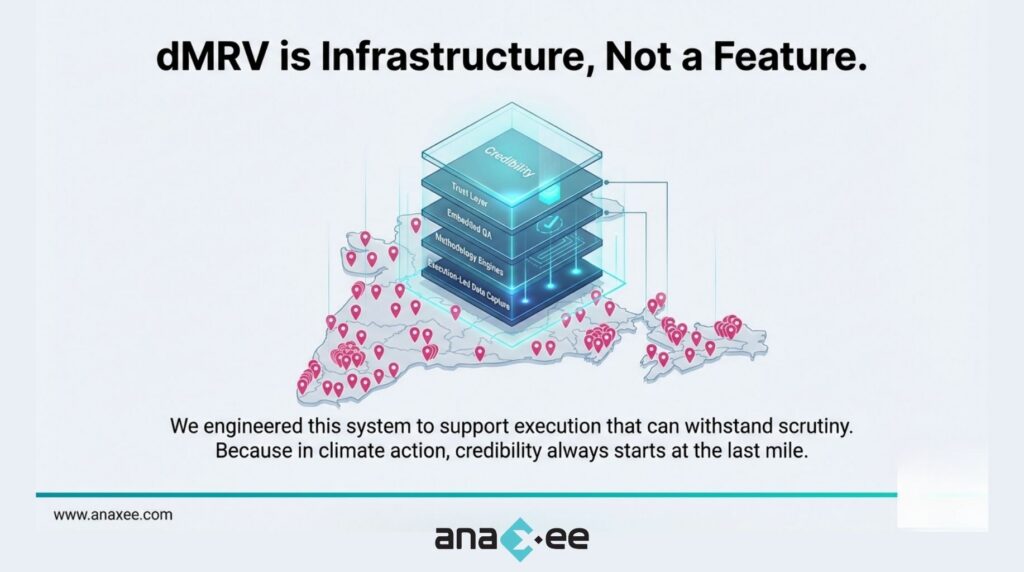
We do not see dMRV as a feature. We see it as infrastructure.
As climate action moves from pilots to programs, the ability to generate trusted ground truth will define who scales and who stalls.
At Anaxee, we will continue refining this system—not to chase trends, but to support execution that can withstand scrutiny.
Because in climate action, credibility compounds. And it always starts at the last mile.