
A few years ago, a marketing head from a national brand shared something interesting.
“We’re everywhere,” he said.
“Search ads, social ads, hoardings, retail branding.
People recognise us instantly.”
Then he paused.
“But when my distributor calls, he still says demand is patchy.
Some areas move fast. Others don’t move at all.”
This contradiction is becoming common.
Brands are visible.
But visibility isn’t converting into confidence.
And confidence is what actually moves demand.
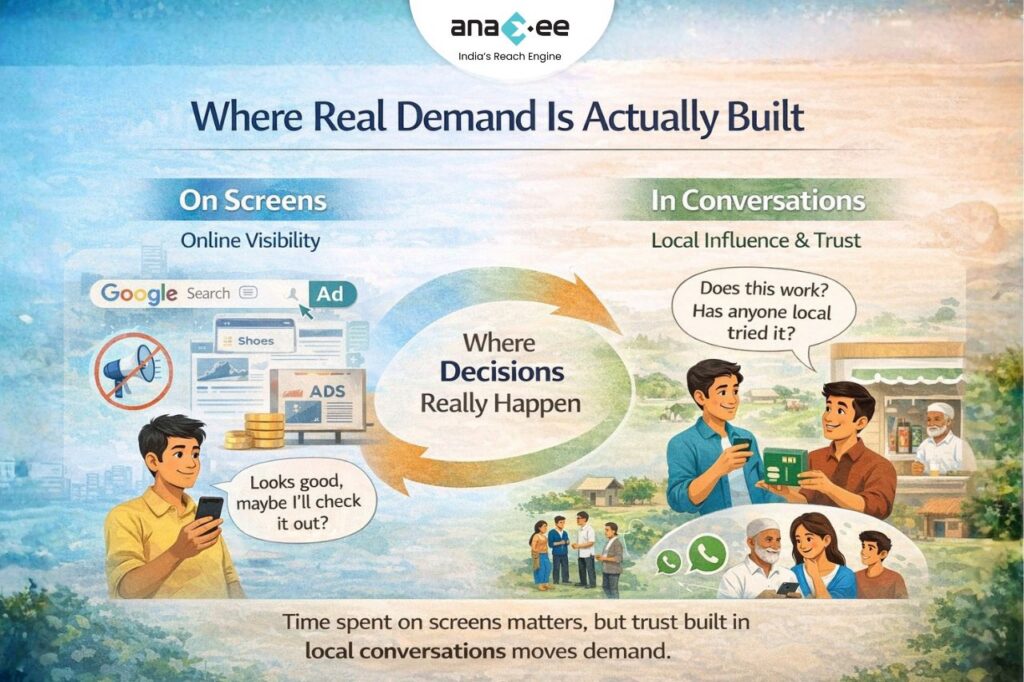
Where the real decision happens
Most marketing teams focus on the moment of discovery:
- When someone sees an ad
- When someone clicks
- When someone visits a website
But that’s not where most buying decisions are finalised.
The real decision usually happens later.
At a shop counter.
During a casual conversation with someone trusted.
Someone asks quietly:
“Is this actually good?”
“Have you tried it?”
“Does it work in our kind of situation?”
That’s where marketing either wins—or quietly loses.
Why this matters even more outside metros
In large cities, people experiment more easily.
They try, discard, try again.
In semi-urban and rural markets, decisions are slower—but deeper.
People:
- Observe before buying
- Ask around before switching
- Prefer proven choices over flashy ones
Trust is built socially, not individually.
Which means mass messaging often struggles to tip the scale.
The myth of “one more campaign”
When growth slows, the instinctive response is predictable:
- New creatives
- Bigger budgets
- Another campaign
But campaigns behave like waves.
They rise, peak, and disappear.
What many brands actually need is not another wave—
but a current that keeps flowing.
That current is trust.
Word-of-mouth: powerful, but unpredictable
Everyone agrees that word-of-mouth works.
But most brands treat it like weather.
Nice when it happens. Uncontrollable when it doesn’t.
Left alone, word-of-mouth:
- Moves unevenly
- Stays limited to pockets
- Is impossible to track
Which is why marketers hesitate to rely on it.
The question isn’t whether word-of-mouth works.
It’s whether it can be designed without losing authenticity.
When conversations become a system
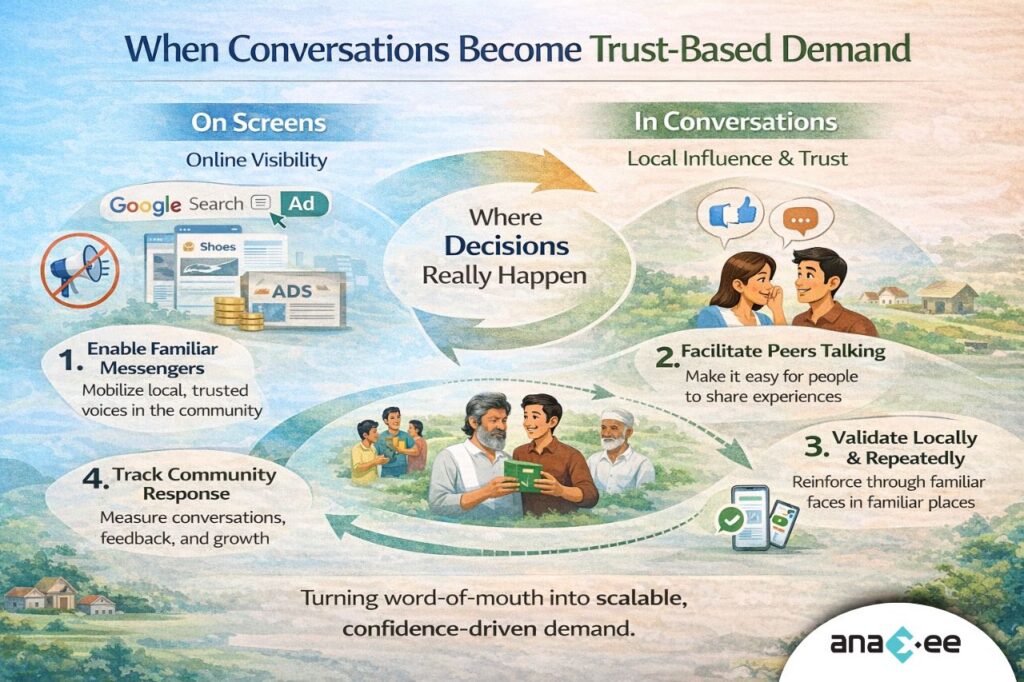
Here’s where the shift begins.
Instead of asking:
“How do we push messages?”
Some brands are asking:
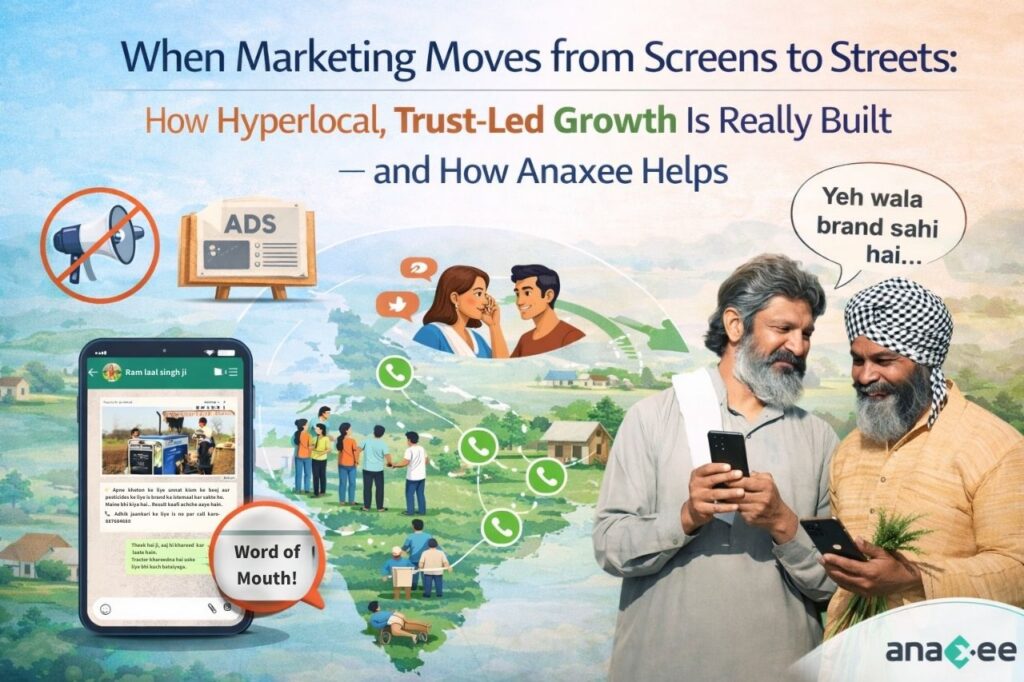
“How do we support the conversations already happening?”
This changes the role of marketing completely.
Marketing stops being a broadcast function.
It becomes an enabler of trust exchange.
The moment conversations are:
- Repeated
- Contextual
- Anchored in familiar networks
They stop being random.
They start becoming momentum.
Why WhatsApp matters in this story
Across India, WhatsApp isn’t just communication.
It’s coordination.
Families, farmers, retailers, self-help groups, professionals—
entire communities already operate here.
Information shared here feels:
- Personal
- Relevant
- Low-pressure
A recommendation inside a WhatsApp group doesn’t feel like an ad.
It feels like advice.
That difference matters.
From isolated chats to influence networks
Now imagine this at scale.
Not one group.
Not ten groups.
But hundreds, even thousands of local groups—
each rooted in its own social reality.
When influence flows through such networks:
- Adoption feels safer
- Resistance drops
- Repetition reinforces belief
This is how demand spreads village by village,
not headline by headline.
Why structure makes all the difference
There’s a fine line here.
Without structure, community marketing becomes chaos.
With too much control, it loses trust.
The balance lies in:
- Human-led execution
- Clear intent
- Consistent presence
- Measurable signals
This is where most brands struggle to operate alone.
They understand the need.
But execution at this depth requires:
- Local understanding
- Operational discipline
- Systems that don’t break at scale
Where Anaxee enters the picture
Anaxee exists because this gap exists.
Brands come to Anaxee when they realise:
- Ads are creating awareness, not confidence
- Campaigns spike interest, then fade
- Demand needs to be built closer to real life
Instead of forcing influence,
Anaxee helps organise it.
Human-led.
Hyperlocal.
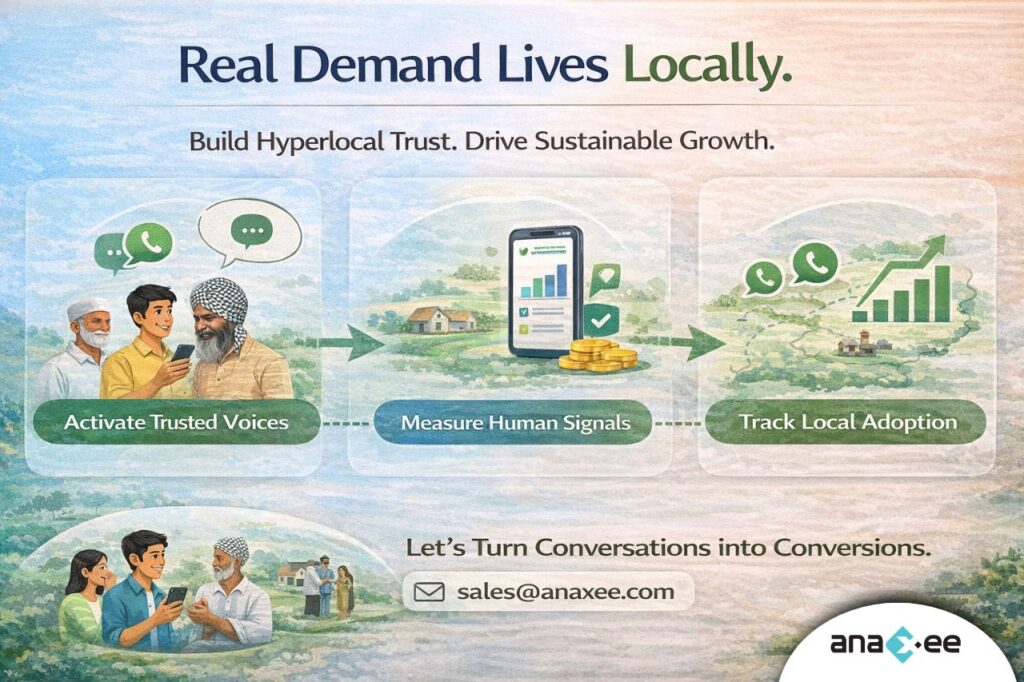
Designed to move trust—not just impressions.
From visibility to belief
There’s a subtle but important difference between being seen and being chosen.
Visibility says:
“I know this brand exists.”
Belief says:
“I trust this brand enough to act.”
Hyperlocal, trust-led marketing focuses on that second leap.
And once belief forms, something interesting happens:
- Repeat behaviour increases
- Recommendations multiply
- Growth stabilises
Marketing stops feeling like effort.
It starts feeling like momentum.
Proof doesn’t always look like clicks
One reason this approach feels unfamiliar is measurement.
Clicks are instant.
Trust is gradual.
But trust leaves signals:
- Engagement that sustains
- Communities that stay active
- Behaviour that changes over time
When measured properly, these signals often predict long-term growth better than short-term conversions.
Why this approach works across use cases
Whether it’s:
- Health awareness campaigns
- Agriculture and rural product launches
- New product introductions
- Hyperlocal GTM efforts
The principle stays the same:
People adopt faster when they feel understood,
not targeted.
Human-led influence scales best
when it feels local, familiar, and relevant.
The shift already underway
This isn’t a future idea.
It’s already happening quietly.
Brands that embrace trust-led systems are:
- Less dependent on constant ad spend
- More resilient to market noise
- Better positioned in hard-to-reach markets
They aren’t louder.
They’re closer.
A simple way to think about modern marketing
Ads help people find you.
Trust helps people choose you.
The brands that win next will invest in both—
but they won’t confuse one for the other.
They’ll build systems that respect how real decisions are made.
That’s what hyperlocal, trust-led marketing enables.
And that’s where Anaxee helps brands move
from being visible everywhere
to being trusted where it matters most.