
Why ESG Fails at the Last Mile
ESG frameworks are getting sharper. Reporting standards are tightening. Stakeholders are asking tougher questions.
Despite this, a surprising number of ESG initiatives underdeliver.
Not because organisations lack commitment.
Not because strategies are flawed.
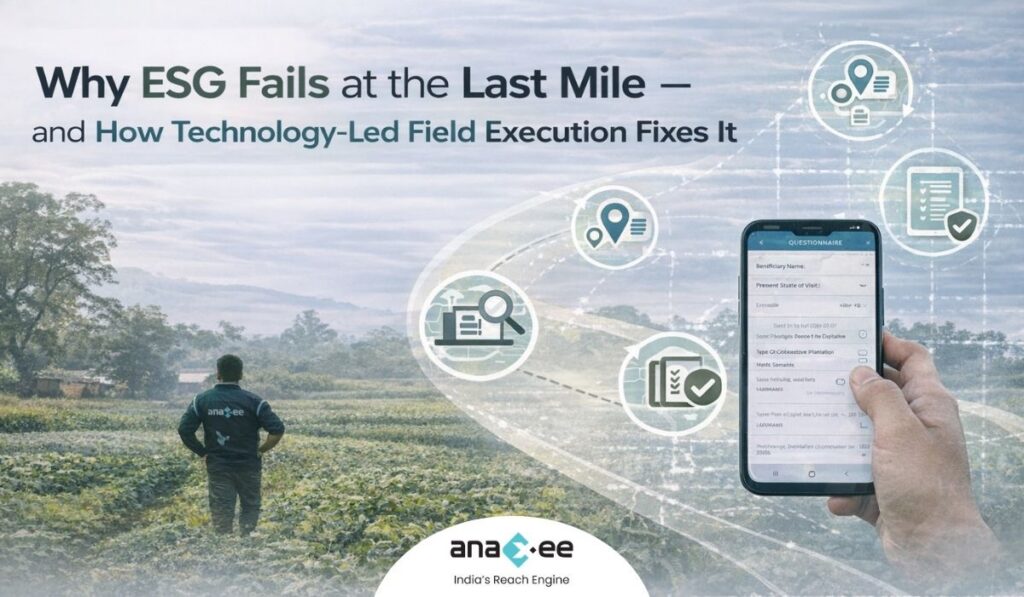
But because ESG frequently breaks down at the last mile.
The Illusion of Progress
From headquarters, everything looks structured:
- Clear objectives
- Approved budgets
- Defined KPIs
- Partner networks
- Reporting timelines
Yet on the ground:
- Activities get delayed
- Data arrives late
- Surveys lack consistency
- Beneficiary records mismatch
- Monitoring is sporadic
By the time discrepancies surface, reporting cycles are already underway.
Where ESG Programs Typically Derail
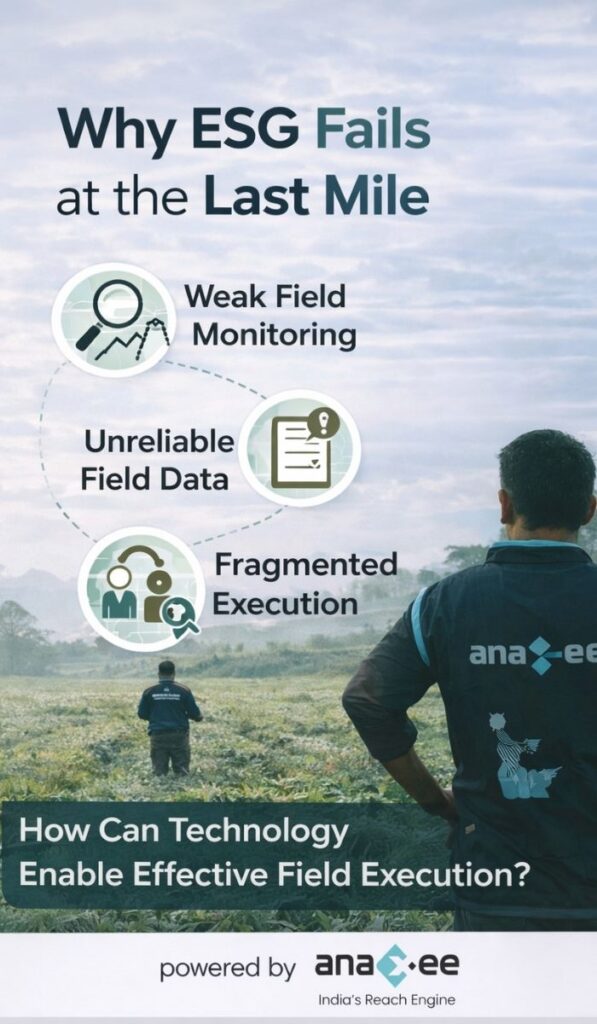
1. Fragmented Field Operations
Multiple NGOs, agencies, vendors, consultants — coordination becomes messy. Ownership diffuses.
2. Manual Data Collection
Paper forms and spreadsheets introduce:
- Errors
- Delays
- Selective reporting
- Backfilled entries
3. Weak Beneficiary Validation
Ghost beneficiaries. Duplicate records. Inflated outreach numbers.
4. Limited Monitoring
Was the intervention actually delivered? Was it delivered correctly? Was quality maintained?
5. Retrospective Evidence Creation
Photos taken later. Forms completed after events. Documentation reconstructed.
The ESG Credibility Problem
ESG is increasingly scrutinised by:
- Investors
- Regulators
- Auditors
- Rating agencies
- Media
- Civil society
Weak evidence doesn’t just weaken reports. It erodes trust.
And trust, once lost, is expensive to rebuild.
The Last-Mile Paradox
Ironically, the most critical ESG activities are often:
✔ Least visible
✔ Least digitised
✔ Least monitored
Yet they carry the greatest weight in impact claims.
Technology-Led Field Execution: A Structural Fix
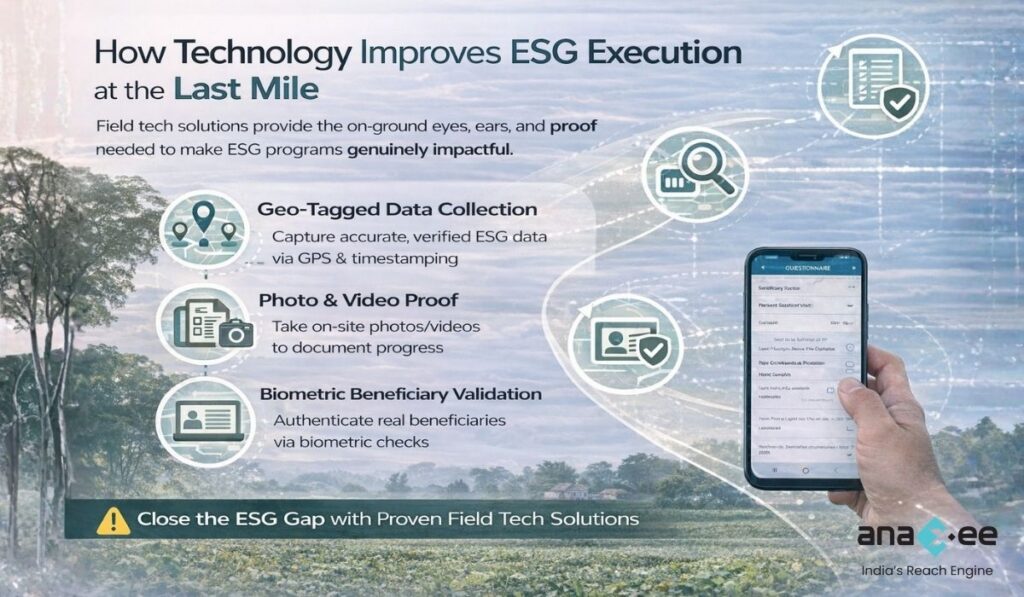
Strong ESG performance depends on converting field complexity into structured systems.
This requires:
📱 Digital data capture
📍 Geo-verification
🧭 Real-time monitoring
🗂 Standardised workflows
📊 Live dashboards
How Anaxee Addresses Last-Mile ESG Risks
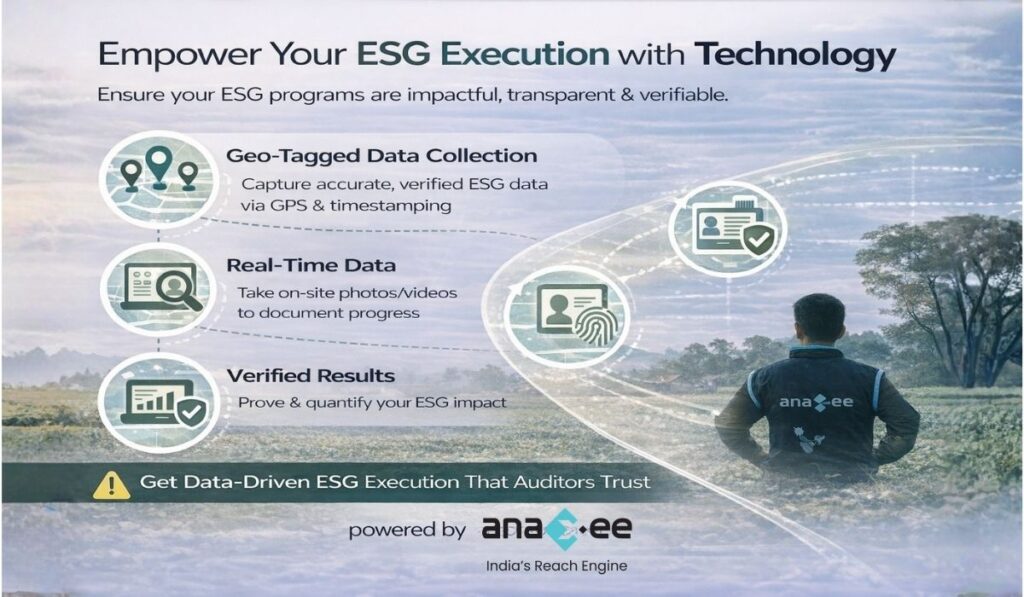
✔ Digitised Field Activities
Every interaction, survey, and task captured via mobile applications.
✔ GPS & Time-Stamped Evidence
Proof tied to location and time reduces manipulation.
✔ Photographic Documentation
Visual validation strengthens auditability.
✔ Structured Questionnaires
Standardisation improves comparability and reliability.
✔ Offline Capability
Essential for rural and low-connectivity areas.
✔ Monitoring Distributed Teams
Routes, productivity, and completion rates become measurable.
✔ Centralised Dashboards
Leadership sees progress without waiting for layered summaries.
Why This Changes ESG Outcomes
1. Reduced Data Distortion
Field data is captured at source, not reconstructed.
2. Higher Transparency
Activities are traceable, not assumed.
3. Early Problem Detection
Delays and deviations are visible in real time.
4. Stronger Audit Readiness
Digital trails replace fragmented documentation.
5. Better Budget Efficiency
Leakages and redundancies become identifiable.
ESG is Becoming Evidence-Driven
Stakeholders no longer accept broad claims like:
❌ “We impacted 1 million lives.”
❌ “We planted 500,000 trees.”
They now ask:
✅ Where?
✅ When?
✅ How verified?
✅ Survival rate?
✅ Data source?
Execution systems determine whether organisations can answer confidently.
The India Factor
India’s ESG landscape is shaped by scale:
- Rural dispersion
- Multi-state operations
- Informal ecosystems
- Infrastructure diversity
Execution discipline becomes the defining success variable.
Reframing ESG Success
Old view:
ESG = Policy + Reporting
New reality:
ESG = Strategy + Execution + Verifiable Data
Closing Reflection
Most ESG failures are not dramatic collapses. They are silent erosions:
- Slightly inflated numbers
- Slightly delayed updates
- Slightly incomplete monitoring
Over time, “slightly” compounds into systemic weakness.
Technology-enabled execution frameworks don’t just improve efficiency — they protect credibility.
And credibility is the currency ESG ultimately trades on.
If you’d like, I can next create:
✅ A third blog (e.g., ESG + Climate Projects / Carbon / CSR)
✅ LinkedIn snippets from these blogs
✅ Website landing page version
✅ Email campaign copy
Just tell me your target audience (CMO, CSR Head, Sustainability Lead, Investor Relations, etc.).