

What the CCP Label Actually Changes for Indian Project Developers
Ask ten people in the Indian carbon market what the CCP label does and you’ll get two kinds of answer.
One group treats it as a stamp that unlocks buyers. The other treats it as an expensive bureaucratic hurdle that mostly benefits large developers. Neither is quite right, and the gap between them costs Indian projects real money — because developers on both sides are making pipeline decisions based on a rough picture of something quite specific.
Here’s what the label is, what it demonstrably does to price and demand, and what it means if you’re building projects in India.
What it actually is
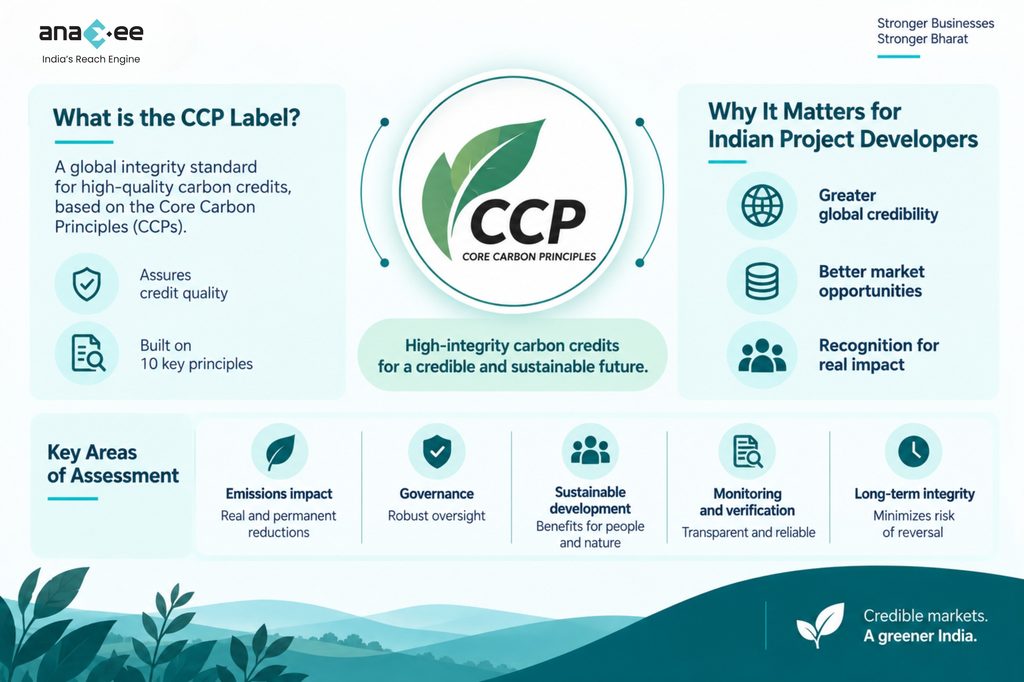
The Core Carbon Principles label comes from the Integrity Council for the Voluntary Carbon Market. The ICVCM doesn’t assess individual projects. It assesses methodologies — the rulebooks projects use to calculate emission reductions — and it assesses crediting programmes like Verra and Gold Standard for eligibility.
For a credit to carry the label, both have to line up: the programme must hold CCP-eligible status, and the specific methodology the project used must be CCP-approved.
This is the first thing developers get wrong. Being registered with Gold Standard doesn’t make your credits CCP-labelled. Using a CCP-approved methodology doesn’t either, if you haven’t met the conditions attached to that approval.
The conditions are the hard part
Most CCP approvals are conditional, and the conditions are substantive.
The cookstove decisions are the clearest example. The ICVCM approved three cookstove methodologies but attached requirements around how fNRB is derived and how stove usage is monitored. Projects using an approved methodology could still fall outside the label if they didn’t meet those conditions.
In April 2025, one European developer publicly pointed out that under the conditions as written, their household biogas programme — using an ICVCM-approved methodology — was not CCP-eligible. They weren’t complaining about rejection. They were pointing out that approval of the methodology and eligibility of the credits are two different things.
If you are currently describing your project as CCP-labelled, check which of the two you actually mean. It is a checkable claim, and in a market that just spent two years on an integrity reckoning, getting it wrong in a pitch deck is expensive.
What it does to price — honestly
Here the published figures diverge, and it’s worth understanding why rather than quoting the most flattering one.
Different analysts report the CCP premium at roughly 8–14%, at around $3.83 per credit, and at up to 25%. These aren’t contradictions so much as different samples, different periods and different comparison sets. What they agree on is direction: labelled credits sell for more than unlabelled equivalents, and the gap has widened rather than narrowed.
The share figures vary similarly. By mid-2026 the ICVCM’s own head put the label at around 13% of fresh issuance; other analyses citing broader accreditation coverage report higher figures. Again, different denominators.
The honest summary: the premium is real, it’s meaningful, and it is not large enough to rescue a project whose economics don’t otherwise work. Anyone selling you a pipeline on the strength of an expected CCP premium is doing arithmetic you should check.
There’s also a causation question worth sitting with. Projects that qualify for CCP approval usually already have strong governance and rigorous monitoring. Those attributes would probably attract better prices without the label. Part of what looks like a CCP premium may be the market paying for underlying quality that the label surfaces rather than creates.
That distinction matters for a developer. Building a project well is what earns the premium. The label is how buyers find you.
Where the label genuinely changes your position
Four places.
1. Corporate claims frameworks. The VCMI Claims Code points buyers toward CCP-approved credits as a condition for credible corporate claims. If your buyer is making a public claim under that framework, the label stops being a preference.
2. Procurement shortlists. Large corporate buyers increasingly use the label as a first-pass filter. Not because it’s sufficient — serious buyers still do project-level due diligence — but because it’s a defensible way to cut a long list. Without it, you may not reach the conversation where your project’s merits could be argued.
3. Regulatory direction of travel. The EU and several national governments have begun referencing the Core Carbon Principles as a quality benchmark. Where that continues, the label moves from market signal toward something closer to a compliance reference.
4. Legacy inventory. If you hold unsold credits from older vintages under rejected methodologies, the label has already changed your position — downward. That’s not a future risk to plan around. It’s a present fact to price in.
What it means specifically in India
Three India-specific consequences.
Legacy pipelines took the hardest hit
India has a large stock of projects registered under older cookstove and renewable energy methodologies. A significant share of that inventory sits outside the label, and buyer demand has moved. Developers holding it face a genuine choice: transition to a compliant methodology where possible, or accept that the credits sell into a shrinking pool of buyers at falling prices.
Transition is often possible. It usually requires rebasing the carbon accounting and, in most cases, building monitoring capacity the project never had.
The bar is now field capability, not paperwork
This is the shift that matters most for Indian developers, and it’s underappreciated.
Meeting CCP conditions is rarely a documentation problem. It’s an operations problem — periodic Kitchen Performance Tests across scattered villages, usage monitoring that catches stove stacking, plot-level measurement for agroforestry, defensible sampling with real back-checks.
A developer with a strong technical team and no field infrastructure cannot meet these conditions, however good the PDD looks. A developer with genuine rural reach can. That’s a meaningful reordering of who is competitive in the Indian market, and it favours organisations that built ground capability rather than deal capability.
Smaller projects face a squeeze
Higher monitoring requirements cost money, and the cost doesn’t scale down neatly. There’s a real risk that community-scale Indian projects get priced out of the label — which is why Gold Standard’s updated simplified methodology for micro-scale projects matters, and why it’s worth watching whether it works in practice.
What to actually do
If you’re developing in India, three practical steps.
Audit your claims. For every project, write down: is the programme CCP-eligible, is the methodology CCP-approved, and have the attached conditions been met? Three separate boxes. Most developers can tick fewer than they assume.
Cost the conditions before committing. The monitoring requirements attached to CCP approval have a real, recurring field cost across the crediting period. Model it properly at pipeline stage, not after registration.
Don’t build the business case on the premium. Build it on a project that works, then treat the label as the mechanism that gets it in front of buyers who’ll pay for it.
The uncomfortable summary
The CCP label didn’t raise the standard of the carbon market. It made the existing standard legible — and in doing so, it made a large volume of previously saleable credits difficult to sell.
For Indian developers with real measurement capacity, that’s an opening. Fewer competitors can clear the bar, buyers are paying more for those who do, and the projects that clear it are genuinely better than what came before.
For developers whose model depended on the old arithmetic, there isn’t a workaround. There’s a rebuild.
Anaxee’s Climate Command Centre supports Indian carbon projects with the field measurement capacity CCP conditions require — baseline surveys, Kitchen Performance Tests, usage and stacking monitoring, plot-level agroforestry data and digital MRV — through 40,000+ Digital Runners across 540+ districts and 11,000+ pincodes. If you’re assessing whether a project can meet CCP conditions, talk to our team.