
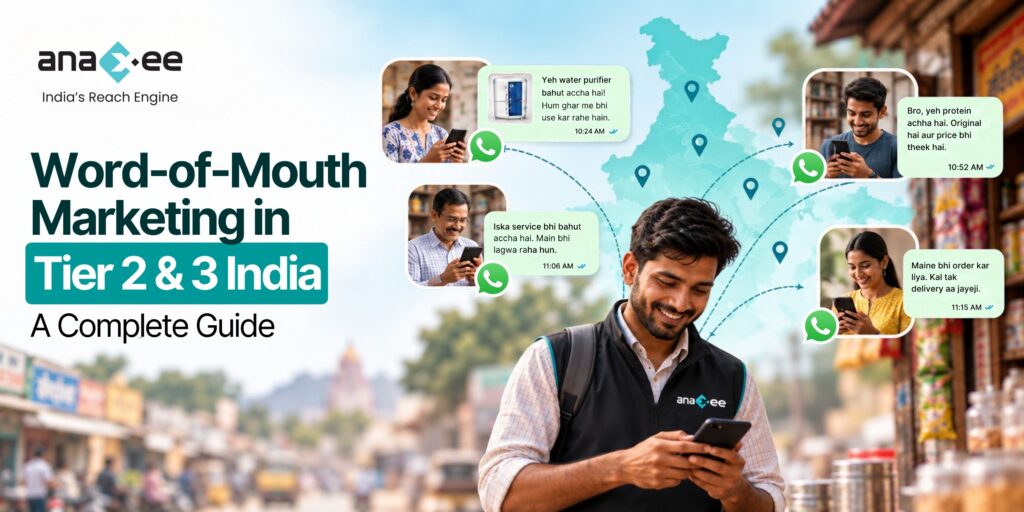

In Tier 2, 3, and 4 India, word of mouth isn’t just one marketing channel — it’s usually the deciding one. People in these markets buy on the word of someone they trust far more than on any ad they scroll past. So the brands that win here aren’t the ones that shout loudest. They’re the ones that get recommended.
That’s a hard shift for marketing teams trained on metro playbooks, where reach and impressions rule. The tactics that work in Mumbai or Bangalore often fall flat two districts over.
This guide is about what actually works in small-town and rural India: why word of mouth dominates there, the channels that carry it, how to run it on purpose instead of hoping for it, the mistakes to avoid, and how to measure the results.
The market beyond the metros
First, what we’re talking about. India’s cities are loosely grouped into tiers by size. The metros — Delhi, Mumbai, Bangalore, and a handful of others — are Tier 1. Below them sit hundreds of Tier 2 and Tier 3 cities, then thousands of Tier 4 towns, and beyond that, rural India.
Here’s the part marketers sometimes miss: the metros are a small slice of the country. The vast majority of Indians — and a fast-growing share of consumer spending — live in these smaller towns and villages. As incomes rise and smartphones spread, this is where much of the next decade’s growth will come from.
And it behaves nothing like Tier 1.
In a metro, people are anonymous, time-poor, and bombarded with ads they’ve learned to ignore. In a smaller town, life is more connected. People know their shopkeeper, their neighbours, the teacher down the lane. Reputation travels fast. A product that earns a good name spreads; one that disappoints gets quietly avoided.
That social density is the single most important fact about marketing here. It’s why the same rupee spent behaves so differently. In a metro, you’re buying attention in a crowd of strangers. In a Tier 3 town, you’re operating inside a web of relationships — and relationships, not impressions, are what move products.
Why the metro playbook fails here
Most brands don’t build a small-town strategy. They take the metro campaign and stretch it outward. It rarely works, for a few clear reasons.
Ad reach goes thin. National TV and digital campaigns technically “reach” these towns, but faintly, and against far more competition for attention than the spend assumes. You end up paying metro rates for a fraction of metro impact.
Big creators don’t carry. The Instagram or YouTube star who moves a metro audience often means little in a Tier 3 town. Different aspirations, different trusted figures. Influence there is local, not national.
Language is a wall. A slick English or Hindi-only campaign can feel distant, even alienating, in a market that lives in Marathi, Bhojpuri, Telugu, or any of dozens of local languages. The message doesn’t just underperform — it signals “this isn’t for you.”
Trust matters more, and ads carry less of it. These are often more considered, more price-sensitive purchases, made carefully. An ad’s word counts for little. A known person’s word counts for a lot.
The pattern underneath all four: metro marketing is built to buy attention from strangers at scale. Small-town India doesn’t run on attention from strangers. It runs on trust between people who know each other. Pour a metro budget into that market unchanged, and most of it leaks away.
Why word of mouth rules these markets
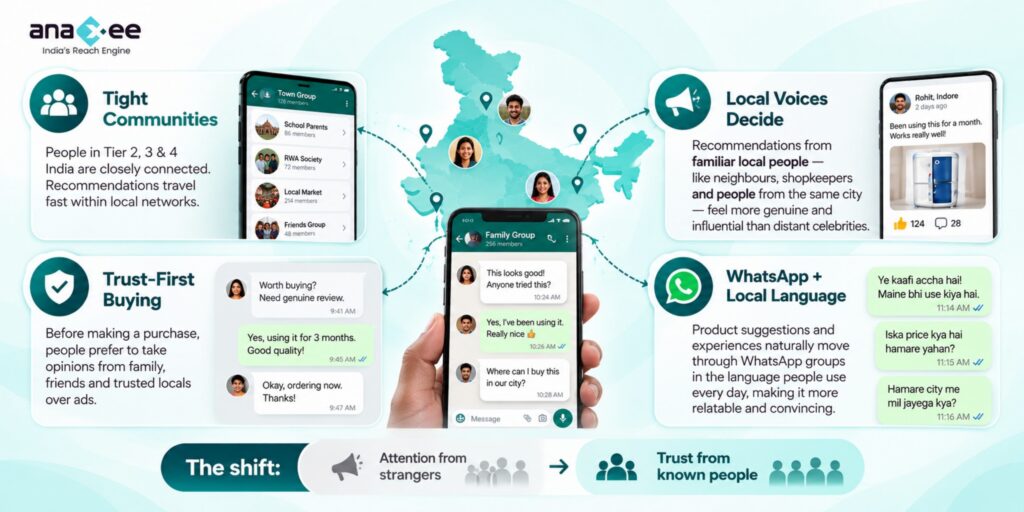
If ads carry less trust here, what carries more? People. Specifically, known people.
In a tightly connected town, a recommendation isn’t just information — it’s a kind of guarantee. When a neighbour says a product is good, they’re putting a sliver of their own reputation behind it. They’ll see you again next week. That accountability is exactly why the recommendation is believed, and why it converts.
Three things make word of mouth especially powerful in Tier 2, 3, and 4 markets:
- Tight communities. Word travels fast and far when everyone is a couple of connections apart. A few trusted mentions can ripple through a whole locality.
- Trust-first buying. For considered purchases, people actively seek a known opinion before deciding. They ask around. Whoever they ask is your real marketing channel.
- Local voices decide. The shopkeeper, the teacher, the community elder, the successful local professional — these are the people whose word actually shifts choices in that town. Not a distant celebrity.
So word of mouth here isn’t a soft “nice to have.” It’s the primary way trust gets transferred, and trust is what gets products bought. A brand that earns and organises local recommendation is working with how these markets actually make decisions, instead of fighting it with volume.
The channels that actually work
Word of mouth in these markets travels along a few specific rails. Knowing them is half the battle.
Trusted local people. The most important channel isn’t a platform — it’s a person. Shopkeepers, teachers, society members, medical reps, advocates, successful local businesspeople. Their recommendation is the highest-converting media in the town.
WhatsApp. This is where digital word of mouth now lives in India. Links forwarded, products vouched for, offers shared in family and community groups. It’s cheap, universal, and personal — a message from someone you know, not a banner from a brand you don’t. Any small-town strategy that ignores WhatsApp is leaving the main road unused.
On-ground presence. The shop counter, the local camp, the community gathering — physical moments where a product can be seen, tried, and talked about. In markets where people want to touch before they trust, presence matters.
Local language, always. Whatever the channel, the message has to arrive in the language people think in. It’s not a translation nicety; it’s the difference between belonging and being an outsider.
Notice what’s not at the top of this list: national TV, metro influencers, English social campaigns. They can play a supporting role, but they aren’t the engine. The engine is a trusted local voice, usually on WhatsApp or at the counter, speaking the local language.
How to run it on purpose
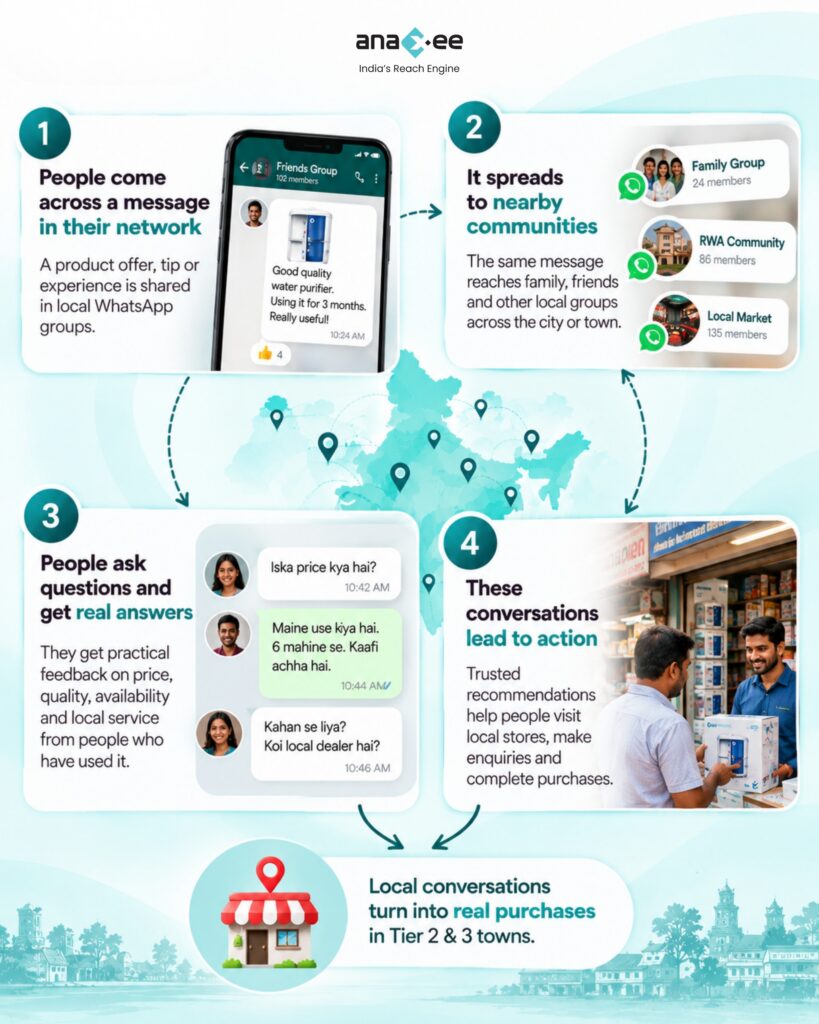
The mistake most brands make is treating word of mouth as something that either happens or doesn’t. In these markets, you can run it deliberately. Here’s the shape of it.
1. Find the trusted locals. In each town you care about, identify the people whose word already carries weight — not the ones with the biggest reach, the ones with the most trust. This is the foundation.
2. Give them a real reason to talk. Tell them clearly what your product is and why it’s worth recommending. Give them a genuine hook — a real benefit, a good offer — not a script to recite. Scripts are what make word of mouth sound fake, and fake is fatal here.
3. Distribute it locally. Hand them a simple task on the channel that fits — usually a WhatsApp message or link to share with the people they’d naturally talk to, in the local language.
4. Track what happens. Tie each person’s activity to a result — a click, a sign-up, a sale — so you can see what’s working and do more of it.
Those four steps are exactly what turns scattered word of mouth into structured word of mouth — a channel you can plan, aim, and measure. (We cover the concept in depth in our guide to structured word of mouth.)
The key mindset shift: you’re not launching a campaign at the town. You’re activating trusted voices inside it.
What it looks like across sectors
The approach adapts to almost any business selling into these markets. Four quick examples.
FMCG and consumer products. A new product on a small-town shelf is invisible until someone vouches for it. Trusted locals who use it and mention it get those crucial first trials going — and in a connected town, the first few honest “I tried this, it’s good” conversations spread quickly.
Regional media and newspapers. Subscriptions grow when a familiar local figure — a teacher, a society secretary — recommends the paper to families in their circle, in their language, rather than when a generic ad runs. The pitch that works is a neighbour’s, not a marketer’s.
Fintech and service apps. Nothing needs trust more than an app asking for money or documents. People hesitate over a stranger’s ad, but follow a known person who walks them through it. A trusted local recommendation is what gets real, active users, not just downloads.
Auto, tyres, and hardware. Here the trusted voices are the mechanics and shopkeepers whose word customers follow at the moment of purchase. Turning them into advocates puts your brand in the conversation exactly when the buying decision is being made.
The common thread: in every case, the trusted local voice does the job that an ad, however clever, can’t do in these markets — it converts.
Common mistakes to avoid
Brands lose money in small-town India in fairly predictable ways. Watch for these.
- Copy-pasting the metro campaign. The same creative, the same channels, the same assumptions — just aimed at a different pin code. It’s the most common mistake and the most expensive.
- English-only, or Hindi-only where it doesn’t fit. A message that ignores the local language quietly tells people the brand isn’t really for them.
- One-off blasts. A single burst of activity and then silence. Trust and recommendation build through repetition, not a one-day spike.
- Skipping local trust entirely. Spending big on reach while ignoring the trusted people who actually move decisions in the town. Reach without local trust underperforms here every time.
- No measurement. Running loose “awareness” activity with no way to tell what converted, so you can’t learn or improve. This is what keeps word of mouth a gamble instead of a channel.
- Treating it as charity or an afterthought. Small-town markets are a serious growth engine, not a box to tick. Half-hearted effort gets half-hearted results.
The fix for all of them is the same discipline: local voices, local language, repeated over time, and measured — run as a real channel, not a leftover slice of the national plan.
How to measure it
The old objection to word of mouth is that you can’t measure it. In small-town markets, where it’s your most important channel, that objection has to be answered — or you’ll never be able to justify investing in it properly.
The answer is to build tracking into the activity from the start. When your word of mouth runs through known people, on channels you can see, with trackable links or codes, you can connect a conversation to an outcome. You can tell which town produced sign-ups, which type of local voice converted best, which message actually moved people.
That turns a vague “we’re building buzz” into real numbers: cost per conversion, performance by district, and a clear read on what to scale. You can start with one town, measure honestly, and expand only into what works.
This is the difference between hoping and knowing — and it’s exactly what structured word of mouth is designed to deliver. In markets this important to your growth, measurement isn’t optional. It’s what lets you keep spending on the channel with confidence.
Putting it to work: Anaxee’s Prabhavak
Knowing that trusted local recommendation is the way to win these markets is the easy part. Actually finding trusted people across hundreds of towns, activating them, and tracking every conversation is a serious operation — and it’s where most brands get stuck.
This is what Anaxee was built for. Anaxee runs a large last-mile network across India — 40,000+ trained “Digital Runners” reaching 540+ districts — and has delivered on-ground campaigns for 350+ brands. Its Prabhavak model turns that network into structured word of mouth for exactly these markets: trusted local people carrying your brand into real conversations, in the local language, with every activity tracked back to a result.
The positioning is honest and worth repeating: Prabhavak doesn’t replace your existing marketing — it amplifies it. Your national ads and campaigns build awareness; Prabhavak takes it the last mile, into the towns and conversations where the buying decision actually happens.
And you don’t have to commit to a nationwide rollout to test it. The usual starting point is a single district — run it, read the numbers, then scale into the towns that perform.
If you’re building for Tier 2, 3, and 4 India, that’s the conversation worth having.
New to the model? Start with what a Prabhavak is, see how it compares in Prabhavak vs influencer marketing, and go deeper on the method in structured word of mouth.
Frequently asked questions
What’s the best way to market in Tier 2 and 3 cities in India? Lead with trusted local recommendation rather than metro-style advertising. In these markets, people buy on the word of someone they know, so activating trusted local voices — in the local language, often over WhatsApp — outperforms broad ad spend.
Why doesn’t digital advertising work well in small towns? It reaches thinly, faces language barriers, and carries little trust. Big online creators have limited pull outside the metros, and considered, price-sensitive buyers act on known opinions, not ads.
Is word of mouth really better than ads in rural India? For conversion, usually yes. Ads can build some awareness, but the decision to actually buy is most often driven by a trusted local recommendation. The two work best together — ads for awareness, word of mouth to convert.
How do you do word-of-mouth marketing on purpose? By structuring it: choose trusted local people, give them a genuine reason to recommend your product, distribute it on local channels like WhatsApp, and track each conversation back to a result.
Which channels matter most in Tier 2, 3, 4 markets? Trusted local people first, then WhatsApp, on-ground presence, and always the local language. National TV and metro influencers play only a supporting role.
How do you measure word-of-mouth marketing? By running it through known people and trackable links or codes, so you can tie conversations to clicks, sign-ups, and sales — and see performance by town and by type of recommender.
Who can help brands run this in India? Anaxee runs its Prabhavak model as structured word of mouth built for these markets, on a last-mile network across 540+ districts — typically starting with a single district so brands can see results before scaling.