
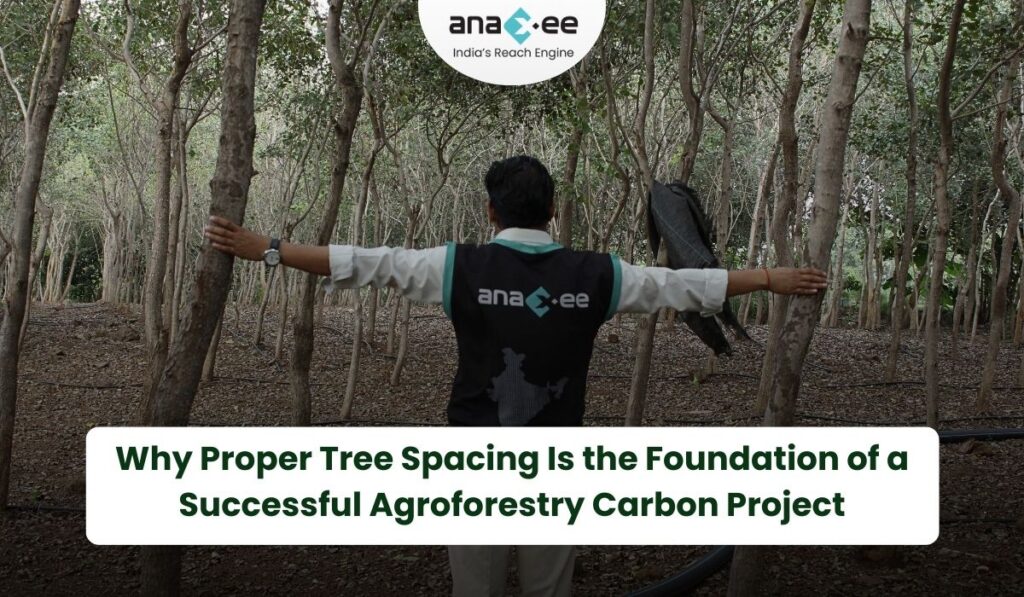

Why Proper Tree Spacing Is the Foundation of a Successful Agroforestry Carbon Project
If you’ve ever walked through a well-planned agroforestry site and then visited one where trees were planted without thought, the difference hits instantly. In one, you see trees breathing—open crowns, healthy stems, sunlight reaching the soil. In the other, everything is cramped. Trees lean, fight, and struggle. Some dominate while others shrink back like they never belonged.
What many people don’t realize is that this difference starts long before a carbon credit is issued, long before biomass is measured. It begins on Day 1, at the most basic step: where a sapling is placed in the soil.
Most agroforestry carbon projects rise or fall based on spacing. It’s not a fancy topic. It’s not something you’ll find in glossy presentations. But in the real world—on Indian farmlands—spacing decides survival, canopy growth, farmer income, and carbon credit accuracy.
This blog breaks down why tree spacing is not a plantation detail but the foundation of any successful agroforestry carbon project.
1. Why Spacing Matters More Than Most People Think
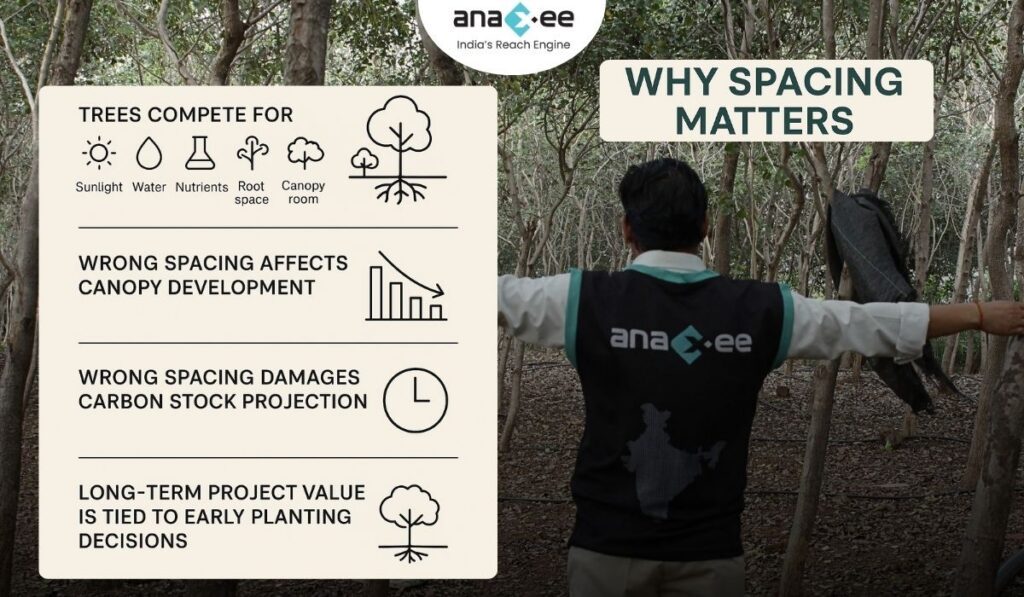
Trees are not passive. They don’t grow politely. They battle—quietly, consistently—for the basics of life:
- sunlight
- water
- nutrients
- root space
- canopy area
When they stand too close, the stronger one wins, and the weaker ones turn stunted, tilted, or lifeless. You don’t see the failure immediately. But by year two, the signs are everywhere:
- thin stems
- uneven crowns
- early defoliation
- reduced height
- suppression of understory vegetation
And because carbon stock is directly tied to biomass, every wrong spacing decision eats into the project’s carbon numbers. MRV teams end up measuring a canopy structure that doesn’t match the model. Carbon credit issuance gets delayed or rejected. Farmers lose confidence. Investors question the science.
Spacing mistakes do not stay small. They compound.
A carbon project is a 20-year commitment.
If spacing is wrong at the beginning, it continues punishing the project for two decades.
2. Species-Based Spacing: Why One Rule Can’t Fit All
One of the most common field-level mistakes is using uniform spacing. Many workers and farmers assume “2–3 feet idhar-udhar se koi farak nahi padta.” But different species behave differently. Some shoot straight up, some spread wide, some are water-hungry, some take slow, bushy shapes.
Teak & Eucalyptus → ~2 meters spacing
These are upright growers. Their early canopy is small and vertical. They respond well to slightly tight rows because:
- they grow fast
- they compete vertically, not horizontally
- their timber value increases with straight stems
- closer spacing encourages height growth
Too wide spacing wastes land. Too tight spacing produces extremely thin, weak stems.
2 meters is a sweet spot for timber + biomass.
Mango, Guava & Fruit Trees → 3 to 3.5 meters spacing
Fruit species need space. Their branches extend outward. Their roots search laterally. Their fruiting depends on sunlight hitting the canopy from all sides.
Tighter spacing means:
- less fruit
- disease susceptibility
- poor branching
- weak yields
- farmer dissatisfaction
Fruit trees planted at 3 to 3.5 meters grow stronger, produce better yields, and survive longer. Agroforestry only works when farmers actually earn—spacing controls this.
Why the difference?
Simple biology:
- Timber species = vertical growth + narrow crown
- Fruit species = horizontal crown + wider root system
- Timber needs density; fruit needs light
- Timber races upwards; fruit grows outward
Spacing respects species behaviour. Ignoring it guarantees long-term loss.
3. The Most Common Spacing Mistakes Seen in Indian Agroforestry Projects
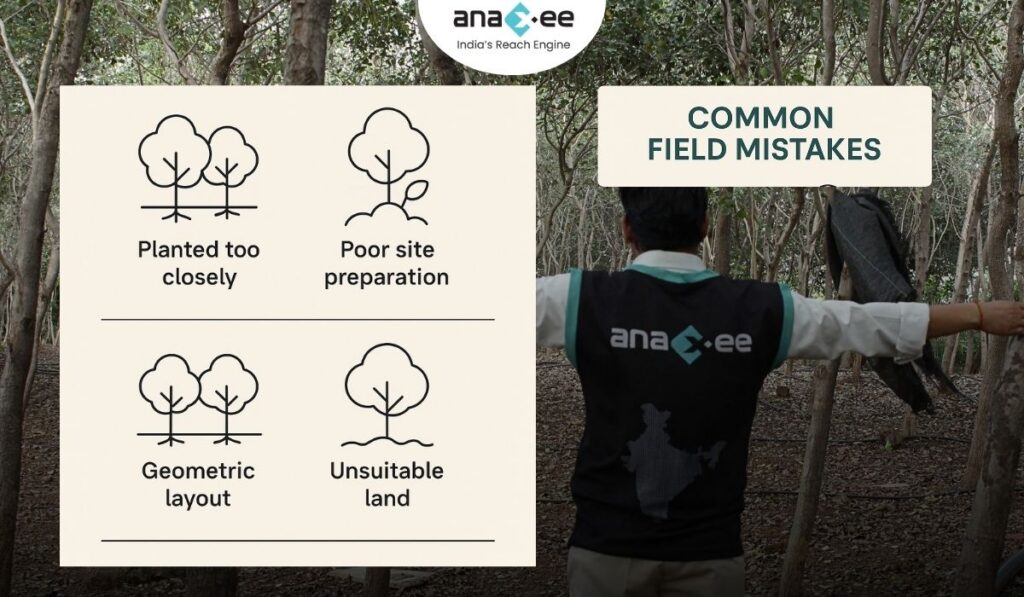
Across states—MP, UP, Maharashtra, Assam, Odisha—the mistakes repeat themselves. And they repeat because plantation days are chaotic, labour-driven, and poorly supervised.
Here are the patterns we see:
1. Random gaps created by daily labour
Workers eyeball distances. Precision is rare unless someone supervises every row.
2. The “sab badha ho jayega” assumption
Many people believe trees are resilient enough to adjust. They are not.
3. No understanding of species
Fruit trees get the same spacing as eucalyptus. Vice versa. This destroys both.
4. One spacing rule used everywhere
From rocky land to fertile black soil, from Kerala rainfall to Bundelkhand dryness—same numbers. This is a planning disaster.
5. Farmers overplant expecting higher yields
Planting 300 saplings on land meant for 150 looks great on Day 1.
By Year 2, most are dead.
These mistakes don’t just affect carbon growth—they break trust. Farmers lose faith. Developers face pressure. Projects lose credibility.
4. Consequences of Wrong Spacing
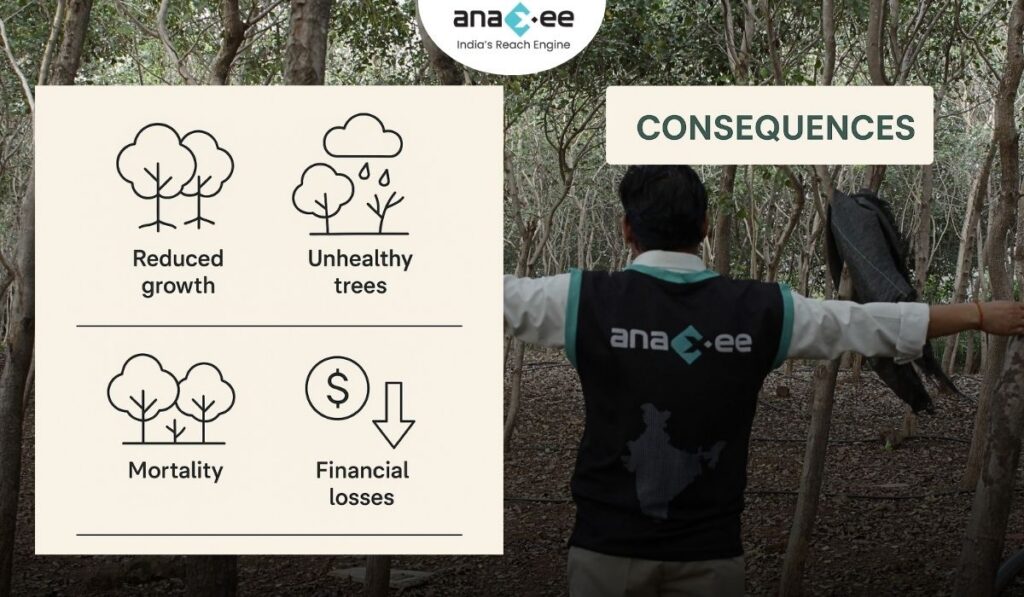
If spacing is wrong, the project begins slipping from Day 1. The consequences are harsh and almost impossible to reverse.
1. Only one tree survives; others die early
Competition eliminates weaker saplings.
2. Fruit trees stop fruiting
Shaded canopies destroy yields. Farmers hit financial loss, leading to disengagement.
3. Stunted growth = lower biomass
Thin stems, low heights, and weak crowns reduce carbon sequestration.
4. Carbon model becomes inaccurate
Your growth curve assumptions fall apart. Verifiers flag inconsistencies.
5. Replantation needed after 2–3 years
This doubles cost and destroys project efficiency.
6. MRV audits fail
Crown diameter, tree height, and spacing values don’t match the projected model. This alone can halt credit issuance.
Spacing failure is not a plantation issue — it’s a carbon failure, farmer failure, and economic failure.
5. Land, Soil, and Climate Change Spacing — India Is Too Diverse for One Recipe
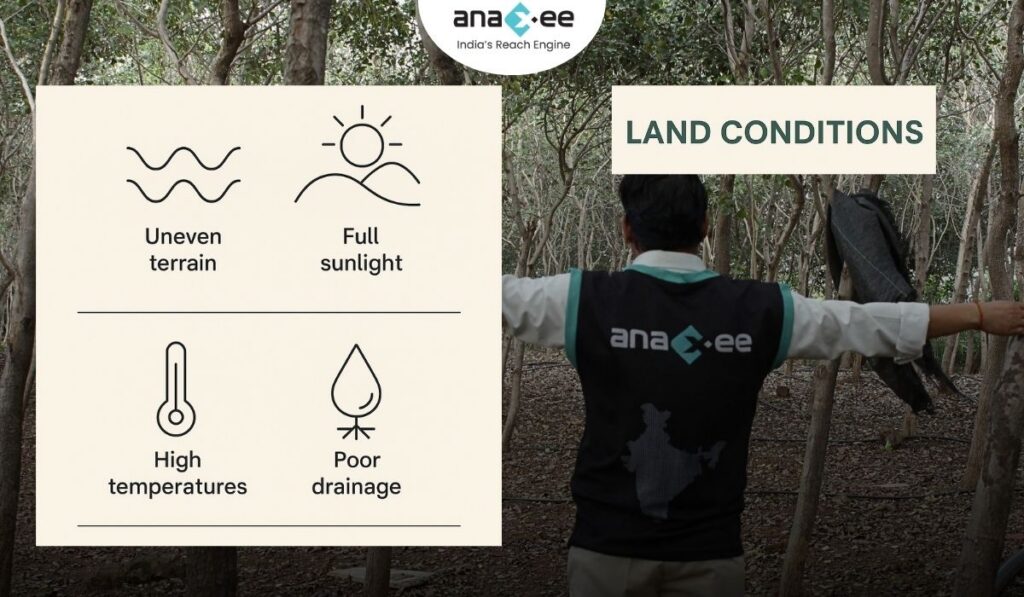
Spacing is not a universal formula. It must adapt to ground conditions.
Pathreeli (rocky) land
Shallow roots struggle. Wider spacing is essential.
Shallow soil
Roots can’t anchor deeply; horizontal competition increases.
High rainfall zones (Kerala, Assam)
Trees grow faster and wider. Spacing must increase.
Dry zones (MP, Rajasthan)
Water scarcity means trees need extra distance to prevent competition.
Soil fertility
Black cotton soil allows slightly closer planting, sandy soil does not.
Water availability
Where irrigation is limited, spacing must be widened.
Slope and erosion zones
Root anchoring becomes critical. Crowding accelerates erosion.
What works in Central India fails in the Northeast.
What succeeds in Kerala fails in Bundelkhand.
Spacing must be adapted, not copied.
6. Why Poor Spacing Is the #1 Reason Agroforestry Carbon Projects Fail
After reviewing several plantations across India, one conclusion stands firm: spacing is the most common reason agroforestry carbon projects fail, even when funding, intention, and community support are strong.
Here’s why:
- Farmer incentives collapse
- Survival rate drops sharply
- Carbon sequestration reduces
- MRV becomes complicated
- Plantations require rework
- Investor confidence weakens
- Carbon issuance gets delayed
Projects rarely fail in year 7.
They fail in year 0 — at the moment of planting.
7. What Happens When Spacing Is Done Right
Spacing is not an operational detail. It is a performance multiplier.
Correct spacing leads to:
Better canopy development
Trees grow with symmetrical, full crowns.
Higher survival
Less competition means more healthy trees.
Better farmer income
Fruit trees give higher and consistent yields.
Predictable carbon stock
Biomass models match MRV assumptions.
Lower long-term cost
No replantation or corrective interventions.
Permanence for 20+ years
Healthy trees stay productive longer.
Spacing is strategy, not measurement.
8. How Anaxee Ensures Spacing Discipline Across Thousands of Acres
Anaxee’s approach blends tech with last-mile execution. Spacing is not left to chance.
1. Digital Runners capture land, soil, and spacing insights before planting
They record species selection, slope patterns, and natural constraints.
2. Training for farmers and labourers
Spacing is explained through practical demos, not manuals.
3. Every sapling is geotagged with spacing validation
We store exact coordinates and distances between trees.
4. Digital MRV tracks canopy development
We monitor growth patterns to verify spacing outcomes.
5. Transparency for developers and investors
They see actual plant-level evidence mapped on dashboards.
6. Continuity for decades
Spacing discipline ensures that growth models remain accurate for 10–20 years.
7. Tech + Execution = Reliable Climate Infrastructure
This is how projects avoid early failure and build long-term value.
Final Thoughts
Tree spacing sounds like a small technical detail. In reality, it is the backbone of agroforestry success. It determines survival, income, biomass, canopy, and carbon accuracy. Most project failures start with simple spacing errors that go unnoticed during planting.
The reality is clear:
Projects don’t fail in year 7.
They fail in year 0 — at the moment of planting.
Spacing decides the future.
Spacing decides carbon.
Spacing decides trust.
And in agroforestry, the difference between success and collapse is sometimes just a few feet.
About Anaxee:
Anaxee is building the Climate infrastructure platform that helps Carbon Project developers and Climate investors maintain continuity of their project over its lifetime. From field data to verified credits. They believe the future of carbon projects lies in trust, transparency, and technology working together.
Anaxee Digital Runners helps in implementation of large-scale, country-wide, climate and Carbon Credit projects across India. Anaxee focuses on Nature-Based Solutions (NbS) and community-driven interventions, including agroforestry, regenerative agriculture, improved cookstoves, solar devices, and clean water systems.
Anaxee’s “Tech for Climate” infrastructure integrates a tech-enabled, feet-on-street network with digital MRV (Measurement, Reporting, and Verification) systems to ensure transparency and real-time validation for every carbon project. By combining data intelligence with local execution, Anaxee enables corporates, investors, and verifiers to trust the integrity, additionality, and traceability of each carbon credit. This approach bridges the gap between communities and global carbon markets, advancing scalable and verifiable climate action across India.