

The Great ESG Rethink
For the last decade, “ESG” has been the corporate world’s favorite acronym. Environmental, Social, and Governance metrics became the go-to framework for evaluating how responsible a company was. If you were a CEO, investor, or board member, ESG was in every presentation, every shareholder letter, every pitch deck.
But something is shifting. The world is realizing that ESG has turned into an industry of checklists, ratings, and glossy reports — often disconnected from what truly matters: outcomes that improve lives and safeguard the planet.
According to McKinsey’s Beyond ESG study, the median large corporation today monitors about 100 ESG-related KPIs — a 30% increase since 2018. Yet public trust and visible impact have not kept pace. ESG fatigue is setting in. In the U.S., shareholder proposals on ESG actually declined in 2025. Even the number of media mentions, which exploded from 5,000 in 2014 to 300,000 in 2024, has begun to dip.
We’ve reached a breaking point. The question is no longer whether companies should care about sustainability — but how they can make their impact real, measurable, and sustainable in business terms.
And that’s exactly where India’s corporate landscape stands today.
The Compliance Trap
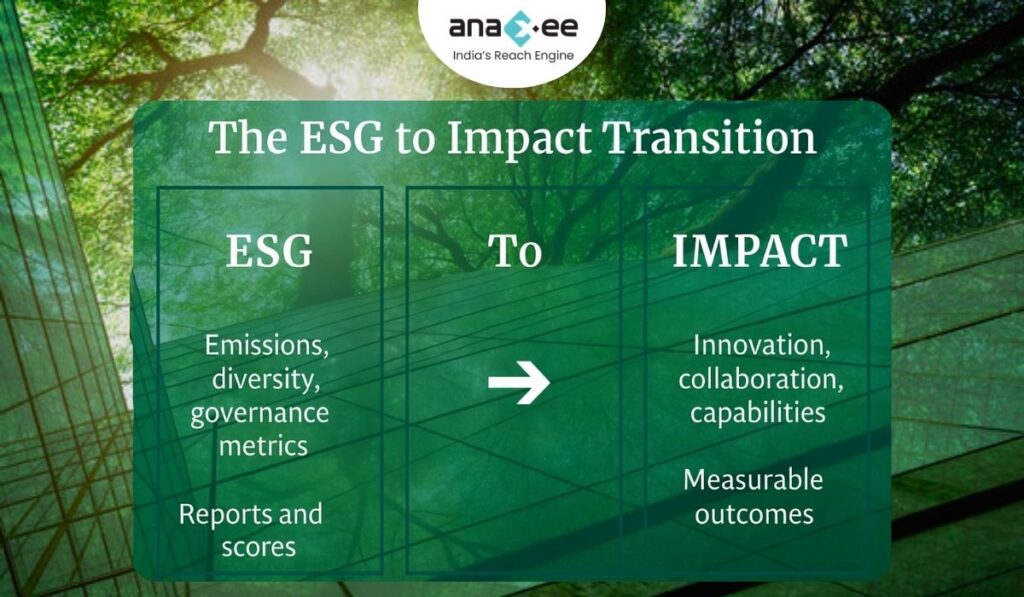
Let’s be honest — ESG, as practiced today, is often about paperwork. Reports. Certifications. Scores.
The European Union is enforcing its Corporate Sustainability Reporting Directive (CSRD). The U.S. is scaling back reporting requirements. India is introducing its BRSR Core framework, pushing listed companies to disclose deeper sustainability metrics. These are important steps, but they remain primarily compliance-oriented.
Corporates are caught in a strange loop: do just enough to stay compliant, but not enough to change the real economy.
The result? Fragmented metrics, inconsistent ratings, and minimal clarity. One McKinsey analysis found the average correlation between ESG ratings across agencies to be just 0.38 — meaning two rating systems can see the same company in completely different lights.
Numbers multiply, but meaning gets lost. CEOs track emissions, diversity ratios, and waste data — but few can answer the simplest question:
“How has our business tangibly improved society this year?”
That’s the core failure of checklist ESG — it measures inputs, not outcomes.
The Shift from Reporting to Responsibility
The starting point for reforming ESG is acknowledging a basic truth: companies already shape society far more than they realize.
Every rupee a company earns gets distributed across society in multiple ways — through wages, supplier payments, taxes, dividends, and investments. McKinsey’s analysis shows that $0.83 of every $1 of revenue generated by a large company flows back to employees, suppliers, and customers. Businesses already fund livelihoods, innovation, and infrastructure — but often unintentionally.
What’s missing is intentionality.
When companies align their core capabilities — R&D, operations, technology — with societal needs, the results can be transformative. Think of Reliance Jio, which didn’t just sell data; it democratized internet access in India, unlocking digital participation for hundreds of millions. Or Zipline, which used drones to deliver life-saving blood supplies across Rwanda — cutting delivery time from hours to minutes.
These are not ESG “projects.” They’re examples of how business innovation can solve societal challenges at scale.
The lesson: when companies move from compliance-driven ESG to capability-driven responsibility, they stop treating impact as charity — and start treating it as strategy.
What Companies Are Getting Wrong About ESG
The biggest misconception about ESG is that it’s one big umbrella that every company must fit under. That’s impossible.
McKinsey’s data shows that a large company can realistically make a meaningful difference on just one to three of the 18 major societal issues analyzed — from climate change and biodiversity to education and health.
Trying to tackle all 18 dilutes focus, confuses strategy, and wastes capital. This is what the report calls the “Horses for Courses” approach — companies must focus where they’re best suited to run.
For instance:
- Healthcare providers could drive change on maternal health, mental health, and noncommunicable diseases.
- Construction and engineering firms could tackle housing and water infrastructure.
- Telecom and digital service providers could close the internet access gap.
Each sector has its “course” — and success depends on matching the right “horse.”
The Indian Context: From BRSR to Real Impact
India is an interesting case study. On one hand, regulatory momentum is building — the Business Responsibility and Sustainability Report (BRSR) is now mandatory for top listed companies. The Carbon Credit Trading Scheme (CCTS) is linking corporate emissions to tradable carbon assets. CSR laws ensure companies allocate at least 2% of profits toward social projects.
On paper, India is an ESG success story.
But on the ground, impact remains inconsistent. Reports abound; outcomes lag. Corporates often outsource CSR to third-party NGOs without data visibility. ESG becomes a communication exercise, not a capability-building one.
That’s why the next wave of sustainability in India won’t come from compliance — it will come from execution.
This is where Anaxee’s model is instructive. We’re not a consultancy writing reports; we’re a tech-enabled field network executing real projects — geotagging trees, verifying plantations, training rural communities, and tracking survival rates through dMRV tools.
We call it:
Tech for Societal Good.
That’s how companies can move beyond ESG in practice — by embedding measurable, technology-backed actions into their business DNA.
Case Study: When Innovation Meets Policy
One of the most striking lessons from Beyond ESG is how progress happens — not through charity, but through iterative collaboration between innovation and policy.
Let’s look at a few historical examples that prove the point.
- Leaded Gasoline → Unleaded Transition (1970s–1990s)
Innovation: Catalytic converters developed by automakers.
Policy: U.S. EPA phased out leaded fuel.
Result: Lead levels in U.S. children dropped by 94%. - Seat Belts → Auto Safety Revolution (1950s–1980s)
Innovation: Car companies improved design and made safety a selling point.
Policy: State mandates, insurance incentives.
Result: U.S. road fatalities fell dramatically. - Ozone Layer → CFC Ban (1980s–2000s)
Innovation: Companies developed ozone-safe refrigerants.
Policy: Montreal Protocol enforced global compliance.
Result: The ozone hole began shrinking — one of the few global environmental success stories.
In each case, progress didn’t come from regulation alone. It came from the dance between policy and innovation — between government intervention and business adaptation.
That’s the playbook for ESG 2.0.
Why Innovation Matters More Than Reporting
Consider the example of maternal health in Africa, highlighted in the report. In Rwanda, Zipline’s drones now deliver blood and vaccines to rural hospitals. What began as a startup pilot became a national health infrastructure when the government signed a long-term contract and global donors co-financed the rollout.
The result:
- Infant deaths reduced sharply.
- Vaccine delivery cost fell by 85%.
- Each dose now costs just $0.24, compared to over $1.50 by motorbike.
It’s not about drones. It’s about collaboration, incentives, and systems that align business goals with human needs.
In India, a similar transformation happened with Reliance Jio. Between 2016 and 2023, India’s internet penetration skyrocketed from 27% to over 70%. Free trials, affordable handsets, and policy support like Digital India and BharatNet turned data into a public utility.
The pattern repeats: business innovation + public policy = exponential social impact.
The Economics of Impact
Now, let’s talk about money — because societal good is only sustainable when it makes economic sense.
McKinsey’s research estimates that solving 18 global societal issues — from pollution to health and education — would require $6 trillion in annual investments. That’s roughly three times the total profits of Fortune Global 500 companies.
But here’s the twist: the long-term economic benefits would outweigh the costs. Issues like malnutrition or clean water have benefit-to-cost ratios of 10–40x. Even low-return interventions, like infrastructure upgrades, yield at least 2x in economic returns.
The catch? Most benefits accrue over decades, not fiscal quarters. And that’s where corporate incentives misalign.
Quarterly reporting cycles discourage long-term investments. Impact requires patience — and patient capital.
India is uniquely positioned here. Through mechanisms like the Green Credit Programme, CCTS, and CSR-linked blended finance, India can structure long-term payoffs for societal interventions. Private capital, public funds, and carbon markets can converge — turning ESG from a cost center into an investment thesis.
A Capabilities-Based Future
Moving “Beyond ESG” means changing the question companies ask.
Instead of:
“What ESG metrics should we report next year?”
Ask:
“Where are we uniquely capable of solving a societal problem?”
That’s a fundamentally different mindset. It doesn’t discard ESG — it deepens it.
For example:
- A logistics firm might decarbonize supply chains through green trucking.
- A financial institution might expand microcredit to underbanked communities.
- A digital company like Anaxee might track carbon sinks and rural impact data at scale.
Each action uses existing strengths to create measurable societal value — no greenwashing, no tokenism.
McKinsey calls this the “Horses for Courses” approach. It’s not about doing everything for sustainability; it’s about doing something that truly counts.
From ESG to ESG+T: Adding Technology to the Equation
Here’s the frontier that’s still underappreciated — technology as the multiplier of societal impact.
Tech converts intention into measurement.
It converts anecdotes into data.
And most importantly, it converts pilot projects into scalable systems.
At Anaxee, we’ve seen this first-hand through our Digital Runners Network — over 25,000 on-ground data collectors who digitize information from India’s remotest districts. Using geotagging, satellite validation, and AI-powered dMRV (Digital Measurement, Reporting & Verification), we’re proving that corporate commitments can be measured, verified, and scaled across millions of data points.
This is what ESG needs now — execution intelligence. The ability to see what’s working, what’s not, and where to allocate resources efficiently.
Data transparency doesn’t just reduce fraud; it accelerates trust. It bridges the gap between investors and impact on the ground.
In the next five years, the most valuable ESG metric won’t be a disclosure score. It will be the trust score — the confidence that claimed impact is real.
A Practical Roadmap for Indian Companies
If Indian corporates want to move beyond ESG checklists, here’s a realistic roadmap:
- Pick Your Battles.
Choose 1–3 issues that align with your business strengths. Avoid the temptation to “do everything ESG.” - Build Capabilities, Not Committees.
Create internal teams that can implement and monitor impact, not just report it. - Embed Tech from the Start.
Use geotagging, IoT, blockchain, and AI to track progress and validate outcomes. - Form Coalitions.
Partner with implementation players like Anaxee, policy institutions, or local NGOs. Systemic problems require shared solutions. - Redefine ROI.
Treat societal impact as an asset class — measurable, tradable, and monetizable through carbon markets or SDG-linked finance. - Communicate Honestly.
Move from glossy ESG brochures to transparent dashboards showing field data. - Stay Long-Term.
Real impact takes years, not quarters. Stay invested in capability building.
This approach doesn’t replace compliance; it transcends it.
Why This Matters Now
Globally, ESG is in flux. Investors are rethinking their models, regulators are re-drawing boundaries, and consumers are demanding proof.
In India, the stakes are even higher:
- The country is targeting Net Zero by 2070.
- 400 million people still depend on rural livelihoods.
- Corporate India is expected to be both profitable and purposeful.
This dual expectation — to deliver shareholder and societal value simultaneously — will define the next decade of business leadership.
Companies that adapt early will build reputational capital that lasts. Those that stay stuck in compliance mode risk being irrelevant in a market where “impact credibility” is the new brand equity.
Anaxee’s View: The Future Is Measurable
At Anaxee, we’re seeing the future unfold on the ground every day.
When our Digital Runners geotag a sapling in Madhya Pradesh,
When our dashboards verify survival rates in Bund plantations,
When our tech tracks livelihood improvements in a forest-fringe village —
We’re not collecting data; we’re building proof of progress.
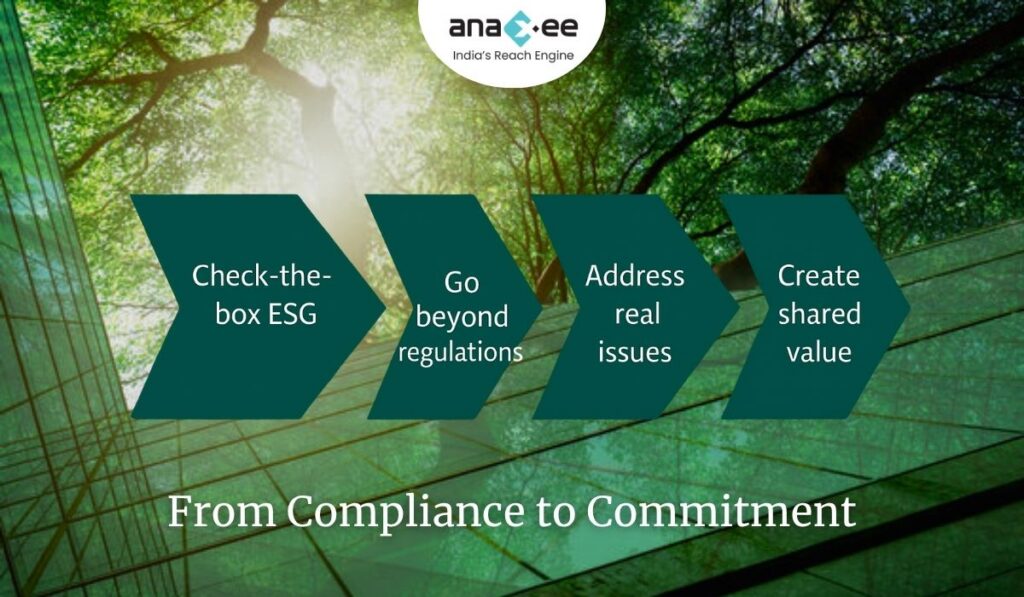
That’s the evolution ESG needs: from checklists to capabilities, from metrics to mechanisms, from reports to results.
We believe the next generation of corporate leaders will be measured not by how much they report — but by how much they deliver.
Conclusion: The Era of Execution
The ESG movement was born out of good intentions — transparency, accountability, sustainability. But as it matured, it became bureaucratic. The next phase must bring ESG back to its core purpose: solving real problems.
That’s what “Beyond ESG” really means.
It’s not anti-ESG. It’s post-ESG — a more practical, data-driven, impact-focused evolution of the same ideal.
For Indian companies, this is a rare opportunity to lead, not follow. To move from compliance to contribution. To go beyond the dashboard and into the field.
And as India transitions into a carbon-conscious, digitally verified economy, the companies that will thrive are those who understand this one truth:
The future of ESG is not in the report — it’s in the results.




Great perspective — love how this article pushes Indian companies to go beyond ESG checklists and focus on real, measurable societal impact that truly moves the needle.