
For years, marketing conversations revolved around one central question:
How much should we spend on Google and Meta this quarter?
That question still exists. But it’s no longer the most important one.
Today, a quieter, more uncomfortable question is taking its place:
What do we do when paid ads stop delivering meaningful growth?
Because for many brands, that moment has already arrived.
When more spending doesn’t mean more growth
At some point, every scaling brand notices the pattern.
You increase ad budgets.
You test new creatives.
You optimise landing pages.
You retarget harder.
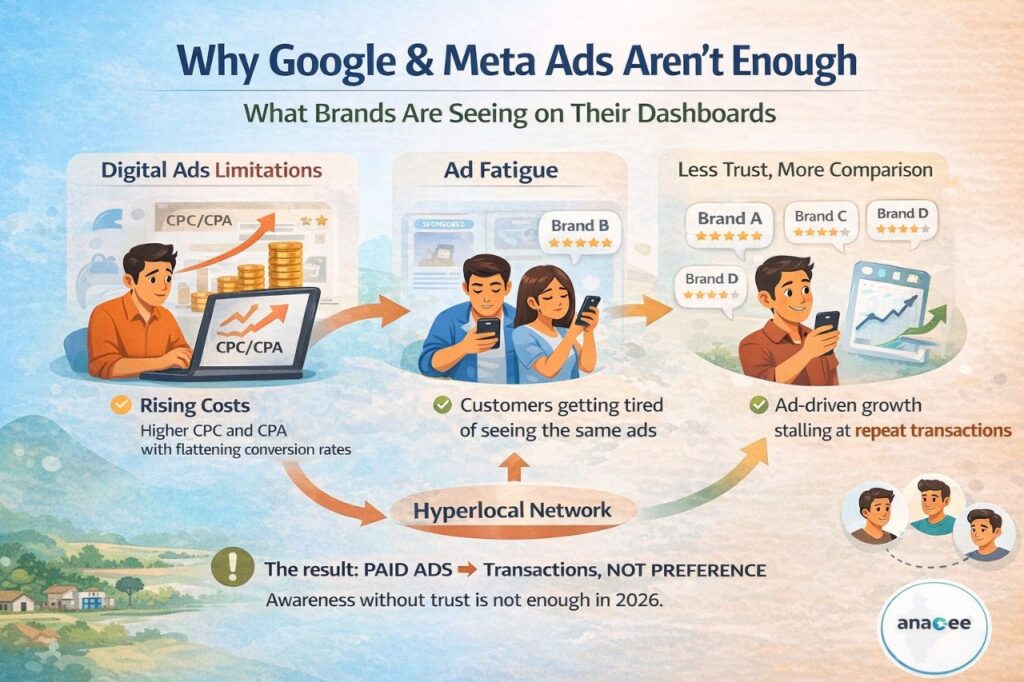
And yet, results plateau.
The dashboards still show clicks. Impressions look healthy. Leads keep coming in.
But conversion quality drops, repeat purchases slow, and customer acquisition costs creep upward.
This isn’t a failure of execution.
It’s a limitation of the channel itself.
Google and Meta are powerful. But they are not designed to do everything.
What Google and Meta are actually good at (and what they aren’t)
Let’s be clear: digital ads aren’t broken.
They are excellent at:
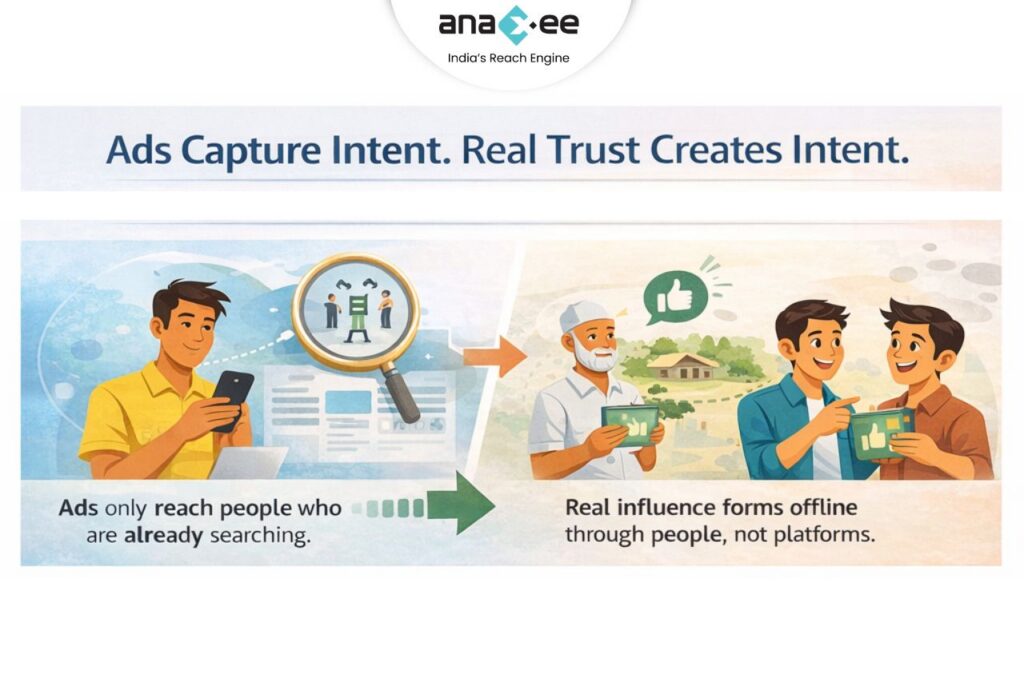
- Capturing existing demand
- Serving customers who already have intent
- Driving short-term actions
Where they struggle is creating belief.
Ads can introduce a brand.
They can remind.
They can nudge.
But they rarely answer the most important question in a buyer’s mind:
“Will this actually work for someone like me?”
That answer doesn’t come from a banner or a reel.
It comes from people.
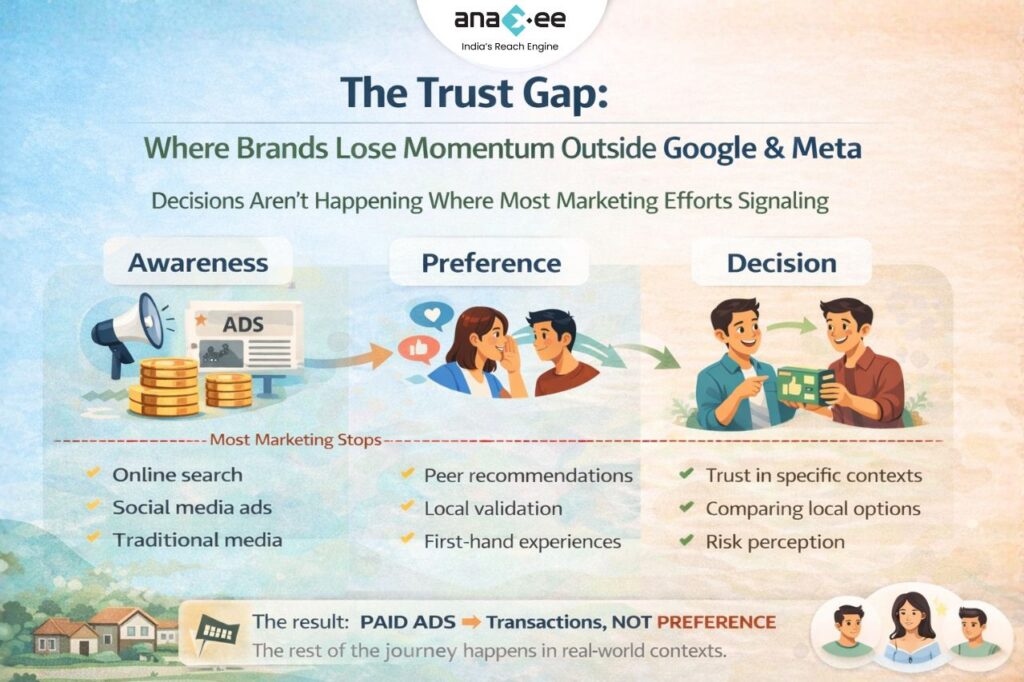
The trust gap most marketing strategies ignore
Most purchase decisions don’t begin on a search engine.
They begin:
- In conversations
- Through peer validation
- At the point of recommendation
Especially in markets where:
- Choices are many
- Price differences are small
- Risk feels personal
In these environments, trust travels faster than advertising.
Yet most marketing plans are built around broadcasting messages, not activating trust.
That’s the gap where brands start losing relevance — even with strong ad spends.
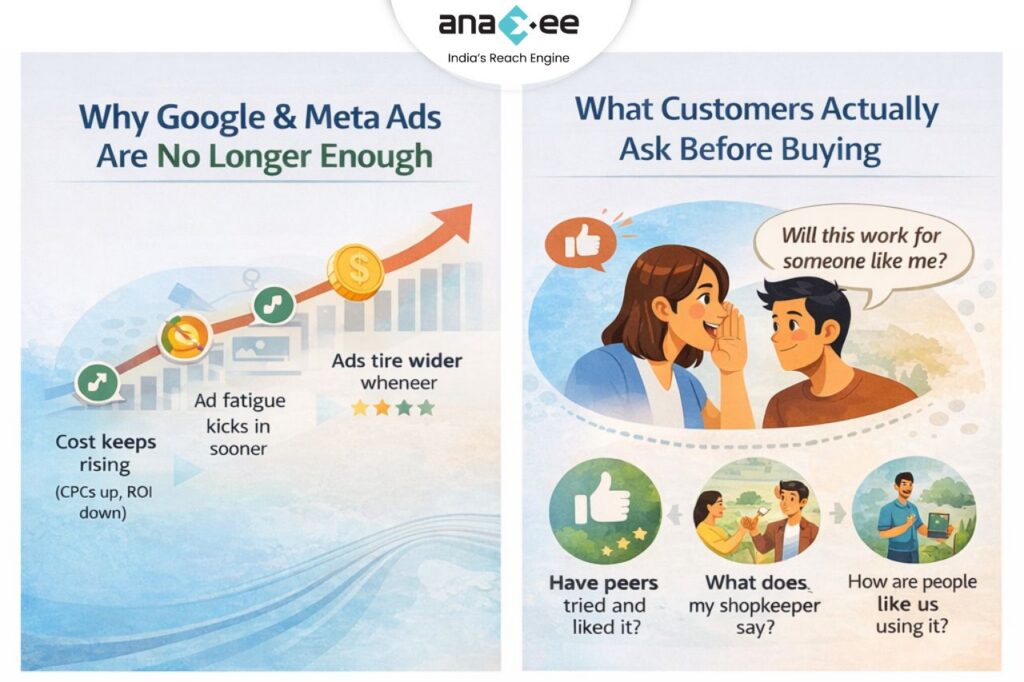
Why traditional marketing doesn’t solve this either
When digital ads start underperforming, brands often turn back to traditional media.
Print. Outdoor. Events. Hoardings. Dealer branding.
These channels still have value, but they come with familiar problems:
- High cost with unclear attribution
- Broad reach, low precision
- Visibility without engagement
They create presence, but not necessarily preference.
And in today’s environment, presence alone is not enough.
The real shift happening in modern marketing
Smart brands are not choosing between online and offline.
They’re asking a more strategic question:
Where is influence actually formed — and how do we show up there?
The answer is increasingly clear:
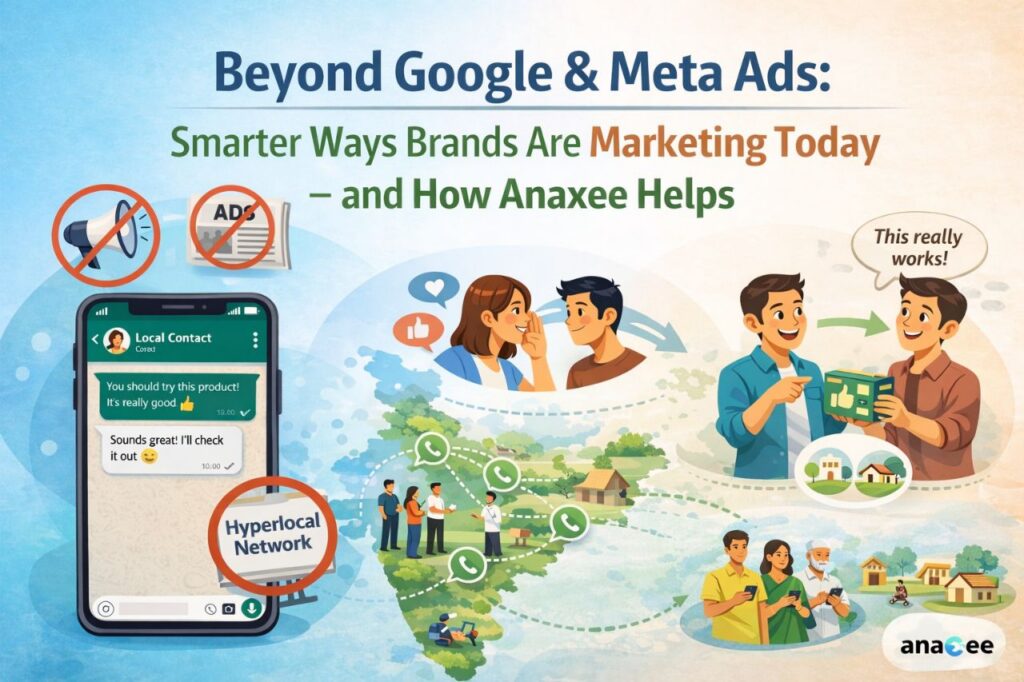
- Influence forms locally before it scales widely
- Recommendations matter more than recall
- Adoption spreads through networks, not impressions
This is why we’re seeing a shift from campaign-led marketing to system-led marketing.
Not louder.
More embedded.
The rise of hyperlocal, trust-led marketing
Hyperlocal marketing isn’t about geography alone.
It’s about context.
- Who influences whom?
- Where do buying decisions get validated?
- What signals make a recommendation feel safe?
In many categories — especially in non-metro, semi-urban, and rural markets — trust doesn’t come from brands directly.
It comes from familiar voices, repeated exposure, and shared experiences.
When marketing aligns with this reality, demand starts to move differently.
Not in spikes.
But in steady, compounding waves.
Why this approach can’t be “copied” easily
If hyperlocal, trust-led marketing works so well, why isn’t everyone doing it?
Because it’s operationally hard.
It requires:
- Consistency across thousands of micro-markets
- Deep understanding of local behavior
- Systems that work quietly over time
- Execution discipline beyond creatives and media plans
This is not something you switch on for a quarter.
It’s something you build.
Where Anaxee helps — without adding noise
Anaxee’s role in this shift is not to replace digital ads or traditional media.
It’s to solve the part they don’t reach.
Brands come to Anaxee when they notice:
- Awareness exists, but preference doesn’t
- Products are known, but not recommended
- Campaigns run, but demand doesn’t sustain
Instead of pushing more messages, Anaxee helps brands establish presence inside real influence networks.
Not by shouting louder.
By showing up where decisions are already being shaped.
Why this matters more in today’s markets
Modern consumers — especially outside the top metros — are not under-informed.
They are cautious.
They compare.
They ask around.
They observe before committing.
Marketing that ignores this behaviour ends up feeling disconnected.
Marketing that respects it becomes part of the decision process.
That’s the difference between visibility and impact.
From campaigns to continuity
One-off campaigns create spikes.
Systems create momentum.
The brands winning today are not the ones running the most ads —
they’re the ones building continuity in how their brand is experienced.
Repeated validation beats repeated impressions.
That’s the principle behind smarter marketing today.
Why this doesn’t show up in dashboards immediately
One reason many brands hesitate to invest beyond ads is impatience.
Hyperlocal, trust-based systems don’t always show instant ROAS.
What they show instead:
- Stronger retailer pull
- Faster product movement over time
- Organic recommendation loops
- Lower resistance at the point of sale
These are leading indicators of sustainable growth — even if they don’t fit neatly into a weekly report.
Marketing that works even when spend slows down
Perhaps the biggest advantage of moving beyond ad dependency is resilience.
When your brand is recommended, not just advertised:
- Demand doesn’t collapse when budgets tighten
- Competition on price becomes less aggressive
- Loyalty becomes harder to disrupt
This is where marketing stops being an expense and starts becoming an asset.
The question brands should be asking now
It’s no longer:
“Which platform should we advertise on next?”
It’s:
“How do we earn trust at scale, not just attention?”
That question leads to very different marketing decisions.
And that’s where Anaxee helps brands rethink growth — not as a campaign problem, but as a system problem.
Closing thought
Google and Meta will continue to be important.
But the brands that win in the next phase won’t rely on them alone.
They’ll invest in:
- Trust before transactions
- Presence before promotion
- Systems before campaigns
And they’ll quietly build demand where it actually begins.
For further Info connect with our team at sales@anaxee.com