

Introduction
Navigating carbon credits is often seen as a maze — heavy with technical jargon, multiple methodologies, rigorous validations, and shifting regulatory frameworks. Many organizations start with high hopes of leveraging carbon credits for both climate impact and revenue, only to get bogged down in feasibility studies, consultant stacks, and legal uncertainties.
At Anaxee, we believe that clarity comes from doing. Strategy and advisory have their place — but real progress occurs when you roll up your sleeves and implement. In this blog, we will walk you through the journey from complexity to clarity, showing how a focus on hands-on execution can turn carbon credit ambition into scalable growth.
We’ll cover:
- Why carbon credits feel so complex
- Typical breakdowns between strategy vs execution
- How an implementation-first approach moves you forward
- A phased roadmap you can adopt
- Pitfalls to watch out for
- Real-world case illustration
- How Anaxee positions itself uniquely
- Key takeaways and next steps
By the end, you’ll see how implementation is the missing link that turns carbon credit theory into action — and how Anaxee can be your partner in that journey.
1. Why Carbon Credits Are So Hard- and Where Many Projects Stall
Carbon credit projects are complex for good reason: they must maintain scientific credibility, regulatory compliance, and financial viability simultaneously. Below are key sources of friction:
a) Multiple registries and methodologies
Each registry (Gold Standard, Verra, etc.) has its own rules and methodological standards. A methodology may run dozens or hundreds of pages. Projects must adhere strictly; small deviations can lead to rejection or devaluation.
b) Disconnect between strategy and ground realities
Many organizations hire high-level consultants to define carbon strategies, but those strategies then get handed off to technical teams (or external contractors). The gap between what was planned and what can be built is where many projects stall.
c) High upfront costs, fragmented advisory stack
Life Cycle Assessments (LCAs), baseline studies, monitoring tools, validation, stakeholder engagement — each often handled by a different consultant. If the costs balloon or timelines slip, momentum is lost.
d) Risk of misalignment
You may end up with a plan that’s scientifically sound on paper but unrealistic in execution (due to local constraints, lack of capacity, weak data collection systems, etc.). When things deviate, credibility suffers.
e) Unclear accountability and ownership
Who is responsible for integration, coordination, and ensuring all components interact perfectly? Without a single owner, coordination overhead skyrockets.
Because of these interlocking challenges, many projects stall in “analysis paralysis” or waste time coordinating dozens of consultants.
2. Strategy Versus Implementation — Why Many Carbon Projects Fail to Launch
To see why “doing” is crucial, let’s contrast two models:
| Feature | Strategy / Advisory Approach | Implementation-First Approach |
|---|---|---|
| Who leads | Consultants, analysts | Practitioners, engineers, execution teams |
| Output | Roadmaps, frameworks, reports | Actual deployed systems, data pipelines, integrations |
| Engagement | Short term, phased | Ongoing, adaptive, execution-oriented |
| Risk | Plans misaligned with ground realities | Early failures are surfaced, iterated, corrected |
| Cost profile | Often front-loaded with heavy consulting fees | Spreads cost across build phases and offers tangible deliverables early |
| Accountability | Diffuse across many parties | Ownership consolidated in implementation partner |
Many organizations stop at “strategy” because it’s safer and less risky — but the real value lies in seeing those strategies come alive. Without execution, they remain theoretical.
For carbon credits, that gap is especially acute: an LCA, data tool, or monitoring system that works in one geography or project may fail in another. Only by doing can you discover those gaps and iterate.
3. Why Implementation Matters: Bridging Ambition and Reality
An implementation-first mindset — anchored in delivering working systems — unlocks multiple advantages:
3.1 Validated assumptions early
Instead of spending a year studying every variable, you build prototypes or minimum viable systems. These surface real-world constraints (data gaps, sensor issues, computational lags) earlier.
3.2 Integrated systems from day one
Rather than stitching outputs from multiple independent consultants, you can integrate the LCA, GIS, sensor monitoring, registry reporting, and dashboards into a coherent system from the start. That reduces friction, mistakes, and handoffs.
3.3 Scalability baked in
When you build modular, reusable components (for example, data ingestion pipelines, emission factor modules, reporting templates), future expansions or new geographies become easier.
3.4 Real deliverables = real momentum
Each milestone gives tangible outputs — software modules, dashboards, validated baselines — which maintain stakeholder confidence and internal momentum.
3.5 Single accountability
A single implementation partner takes responsibility for end-to-end delivery. You don’t end up managing 5–10 vendors; you manage one partner with deliverables and SLAs.
In short: Implementation is not just “putting strategy into action” — it’s the crucible in which strategy is tested, refined, and made resilient.
4. A Phased Roadmap to Carbon Credit Implementation
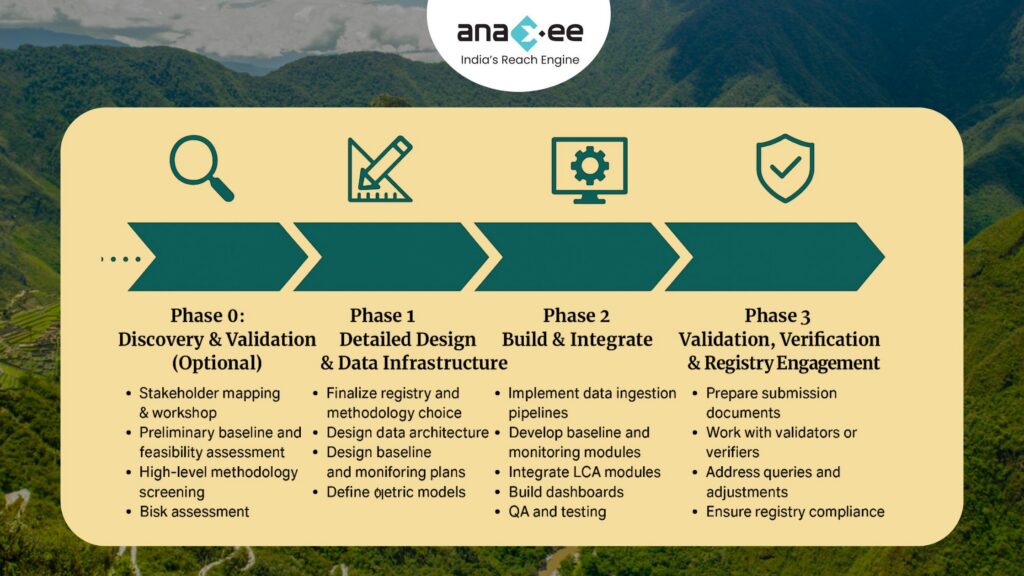
Below is a practical phased roadmap you can adopt or tailor. It assumes you already have some preliminary feasibility or interest; if you don’t, you may begin with a short “discovery” pre-phase.
Phase 0: Discovery & validation (optional)
- Stakeholder mapping & workshop
- Preliminary baseline and feasibility assessment
- High-level methodology screening
- Risk assessment
- Build consensus among internal teams
If this phase is run by the same team that will execute, many assumptions carry forward and you avoid rework.
Phase 1: Detailed design & data infrastructure
- Finalize registry and methodology choice
- Define data architecture (what sensors, data sources, periodicity)
- Design baseline and monitoring plans
- Define metric models (emission factors, leakage, additionality)
- Build or configure LCA tool, GIS or spatial modules
- Define reporting schema
Deliverable: a design package, data system plan, and tool architecture that are ready to be built.
Phase 2: Build & integrate
- Implement data ingestion pipelines (IoT, satellite data, surveys)
- Develop modules: baseline calculator, emissions monitoring, leakage adjustments
- Integrate LCA modules with registries’ templates
- Build dashboards and reporting templates
- QA, validation, internal testing
- Iterative calibration (run pilot data)
Deliverable: a working, tested carbon project software stack tailored to your project.
Phase 3: Validation, verification & registry engagement
- Prepare Project Design Document (PDD) or relevant submission docs
- Work with third-party verifiers or validators
- Address queries, responses, adjustments
- Ensure registry compliance
- Submit and track approvals
Deliverable: registry-accepted carbon credit project.
Phase 4: Monitoring, issuance & scaling
- Operationalize continuous monitoring (sensors, remote data, auditing)
- Automate data uploads, report generation
- Issue credits, handle retirements or sales
- Expand to additional geographies, modalities
- Continuous improvement, model refinements
Deliverable: scalable operations, recurring credit issuance, and a roadmap for expansion.
Throughout phases, maintain feedback loops. When you hit data issues, or registry queries, adapt modules, refine models, and revalidate.
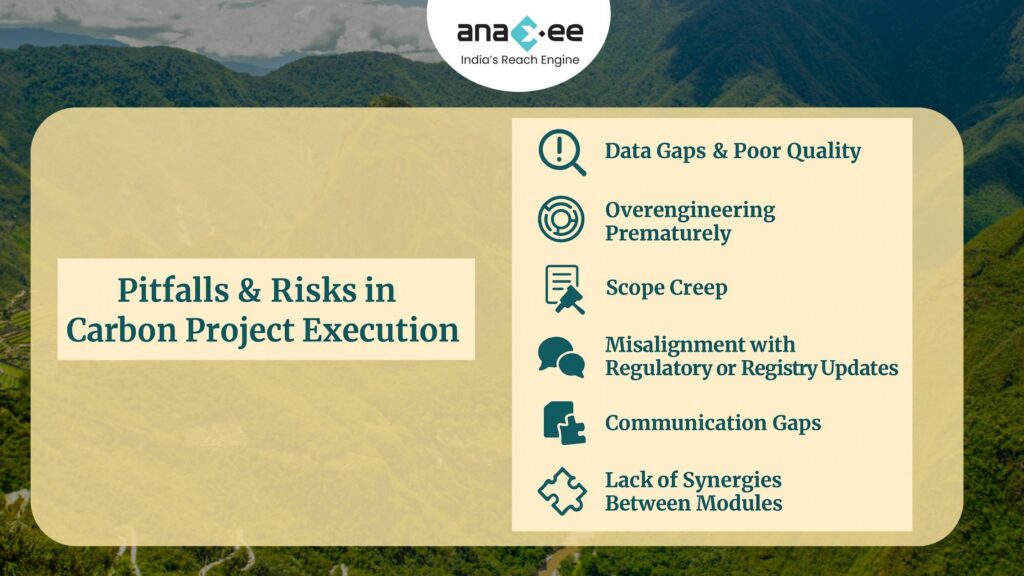
5. Pitfalls & Risks in Carbon Project Execution — What to Watch Out For
Even with a strong implementation partner, several risks can derail progress. Anticipating and managing these is essential.
5.1 Data gaps & poor quality
Often, what looks fine in theory falls apart in the field. If sensor coverage is patchy or data streams drop, your monitoring modules break down. You must build fallback or redundancy strategies (manual surveys, interpolation, quality checks).
5.2 Overengineering prematurely
Trying to build an “ultimate platform” before getting basic functionality working can lead to months of delay. It’s better to start with a minimal viable module, test it, and then scale.
5.3 Scope creep & gold-plating
Requests for additional data, fancy dashboards, extra modules can balloon scope. Without strict change control, budgets and timelines slip.
5.4 Misalignment with regulatory or registry updates
Registry rules evolve. If your methodology is tightly coded, changes might require reworking core logic. You should design modularity and version control to adapt to updates.
5.5 Communication gaps
If the client’s internal team, external auditors, or stakeholders don’t understand data outputs or dashboards, distrust may creep in. Good documentation and training is mandatory.
5.6 Lack of synergies between modules
If components (data, LCA, reporting) are built in silos, integration issues crop up. Interface definitions and consistent data models matter deeply.
5.7 Vendor lock or black-box modules
If critical parts are opaque (you cannot inspect or modify), future changes or maintenance become risky. Favor transparent, modular code and architectures.
By anticipating these, you can build guardrails, fallback paths, and mitigation strategies.
6. Case Illustration (Hypothetical / Adapted)
To make the roadmap concrete, here’s a stylized example inspired by the Offstream / Ground Up case (as in the article you shared). Use this as a template to convert into your own client story later.
Client: EcoSoil Solutions (a startup converting agricultural waste into biochar for smallholder farmers)
Challenge: EcoSoil wanted to monetize through carbon credits but lacked internal capacity. They had partial trials but no system to scale. Their advisory consultants gave a roadmap, but execution was fragmented and slow.
Here’s how Anaxee structured the engagement:
Phase 0 & 1
We conducted stakeholder workshops (farmers, agronomists, local agencies) and did a high-level feasibility check. We then selected the registry (e.g. Verra’s biochar methodology) and designed a hybrid data architecture combining satellite remote sensing, field sensor data, and sample surveys.
Phase 2
We built the data ingestion pipeline, modules for baseline and emission factors, integrated satellite NDVI data, connected IoT sensors for moisture/temperature, and built dashboards for real-time monitoring. We iterated using pilot plots to validate the modules.
Phase 3 & 4
We prepared the PDD, liaised with the validator, responded to queries, and secured registry approval. Then we operationalized continuous monitoring and built a scalable pipeline to onboard more farms.
Outcomes
- The client avoided needing 4–5 separate consultants by having a single implementation partner.
- Time-to-first-credit was reduced by ~40%.
- Data issues were surfaced early, so the system was more robust.
- The client gained investor confidence (because they saw a working system, not just a plan).
- When scaling to new geographies, modules were reused with minimal adaptation.
You can shape this narrative with real numbers, client names (if permitted), and metrics to make it more compelling for your audience.
7. What Makes Anaxee a Unique Implementation Partner
Because you asked me to position this for Anaxee, here are strengths and differentiators you might highlight (you should plug in your actual capabilities):
7.1 Implementation-first philosophy
At Anaxee, we don’t just design; we build. We believe that real learning happens when you execute. That means you benefit from working software early, not just slide decks.
7.2 End-to-end accountability
From data architecture to LCA modules, registry integrations, dashboards, and monitoring — we own the full stack. You don’t have to coordinate multiple vendors.
7.3 Modular, reusable systems
We build tools with versioning, modularity, and adaptability in mind. New projects, geographies, or methodologies can plug in with minimal rework.
7.4 Strong domain partnerships
While we specialize in implementation, we maintain connections with expert domain consultants (LCA specialists, forest ecologists, verification agencies). We can coordinate or integrate those experts as needed — so you get both domain depth and execution strength.
7.5 Transparent processes & training
We don’t build black boxes. We provide training, documentation, and enable your internal teams to understand, audit, and take over parts if needed.
7.6 Agile & iterative practices
We release in sprints, gather feedback, course-correct, and adapt. That reduces risk and keeps the project aligned with evolving needs.
7.7 Focus on outcomes, not just deliverables
We care about credit issuance, verifiable impact, investor confidence, and scaling — not just handing over reports.
You can pepper the blog with short callouts or quotes showing your values, such as “At Anaxee, building a working data pipeline in 4 weeks is more meaningful than drafting a 100-page plan.”
8. Best Practices & Tips for Implementation Success
Here’s a distilled list of practical recommendations (you can turn this into a “Checklist for your carbon project” sidebar):
- Begin with a Minimum Viable Module (MVM) — just enough to test the core functionality
- Use modular architecture so updates don’t require full rewrites
- Establish strong data validation and fallback logic from the start
- Maintain version control and change logs (especially for methodologies)
- Automate as much as possible (data ingestion, reporting, alerts)
- Document assumptions, data sources, and limitations transparently
- Design training and dashboards for non-technical stakeholders
- Build in audit trails (for registry compliance)
- Keep abstraction layers between methodology logic and data pipelines (so methodology changes are easier)
- Use pilot plots or test phases to detect real-world anomalies
- Budget contingency for unexpected data gaps or field issues
- Stay updated with registry and regulatory changes; design modular adaptation paths
9. How to Get Started
If you’re at the point of ambition but still hesitating due to complexity, here’s how to move forward with Anaxee:
- Step 1: Strategy + gap scan workshop (short engagement, ~2–4 weeks): We map your current ready assets and gaps
- Step 2: Implementation engagement: We co-create a phased plan and start building
- Step 3: Scaling support: Once your first credits are issued, we help you scale across geographies, methodologies, or modalities
Because we primarily focus on implementation, our engagements are cost-efficient, focused, and outcome-driven. We can also plug in domain experts as partners (e.g. LCA, validation, ecologists) under a coordinated structure.
If you’d like, I can prepare a one-pager or slide version of this roadmap (with your branding) for your website or sales materials.
10. Key Takeaways
- Carbon credit projects often fail to launch because of overemphasis on planning and fragmentation in execution.
- Implementation is where theory meets reality — building working modules surfaces constraints, drives integration, and preserves momentum.
- A phased, modular roadmap helps manage risk, cost, and adaptability.
- The difference between acceptable and exceptional lies in consolidating accountability, transparency, and iteration.
- Anaxee’s value is in being your trusted implementation partner: we build, integrate, iterate, and adapt — coordinating domain experts as needed but never abdicating accountability.
- If you’re ready to move from carbon credit ideas to issuance and scaling, the path begins with executing the first module.
Wanna know how Anaxee can add values to your Project? Connect with us at Sales@anaxee.com