
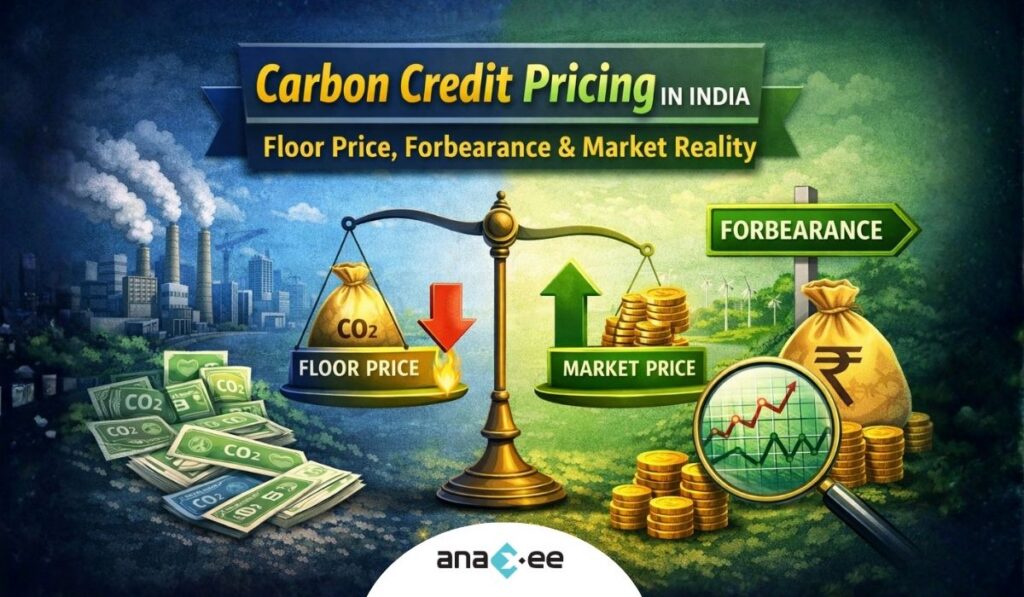

Why Pricing Will Decide the Success of India’s Carbon Market
You can design the best carbon market structure.
You can define roles and systems perfectly.
But if pricing is wrong:
👉 The entire market fails.
Carbon markets are not driven by intent.
They are driven by price signals.
How Carbon Credit Pricing Works
In India’s system:
- Prices are discovered through trading
- Buyers and sellers interact on exchanges
But it is not a completely free market.
There are controls.
What Is Floor Price?
Floor price is:
👉 The minimum price at which carbon credits can be traded
Why It Exists
Without a floor:
- Prices can crash
- Credits lose value
- No incentive to reduce emissions
Example
If credit price falls too low:
- It becomes cheaper to buy credits than reduce emissions
👉 This defeats the purpose of the system
What Is Forbearance Price?
Forbearance price is:
👉 The maximum price limit
Why It Exists
Without a cap:
- Prices can spike
- Industries face sudden cost pressure
- Market becomes unstable
Why Both Are Necessary
These two together create:
👉 A controlled price band
This ensures:
- Stability
- Predictability
- Reduced volatility
The Balancing Act
Setting these prices is not technical.
It is:
👉 Economic + political decision
If Floor Price Is Too Low
- No incentive to reduce emissions
- Market becomes inactive
If Floor Price Is Too High
- Industries resist
- Compliance becomes costly
If Forbearance Price Is Too Low
- Supply gets restricted
- Market becomes tight
If Too High
- Cost shocks for industries
Real-World Lessons from Other Markets
Globally:
- Some carbon markets failed due to low prices
- Some faced backlash due to high prices
India is trying to avoid both extremes.
What Actually Determines Price?
Beyond limits, real pricing depends on:
1. Supply of Credits
More projects → more credits → lower prices
2. Demand from Obligated Entities
Stricter targets → higher demand → higher prices
3. Market Liquidity
More participants → better price discovery
Biggest Misconception
People assume:
👉 “Carbon credit price will automatically rise over time”
That’s not guaranteed.
Real Risk
If:
- Too many credits are issued
- Demand is weak
Then:
👉 Prices collapse
Strategic Insight
For developers:
- Don’t depend on price speculation
- Focus on quality and scale
For buyers:
- Understand long-term pricing trends
- Avoid panic buying
Final Thought
Carbon pricing is not just about numbers.
It is about:
👉 Incentives
If pricing is correct:
- Emission reduction becomes economically viable
If not:
- The system becomes symbolic
One-Line Summary
👉 Carbon markets succeed or fail based on price—not policy
About Anaxee:
Anaxee drives large-scale, country-wide Climate and Carbon Credit projects across India. We specialize in Nature-Based Solutions (NbS) and community-driven initiatives, providing the technology and on-ground network needed to execute, monitor, and ensure transparency in projects like agroforestry, regenerative agriculture, improved cookstoves, solar devices, water filters and more. Our systems are designed to maintain integrity and verifiable impact in carbon methodologies.
Beyond climate, Anaxee is India’s Reach Engine- building the nation’s largest last-mile outreach network of 100,000 Digital Runners (shared, tech-enabled field force). We help corporates, agri-focused companies, and social organizations scale to rural and semi-urban India by executing projects in 26 states, 540+ districts, and 11,000+ pin codes, ensuring both scale and 100% transparency in last-mile operations. Connect with Anaxee at sales@anaxee.com