
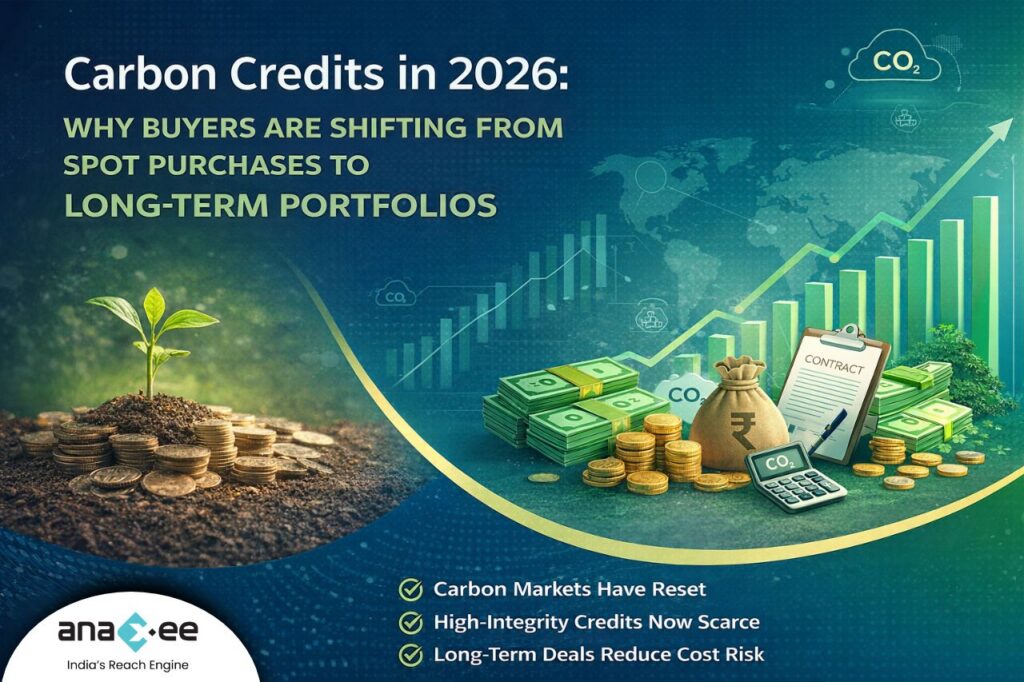

Carbon Credits in 2026: Why Buyers Are Shifting from Spot Purchases to Long-Term Portfolios
For years, buying carbon credits was treated like an annual housekeeping task.
A sustainability team would calculate residual emissions, look for “available credits,” negotiate a price, retire them, publish a report, and move on. As long as the credits were affordable and reputationally safe, the job was considered done.
That model is breaking down fast.
By 2026, carbon markets have entered a different phase altogether. Carbon credits are no longer a discretionary sustainability expense. They are becoming a strategic input — tied to risk management, future compliance exposure, and long-term cost certainty. Buyers who still approach the market through short-term, spot purchases are discovering that the rules have quietly changed.
This shift isn’t driven by ideology or climate activism. It’s driven by scarcity, regulation, integrity standards, and price reality — trends clearly laid out in the 2026 Carbon Market Decarbonisation Buyer’s Guide 2026_Carbon_Market_Buyers_Guide.
Let’s unpack what’s actually happening, in plain language.
The carbon market didn’t “recover” — it reset
Many people describe the last few years as a recovery phase for carbon markets after intense scrutiny and criticism. That framing is misleading.
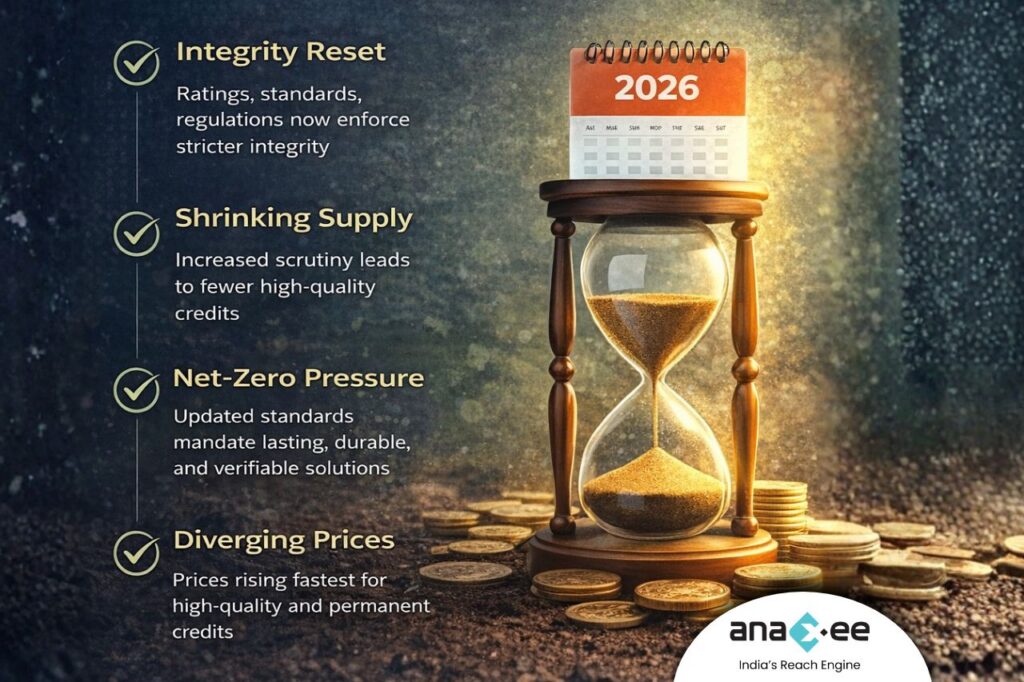
What actually happened was a reset.
Between 2022 and 2025, the voluntary carbon market went through a credibility stress test. Methodologies were questioned. Old projects were re-rated. Buyers faced legal scrutiny around green claims. And suddenly, credits that once cleared easily were left unsold.
By 2026, the market has stabilised — but on very different terms.
High-integrity is no longer a premium feature. It is the minimum requirement. Credits that cannot withstand third-party ratings, verification scrutiny, and public claims risk simply don’t move. At the same time, standards have tightened, verification requirements have become more demanding, and issuance volumes have shrunk.
In simple terms:
There are fewer credits available — and the ones that matter cost more.
Why spot buying worked earlier — and why it doesn’t anymore
Spot buying made sense in an earlier market for three reasons:
- Supply was abundant
Large volumes of avoidance credits were available at low prices, often with limited buyer scrutiny. - Integrity expectations were loose
Few companies faced detailed claim governance or legal enforcement. - Future obligations were unclear
Net-zero targets were distant, removals were optional, and compliance spillover into voluntary markets was limited.
All three conditions have changed.
By 2026:
- Integrity is actively enforced by rating agencies, standards, and regulators.
- Net-zero frameworks increasingly specify what types of credits are acceptable, and when.
- Prices are diverging sharply based on quality, durability, and scarcity.
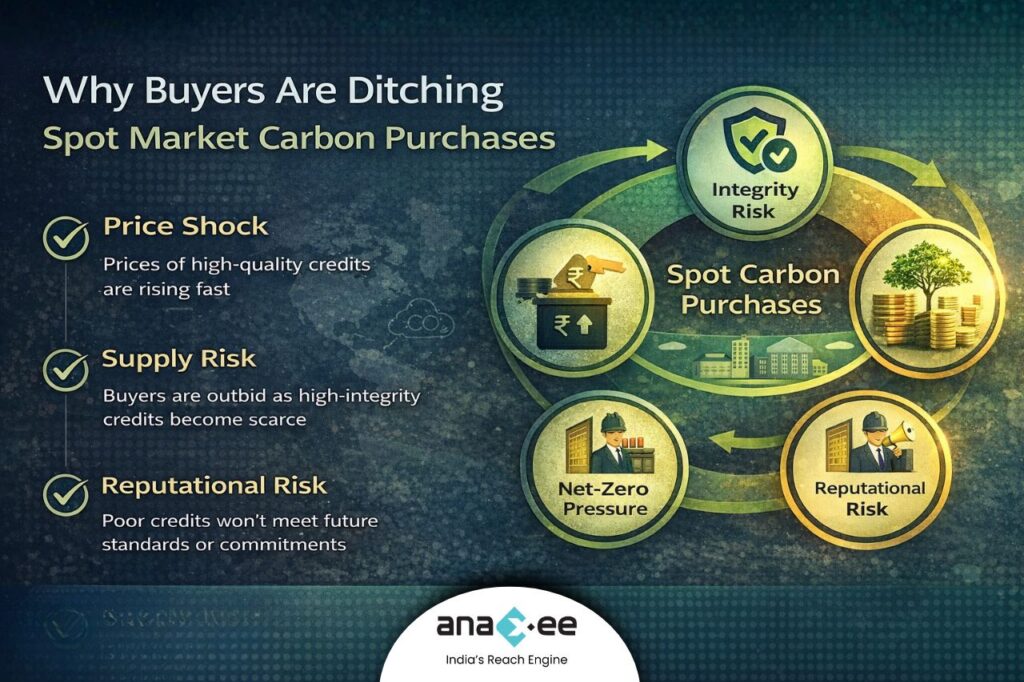
Spot buying now exposes buyers to three risks: price shock, supply risk, and reputational risk.
Carbon credits are being reclassified — from cost to asset
One of the most important ideas emerging in 2026 is this:
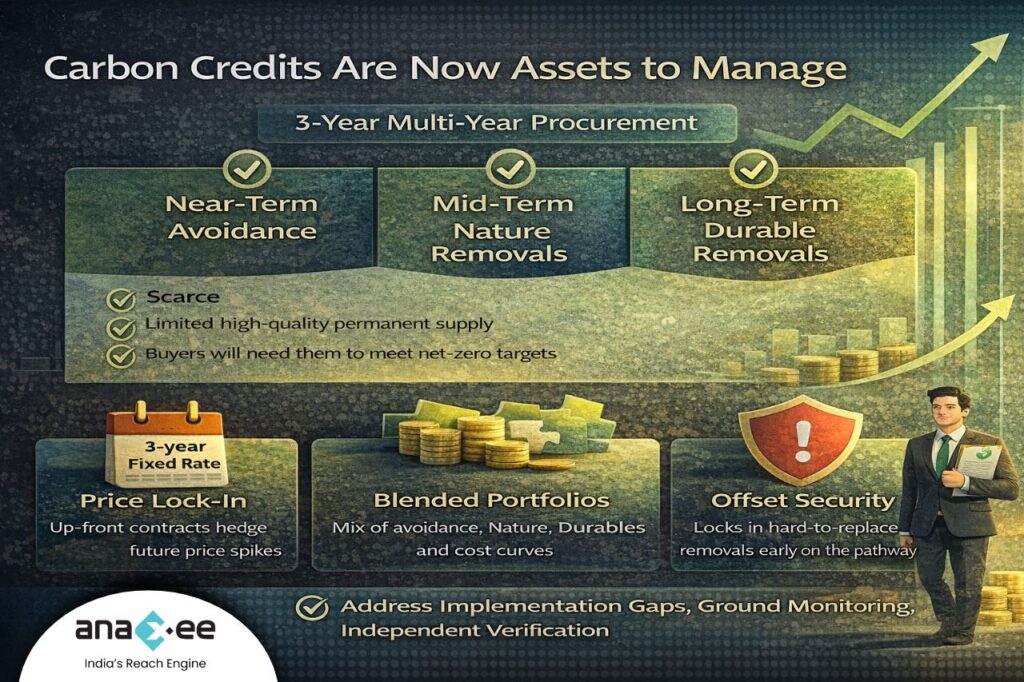
carbon credits are no longer treated purely as an expense — they are increasingly viewed as a portfolio asset.
Why?
Because high-quality credits:
- Are scarce
- Will be needed in the future
- Are getting structurally more expensive
The Buyer’s Guide frames this clearly: companies that secure long-term access to high-integrity credits today are effectively hedging against future carbon costs 2026_Carbon_Market_Buyers_Guide.
This is not speculation. It’s driven by basic supply-demand dynamics.
The uncomfortable truth about future prices
Many buyers assume carbon prices will stay “reasonable” because markets will innovate, technologies will mature, or supply will scale.
The data doesn’t support that assumption.
Price projections show a wide divergence:
- Low-quality or low-integrity credits may remain cheap — but increasingly unusable.
- High-quality credits, especially removals, are expected to rise sharply as demand converges around integrity.
In high-integrity scenarios, prices rise not because of hype, but because:
- Verification costs are higher
- Monitoring is continuous
- Permanence requirements are stricter
- Supply takes longer to build
Waiting does not reduce cost. Waiting concentrates cost into fewer future years.
Net-zero targets are quietly reshaping buying behaviour
Another reason spot buying is fading is the evolution of net-zero standards.
Earlier frameworks allowed flexibility: avoid emissions now, worry about removals later. That flexibility is narrowing.
Draft updates to major frameworks increasingly:
- Recognise avoidance and removal as complementary, not interchangeable
- Specify durability expectations for neutralisation
- Push buyers to plan removal exposure years in advance
For buyers, this means one thing:
future compliance and credibility depend on decisions made today.
You cannot suddenly procure large volumes of high-durability removals at scale in the final years of a net-zero pathway. The supply simply won’t be there.
Why sophisticated buyers are locking in long-term supply
Leading buyers are responding in three ways:
1. Moving from annual buying to multi-year strategies
Instead of asking, “How many credits do we need this year?”, they ask, “What does our carbon exposure look like over the next 10–15 years?”
2. Building blended portfolios
They combine:
- Near-term avoidance credits for immediate impact
- Nature-based removals for medium-term scaling
- Engineered or durable removals for long-term neutralisation
3. Securing offtakes early
Long-term agreements don’t just stabilise prices. They also:
- De-risk project development
- Improve data transparency
- Align incentives between buyers and developers
This is less about locking in a deal — and more about locking in certainty.
Where most strategies still fail: execution risk
Here’s the part many market reports gloss over.
A long-term carbon strategy only works if projects survive verification, monitoring, and audits year after year.
Execution risk is where many well-designed strategies collapse:
- Poor baseline data
- Weak on-ground monitoring
- Inconsistent farmer or community engagement
- Gaps between reported and actual outcomes
As integrity standards tighten, these gaps matter more.
This is why buyers are paying closer attention to:
- Digital MRV systems
- Ground-level data collection
- Independent verification readiness
- Implementation partners, not just registries
Carbon markets are no longer forgiving of operational shortcuts.
The real shift happening in 2026
The shift is not from “cheap” to “expensive” credits.
It’s from transactional buying to strategic ownership.
Carbon credits are being treated like:
- Long-term inputs
- Risk management tools
- Enablers of credible transition pathways
Buyers who adapt early gain optionality. Buyers who wait inherit constraints.
The question buyers should be asking now
Not:
“Which credits are cheapest this year?”
But:
“Which carbon supply chains will still exist, and still be credible, when we need them most?”
That question changes everything — timelines, partners, pricing, and expectations.
And it’s the question that defines carbon buying in 2026.
About Anaxee:
Anaxee drives large-scale, country-wide Climate and Carbon Credit projects across India. We specialize in Nature-Based Solutions (NbS) and community-driven initiatives, providing the technology and on-ground network needed to execute, monitor, and ensure transparency in projects like agroforestry, regenerative agriculture, improved cookstoves, solar devices, water filters and more. Our systems are designed to maintain integrity and verifiable impact in carbon methodologies.
Beyond climate, Anaxee is India’s Reach Engine- building the nation’s largest last-mile outreach network of 100,000 Digital Runners (shared, tech-enabled field force). We help corporates, agri-focused companies, and social organizations scale to rural and semi-urban India by executing projects in 26 states, 540+ districts, and 11,000+ pin codes, ensuring both scale and 100% transparency in last-mile operations. Connect with Anaxee at sales@anaxee.com