
Every engineering student starts their final year with the same ambition —
“This time, I’ll build something meaningful.”
But somewhere between choosing a topic, juggling exams, dealing with placements, and trying to understand Kaggle datasets… that ambition slowly fades. The project becomes a deadline. A submission. A PDF.
And that’s where things start falling apart.
Most students don’t realize this until the placement interviewer asks:
“Explain your project.”
And suddenly, the gap between what they built and what companies expect becomes painfully visible.
This blog isn’t about blaming students.
It’s about exposing the root causes behind why most final-year AI projects collapse before they even start — and how a small minority manages to build projects that recruiters remember.
If you want to be in that 10%, read this carefully.
The Harsh Truth: Why 90% of Final-Year AI Projects Fail
Let’s break down the biggest reasons — the ones no one talks about openly.
1. Students Pick “Idea Projects” Instead of Real Problems
Most final-year AI projects are based on:
- Generic titles
- Old problem statements
- Small toy datasets
- Overused code available online
Nothing here reflects real-world AI work.
The problem isn’t effort. It’s direction.
Students build something impressive-sounding… but not industry-relevant.
Real AI projects don’t start with an idea.
They start with a problem worth solving.
2. They Try to Train AI on “Clean” Textbook Data
Real datasets are messy, imperfect, inconsistent, and full of noise.
College datasets are the opposite. They’re neat and tiny.
Students think they are building a model.
Recruiters know they’ve built a demo.
The gap isn’t talent.
It’s exposure to data at real operational scale.
3. AI Concepts Are Understood in Theory, Not Practice
Most students understand AI like this:
- What is NLP? ✔️
- What is Computer Vision? ✔️
- What is a neural network? ✔️
But if you ask:
- How will AI help automate a business workflow?
- How does data flow from field → verification → model → output?
- How do you deploy a model in a real environment?
There’s silence.
This is normal — because college projects don’t show the context in which AI truly becomes useful.
But without this context, projects remain academic.
Not applied.
4. Students Don’t Know How to Convert Data → Insight → Product
Recruiters don’t care about your code as much as you think.
They care about your ability to build value.
AI isn’t just models.
It’s:
- Problem framing
- Data understanding
- Model building
- Integration
- Deployment
- Feedback loop
- Iteration
Most student projects stop at step 2.
5. Lack of Mentorship and Industry Touchpoints
The right mentor doesn’t just help you “finish the project.”
They help you:
- Think better
- Prioritize better
- Debug problems faster
- Build for real-world conditions
Without this, students reinvent the wheel — slowly.
Good students don’t fail from lack of intelligence.
They fail from lack of exposure.
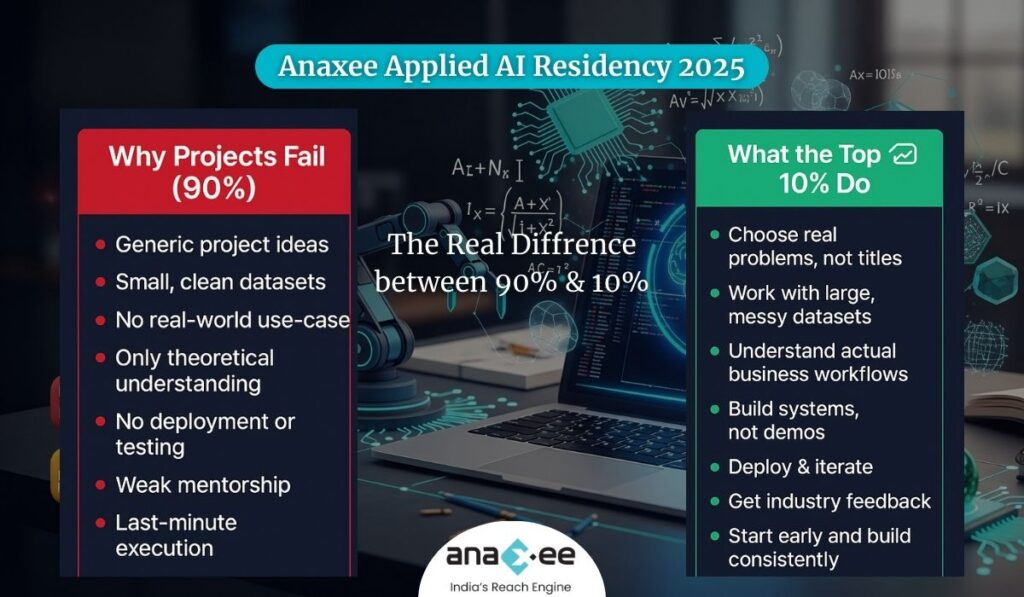
Now Let’s Flip the Script: What the 10% Do Differently
Here’s what top students’ projects have in common — across colleges, states, and years.
1. They Work on Real Data and Real Problems
Not ideas.
Not textbook datasets.
Not “college problems.”
The top 10% pick problems that:
- Impact real people
- Are connected to real processes
- Matter to real businesses
They don’t run after fancy models.
They solve meaningful things.
2. They Use Data That Forces Them to Learn
Good datasets make you comfortable.
Real datasets make you skilled.
When you work with:
- Voice call recordings
- Field survey images
- WhatsApp text logs
- CRM data
- Multilingual conversations
You learn things a classroom cannot teach.
3. They Build Systems, Not Just Models
A recruiter can instantly tell when a student understands the bigger picture.
Top projects show:
- Input → Processing → AI model → Output
- User flow
- Operational value
- A demo that actually solves something
That’s the difference between a submission and a portfolio piece.
4. They Don’t Work Alone
The strongest projects are shaped by:
- Mentors
- Feedback
- Real users
- Industry scenarios
The project becomes a journey — not an assignment.
5. They Choose Environments That Push Them
Growth doesn’t happen in comfort zones.
The best students deliberately put themselves in:
- Real-world data
- Real-world time pressure
- Real-world expectations
Because that’s where learning compounds fast.
The Missing Link for Most Students: A Real-World AI Environment
Let’s be honest.
Most colleges cannot provide:
- Large datasets
- Real operational scenarios
- Industry feedback loops
- Deployment environments
- Live problem statements
Not because they don’t want to.
But because that setup requires years of field operations and infrastructure.
This is where companies like Anaxee come in — companies that have spent nearly a decade building real data, real reach, and real AI-driven workflows across India.
And that’s where the Applied AI Residency 2025 becomes a game-changer.
Not because it “teaches AI”…
But because it exposes students to the exact conditions where AI actually becomes relevant.
The Hidden Truth No One Tells Students
AI is not about:
- Fancy models
- High accuracy scores
- Kaggle leaderboards
AI is about making things work in the real world.
If your project can:
- Solve a real problem
- Work on messy data
- Function in a live environment
- Deliver value
Then you’re already ahead of 90% of graduates.
This is the real shortcut.
Not another online course.
Not another tutorial.
Not another dataset download.
But doing AI where AI is actually needed.
What You’ll Realize After Reading This (The 3 Big Mindshifts)
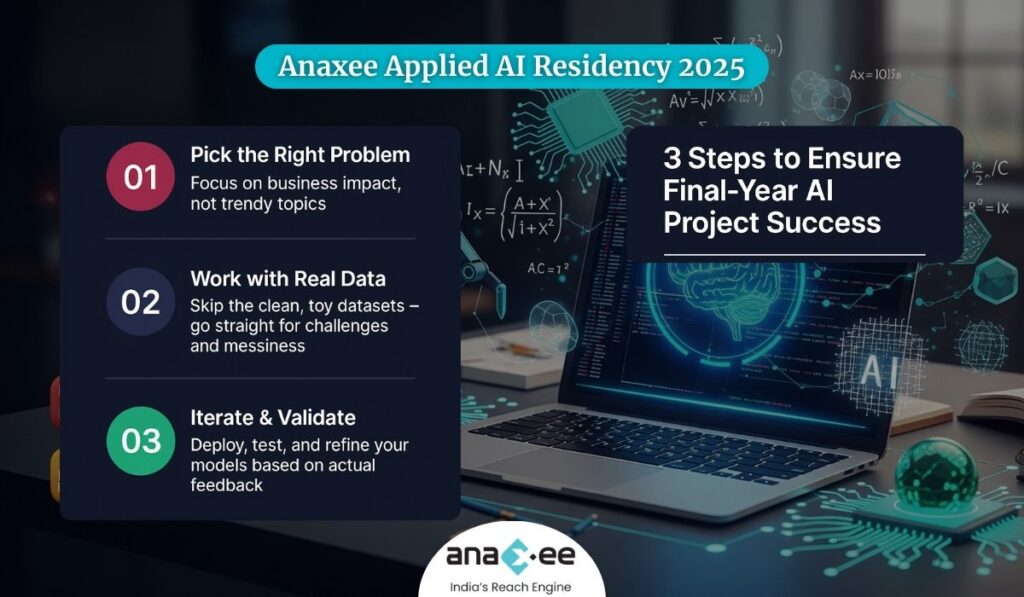
Here are the three shifts top students experience early — and the ones that change their entire trajectory:
1. “Ideas don’t matter. Real problems matter.”
Anyone can imagine a chatbot.
Not everyone can build one that solves a real workflow inside a company.
The moment you switch from idea-first to problem-first thinking, you start understanding AI like an engineer — not a hobbyist.
2. “Small datasets = small skills.”
If you want to be industry-ready, you need exposure to:
- messy data
- large data
- diverse data
It forces you to learn faster than any course ever can.
3. “AI isn’t a project. It’s an ecosystem.”
This is the biggest one.
The top 10% of students start thinking in systems:
- Where does data come from?
- Who uses the output?
- What problem are we solving?
- How will this work at scale?
This thinking makes you different.
This thinking makes you employable.
And this thinking only emerges when you build AI in real-world settings — not simulations.
If You Want to Be in the 10%, Start Here
No loud pitch.
Just a simple next step.
If you want to explore:
- Real AI project themes
- Real data
- Real industry mentorship
- Real workflows
- Real opportunities for final-year students
Then the next logical step is to explore the project list created exclusively for engineering/MCA students.
Not to register.
Not to “sign up.”
Just to understand what real AI problems look like.
👉 Explore the project themes here:
https://students.anaxee.com
Spend 10 minutes there.
It will change the way you think about your final-year project.