

A Startup Born from a Simple Question: How Do You Reach Rural India Digitally?
When most startups in India were chasing urban consumers with apps, ads, and convenience products, Anaxee Digital Runners Pvt. Ltd. started by asking a harder question:
“Who will help bridge India’s digital divide at the last mile?”
Founded in Indore, Madhya Pradesh, Anaxee began with a conviction that digital inclusion in India cannot happen without human inclusion.
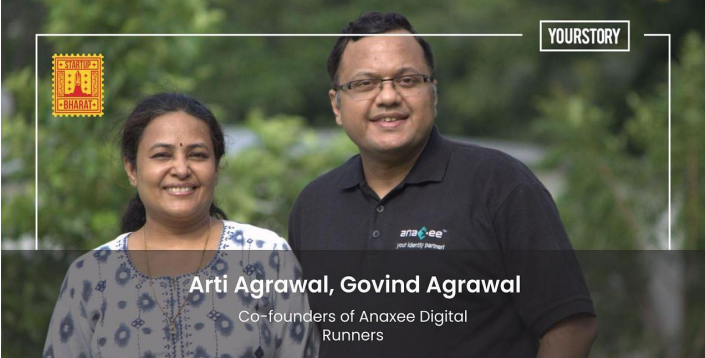
Long before “digital public infrastructure” became a national buzzword, Anaxee’s founders — Govind Agrawal and Aarti Agrawal — realized that to bring services, data, and access to rural areas, you first need people on the ground who can act as digital enablers.
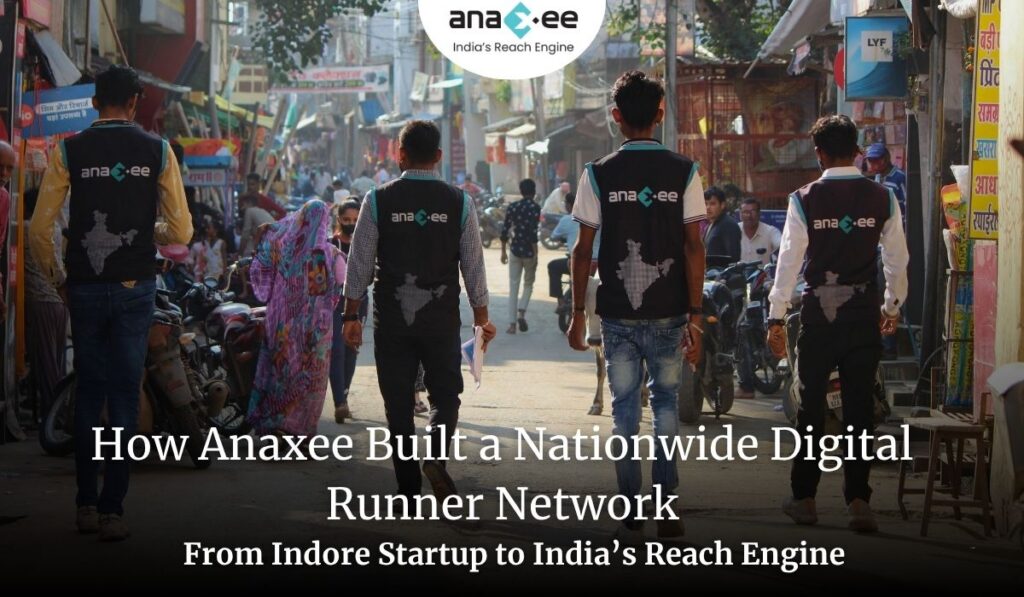
This idea gave birth to the Digital Runner model — a distributed network of trained rural youth who use smartphones and apps to perform tasks for companies, NGOs, and governments in their own villages.
As Entrepreneur Magazine noted in its profile of Anaxee,
“Anaxee was built on a unique vision — to create a network that could deliver digital tasks, collect data, and bridge India’s digital divide by combining technology with human reach.”
(Entrepreneur.com)
2. The Early Days: Building from Indore, Not Bangalore
In the Indian startup ecosystem dominated by metros like Bengaluru and Gurgaon, launching a tech company from Indore was almost counterintuitive.
But Anaxee’s choice was intentional.
Indore, being closer to India’s heartland and rural demographics, gave Anaxee both context and conviction.
While big cities had data but no ground presence, rural India had needs but no connectivity.
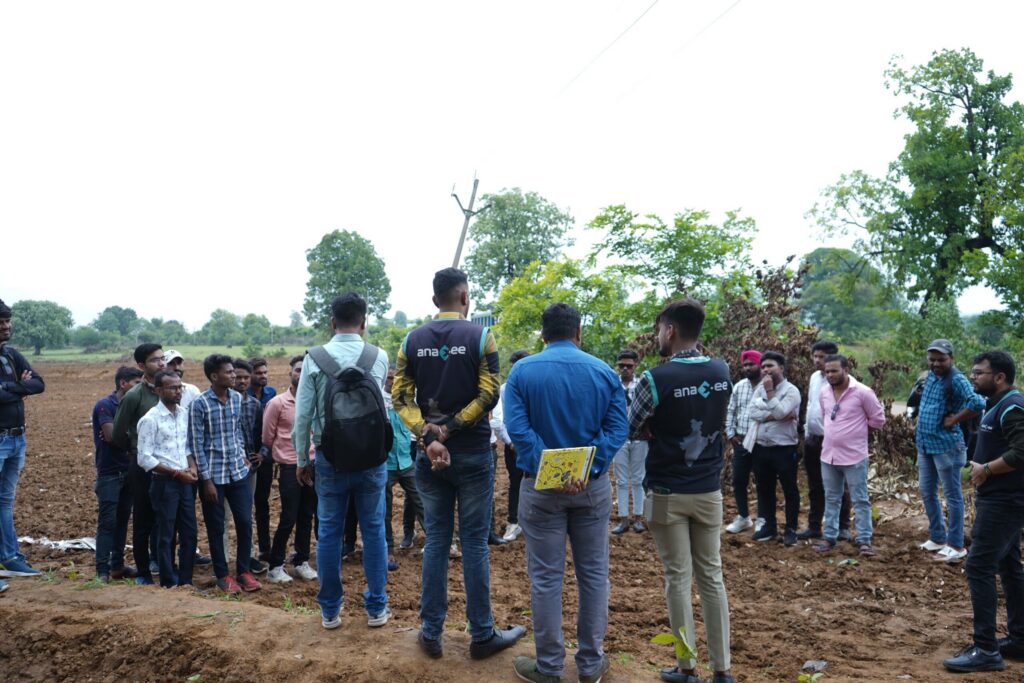
The founders envisioned a platform that could connect these two realities: a tech-enabled, human-powered delivery network for digital services.
The initial years were spent designing pilot programs for data collection, customer verification, and outreach for fintech and telecom clients — essentially early forms of “digital errands” executed by local youth.
But what began as a gig-model experiment quickly grew into a scalable rural infrastructure.
Each Digital Runner was geo-tagged, trained via mobile app, and monitored through dashboards — a system that would later prove critical during large-scale social campaigns like Project Swaraksha.
As Govind Agrawal explained in one of the early interviews:
“If Amazon can deliver products anywhere, why can’t India build a network that can deliver digital tasks to every village?”
That question became the company’s mission statement.
3. Recognition and Breakthrough: The Golden Ticket to Global Entrepreneurship Summit (GES) 2017
Anaxee’s breakthrough moment came when it won the “Golden Ticket” at the Road to GES – Indore event organized by the WEF Global Foundation (WF Global) in partnership with NITI Aayog and the U.S. State Department.
(WFGlobal.org)

This recognition meant that Anaxee would be one of the select startups to showcase its concept at the Global Entrepreneurship Summit (GES) 2017, co-hosted by India and the U.S., and inaugurated by Prime Minister Narendra Modi and Ivanka Trump.
Out of thousands of applicants, Anaxee made it to the semi-finalists list of the GIST Catalyst Pitch Competition, hosted by the U.S. Department of State.
(GES2017.org)
The Times of India and Free Press Journal both covered the story, emphasizing how an Indore-based startup representing India’s Tier-2 ecosystem had earned global attention for its scalable impact model.
The Free Press Journal headline read:
“Indore city-based start-up wins Golden Ticket to showcase concept at Global Summit.”
(FreePressJournal.in)

This milestone validated not just Anaxee’s model, but the broader belief that innovation doesn’t only belong to metros — impact innovation can be born anywhere in India.
4. The WEQ & AnitaB.org Connection: Women Entrepreneurs Leading from the Front
Anaxee’s story is also deeply tied to women-led innovation.
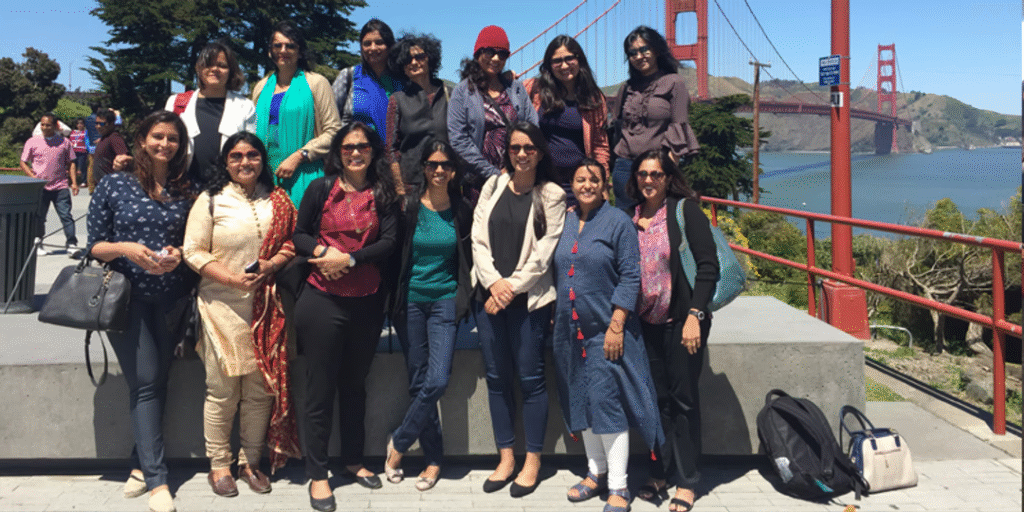
Co-founder Aarti Agrawal was selected as one of the Top 10 finalists of the Women Entrepreneurs Quest (WEQ) 2016, a prestigious initiative by AnitaB.org India, supported by DST (Department of Science and Technology) and Government of India.
(AnitaB.org)

The recognition took her to Silicon Valley, where she interacted with mentors and investors focusing on women-led technology ventures.
The WEQ platform highlighted how women entrepreneurs in India are increasingly leading tech innovation in underrepresented areas like rural inclusion and data access.
As AnitaB.org wrote:
“Aarti’s work through Anaxee represents the power of inclusive innovation — bringing digital access to the last mile, while creating local employment opportunities for rural youth.”
This global visibility reinforced Anaxee’s positioning not just as a startup, but as a purpose-driven tech enterprise — with inclusivity, gender representation, and social impact built into its DNA.
5. From Wharton to Inc42: Startup India Takes Notice
Shortly after its GES recognition, Anaxee was shortlisted as a finalist in the Wharton India Startup Challenge, organized by the Wharton School of the University of Pennsylvania.
(Inc42.com)
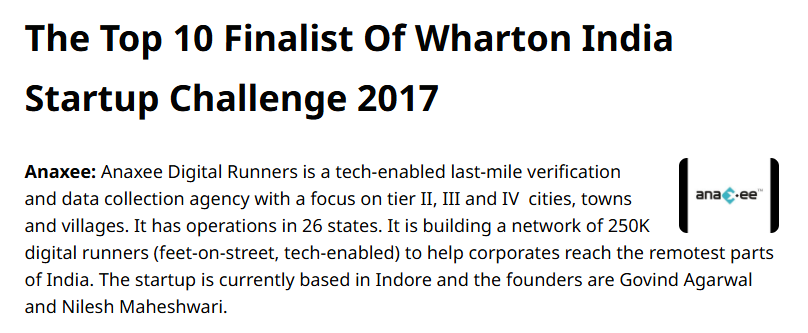
This platform, which highlights India’s most promising startups across sectors, acknowledged Anaxee’s potential to scale a physical-digital hybrid network across India’s hinterlands — something few others were attempting at the time.
Meanwhile, Inc42 and YourStory began covering the broader rise of non-metro entrepreneurs like those in Indore, highlighting Anaxee as an example of how small-city startups were redefining innovation geography.
YourStory’s feature on women founders in 2017 mentioned Aarti Agrawal’s journey as an entrepreneur balancing societal expectations with a vision for large-scale rural inclusion.
(YourStory.com)
That early media coverage mattered — it reframed the narrative that real tech innovation in India could (and should) solve real problems for rural citizens, not just urban consumers.
6. The Digital Runner Model: A Scalable Framework for Impact
By 2018, Anaxee’s Digital Runner network was expanding rapidly.
The company trained young people from villages and small towns to become micro-entrepreneurs — performing tasks like:
- Data collection for financial inclusion programs
- KYC verifications and digital onboarding
- Rural marketing and survey execution
- Health and vaccination awareness campaigns
- Community engagement for CSR and NGO partners
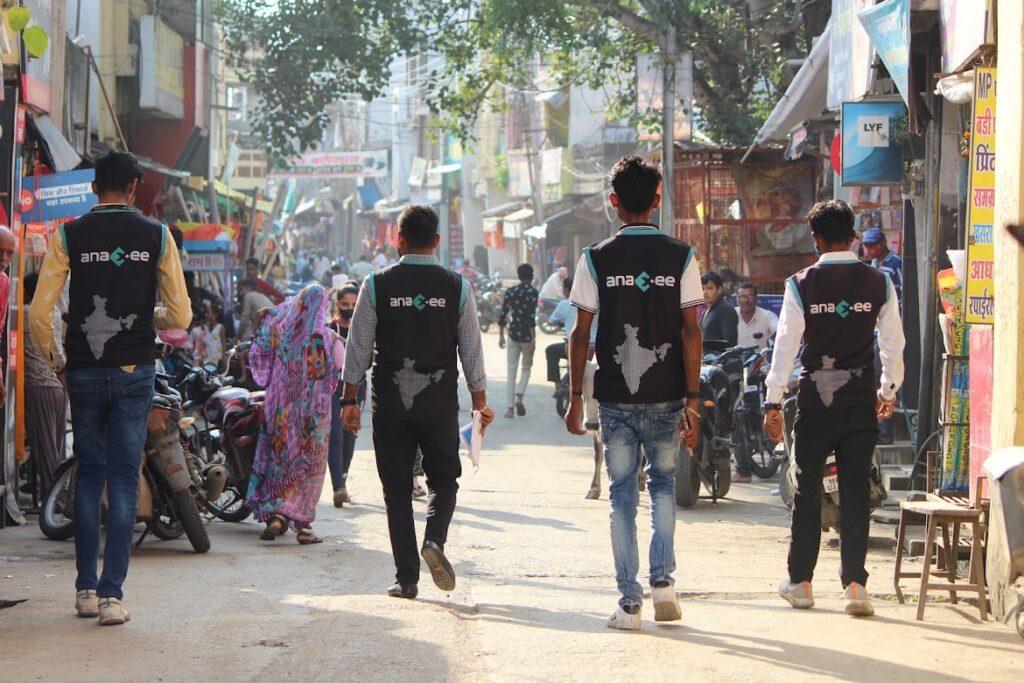
Each Digital Runner had access to Anaxee’s proprietary app, which allowed the company to track real-time field activity, authenticate data, and provide clients with instant visibility into execution metrics.
This hybrid model — half digital, half human — became Anaxee’s competitive moat.
It combined the scalability of a tech platform with the authenticity of community-level presence.
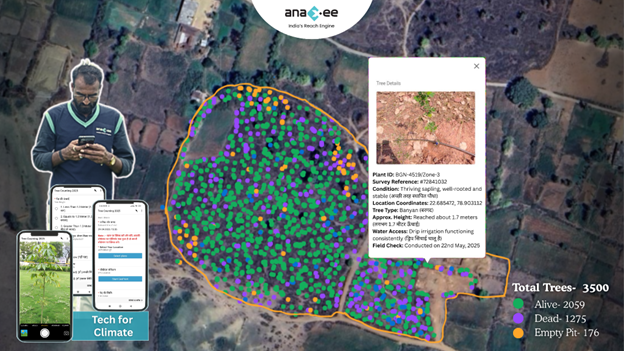
In later years, this same infrastructure would evolve into the “Tech for Climate” backbone that enables Anaxee to monitor carbon and tree plantation projects across India — an application of the same runner network in a completely different vertical.
7. Scaling Beyond Recognition: From Social Enterprise to India’s Reach Engine
Recognition is one thing; building sustainable infrastructure is another.
Post-2018, Anaxee doubled down on two priorities:
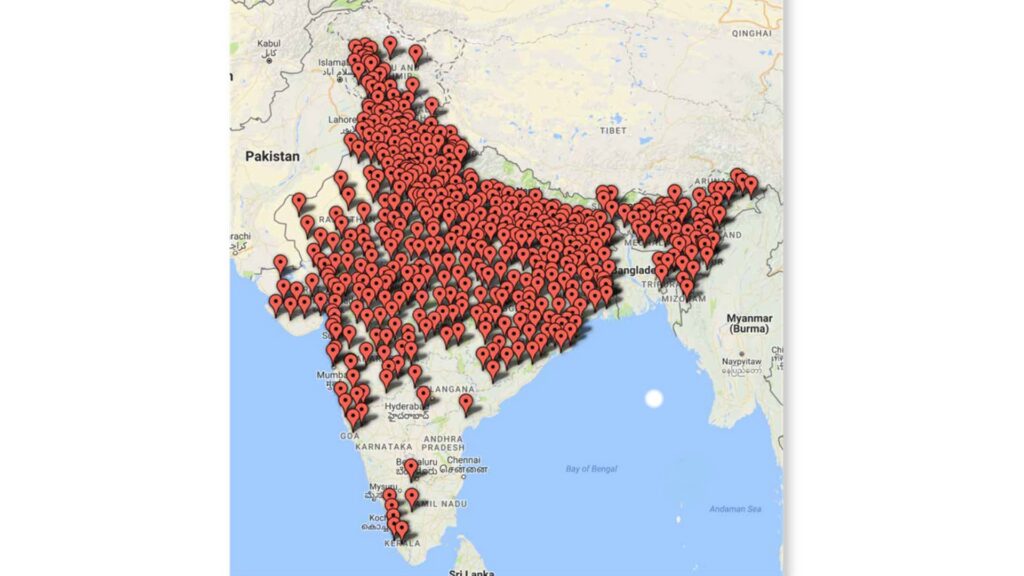
- Expanding the Digital Runner network — onboarding thousands of new runners across 26 states.
- Evolving the technology stack — building data dashboards, geo-tracking systems, and mobile-first project management tools.
This operational backbone earned Anaxee the title “India’s Reach Engine” — a term that captures its dual ability to collect data from and deliver services to India’s remotest geographies.
The company’s philosophy remained constant:
“Reach is infrastructure. Whoever controls last-mile reach controls impact.”
With a mix of commercial, developmental, and CSR clients, Anaxee’s network became a national resource — for everything from eKYC drives to vaccination campaigns and now, carbon monitoring for climate projects.
8. Why Anaxee’s Model Matters in Today’s India
India’s policy landscape today — Digital India, Skill India, ESG mandates, and carbon credit trading schemes — all demand scalable last-mile execution.
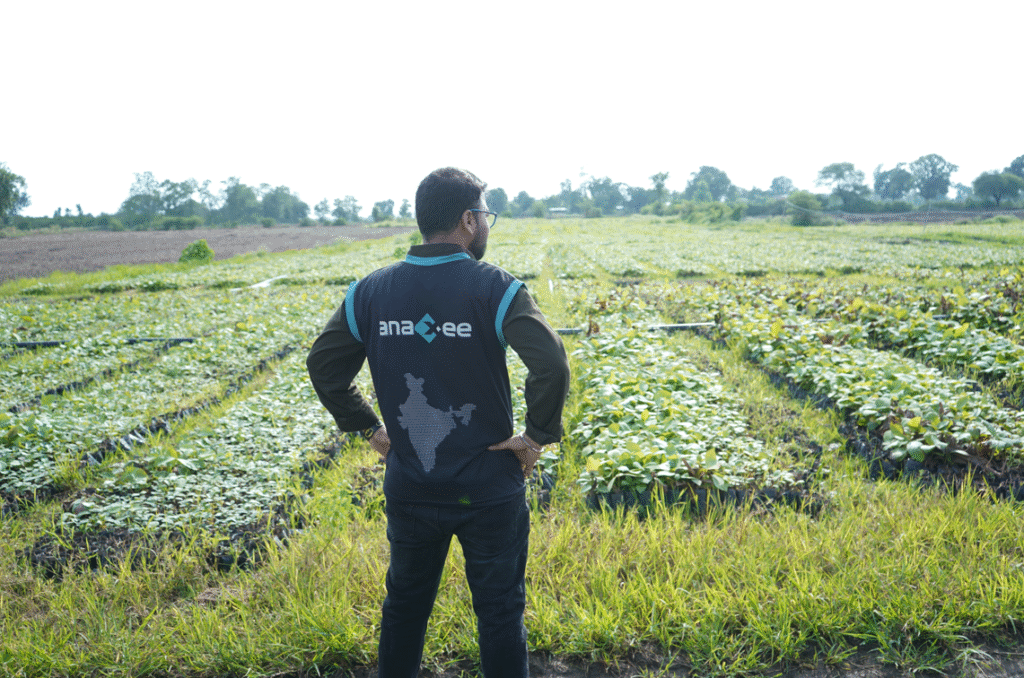
But scale fails without trust, and trust in rural India is earned only through human presence.
That’s where Anaxee’s model remains uniquely relevant.
- For corporates: It’s a channel to execute CSR and ESG programs with verifiable on-ground data.
- For governments: It’s a decentralized implementation partner that can reach rural households efficiently.
- For startups and NGOs: It’s a bridge between digital innovation and field execution.
Anaxee essentially built what India lacked — a trustworthy physical-digital interface between urban institutions and rural citizens.
It’s not a delivery network of goods, but of information, awareness, and data integrity.
That combination makes Anaxee as much an infrastructure company as it is a tech platform.
9. Lessons from the Journey
Anaxee’s rise from a Tier-2 startup to a nationally recognized impact platform offers a few clear lessons for India’s new generation of entrepreneurs:
- Build for Bharat, not just India. The future market growth lies beyond metros.
- Tech alone doesn’t solve social problems — people do.
- Trust is a currency. The more local your network, the more scalable your impact.
- Recognition helps, but resilience builds sustainability. Awards open doors, but execution earns partnerships.
- Purpose and profitability can align. Anaxee’s business model shows that creating rural jobs and delivering corporate value are not mutually exclusive.
As Aarti Agrawal once remarked in a panel after WEQ:
“For us, impact is not an add-on. It’s the business model.”
10. From Silicon Valley to Small Villages: The Road Ahead
From pitching in Silicon Valley and Wharton to training rural youth in Nagaland and Bihar, Anaxee’s trajectory reflects the diversity of modern India.
The same company that once showcased its model at GES alongside global innovators now uses that model to plant trees, enable farmers, and generate verified carbon credits.
In that sense, the journey has come full circle — innovation for India, executed by India’s own youth.
As the company expands its Tech for Climate vertical and builds the Climate Command Centre (a digital monitoring hub for NbS and carbon projects), the foundations laid during its startup years — transparency, data verification, and field accountability — remain intact.
Every recognition, every pilot, every rural visit during those early years prepared Anaxee for this stage — scaling purpose with precision.
11. Closing: From Recognition to Responsibility
Anaxee’s journey demonstrates that “India’s next billion users” is not just a market segment — it’s a social responsibility.
The company’s recognitions — from WEQ to GES — were milestones, but not endpoints. They marked the beginning of a much larger mission:
to make technology meaningful for those who were historically left behind.
As Anaxee continues to execute national-scale projects in health, livelihood, and climate, its story remains a powerful case study in what Tech for Impact can truly mean.
To borrow a phrase from its own tagline:
Anaxee isn’t just building reach — it’s building the infrastructure of inclusion.