
India’s climate transition is not happening through grand speeches or flashy green pledges alone. A large part of the shift is actually coming through quiet policy changes — reforms that reduce friction, simplify compliance, and create room for decentralized, community-driven climate solutions to scale.
On October 17, 2025, the Ministry of Environment, Forest and Climate Change (MoEFCC) notified a revised list of “White Category” industries under both the Air (1981) and Water (1974) Pollution Acts. This change went almost unnoticed in mainstream climate discussions — yet its impact is significant.
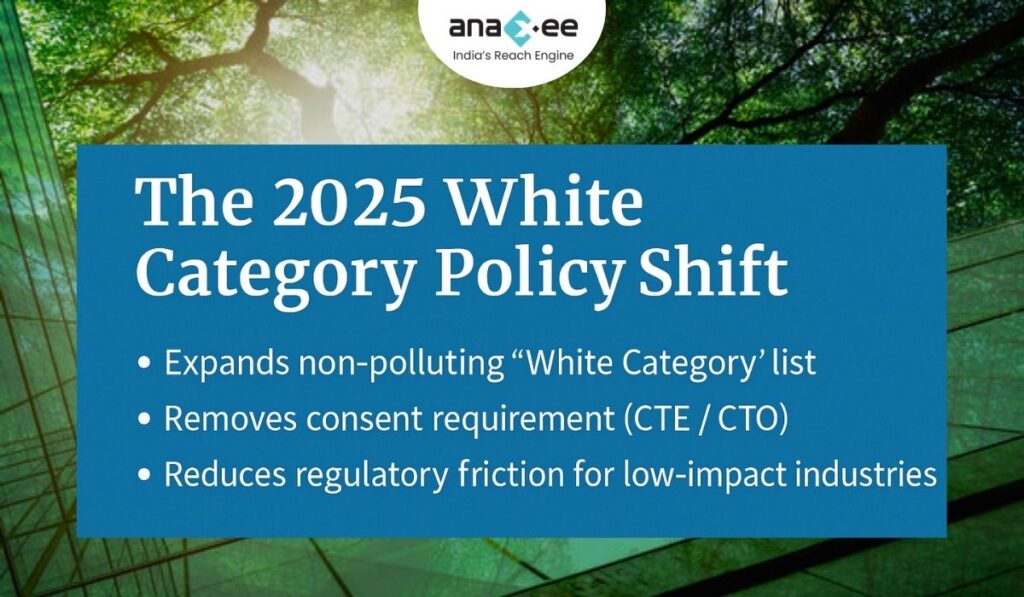
The White Category essentially covers non-polluting or nearly negligible-pollution industries. Projects falling into this category:
- Do not require Consent to Establish (CTE)
- Do not require Consent to Operate (CTO)
- Are exempt from routine regulatory inspections
- Are treated as environmentally benign activities
This is not just a bureaucratic classification. It is a signal:
India is deliberately removing procedural hurdles for cleaner, smaller, decentralized manufacturing and livelihood-linked industries — exactly the ecosystem where climate and carbon projects like Clean Cooking, Agroforestry, and Biochar operate.
For companies working at the ground level, including Anaxee Digital Runners, this shift changes how projects get designed, approved, financed, and scaled.
Why the White Category Matters
To understand its importance, consider the historical bottleneck in implementing community-scale climate projects in India:
| Challenge | How it Previously Played Out |
|---|---|
| Regulatory Permissions (CTE/CTO) | Took months; required running to state boards |
| Interpretation Variability | Different officers → different compliance expectations |
| Financial/ESG Risk Perception | Investors saw decentralized rural units as “uncertain” |
| Scaling Constraints | Project developers avoided multiple small sites due to paperwork burden |
By expanding the White Category, the government has effectively:
- Reduced regulatory friction for decentralized green activities
- Signaled trust in low-impact renewable/natural processes
- Encouraged local manufacturing and agro-linked enterprises
- Strengthened the case for distributed climate project scaling
This shift matters most in rural and peri-urban economies, where both climate action and livelihood generation need to happen together.
What Changed in the 2025 Notification
The Gazette notification replaces the previous White Category list with an expanded set of 86 industrial activities, ranging from:
- Handmade soap
- Coir and jute processing
- Organic manure mixing
- Solar module assembly
- Scientific instruments
- Clean bakery operations
- Compressed Bio-Gas (CBG) plants
- Household biogas digesters
- Mini-hydel systems
- Small-scale agro-processing units
- And decentralized manufacturing with only dry processes
The common thread among all of them:
- No effluent discharge
- Minimal or zero emissions
- Limited heat treatment or chemical solvents
- Dry, mechanical, small-to-mid scale operations
- Cleaner energy usage (electricity/gas instead of fossil burning)
But beyond the full list, three specific categories directly intersect with the climate-carbon sector:
- Compressed Bio-Gas (CBG) Plants
- Organic Manure (FOM/LFOM) Production
- Household Biogas Digesters (Gobardhan Type)
- Agro-Residue and Biomass Pelletization (covered indirectly through physical mixing & pellet units)
And indirectly relevant:
- Agro-processing units <1 TPD using clean fuel
- Solar module assembly and non-conventional energy systems
Each of these aligns closely with carbon project implementation pathways.
The Policy Direction Behind This Reform
The expansion of the White Category is not accidental. It reflects a strategic climate-economic view:
- India wants climate action to be decentralized.
Carbon reduction cannot be achieved by cities and industries alone. - Rural economies need livelihood-linked climate assets.
Instead of subsidy dependence, rural systems must generate recurring economic value. - Compliance needs simplification for distributed scaling.
If 10,000 households adopt clean cooking, the paperwork cannot look like building a refinery. - Carbon markets and climate finance require “project readiness”.
Investors need assurance that project activities are regulatory safe, not ambiguous.
This notification lowers the regulatory burden, which means the cost of proof shifts from government approvals to credible monitoring & reporting.
That’s exactly where implementation & MRV-focused organizations like Anaxee come in.
Connecting the Gazette to Carbon Project Development
Let’s break down how this change enables faster deployment of Anaxee’s core climate project work.
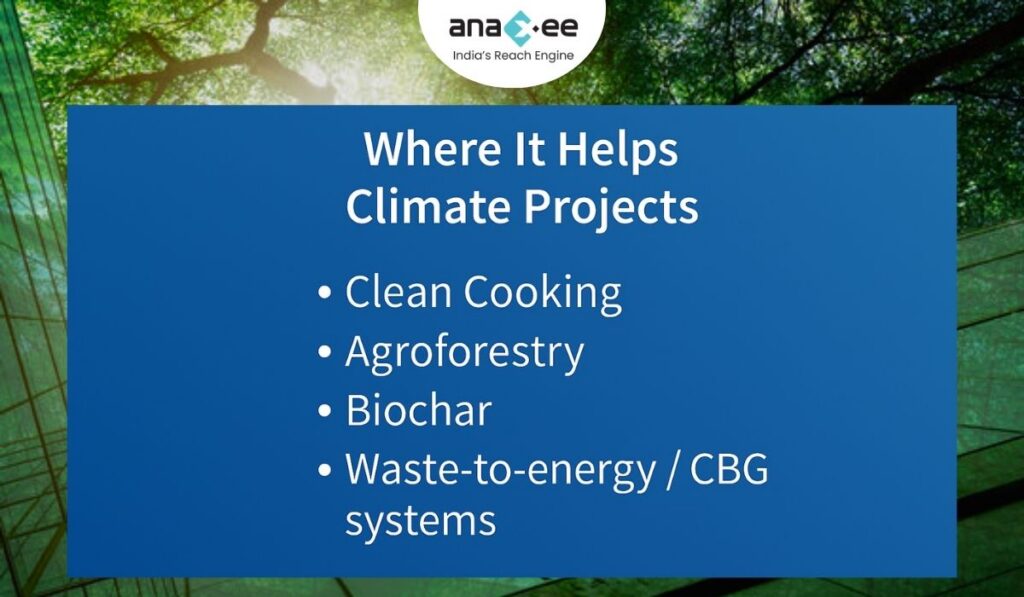
1. Clean Cooking Projects
Traditional biomass cookstoves create emissions, deforestation pressure, and health risks. Clean cooking solutions — LPG transition, improved stoves, ethanol/biogas systems — are eligible under carbon methodologies.
White Category relevance:
- Household biogas units and used cooking oil collection centers are now recognized as non-polluting.
- Clean stove assembly units do not need CTE/CTO if they follow dry-process manufacturing.
- Small distribution/storage hubs avoid compliance delays.
Outcome:
Faster rollout, simpler supply chains, easier micro-enterprise adoption.
2. Agroforestry Projects (Bund, Boundary, and Mixed Systems)
Agroforestry requires:
- Farmer trust
- Low-friction enrollment
- Clarity on what land-use practices are allowed
Even though tree planting is not an industrial activity, the agro-produce processing and biomass handling units associated with agroforestry are included in the White Category, reducing friction around:
- Sapling nursery operations
- Farmer-level produce aggregation
- Biomass product processing and pelletizing
- Decentralized organic manure enrichment units
Outcome:
Enrollment + supply chain + value addition becomes smoother.
3. Biochar Projects
Biochar is produced by pyrolysis of biomass. Small-scale decentralized pyrolysis units can be set up in rural clusters, but historically required pollution consents due to perceived emissions.
Under the new notification:
- Pelletization and biomass preparation units fall into White Category (dry mechanical process).
- Organic manure mixing and soil-amendment blending are also exempted.
- Small CBG plants producing digestate (which can be enriched into biochar-based fertilizers) are recognized as non-polluting.
This doesn’t directly exempt every pyrolysis unit — but it enables the entire supporting ecosystem to operate with lower compliance risk.
Outcome:
Biochar project implementation becomes simpler, faster, investable.
So Where Does Anaxee Fit?
India’s climate financing landscape is shifting. Multiple actors now operate:
| Actor Type | Responsibility | Gap |
|---|---|---|
| Carbon Standard / Registry | Methodology + certification rules | No on-ground execution |
| Project Developer / Aggregator | Designs project, raises finance | Often weak ground presence |
| Community Organizations | Work with farmers/households | Lack scientific MRV capability |
| Investors / Buyers | Fund projects or buy credits | Need trust and assurance |
Anaxee sits at the intersection.
Anaxee is not just a document/project developer.
The company specializes in:
- Large-scale project implementation in rural areas
(via Digital Runner network across districts & villages) - Monitoring & Reporting systems
(including digitized census-based sampling, dashboards, ground verification) - Community capacity-building & maintenance workflows
As the regulatory friction reduces, the implementation + monitoring bottleneck becomes the new critical factor.
That’s precisely where Anaxee’s model has leverage.
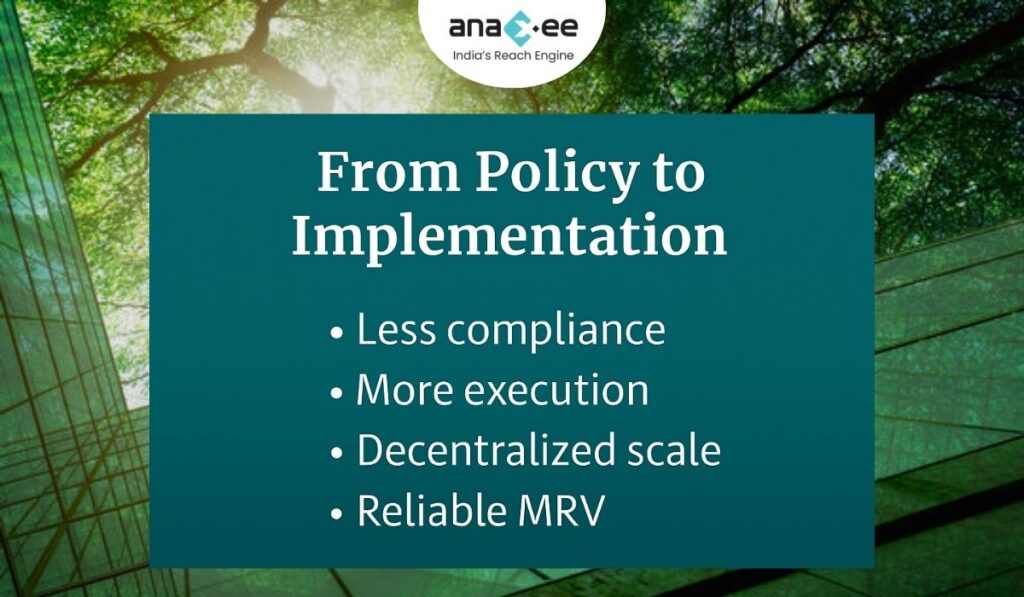
Why This Policy Change Amplifies Anaxee’s Scaling Capability
| Before | After |
|---|---|
| Every micro-unit required state board clarity | White Category → no prior consent needed |
| Scaling required approval-based planning | Scaling now becomes operational process-driven, not approval-driven |
| Investors saw rural models as risky | Investors now see regulatory certainty |
| Monitoring seen as optional | Monitoring becomes the core quality differentiator |
Where earlier the bottleneck was permission,
now the bottleneck is proof.
Which means:
Implementation + Digital MRV = the center of India’s climate action economy.
This is Anaxee’s core specialization.
Forward-Looking Implications
The notification suggests a broader direction:
- The future of India’s climate sector will be localized, distributed, and data-driven.
- Carbon projects will shift from “one big project” to “thousands of micro-sites”.
- MRV will be the primary determinant of credit value and credibility.
- Implementation partners with boots on the ground + digital verification systems will define market leadership.
Investors will increasingly back:
- Clean Cooking rollout programs
- Agroforestry bundled with livelihood crops
- Biochar as a soil + carbon permanence solution
But only if:
- Data is reliable
- Communities actually benefit
- Projects scale without regulatory drag
The White Category reform removes the administrative drag.
Conclusion
The October 2025 White Category Notification is not just a compliance update. It’s a structural enabling mechanism for India’s climate transition — especially in the rural economy.
It reduces friction, encourages decentralized manufacturing and renewable-use processes, and strengthens the feasibility of community-level carbon projects.
As India moves towards a future where climate action is embedded into agriculture, households, and local enterprise systems, implementation and monitoring capacity will define which projects succeed and sustain.
This is where Anaxee’s experience in ground-level execution, digital monitoring, and multi-state rural operations positions it not just as a participant — but as a driver in the next phase of India’s climate project scale-up.
The policy shift has quietly cleared the lane.
Now it’s about who has the capacity to run.
About Anaxee:
Anaxee drives large-scale, country-wide Climate and Carbon Credit projects across India. We specialize in Nature-Based Solutions (NbS) and community-driven initiatives, providing the technology and on-ground network needed to execute, monitor, and ensure transparency in projects like agroforestry, regenerative agriculture, improved cookstoves, solar devices, water filters and more. Our systems are designed to maintain integrity and verifiable impact in carbon methodologies.
Beyond climate, Anaxee is India’s Reach Engine- building the nation’s largest last-mile outreach network of 100,000 Digital Runners (shared, tech-enabled field force). We help corporates, agri-focused companies, and social organizations scale to rural and semi-urban India by executing projects in 26 states, 540+ districts, and 11,000+ pin codes, ensuring both scale and 100% transparency in last-mile operations. Connect with Anaxee atsales@anaxee.com