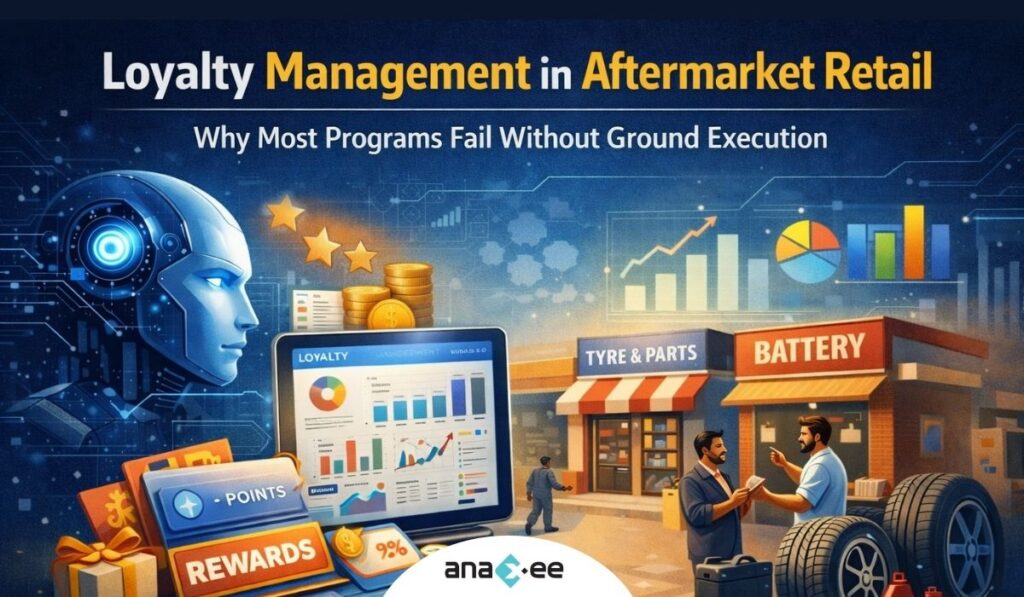

Most companies believe loyalty is about rewards.
Give points. Offer schemes. Run incentives.
And customers—or in this case, retailers and distributors—will stay loyal.
But that’s not how it works in aftermarket.
In reality, loyalty is not built through schemes.
It is built through consistent engagement, trust, and availability.
And this is exactly where most loyalty programs fail.
What is a Loyalty Management Platform (In Simple Terms)
A loyalty management platform is a system that helps brands:
- Design reward programs
- Track engagement
- Incentivize repeat purchases
- Build long-term relationships
It typically works through:
- Points or rewards
- Tier-based benefits
- Personalized offers
- Referral incentives
The goal is simple:
👉 Increase repeat business and engagement after the first sale
Why Loyalty Matters More Than Ever
Retail is becoming more competitive.
Products are similar. Pricing is similar. Margins are tight.
So what differentiates brands?
👉 Relationships
Loyalty programs help:
- Retain customers
- Increase repeat purchases
- Improve lifetime value
- Create brand advocates
And here’s the key insight:
👉 Retaining customers is cheaper than acquiring new ones
But Here’s the Problem in Aftermarket
Most loyalty strategies are designed for FMCG or D2C.
They assume:
- Digital transactions
- Direct customer relationships
- Structured retail networks
But aftermarket doesn’t work like that.
The Ground Reality of Aftermarket Loyalty
In aftermarket categories like:
- Tyres
- Batteries
- Lubricants
- Auto parts
- Agri inputs
The buying chain looks like this:
👉 Company → Distributor → Retailer → Mechanic → Customer
Now ask yourself:
- Who is actually influencing the purchase?
- Who should you build loyalty with?
- Who controls demand?
The answer is not simple.
And that’s why most loyalty programs fail.
Where Traditional Loyalty Programs Break
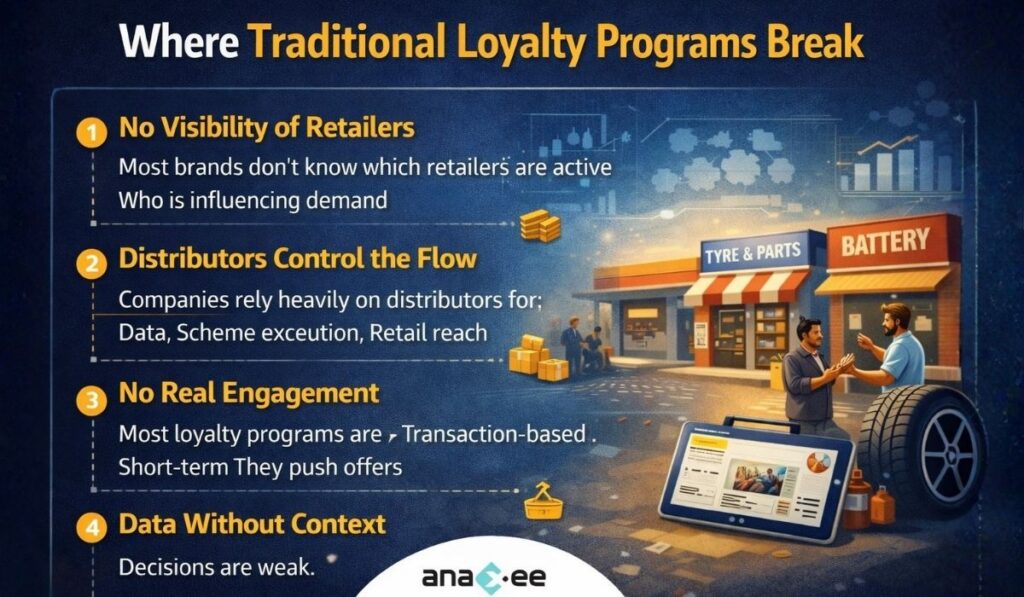
Let’s break it down clearly.
1. No Visibility of Retailers
Most brands don’t even know:
- Which retailers are active
- Who is selling their product
- Who is influencing demand
Without this, loyalty programs are guesswork.
2. Distributors Control the Flow
Companies rely heavily on distributors for:
- Data
- Scheme execution
- Retail reach
But:
👉 Not all distributors push equally
👉 Not all schemes reach retailers
3. No Real Engagement
Most loyalty programs are:
- Passive
- Transaction-based
- Short-term
They don’t build relationships.
They just push offers.
4. Data Without Context
Even when companies collect data:
- It is delayed
- It is incomplete
- It lacks ground validation
So decisions are weak.
What Actually Builds Loyalty in Aftermarket
Let’s be clear.
Retailers don’t stay loyal because of points.
They stay loyal because:
- The brand is available
- The distributor is responsive
- The company engages regularly
- The product moves fast
Loyalty is not emotional alone.
👉 It is operational.
The Shift: From Loyalty Programs to Loyalty Systems
This is where things are changing.
From:
👉 Running schemes
To:
👉 Building loyalty systems
A modern loyalty strategy includes:
- Data + execution
- Incentives + engagement
- Visibility + control
Role of AI in Loyalty Management
AI is changing how loyalty works.
Instead of generic schemes, brands can now:
- Personalize rewards
- Identify high-value retailers
- Track engagement patterns
- Predict demand
Retail loyalty platforms today use data and analytics to deliver personalized experiences and improve engagement
But again:
👉 AI is only as good as the data it gets
And in aftermarket, data is the biggest gap.
6 Practical Ways to Build Loyalty in Aftermarket
Here’s what actually works:
1. Identify the Right Retailers
Not all retailers matter equally.
You need to know:
- High-volume sellers
- Influencers (mechanic-linked shops)
- Growth potential retailers
2. Build Direct Retail Visibility
Stop depending only on distributors.
Create your own:
- Retail database
- Market mapping
- Ground intelligence
3. Engage Beyond Transactions
Don’t just give schemes.
Also:
- Educate retailers
- Build relationships
- Solve problems
4. Track Scheme Effectiveness
Ask:
- Did the retailer receive the benefit?
- Did it impact sales?
Most companies don’t track this.
5. Use Data to Personalize
Not every retailer needs the same incentive.
Segment based on:
- Location
- Sales
- Potential
6. Combine Loyalty with Execution
This is the most important.
Without execution:
👉 Loyalty programs are just marketing campaigns
With execution:
👉 They become growth drivers
Where Anaxee Fits In
Most companies try to solve loyalty with software.
Anaxee solves it with execution + intelligence.
Step 1: Build Retail Visibility
- Identify and map retailers
- Verify real presence
- Create a strong base
Step 2: Capture Real-Time Data
- Ground-level inputs
- Market insights
- Retail feedback
Step 3: Enable Smart Loyalty
Now you can:
- Target the right retailers
- Design better schemes
- Track actual impact
Step 4: Drive Activation
- Ensure schemes reach
- Improve retailer participation
- Strengthen relationships
Why This Approach Works
Because it solves the real problem:
👉 Lack of visibility + lack of control
Instead of assuming loyalty,
You build it systematically.
Final Thought
Most companies think:
👉 “If we launch a loyalty program, retailers will stay loyal.”
But loyalty doesn’t come from programs.
It comes from:
- Presence
- Engagement
- Trust
- Consistency
Loyalty platforms are useful.
But without execution, they are incomplete.
And in aftermarket—
👉 Execution is everything.
About Anaxee
Anaxee Digital Runners is a last-mile execution and retail intelligence company helping brands scale in fragmented markets across India. With a strong on-ground network and tech-enabled workflows, Anaxee enables companies to identify the right retailers, activate markets faster, and capture real-time data from the field.
For non-FMCG and aftermarket brands, Anaxee bridges the gap between strategy and execution—turning visibility into measurable growth.
Call to Action
If you are running loyalty programs but not seeing real impact on the ground, it’s time to rethink your approach.
Reach out to us at sales@anaxee.com to build a loyalty strategy that actually works in the market.