
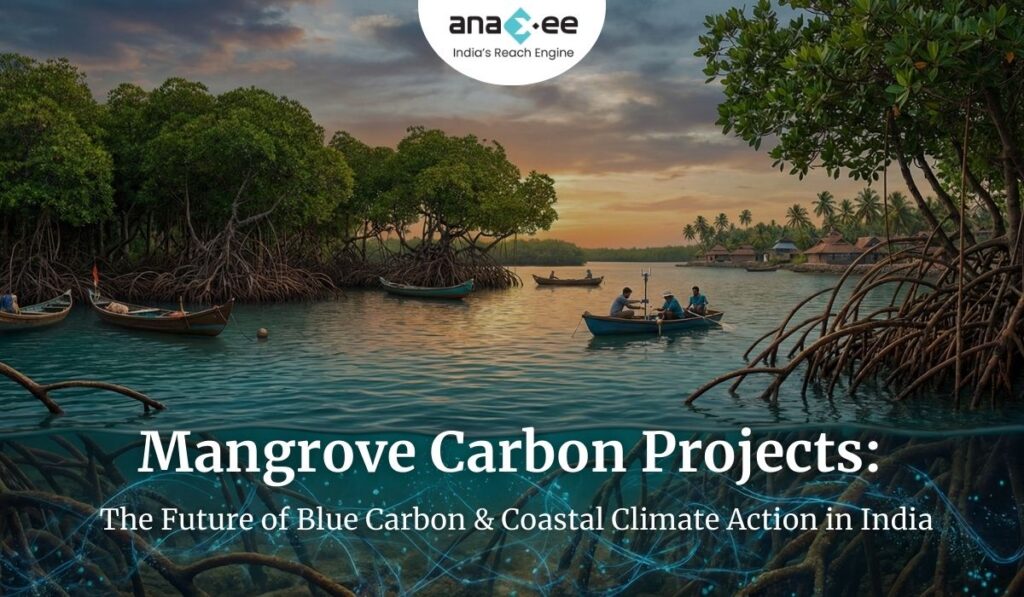

If you spend even a few minutes studying coastal climate risks, one thing becomes obvious: we’re running out of buffers. Sea levels are rising, cyclones are getting stronger, and erosion is eating away at coastlines faster than many states can respond.
Yet, there’s a solution that sits quietly between land and sea—one that stores carbon far more efficiently than most terrestrial forests, protects vulnerable communities, and rebuilds entire ecosystems.
We’re talking about mangroves.
And today, mangrove carbon projects are finally getting the global attention they deserved decades ago.
This blog breaks down, in simple terms, what mangrove carbon projects are, why they matter, and how Anaxee fits into scaling them responsibly across India and beyond.
Why Mangroves Should Matter to Every Carbon Developer and Corporate Climate Team
Let’s start with the fundamentals. Mangroves are not just another “tree plantation project.” They are a unique ecosystem that offers climate, biodiversity, and livelihood benefits simultaneously.
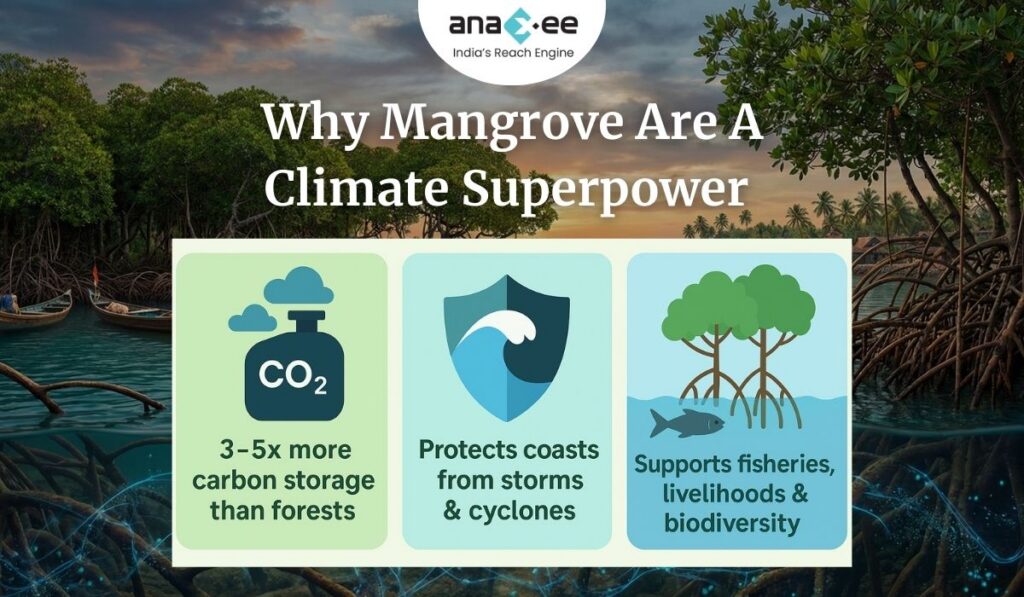
Here are three reasons they’re becoming a global priority:
1. Mangroves store 3–5 times more carbon than terrestrial forests
This isn’t marketing fluff—it’s a hard-science reality.
Mangroves trap enormous amounts of carbon in their biomass + deep soil layers, which can be several meters thick. This is why the world refers to their impact as blue carbon.
When restored properly, they become one of the highest-carbon-stock project types available to developers today.
2. They protect coasts better than any engineering structure
During cyclones or storm surges, mangroves absorb impact, reduce flooding, and protect both infrastructure and communities.
A healthy mangrove belt can reduce wave height by 30–70%, depending on density.
No sea wall or concrete barrier comes close to providing this kind of resilience at such a low cost.
3. They support fisheries, livelihoods, and biodiversity
This part is often ignored in carbon discussions.
Mangroves act as nurseries for countless marine species, sustain fishing livelihoods, and create pockets of biodiversity in regions that otherwise face ecological pressure.
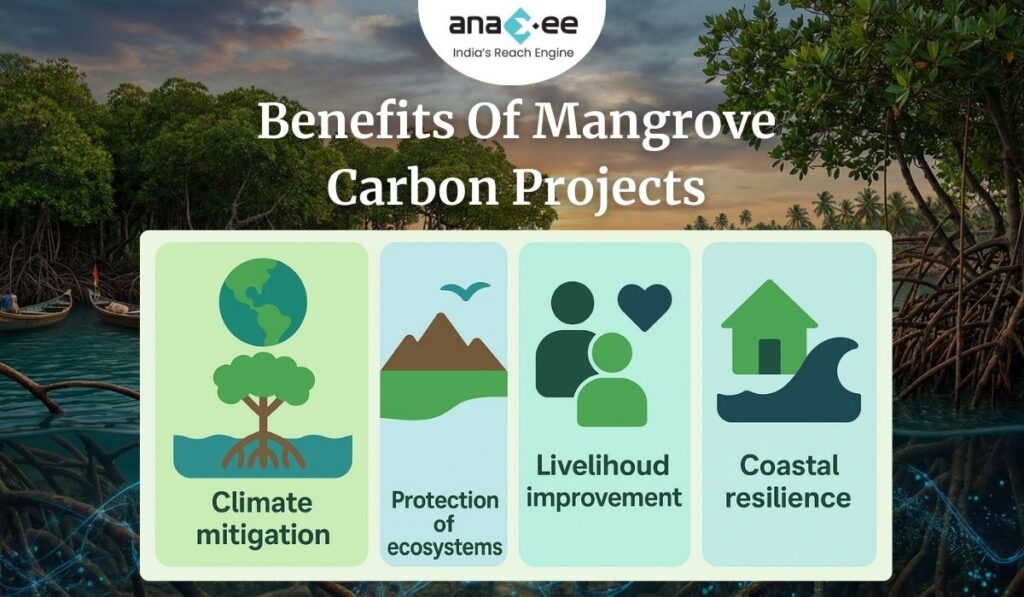
In short, mangroves are climate mitigation + climate adaptation + community development in one package.
But Then Comes the Reality Check: Mangrove Projects Are Not Easy
A lot of people romanticize mangroves.
Yes, they are incredible.
But they’re also notoriously difficult to restore and even harder to maintain.
Here’s the uncomfortable truth:
1. You can’t “just plant” mangroves
They are highly sensitive to:
- salinity levels
- tidal flow
- sediment movement
- hydrology
- elevation
- species selection
- micro-habitats
One wrong assumption and the survival rate collapses.
2. Local community buy-in is non-negotiable
Fisherfolk, coastal farmers, crab collectors—everyone has a stake in the same land. Unless communities see direct value, retention becomes a struggle.
3. Data and monitoring challenge most developers
Mangrove MRV requires:
- biomass growth measurements
- soil carbon sampling
- tidal mapping
- satellite imaging
- survival rate tracking in remote coastal belts
Many developers underestimate this and end up with poorly documented baselines—an issue that later affects validation/verification.
This is where Anaxee brings something unique to the table, especially in large-scale projects.
What Exactly Are Mangrove Carbon Projects? A Simple Breakdown
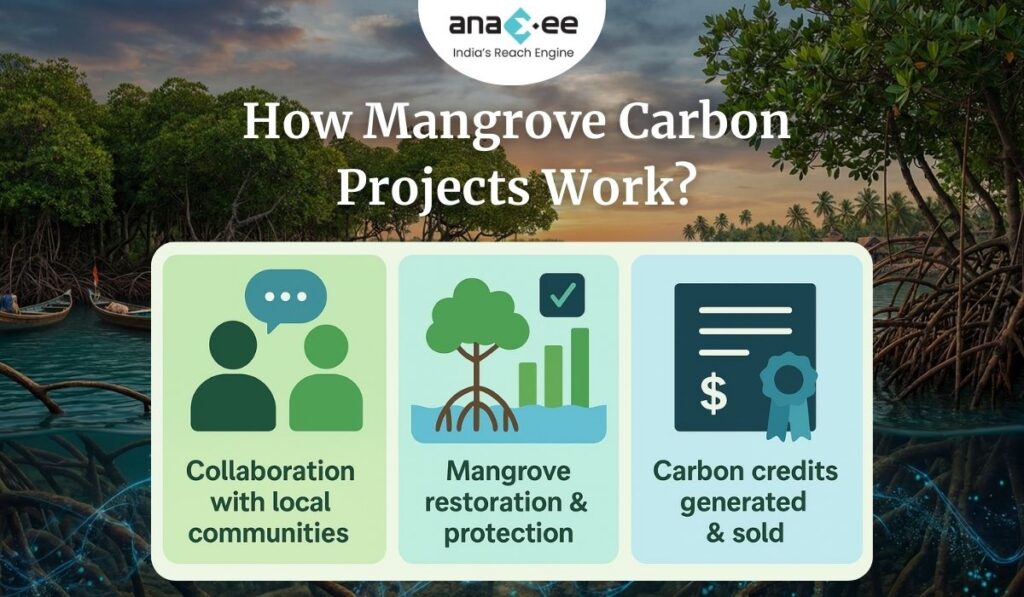
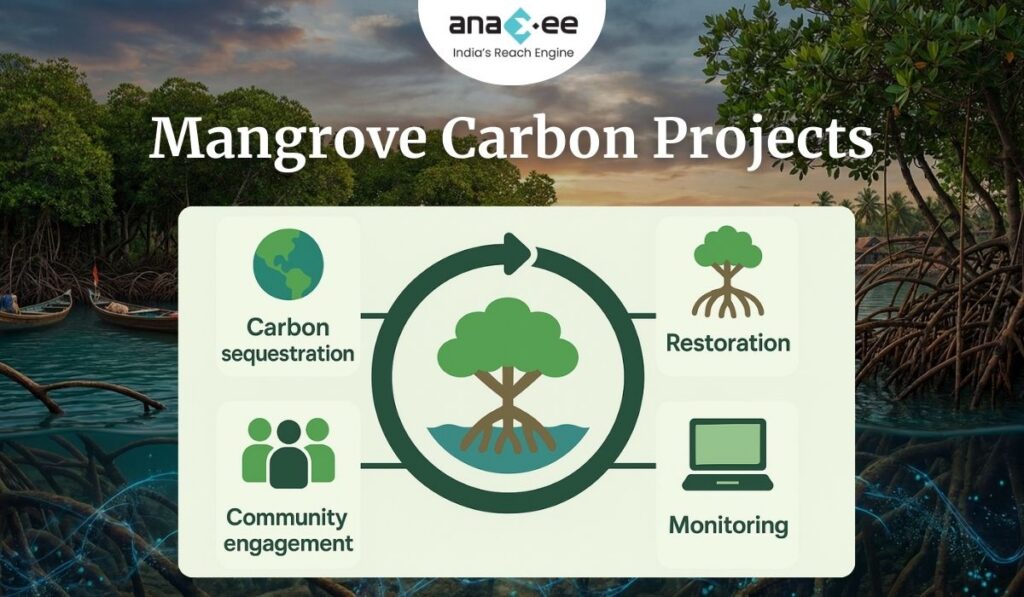
A mangrove carbon project is essentially a structured effort to restore and/or protect mangrove ecosystems while generating carbon credits.
Most projects fall under three buckets:
1. Mangrove Restoration (Planting + Hydrology Correction)
This is the most common type.
The goal is to bring back mangroves in degraded areas by improving tidal flow, correcting hydrology, and planting suitable species.
2. Mangrove Protection / Conservation
Here, the focus is preventing further degradation through:
- patrolling,
- community co-management,
- sustainable livelihood programs.
These projects are usually REDD+ style interventions adapted for coastal ecosystems.
3. Agro-mangrove / Silvo-fisheries Models
Some regions follow mixed-use models where mangroves coexist with shrimp ponds or paddy fields.
These can be structured into carbon programs if designed properly.
Each project type comes with different carbon accounting rules, different baselines, and different timelines.
So, How Do Mangroves Generate Carbon Credits?
Let’s keep it simple—there are two main sources:
1. Above-ground biomass
This is the carbon stored in the mangrove trees themselves:
branches, trunks, leaves.
2. Soil carbon
This is where mangroves outperform most ecosystems.
Their soils store massive amounts of carbon, accumulated over centuries.
With the right methodology (e.g., VCS blue carbon frameworks), a mangrove project can generate credits through:
- restoration,
- avoided degradation,
- improved ecosystem management.
The math is complex, but the principle is straightforward:
healthy, expanding mangroves = carbon removal + avoided emissions.
Where Anaxee Fits in: Scaling Mangrove Carbon Projects with Tech + Last-Mile Execution
You can have a great methodology, great funding, and great intent.
But if you can’t execute at the last mile, everything falls apart.
Mangroves especially require consistent field presence, not just one-time plantation events.
This is where Anaxee’s strengths add real value.
1. Local Digital Runners for Monitoring
Mangrove belts are often remote and difficult to access.
Satellite data alone won’t capture survival rates, species variation, or hydrological issues.
Anaxee’s Digital Runners allow:
- frequent field visits,
- geo-tagged photo/video evidence,
- plot-level survival tracking,
- anomaly detection.
This solves one of the biggest operational gaps in blue carbon projects.
2. Land & Community Mobilization
One of the hardest parts of mangrove projects is land access and community acceptance.
With deep rural access in India, Anaxee helps:
- identify suitable stretches,
- engage local groups,
- build co-management models,
- ensure long-term maintenance.
3. dMRV (Digital Monitoring, Reporting & Verification)
Mangrove projects require continuous documentation.
Anaxee supports with:
- digital baselines,
- satellite overlays,
- survival audits,
- hydrology condition records,
- dashboards for corporate buyers.
This ensures transparency—an absolute requirement in today’s carbon market.
4. Plantation Execution with Scientific SOPs
Planting mangroves is not just digging holes.
Anaxee helps implement:
- species-zone alignment
- tidal mapping
- nursery development
- community-led stewardship
5. Multi-year Maintenance Framework
Carbon buyers want assurance that planted mangroves will survive for years.
Anaxee’s long-term field presence tackles this gap.
In short:
Anaxee bridges the gap between carbon developers, coastal communities, and ground execution.
India’s Mangrove Potential: More Massive Than Most People Realize
India has around 4,900+ sq km of mangroves—much of which can be strengthened, expanded, or restored.
States with the highest potential include:
- Gujarat
- Maharashtra
- Karnataka
- Kerala
- Tamil Nadu
- Andhra Pradesh
- Odisha
- West Bengal
Large stretches are degraded due to shrimp farms, embankments, and industrial pressure.
Restoration in these areas can unlock millions of tonnes of high-quality blue carbon credits over project lifetimes.
Corporate buyers are increasingly searching for:
- nature-based removal credits
- high permanence credits
- biodiversity-linked programs
- coastal resilience projects
Mangroves sit at the exact intersection of all these priorities.
Future Outlook: Mangrove Projects Are Not a Trend—they’re a Long-Term Necessity
If you look at climate risks over the next 10–20 years, mangroves become a frontline defence strategy.
Cyclone-prone states need protection.
Fishing communities need stable ecosystems.
Companies need durable, high-integrity carbon credits.
Developers need project types with strong science behind them.
Mangroves tick all boxes.
The demand for blue carbon credits is growing, and as methodologies improve, mangrove projects will likely be among the most trusted categories in the voluntary carbon market.
But scaling them requires consistent ground execution, transparent data, and community-first design.
That’s exactly where Anaxee is positioning itself.
Conclusion: Mangroves Are Climate Infrastructure—Not Just Trees
If India wants to build climate resilience while tapping into high-value carbon pathways, mangrove projects are non-negotiable.
They are powerful, scientifically proven, and socially meaningful.
The opportunity is real.
The demand is rising.
The coastal regions are ready.
Now it’s about executing at scale with accuracy, transparency, and community alignment—which is what Anaxee specializes in.
About Anaxee:
Anaxee is building the Climate infrastructure platform that helps Carbon Project developers and Climate investors maintain continuity of their project over its lifetime. From field data to verified credits. They believe the future of carbon projects lies in trust, transparency, and technology working together.
Anaxee Digital Runners helps in implementation of large-scale, country-wide, climate and Carbon Credit projects across India. Anaxee focuses on Nature-Based Solutions (NbS) and community-driven interventions, including agroforestry, regenerative agriculture, improved cookstoves, solar devices, and clean water systems.
Anaxee’s “Tech for Climate” infrastructure integrates a tech-enabled, feet-on-street network with digital MRV (Measurement, Reporting, and Verification) systems to ensure transparency and real-time validation for every carbon project. By combining data intelligence with local execution, Anaxee enables corporates, investors, and verifiers to trust the integrity, additionality, and traceability of each carbon credit. This approach bridges the gap between communities and global carbon markets, advancing scalable and verifiable climate action across India.