
Introduction: Carbon Markets Have a Measurement Problem
Carbon credits are built on a simple promise:
One credit = One tonne of verified CO₂e reduced or removed.
But agriculture complicates that promise.
Unlike industrial projects, where emissions reductions can be directly metered, agricultural carbon outcomes are:
- Distributed
- Variable
- Influenced by climate & soil conditions
- Difficult to measure consistently
This is where MRV — Measurement, Reporting & Verification — becomes decisive.
Without credible MRV, agriculture carbon credits struggle with:
❌ Buyer skepticism
❌ Verification delays
❌ Discounted pricing
❌ Integrity concerns
With robust MRV, the same projects can command premium market value.
1️⃣ What Exactly Is MRV in Carbon Projects?
MRV refers to the structured process of:
✔ Measurement – Quantifying emissions reductions or removals
✔ Reporting – Documenting methodologies & results
✔ Verification – Independent third-party validation
In agriculture carbon projects, MRV must capture:
🌱 Practice adoption
🌱 Soil carbon changes
🌱 Emission reductions
🌱 Leakage risks
🌱 Permanence safeguards
MRV is not paperwork.
It is the credibility engine of carbon finance.
2️⃣ Why Traditional MRV Struggles in Agriculture
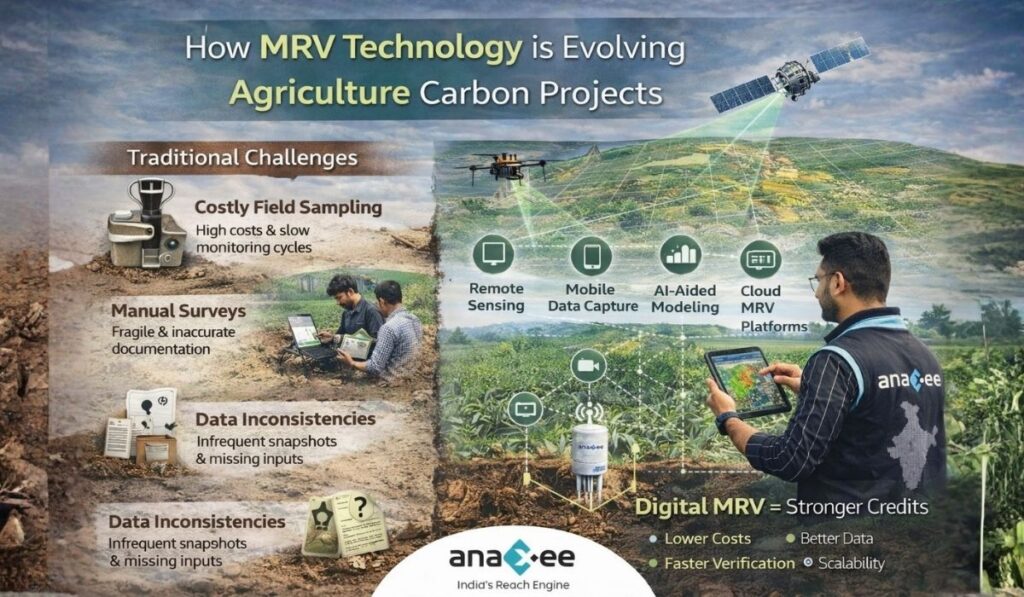
Historically, MRV relied heavily on:
📍 Field visits
📍 Manual surveys
📍 Soil sampling
📍 Static datasets
Problems quickly emerged:
⚠️ High monitoring costs
⚠️ Infrequent measurement cycles
⚠️ Sampling errors
⚠️ Data gaps
⚠️ Limited scalability
For smallholder-dominated regions like India:
- Farms are fragmented
- Practices vary widely
- Documentation is inconsistent
- Access is geographically challenging
Traditional MRV often becomes financially and operationally unsustainable.
3️⃣ Enter MRV Technology: The Structural Shift
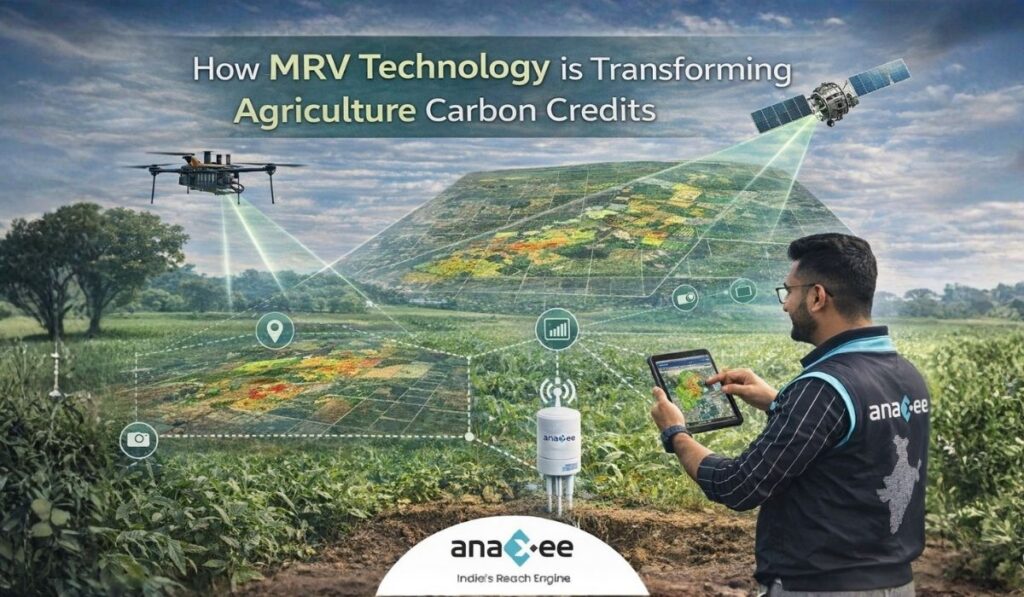
Modern agriculture carbon projects increasingly depend on technology-enabled MRV systems.
These combine:
📡 Remote Sensing & Satellite Monitoring
Enables:
✔ Land-use tracking
✔ Crop cover assessment
✔ Vegetation analysis
✔ Change detection over time
Impact:
📈 Reduced field dependency
📈 Continuous monitoring
📈 Lower verification friction
📱 Mobile-Based Field Data Collection
Allows:
✔ Geo-tagged evidence
✔ Time-stamped records
✔ Digital surveys
✔ Practice documentation
Impact:
📊 Stronger audit trails
📊 Higher data reliability
📊 Faster reporting cycles
🤖 AI & Data Modeling
Supports:
✔ Soil carbon estimation
✔ Adoption probability modeling
✔ Risk analysis
✔ Reversal forecasting
Impact:
📈 Better carbon projections
📈 Conservative crediting
📈 Reduced overestimation risk
🌐 Cloud-Integrated MRV Platforms
Deliver:
✔ Centralized data systems
✔ Real-time dashboards
✔ Evidence repositories
✔ Verification-ready reporting
Impact:
📊 Transparency
📊 Scalability
📊 Investor confidence
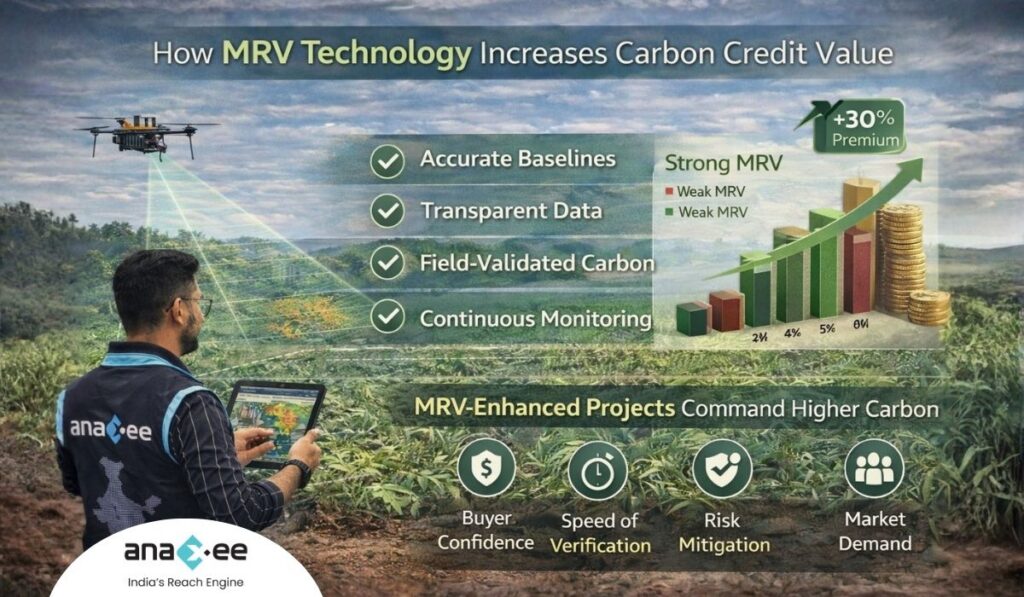
4️⃣ How MRV Technology Increases Carbon Credit Value
Carbon credit pricing increasingly reflects quality & integrity, not just volume.
Robust MRV directly improves:
✔ Credit defensibility
✔ Buyer trust
✔ Verification speed
✔ Transparency
✔ Risk mitigation
Which leads to:
💰 Higher buyer willingness to pay
💰 Lower discounting
💰 Faster issuance
💰 Stronger project economics
In short:
Better MRV → Higher-Value Credits
5️⃣ The Illusion: Technology Alone Is Not Enough
Here’s where many projects miscalculate.
Deploying tools ≠ solving MRV.
Common failures:
❌ Fancy dashboards with weak field data
❌ Satellite models without ground truthing
❌ Data collection apps without adoption discipline
❌ Fragmented tech stack
MRV technology must be supported by:
📍 Last-mile execution
📍 Structured workflows
📍 Human engagement
📍 Data validation loops
Otherwise:
👉 Garbage in → Garbage out
🚀 Where Anaxee’s Model Becomes Critical
Agriculture MRV doesn’t fail due to lack of software.
It fails at the ground interface.
Anaxee’s strength lies precisely there.
🔹 Last-Mile Data Infrastructure
Anaxee’s distributed field force enables:
✔ Geo-tagged farmer data
✔ Practice verification
✔ Photo/video evidence
✔ Continuous monitoring inputs
This solves:
📉 Data gaps
📉 Adoption uncertainty
📉 Audit inconsistencies
🔹 Human + Digital MRV Integration
Instead of “tech replacing fieldwork,” Anaxee delivers:
✔ Tech-enabled field execution
✔ Standardized data workflows
✔ Quality assurance processes
Result:
📊 Verifiable, defensible datasets
🔹 Scalable Smallholder MRV
Smallholder landscapes are the hardest MRV environment.
Anaxee enables:
✔ Farmer aggregation
✔ Cluster-level monitoring
✔ Workflow standardization
✔ Cost-efficient scaling
🔹 Verification-Ready Evidence Chains
Anaxee systems ensure:
✔ Time-stamped records
✔ Digital traceability
✔ Structured reporting outputs
Reducing:
🚫 Credit rejection risk
🚫 Verification delays
🔹 Continuous Monitoring Discipline
Carbon markets increasingly value:
📈 Ongoing performance evidence
📈 Not one-time measurement snapshots
Anaxee’s recurring field presence sustains:
✔ Monitoring cycles
✔ Data refresh reliability
6️⃣ Why This Transformation Matters for the Market
Carbon markets are evolving:
Old mindset:
❌ Estimate → Issue → Sell
Emerging reality:
✔ Measure → Validate → Defend → Monetize
Buyers now scrutinize:
- MRV robustness
- Reversal risk
- Additionality proof
- Data transparency
Agriculture credits with weak MRV face:
📉 Discounting
📉 Reputation risk
📉 Demand erosion
Credits backed by strong MRV gain:
📈 Premium pricing
📈 Long-term buyer interest
7️⃣ Strategic Implication for Project Developers
If you’re designing agriculture carbon projects:
👉 MRV is not a compliance task
👉 MRV is a pricing strategy
👉 MRV is a risk strategy
👉 MRV is an investment strategy
Ignoring MRV design early leads to:
⚠️ Delays
⚠️ Cost escalation
⚠️ Verification friction
Embedding MRV from Day 1 leads to:
📈 Predictability
📈 Credibility
📈 Market acceptance
Conclusion: Integrity Is the New Currency
Agriculture holds enormous potential for carbon removal and emissions reduction.
But markets reward:
✔ Verified outcomes
✔ Transparent data
✔ Credible MRV systems
MRV technology is not just improving efficiency.
It is redefining:
🌱 Credit integrity
🌱 Buyer trust
🌱 Pricing potential
🌱 Scalability
And when combined with Anaxee’s execution-first, last-mile delivery model, projects move from:
“Conceptually viable” → “Commercially credible.”
Because in carbon markets:
👉 Measurement builds trust
👉 Trust drives value
👉 Value sustains projects