

Who Actually Runs India’s Carbon Market?
When people hear “carbon market,” they imagine buyers and sellers.
But that’s only the visible layer.
Underneath, there’s a system of institutions and infrastructure that makes the market function. Without this backbone, trading would be chaotic, unreliable, and easy to manipulate.
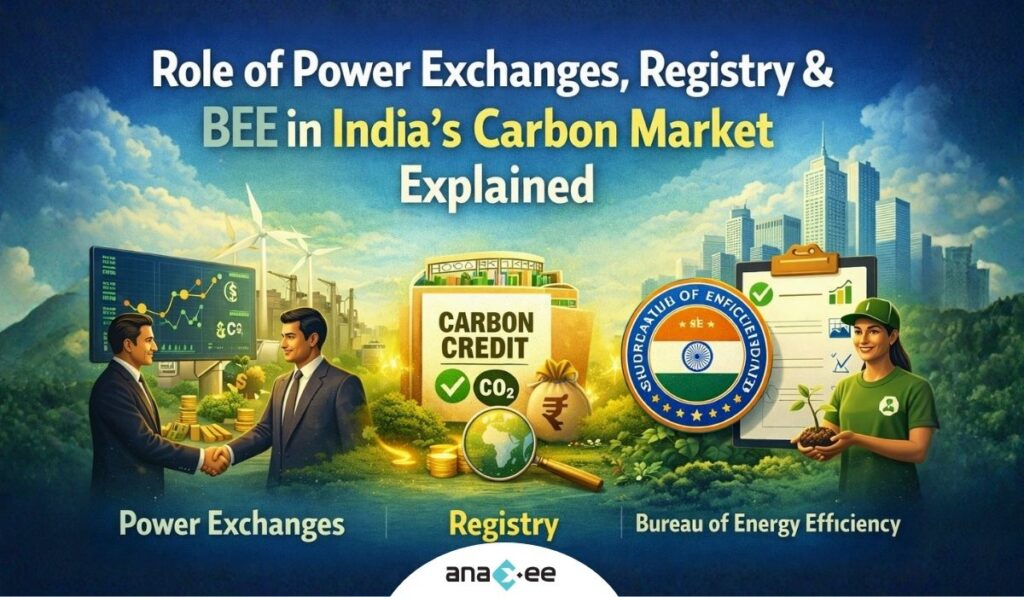
India’s carbon market, under CCTS 2023 and CERC 2026 regulations, is built on three key pillars:
- Power Exchanges
- Registry (Grid Controller of India)
- Bureau of Energy Efficiency (BEE)
Each one plays a very specific role. And more importantly, they must work together seamlessly.
Power Exchanges: The Marketplace
Let’s start with the most visible layer.
Power exchanges are where:
- Buyers place bids
- Sellers offer carbon credits
- Prices are discovered
Think of them as the stock exchange for carbon credits.
Why Power Exchanges?
India could have created a new platform for carbon trading.
But instead, it chose to use existing power exchanges.
That’s a strategic move.
Because power exchanges already have:
- Trading infrastructure
- Participants (industries, utilities)
- Regulatory oversight
- Settlement systems
👉 This reduces friction and speeds up market launch.
What Do Power Exchanges Actually Do?
Their role is not just matching buyers and sellers.
They also:
- Run bidding sessions
- Enable price discovery
- Ensure transaction transparency
- Report trade data to the registry
Important Limitation
Trading is restricted to exchanges (unless allowed otherwise).
This means:
👉 No random off-market deals
This improves:
- Trust
- Standardization
- Price visibility
Registry: The Backbone of Trust
Now comes the most critical component—the registry.
Without the registry, the market cannot function.
What Is the Registry?
It is a centralized digital system that:
- Stores carbon credits
- Tracks ownership
- Records every transaction
Think of it like:
👉 A bank account system for carbon credits
Why Is Registry So Important?
Because carbon credits are intangible.
You cannot physically verify them like goods.
So the system must ensure:
- No double counting
- No fake credits
- No duplicate sales
How It Works
Every entity gets a registry account.
When a trade happens:
- Seller’s account is debited
- Buyer’s account is credited
This ensures:
👉 Ownership is always clear and verifiable
Key Safeguard
The registry also checks:
- Whether a seller actually owns the credits they are selling
If not:
👉 The transaction is cancelled
And repeated violations can lead to penalties.
BEE: The System Administrator
Now let’s talk about the controlling authority.
The Bureau of Energy Efficiency (BEE) acts as the administrator of the carbon market.
What Does BEE Actually Do?
BEE is not trading. It is governing the system.
Its responsibilities include:
- Creating procedures for trading
- Registering entities
- Monitoring compliance
- Sharing market data
- Coordinating with registry and exchanges
Why This Role Matters
Markets don’t regulate themselves well—especially new ones.
Without BEE:
- Rules would be unclear
- Participation would be inconsistent
- Manipulation risks would increase
BEE as a Control Layer
BEE ensures:
- Transparency
- Standardization
- Accountability
👉 It is the referee of the market
How These Three Work Together
Individually, each system is important.
But the real strength lies in their integration.
Simple Flow
- BEE defines rules and procedures
- Registry stores and tracks credits
- Power exchanges enable trading
After a trade:
- Exchanges report transaction
- Registry updates ownership
- BEE monitors overall system
Why Integration Is Critical
If even one link breaks:
- Registry errors → ownership disputes
- Exchange issues → pricing distortion
- BEE failure → weak compliance
👉 The market loses credibility instantly
Hidden Complexity Most People Ignore
On paper, this structure looks clean.
In reality, execution is complex.
Challenges Include:
- Real-time data sync between exchange and registry
- Accurate verification before issuance
- Preventing system misuse
- Handling disputes
Biggest Risk
Not policy.
👉 Operational failure
Because carbon markets are:
- Data-heavy
- Process-heavy
- Trust-dependent
Why This Structure Is Smart (But Not Perfect)
India has chosen to:
- Use existing infrastructure
- Avoid building from scratch
That’s efficient.
But it also means:
- Systems must adapt quickly
- Coordination must be strong
Final Thought
A carbon market is not just about buyers and sellers.
It is about systems that ensure trust.
In India’s case:
👉 Power exchanges create the market
👉 Registry secures the system
👉 BEE governs the process
If these three function well together, the market can scale.
If not, even the best policy will fail in execution.
About Anaxee:
Anaxee drives large-scale, country-wide Climate and Carbon Credit projects across India. We specialize in Nature-Based Solutions (NbS) and community-driven initiatives, providing the technology and on-ground network needed to execute, monitor, and ensure transparency in projects like agroforestry, regenerative agriculture, improved cookstoves, solar devices, water filters and more. Our systems are designed to maintain integrity and verifiable impact in carbon methodologies.
Beyond climate, Anaxee is India’s Reach Engine- building the nation’s largest last-mile outreach network of 100,000 Digital Runners (shared, tech-enabled field force). We help corporates, agri-focused companies, and social organizations scale to rural and semi-urban India by executing projects in 26 states, 540+ districts, and 11,000+ pin codes, ensuring both scale and 100% transparency in last-mile operations. Connect with Anaxee at sales@anaxee.com