
Carbon removal isn’t just a climate buzzword anymore. It’s a strategic necessity if the world is serious about reaching net-zero emissions — not someday, but within this decade.
In recent years, demand for credible and verifiable carbon removal has accelerated. Buyers — from multinational corporations to impact investors — no longer want credits that are good enough. They want assurance that every tonne of CO₂ removed from the atmosphere is measurable, traceable, and permanent.
Yet traditional mechanisms for monitoring, reporting, and verification (MRV) — manual surveys, periodic field audits, and paper-based evidence — are hitting a ceiling. They’re slow, expensive, limited in scope, and often inconsistent across geographies. If carbon markets are to scale beyond boutique pilots and become a pillar of climate finance, we need technology built for purpose — not tech for hype’s sake.
At Anaxee, we believe the next era of carbon markets will be defined by how well technology enables trust at scale. And more importantly, how technology supports those who deliver climate action on the ground — communities, project developers, and local partners — especially in regions like India, where scale and diversity of landscapes are vast.
The Core Challenge: Trust and Scale in Carbon Removal
Before innovation entered the picture, carbon removal suffered from two fundamental limitations:
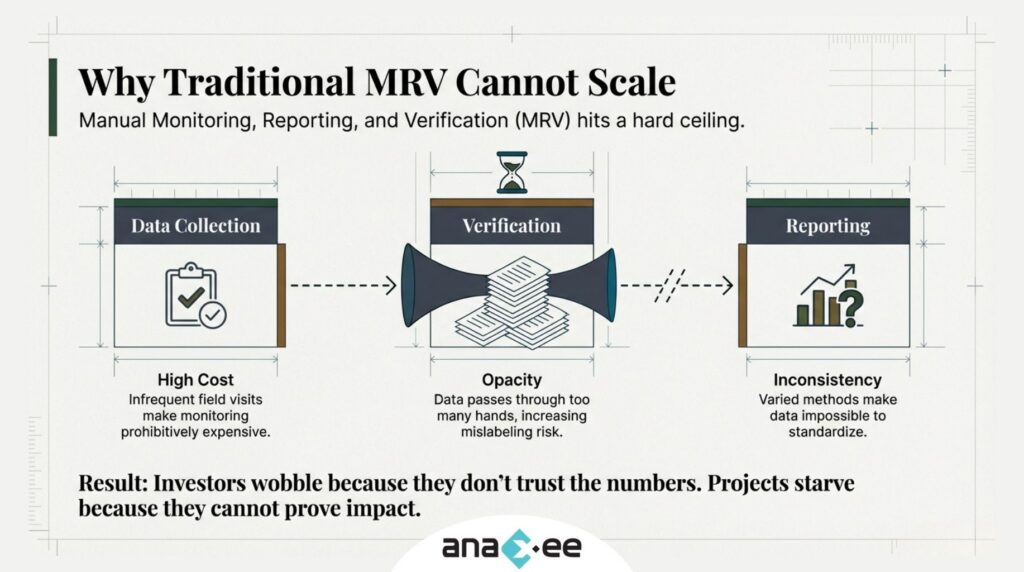
- High Cost of Verification
Traditional verification involves infrequent field visits and manual data aggregation. This makes ongoing, high-frequency monitoring prohibitively expensive and slow. For many project developers, especially in rural or remote regions, rigorous MRV simply doesn’t fit within realistic budgets. - Opacity in Reporting
Project data often travels through multiple intermediaries — field teams, data collectors, verifiers, registries — increasing the risk of inconsistencies, mislabeling, and gaps in transparency. For corporate buyers, this translates to uncertainty about what they’re actually paying for.
These limitations aren’t just operational; they shape perceptions of carbon removal’s legitimacy. Buyers wobble because they don’t trust the numbers. Developers struggle to finance projects because investors demand credible, quantifiable evidence of impact.
Technology doesn’t magically fix climate change. But the right technology makes climate finance credible, traceable, and investable.

Fit-for-Context Tools — What Really Matters
Not all tech is equal. The climate space has seen an influx of shiny tech jargon — blockchain wallets, generative AI dashboards, fancy tokenization — that don’t fundamentally change how carbon projects deliver impact on the ground. At Anaxee, we focus on tools that actually solve practical problems in carbon removal:
### 1. Purpose-Built Digital MRV (dMRV)
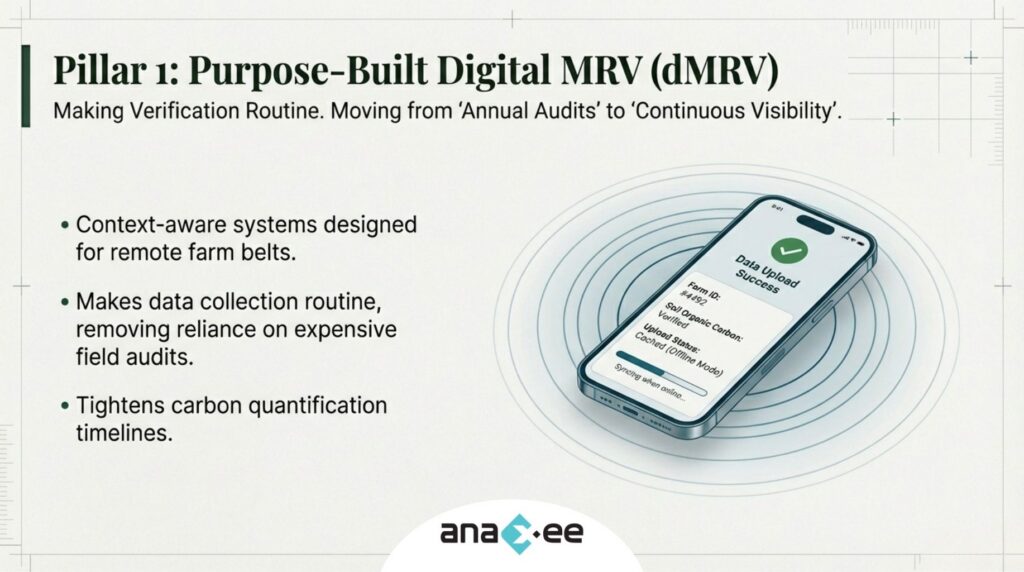
Instead of generic platforms designed for a broad range of use cases, we foreground context-aware digital monitoring, reporting, and verification systems that account for:
- Low-connectivity environments
- Smallholder landscapes
- Multi-stakeholder data inputs (satellite + field sensors + community observations)
This isn’t about flashy analytics — it’s about accuracy, consistency, and usability for people who are implementing projects — not just analysts in climate tech hubs.
Flexible dMRV makes data collection routine — even in remote farm belts — and reduces reliance on expensive field audit cycles. It keeps carbon quantification timelines tight and reporting transparent.
2. Satellite + Field Integration
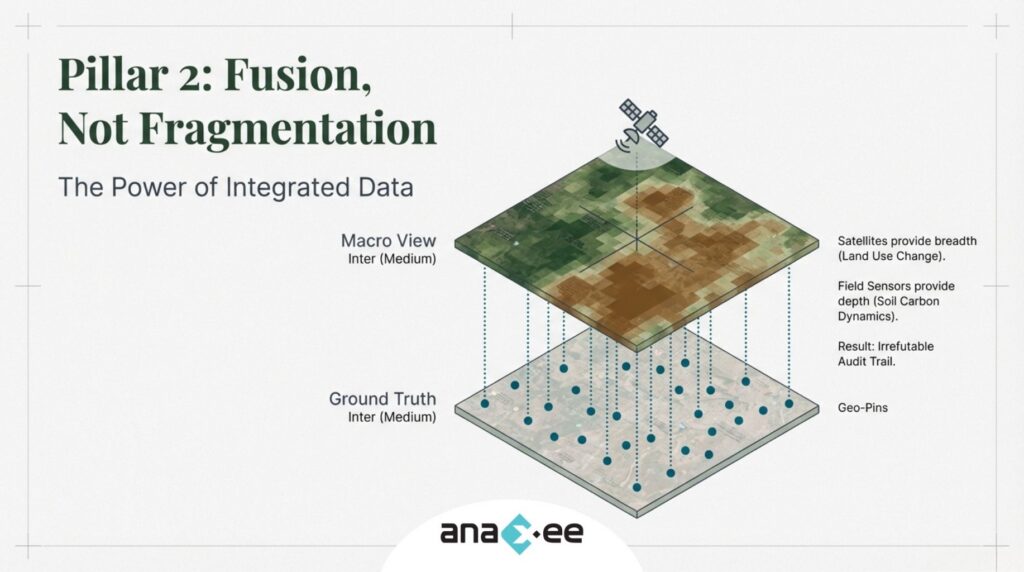
Remote sensing is not new — but its application in carbon markets is only now maturing. Integrating high-resolution satellite imagery with on-ground sensors helps overcome two perennial hurdles in carbon accounting:
- Timeliness: We can detect land-use changes and biomass shifts with higher frequency.
- Validation: Field sensors ground the remote data with real measurements — improving confidence in biomass estimates and soil carbon dynamics.
Unlike one-size-fits-all technology stacks, what matters is fusion — not fragmentation — of data sources.
3. Data Integrity Without the Gimmicks
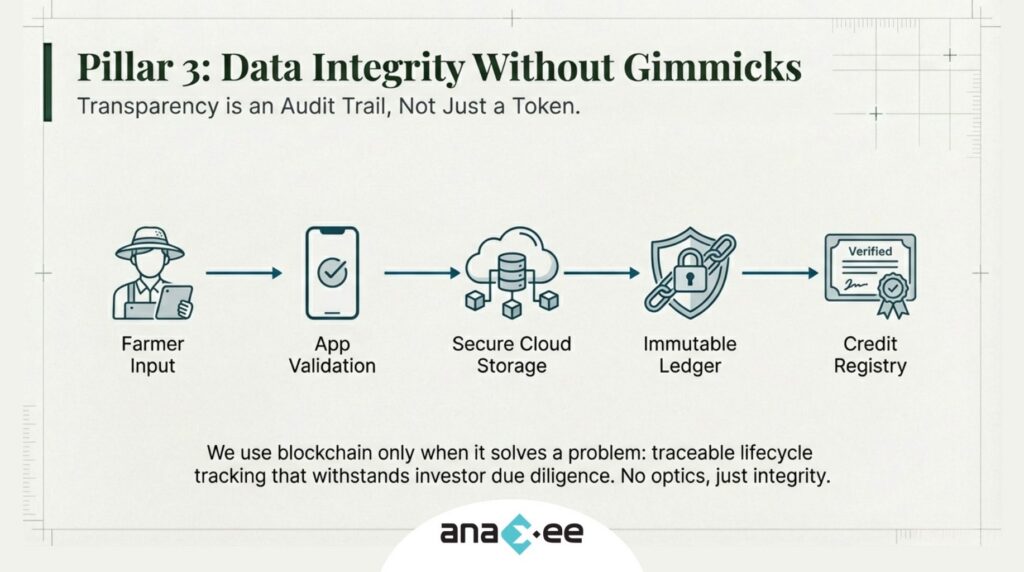
Blockchain gets thrown around as a solution to every transparency issue. At Anaxee, we’re clear: blockchain is a tool when it solves a real problem — not a badge for optics.
We prioritise traceable credit lifecycle tracking, clear audit trails, and secure, consistent reporting — with or without distributed ledgers. The goal isn’t to use blockchain for its own sake. It’s to ensure data integrity and investor confidence at every step.
The Real-World Impact of Technology in Carbon Removal
Let’s move from concepts to actual influence. When we apply technology where it matters — in project implementation and monitoring — tangible results emerge:
🚜 Empowered Local Implementation
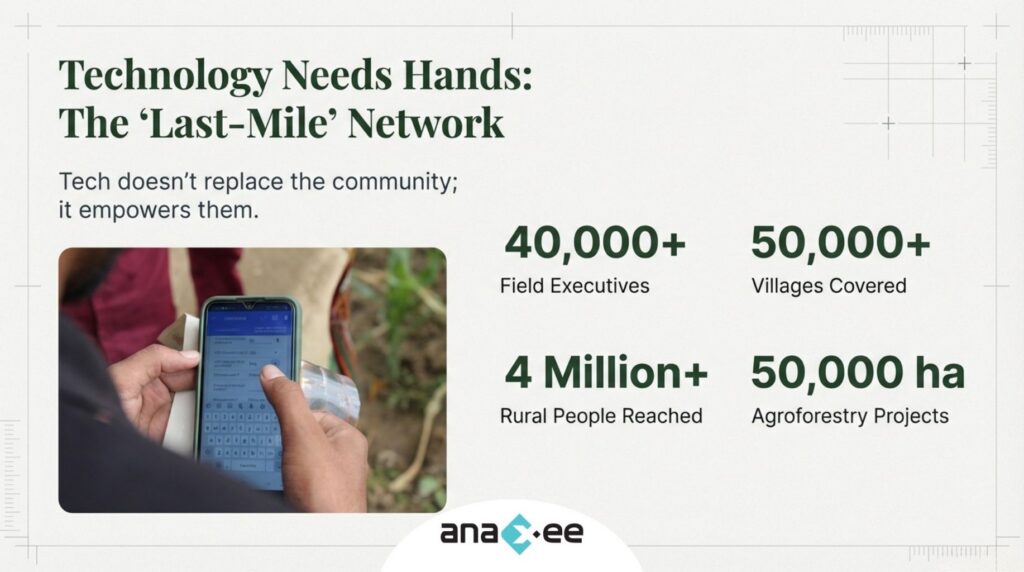
Technology isn’t just about dashboards in city offices. It’s about equipping field teams and community partners with tools they can use every day — for planning, tracking growth, and reporting soil health. This increases agency at the execution level and reduces errors that stem from manual record-keeping.
For instance, farmers participating in agroforestry and regenerative agriculture projects can contribute data via mobile interfaces that sync with cloud systems. So the data reflects real activity, not approximations.
🌱 Credible Carbon Credits That Stand Scrutiny
With reliable MRV and integrated data, carbon credits generated through technology-assisted frameworks hold up under investor due diligence and corporate audit processes. This enhances buyer confidence and creates demand for high-integrity credits.
Growing demand leads to improved pricing and liquidity for quality credits, which in turn attracts more capital into the market.
📊 Lower Cost, Higher Frequency Monitoring
Instead of waiting months for periodic field visits, technology enables continuous monitoring that reduces overall transaction costs, accelerates verification cycles, and allows developers to report more consistently to registries and buyers.
This is a game changer for projects that otherwise would be stymied by verification bottlenecks.
Why We Focus on Climate Projects Rooted in Real Landscapes
At Anaxee, we work at the intersection of technology, climate markets, and real-world project implementation — especially in regions like India and the Global South, where:
- Agricultural landscapes and forest ecosystems are vast
- Smallholder farmers make up a significant portion of land stewards
- Digital literacy and connectivity vary widely across regions
This means that technology must be practical, accessible, and adapted to context — not imported from northern-centric assumptions about cloud connectivity and data infrastructure.
Our work shows that when technology meets on-ground realities:
- Carbon removal projects become bankable and scalable — because they align verification frequency with investor expectations.
- Communities benefit economically and socially — projects that improve soil health, crop yields, and water retention don’t just sequester carbon; they build resilience.
- Climate finance becomes accountable and traceable — buyers can link dollars to verified impact with clarity.
What’s Next for Tech-Driven Carbon Markets
We’re already seeing new tools enter the carbon ecosystem — from advanced soil sensors that measure sequestration in near real-time to edge-AI that enables localised data processing even where connectivity is limited. These developments aren’t futuristic — they’re happening now.
The next phase won’t be defined by more tech, but by smarter integration — technology that:
- Reduces barriers for project developers
- Lowers costs of credible MRV
- Improves verification frequency and transparency
- Connects carbon data directly with finance systems
The imperative is clear: for climate action to scale, credibility and trust must be baked into the foundations of carbon markets. That’s where technology truly earns its place.
Final Thought: Technology as an Enabler — Not a Gimmick
Carbon markets don’t need buzzwords. They need tools that solve real challenges faced by developers, verifiers, buyers, and communities. At Anaxee, that’s the technology we build.
Every tonne of CO₂ removed should represent a verified, measurable climate impact — and every carbon credit sold should reflect quantifiable value for buyers and real uplift for communities.
That’s the promise of technology that’s fit for context — and that’s the future of carbon removal.