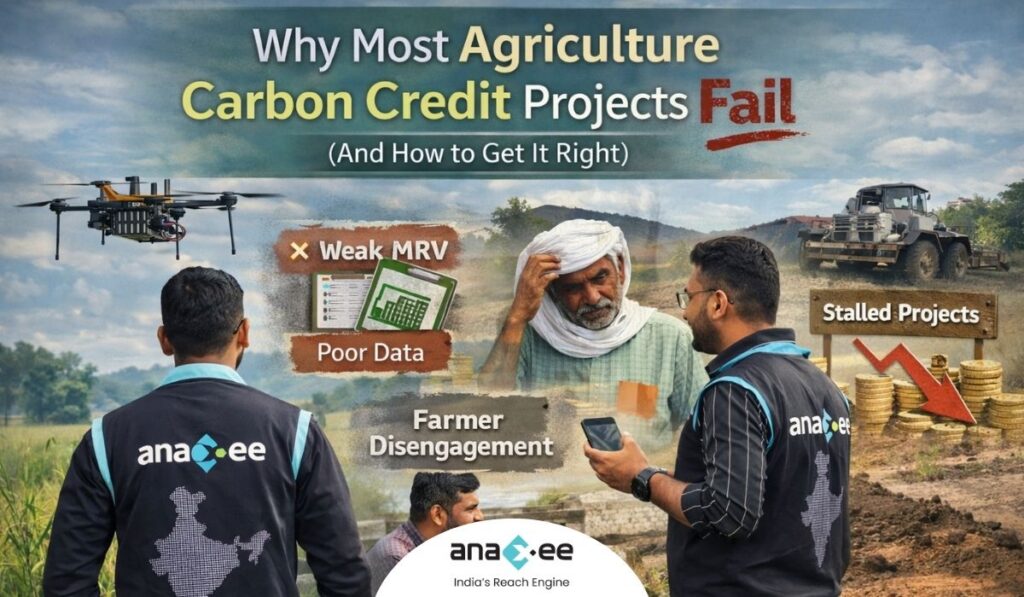

Introduction: The Uncomfortable Reality
Agriculture is widely promoted as the next frontier of carbon credit generation. The narrative is compelling: farmers adopt regenerative practices, carbon is sequestered in soils, credits are issued, incomes rise, and corporations meet climate goals.
Yet behind the optimism lies a harder truth:
A significant number of agriculture carbon credit projects underperform, stall, or fail entirely.
Not because the science is invalid.
Not because farmers are unwilling.
But because execution, measurement, and incentives are often misaligned.
Carbon markets reward outcomes — not intentions.
1️⃣ Weak Measurement, Reporting & Verification (MRV)
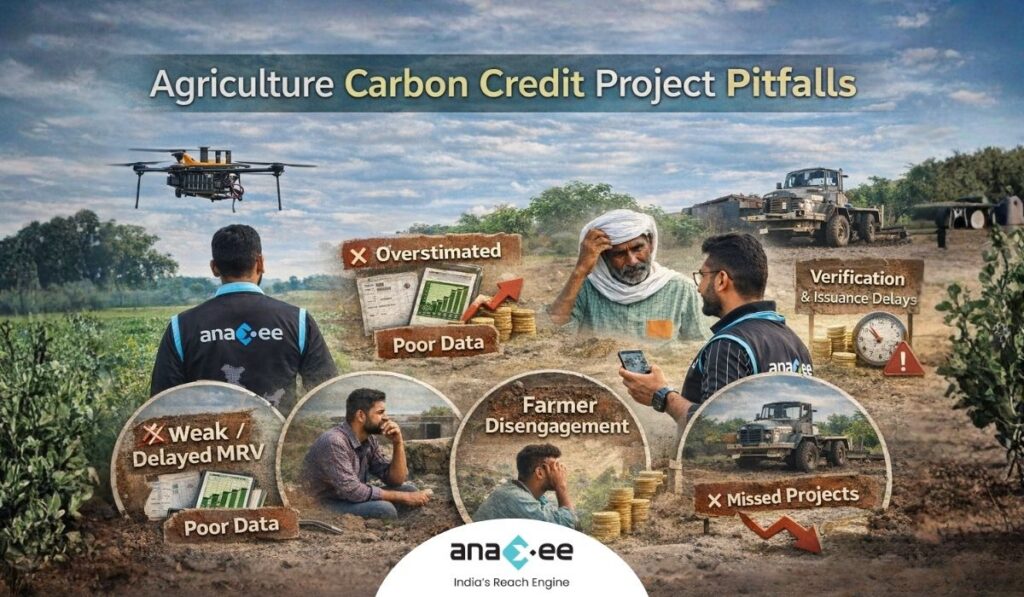
The most common failure point is MRV fragility.
Agricultural carbon is inherently complex:
- Soil carbon fluctuates naturally
- Weather variability distorts outcomes
- Farming practices differ widely
- Sampling is expensive and inconsistent
Projects frequently collapse under:
❌ Inadequate baseline data
❌ Poor sampling design
❌ Inconsistent monitoring cycles
❌ Lack of digital traceability
Without defensible MRV:
- Credits are delayed
- Verification bodies raise objections
- Buyers discount pricing
- Project economics deteriorate
Reality check:
If carbon cannot be measured credibly, it cannot be monetized reliably.
2️⃣ Overestimated Carbon Projections
Early project models often rely on optimistic sequestration assumptions.
Typical issues:
- Uniform sequestration rates applied across diverse geographies
- Ignoring soil saturation limits
- Underestimating reversal risks
- Treating adoption as guaranteed
The result:
📉 Actual carbon outcomes < projected outcomes
📉 Credit issuance < financial expectations
📉 Investor confidence erodes
Carbon accounting is unforgiving.
Exaggeration today becomes a liability tomorrow.
3️⃣ Poor Farmer Engagement & Incentive Design
Many projects underestimate the human dimension.
From a farmer’s perspective:
- Carbon revenue is uncertain
- Payments are delayed
- Practice changes involve risk
- Benefits are intangible initially
Common engagement failures:
❌ Complex onboarding processes
❌ Weak training & education
❌ Delayed incentives
❌ No local trust network
❌ Misaligned expectations
Farmers don’t abandon projects because they reject sustainability.
They disengage when:
👉 Economic value is unclear
👉 Processes are confusing
👉 Promises feel distant
4️⃣ Fragmented Smallholder Landscapes
Agriculture carbon projects often target smallholder farmers, especially in India.
Challenges include:
- Landholding fragmentation
- Diverse crop systems
- Variable documentation
- Dispersed geographies
- Inconsistent practice adoption
Without aggregation capability:
⚠️ Monitoring costs escalate
⚠️ Data quality drops
⚠️ Leakage risks increase
⚠️ Verification complexity multiplies
Scaling smallholder carbon projects is logistics-heavy, not spreadsheet-heavy.
5️⃣ Verification & Methodology Misalignment
Projects sometimes fail due to methodological mismatches.
Examples:
- Activities not fully aligned with chosen standard
- Inadequate permanence safeguards
- Insufficient leakage mitigation
- Data gaps during audit
Verification bodies are increasingly stringent.
If documentation, field data, and evidence chains are weak:
🚫 Credits are rejected
🚫 Issuance is delayed
🚫 Reputation risk increases
Carbon markets are moving from volume-driven to integrity-driven.
6️⃣ Delayed Financial Flows
Carbon projects are long-cycle investments.
But projects falter when:
❌ Farmers wait years for returns
❌ Upfront costs are unsupported
❌ Revenue timelines are unrealistic
❌ Cash flow gaps appear
Without structured financial planning:
💸 Adoption slows
💸 Drop-outs increase
💸 Project viability weakens
✅ How to Get It Right
Understanding failure points is only useful if it informs better design and execution.
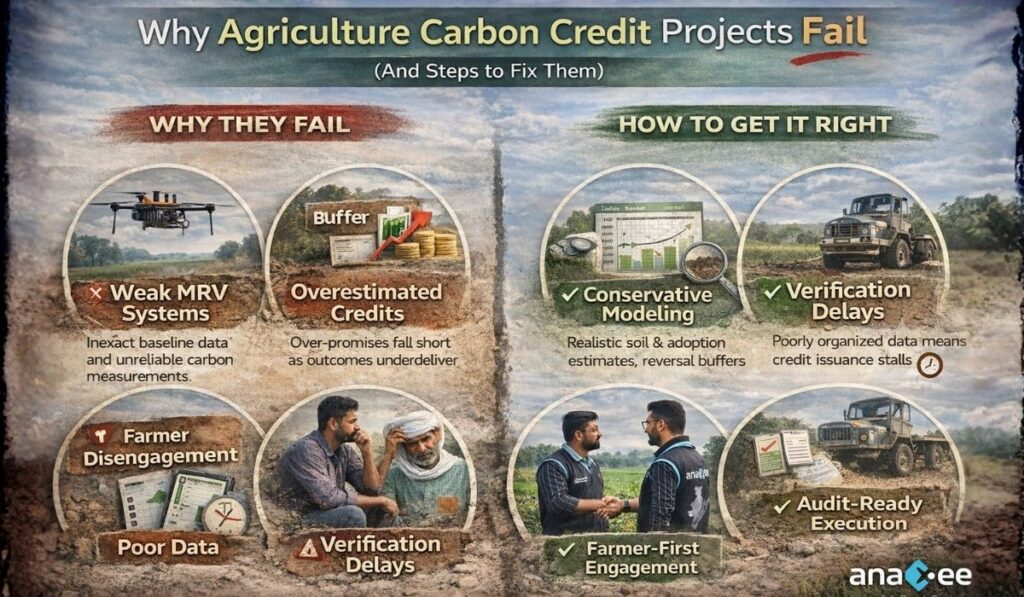
✔️ Build MRV Before Scaling
Strong projects treat MRV as infrastructure, not an afterthought.
This means:
✔️ Defensible baselines
✔️ Hybrid measurement (field + remote sensing)
✔️ Repeatable monitoring cycles
✔️ Digital audit trails
✔️ Transparent reporting systems
MRV robustness directly influences:
📈 Credit acceptance
📈 Buyer confidence
📈 Pricing premium
✔️ Use Conservative Carbon Estimates
Credible projects avoid inflated projections.
Better approach:
✔️ Region-specific models
✔️ Soil-type differentiation
✔️ Reversal buffers
✔️ Realistic adoption curves
Underpromise. Overdeliver.
Markets reward reliability.
✔️ Design Farmer-First Incentives
Successful projects align with farmer economics:
✔️ Clear value communication
✔️ Early benefit visibility
✔️ Simplified participation
✔️ Local training & trust building
✔️ Predictable payment structures
Carbon projects succeed when farmers see:
👉 Practical benefits
👉 Reduced risk
👉 Tangible income potential
✔️ Solve Aggregation & Last-Mile Execution
This is where many models break — and where Anaxee becomes critical.
🚀 Where Anaxee Changes the Equation
Agriculture carbon projects don’t fail at strategy level.
They fail at execution level.
Anaxee addresses precisely that gap.
🔹 Last-Mile Data & Monitoring
Anaxee’s distributed field force enables:
✔️ On-ground data capture
✔️ Geo-tagged evidence
✔️ Practice verification
✔️ Farmer-level traceability
This strengthens:
📊 MRV credibility
📊 Audit readiness
📊 Credit defensibility
🔹 Farmer Engagement Infrastructure
Carbon adoption is behavioural change.
Anaxee provides:
✔️ Local presence
✔️ Training workflows
✔️ Continuous follow-up
✔️ Trust-based relationships
Turning:
“Sustainability initiative” → “Farmer opportunity”
🔹 Aggregation & Scale Management
Fragmented landscapes demand structured aggregation.
Anaxee enables:
✔️ Farmer clustering
✔️ Standardized workflows
✔️ Monitoring consistency
✔️ Cost efficiency at scale
🔹 Verification-Ready Execution
Anaxee’s systems ensure:
✔️ Evidence chains
✔️ Digital documentation
✔️ Process discipline
✔️ Compliance alignment
Reducing:
🚫 Credit rejection risk
🚫 Audit friction
🚫 Revenue delays
📌 The Strategic Insight
Agriculture carbon credits are not:
❌ A pure climate initiative
❌ A simple financial product
❌ A technology-only solution
They are a multi-layer execution challenge involving:
🌱 Science
📊 Measurement
👨🌾 Human behaviour
📍 Logistics
💰 Incentives
📑 Compliance
Projects succeed when these layers are integrated — not isolated.
Conclusion: Quality Credits Require Quality Execution
Carbon markets are evolving fast.
Buyers increasingly demand:
✔️ Integrity
✔️ Transparency
✔️ Verifiable impact
✔️ Low reversal risk
Which means:
Only well-designed and well-executed agriculture carbon projects will survive.
Anaxee’s value is not theoretical.
It sits where projects actually struggle:
📍 Field execution
📍 Farmer engagement
📍 Data reliability
📍 Monitoring discipline
📍 Scalable operations
Because in carbon markets:
👉 Strategy attracts attention
👉 Execution generates credits
👉 Integrity commands premium pricing