
Marketing teams today are under more pressure than ever.
Budgets are scrutinised.
Growth targets are aggressive.
And every channel is expected to prove its worth.
Yet despite more tools, more data, and more platforms than ever before, many brands are quietly facing the same outcome:
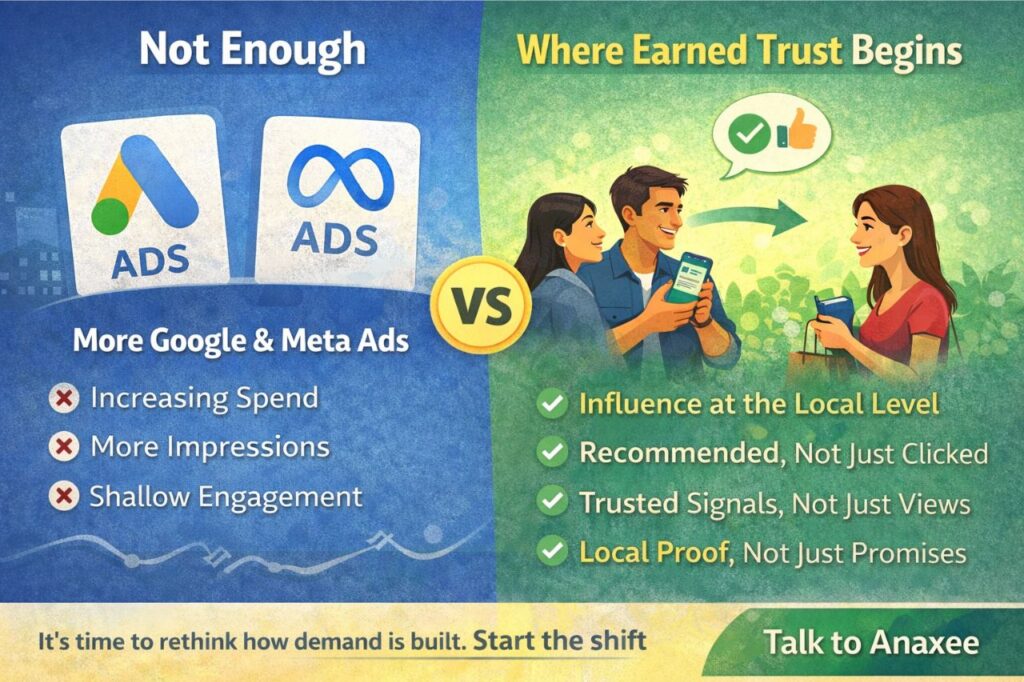
Marketing activity is increasing. Growth is not.
This isn’t because marketers are doing less.
It’s because many of the channels they rely on are no longer designed for how people actually make decisions today.
The hidden assumption behind most marketing strategies
Most traditional and digital marketing plans are built on a flawed assumption:
If we reach enough people, some of them will convert.
This logic worked when:
- Choices were limited
- Attention was cheaper
- Trust in advertising was higher
That world no longer exists.
Today’s buyers are not passive recipients of messages.
They are sceptical, comparison-driven, and socially influenced.
Reach without relevance no longer translates into growth.
Where traditional marketing starts to break down
Traditional channels still dominate many marketing budgets — especially for brands operating at scale.
Print, outdoor, events, retail branding, dealer visibility.
These channels offer:
- High visibility
- Familiar formats
- A sense of legitimacy
But they also come with structural limitations that are hard to ignore.
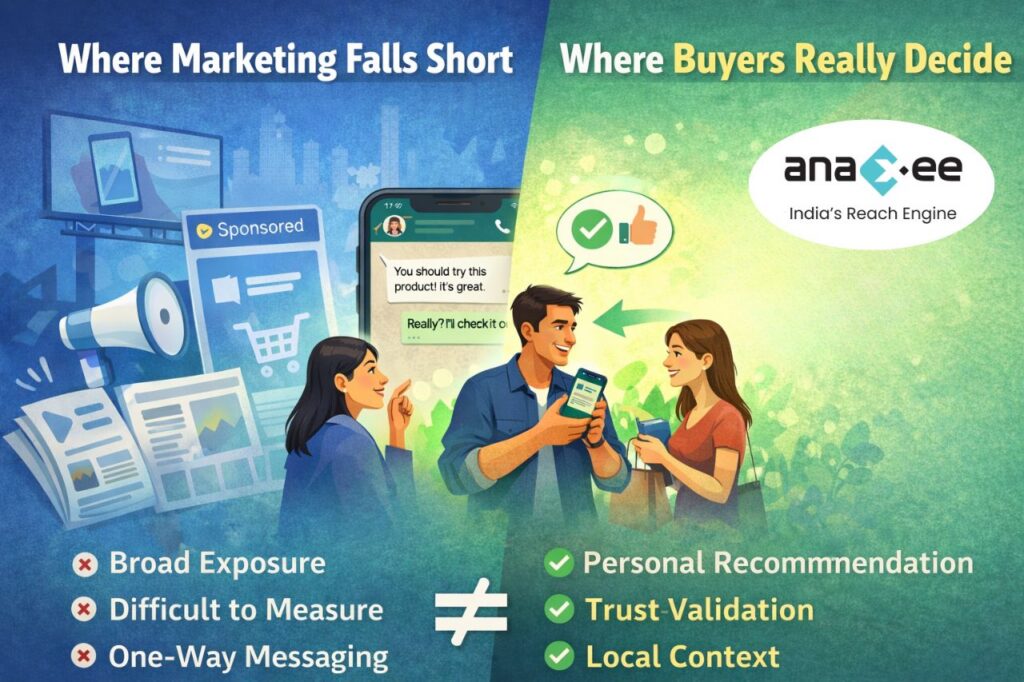
1. Broad exposure, weak influence
Traditional media broadcasts messages widely, but influence is rarely uniform. Seeing a brand doesn’t automatically translate into choosing it.
2. Poor feedback loops
It’s difficult to know what actually worked, what didn’t, and why. Decisions are often made on instinct rather than evidence.
3. One-way communication
Traditional marketing talks at people. It doesn’t participate in conversations where real validation happens.
As a result, traditional marketing often creates awareness — but struggles to create preference.
Why digital marketing isn’t filling the gap either
When traditional marketing falls short, brands turn to digital expecting precision and performance.
And to an extent, they get it.
Digital channels are strong at:
- Targeting
- Tracking
- Optimisation
But they carry their own set of limitations.
Performance without persuasion
Clicks and impressions don’t equal conviction. Many users interact with ads out of curiosity, not intent.
Short-term optimisation bias
Digital systems reward what converts now, often at the cost of long-term brand trust.
Platform dependency
As algorithms change and competition increases, brands find themselves paying more to reach the same audience.
Digital marketing can scale transactions.
It struggles to scale belief.
The common failure point: the moment of decision
If you zoom out, traditional and digital channels fail in the same place:
The moment when a customer decides what to trust.
At that moment, buyers often ask:
- Has someone like me used this?
- Does this work in my context?
- What do people around me say?
Neither a hoarding nor an Instagram ad answers these questions convincingly.
They are answered elsewhere.
How buying decisions actually happen today
In many categories — especially outside top metros — decisions are shaped by:
- Peer conversations
- Local validation
- Familiar intermediaries
- Repeated, low-pressure exposure
This process is slow, social, and contextual.
Marketing strategies that ignore this reality tend to feel disconnected — even if they are visible everywhere.
Why campaigns don’t translate into continuity
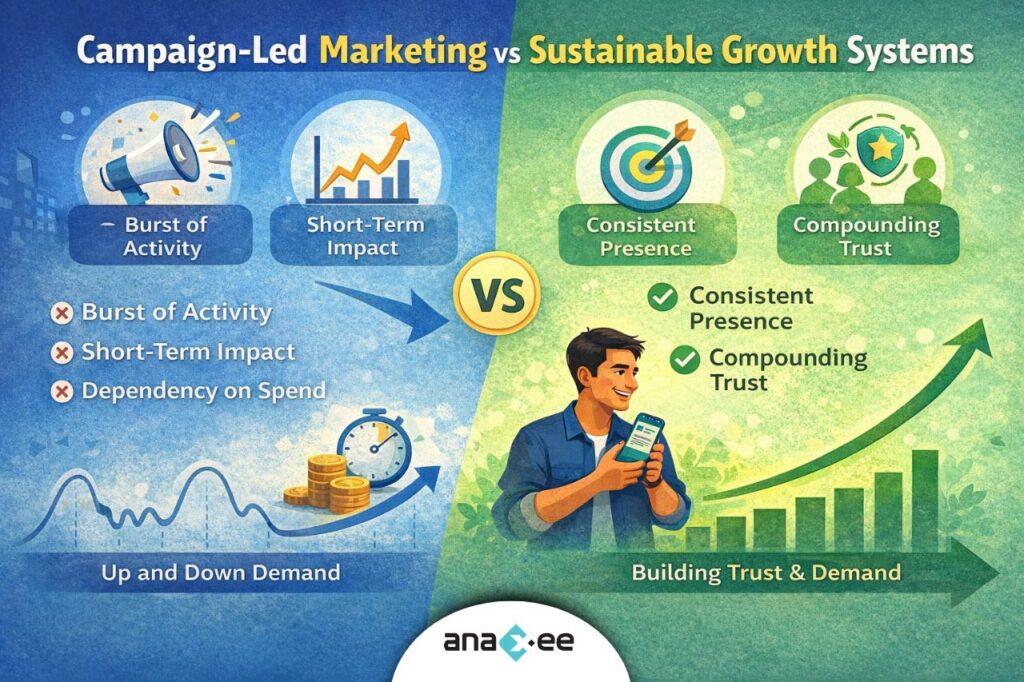
Another structural issue with traditional and digital channels is their campaign-first mindset.
Campaigns:
- Start loudly
- End abruptly
- Rely on constant reinvestment
Once the campaign ends, so does momentum.
But real growth depends on continuity — a steady reinforcement of trust that compounds over time.
This is where many brands feel stuck:
- They keep launching campaigns
- But demand resets after each one
The growing gap between awareness and adoption
Many brands today are well-known.
Ask customers, and they’ve heard the name.
They recognise the logo.
They remember the ads.
Yet adoption lags.
This gap exists because awareness is no longer the bottleneck.
Confidence is.
Marketing channels optimised for awareness struggle when the real problem is hesitation.
Why this problem is more visible in Tier 2, Tier 3, and non-metro markets
In less urbanised markets, the limitations of traditional and digital marketing are amplified.
- Advertising trust is lower
- Price sensitivity is higher
- Recommendations carry more weight
Here, people rely less on brand claims and more on lived proof.
Marketing that doesn’t integrate into local trust structures tends to bounce off.
Where Anaxee helps bridge this gap
Anaxee’s role begins where most channels stop.
Not at awareness.
But at acceptance.
Brands work with Anaxee when they realise that:
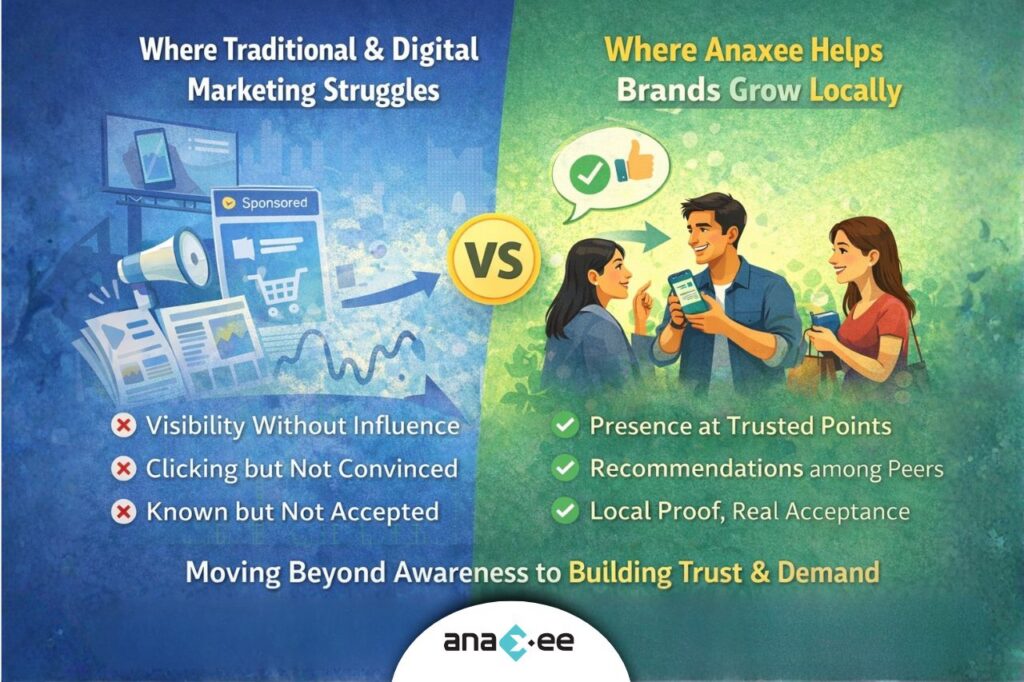
- Their marketing is visible but not influential
- Their campaigns run, but behaviour doesn’t shift
- Their brand is known, but not actively recommended
Instead of adding another layer of communication, Anaxee helps brands embed themselves into local decision environments.
This doesn’t replace existing channels.
It strengthens what those channels can’t do alone.
From exposure to endorsement
The difference between exposure and endorsement is subtle — but critical.
Exposure says: “I’ve seen this brand.”
Endorsement says: “This is a safe choice.”
Traditional and digital marketing excel at the first.
Sustainable growth depends on the second.
That transition requires:
- Repetition without fatigue
- Familiarity without force
- Presence without pressure
Which is why it rarely comes from campaigns alone.
Why brands that fix this early pull ahead
Brands that recognise these limitations early gain an advantage.
They stop chasing every new format.
They stop over-optimising surface metrics.
They invest in how demand forms, not just how it converts.
The result:
- Stronger retailer confidence
- Faster adoption cycles
- Lower resistance at the point of sale
- More stable growth over time
The question marketing leaders should ask now
It’s not:
“Which channel should we add next?”
It’s:
“Where does trust actually form — and how are we present there?”
That question changes everything.
It shifts focus from channels to systems, from noise to influence, from reach to relevance.
And that’s precisely where Anaxee helps brands rethink how marketing works in the real world.
Closing thought
Traditional and digital marketing aren’t obsolete.
They’re incomplete.
Brands that rely on them alone will keep working harder for smaller gains.
Brands that understand their limits — and design around them — will build growth that lasts beyond campaigns, platforms, and trends.