
Cookstove Carbon Projects in India: What Changed, and What It Means for Developers
If you’ve been anywhere near clean cooking carbon projects in the last two years, you know the mood shifted.
For a decade, cookstove credits were one of the easiest stories to tell. Replace a smoky mud chulha with an efficient stove, count the firewood saved, issue credits. Good for the household, good for the forest, good for the buyer’s report.
Then the numbers got checked properly. And a lot of them didn’t hold up.
What followed was the most thorough rewrite of a single project category the voluntary carbon market has attempted. If you’re developing cookstove projects in India — or funding them — the rules you learned before 2025 are largely obsolete. Here’s what actually changed and what it means on the ground.
What went wrong in the first place
Three structural problems, all of them about measurement rather than intent.
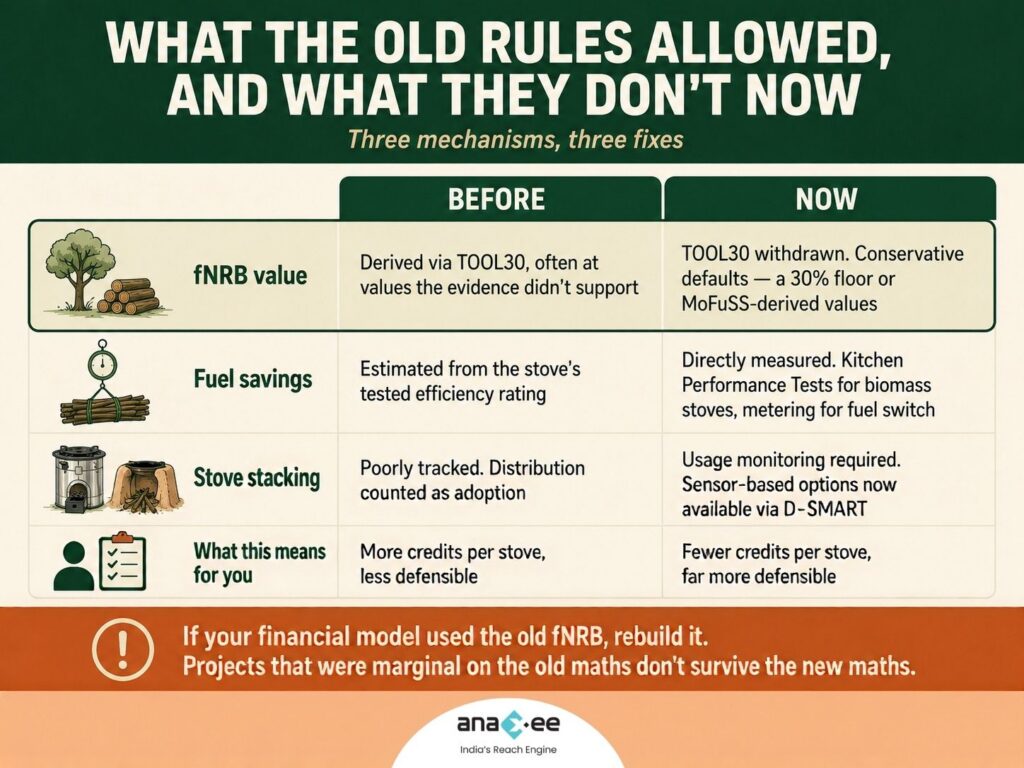
The fNRB problem. Every cookstove project has to estimate what fraction of the firewood being displaced was non-renewable — wood that wouldn’t have grown back. That figure, fNRB, sits at the heart of the credit calculation. Older projects derived it using a CDM tool that, in practice, allowed values far higher than the evidence supported. Higher fNRB, more credits, same stove.
Estimated savings instead of measured savings. Many older methodologies let developers calculate fuel savings from the stove’s tested efficiency rating rather than from what households actually burned. A stove that performs beautifully in a lab does not always perform that way over a wood fire in a village kitchen with three people cooking.
Stacking. Households rarely abandon the old stove. They use the new one for some meals and the traditional one for others — for a large pot, for a particular dish, when the fuel pellets run out. If your monitoring doesn’t catch stacking, you’re crediting a switch that only partly happened.
A 2023 UC Berkeley study quantified the over-crediting across the category and made the problem impossible to argue with. The market responded.
What changed, in order
March 2025. The ICVCM ruled on cookstove methodologies for its Core Carbon Principles label. It approved three — Gold Standard’s Metered and Measured Energy Cooking Devices, Gold Standard’s TPDDTEC version 4, and Verra’s VM0050 — all conditionally. It rejected Gold Standard’s simplified cookstove methodology and its energy-efficiency-measures methodology outright, along with two household biodigester methodologies.
The practical effect was blunt: most cookstove credits already sitting in the market couldn’t claim the label.
September 2025. The ICVCM extended approval to earlier TPDDTEC versions under additional conditions, completing its assessment of the category.
January 2026. TOOL30, the fNRB calculation tool at the centre of the over-crediting concern, was formally withdrawn. Default regional and national fNRB values moved into a different tool, and the ICVCM’s conditions push developers toward either a conservative 30% floor or values derived from the MoFuSS model.
May 2026. Gold Standard published four updated clean cooking and thermal energy methodologies, applying to 2026 credit vintages onwards. Alongside them came D-SMART — a digital stove monitoring, analysis and reporting tool that enables sensor-based monitoring with automated fuel tracking. Verra had already retired VMR0006 in favour of VM0050.
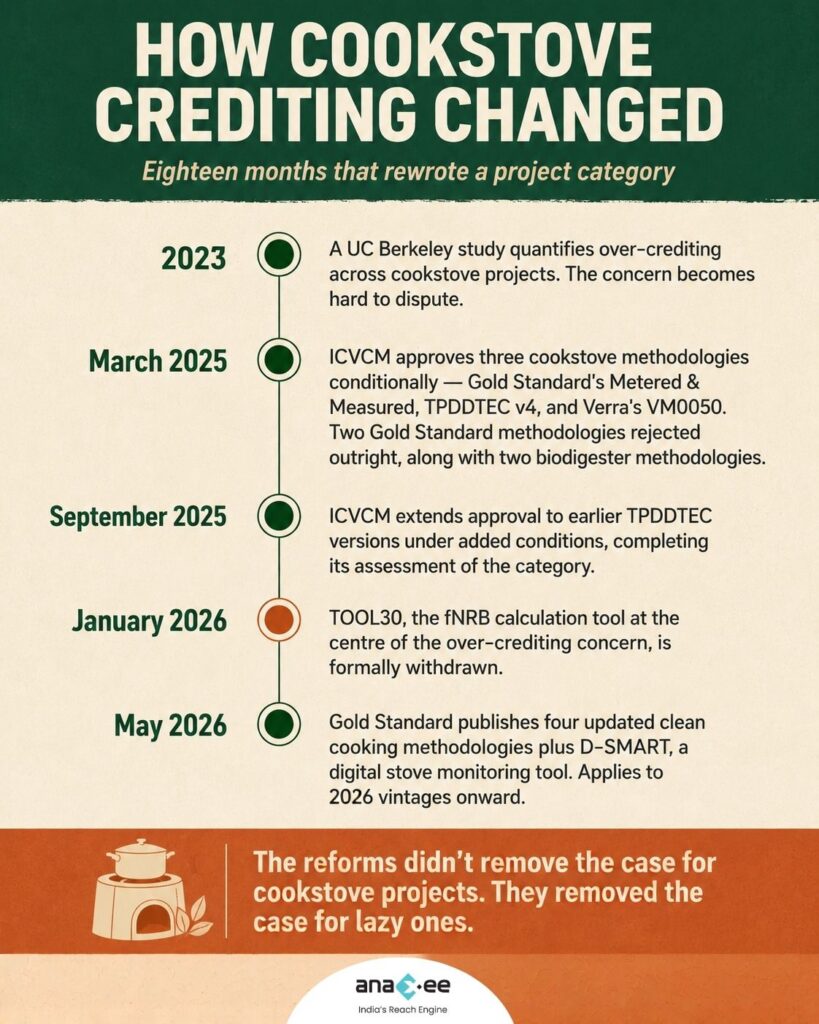
In under 18 months, the category went from loosely governed to one of the most tightly specified in the market.
What this actually means for a developer in India
Four practical consequences.
1. Measurement is no longer optional
The old approach — assume an efficiency gain, apply it to a baseline fuel figure, issue credits — is gone. Improved biomass stove projects now need periodic Kitchen Performance Tests. Fuel-switch projects need direct metering.
That means field capacity. Real households, real visits, real fuel weighed on real scales, on a schedule, for years. For a project spread across 300 villages in Madhya Pradesh and Odisha, this is a logistics problem before it is a carbon problem.
2. Your fNRB number just got smaller
If your financial model was built on an fNRB value derived from the old tool, rebuild it. Conservative defaults mean fewer credits per stove — sometimes substantially fewer. Projects that were marginal on the old maths do not survive the new maths.
This is the single most common reason Indian cookstove pipelines have stalled since 2025. Not regulatory difficulty. Arithmetic.
3. Sample size and usage monitoring decide your rating
Two projects using the identical methodology can rate very differently depending on how many households they monitor, how they’re selected, and how usage is tracked between surveys. Continuous sensor-based monitoring, where it’s viable, changes what you can demonstrate. Where it isn’t viable, larger and better-designed sample surveys do similar work.
Ratings agencies now look hard at this. So do serious buyers.
4. Smaller projects face a genuine cost squeeze
Higher monitoring requirements cost money. There’s a real risk of pricing out small developers — which is why Gold Standard’s updated simplified methodology for micro-scale projects matters. It keeps a door open for smaller interventions using direct performance measurement rather than heavier machinery.
Whether that door is wide enough is still being tested.
The India-specific problem nobody wants to discuss
There’s a harder issue that methodology reform doesn’t fully solve.
India has spent years expanding LPG access. In many households, a subsidised gas connection already exists. It may be used sporadically because refill cost is a real constraint — but it exists.
A Centre for Science and Environment study of cookstove projects in Karnataka found households that had paid for the stoves themselves, were unaware their kitchen was part of a carbon project, and received nothing from the credit revenue. Some already had LPG connections and weren’t using the project stove at all.
That is not a measurement failure. It’s a project design failure, and no amount of sensor data fixes it.
For developers working in India honestly, this is the real bar: can you demonstrate that the stove is wanted, used, and improving something in a household that had a genuine alternative it wasn’t using? If you can, you have a defensible project. If you can’t, better monitoring will only document the problem more precisely.
What a credible Indian cookstove project looks like now
- Conservative fNRB, documented, with the derivation shown rather than asserted
- Direct measurement of fuel use through KPTs or metering, on a defined schedule
- Usage monitoring that catches stacking, not just distribution counts
- Sample design a third party can defend — size, selection method, replacement rules
- Household-level records that demonstrate awareness and consent, not just receipt
- Field infrastructure that can actually reach the villages, repeatedly, for the full crediting period
The last one is where most project plans quietly fail. Distribution is a one-time exercise and it’s the part everyone budgets for. Monitoring is a multi-year commitment across scattered rural geographies, and it’s the part that determines whether your credits are worth anything.
Where this leaves the market
More conservative, smaller in volume, and considerably more defensible.
There are still 2.3 billion people cooking on fuels that damage their lungs and their local forests. Carbon finance remains one of the few mechanisms that moves money toward that problem at scale. The reforms didn’t remove the case for cookstove projects — they removed the case for lazy ones.
For Indian developers willing to build real measurement capacity, the competitive position is arguably better than it was. The bar is higher, and fewer people can clear it.
Anaxee’s Climate Command Centre supports cookstove and clean cooking projects across India with household-level baseline surveys, Kitchen Performance Tests, usage monitoring and digital MRV — delivered through a network of 40,000+ Digital Runners across 540+ districts and 11,000+ pincodes. If you’re re-basing a project against the updated methodologies, talk to our team.