


How to Choose an MRV Partner in India: 9 Questions to Ask Before You Sign
Most carbon projects don’t fail at the methodology stage. They fail somewhere between the village and the spreadsheet.
The methodology is public. The registry requirements are written down. What separates a project that gets verified smoothly from one that spends eight months in clarification loops is almost always the quality of the data coming off the ground — and that comes down to who you hired to collect it.
Choosing an MRV partner in India is harder than it looks, because most vendors sound identical in a pitch. Everyone has a network. Everyone has an app. Everyone says they cover pan-India.
Here are nine questions that separate them.
1. “Show me your coverage in the specific districts I need.”
Not states. Districts. Ideally blocks.
“Pan-India presence” usually means a head office in one city and a plan to subcontract everywhere else. That’s not necessarily disqualifying — subcontracting is how a lot of field work gets done — but you need to know it’s happening, because it determines who is actually standing in the household and how many layers sit between them and your data.
Ask for the district list. Ask how many people they have in your three hardest districts. If the answer is vague, the coverage is aspirational.
2. “Who employs the person who knocks on the door?”
Direct staff, a registered partner, or a chain of local contractors?
Each model works. The problem is not knowing which one you have. Longer chains mean less control over training, higher variance in data quality, and slower response when something goes wrong at the verification stage.
You’re going to sign an attestation about this data. You should know its provenance.
3. “What’s your enumerator training and refresher schedule?”
A Kitchen Performance Test done wrong is worse than one not done at all, because it looks like data.
Ask what training the field team receives, how long it takes, who delivers it, and what happens when a new person joins mid-project. Ask specifically about refresher training — attrition in field roles is real, and a team that was trained well in month one may be half-new by month fourteen.
4. “How do you catch a fabricated survey?”
This is the question that tells you the most.
Every field operation in every country has some fabrication risk. Serious partners have systems for it: GPS validation, timestamp checks, photo verification, audio capture, back-checks on a percentage of samples, statistical flagging of implausible response patterns, supervisor spot visits.
A partner who says this doesn’t happen to them is either inexperienced or not being straight with you. A partner who describes their detection layers in specific detail has thought about it properly.
Ask what percentage of records get back-checked, and what they do when a back-check fails.
5. “What does your raw data look like before anyone cleans it?”
Ask to see an unedited export from a comparable project. Not a dashboard. The underlying table.
You’re looking for: how complete it is, whether GPS and timestamps are attached at record level, whether the field structure matches what your methodology needs, and how much manual reconciliation appears to have happened.
Clean-looking data that arrives too clean is its own warning sign.
6. “Can you handle my sample design, or do you need it handed to you?”
There’s a real difference between a partner who executes a sampling plan and one who can help build it.
If your project needs stratified sampling across household types, or replacement rules when a selected household is unavailable, or a defensible approach to non-response — you want someone who has done this before and will push back when your design is impractical in the field.
The vendor who agrees to everything in the scoping call is the vendor who will silently substitute the easy households for the hard ones.
7. “What’s your language and gender coverage on the ground?”
In India this is not a diversity checkbox. It’s a data quality issue.
Cooking is usually the woman’s domain. If your enumerator can’t have a comfortable conversation with the woman who cooks, in her language, you will get the husband’s estimate of fuel use instead of the cook’s. Those are different numbers.
Similarly, an enumerator working through a translator in a tribal district collects meaningfully worse data than one who speaks the language. Ask how they staff for this.
8. “How do you handle the second, third and eighth monitoring cycle?”
Baseline surveys are the easy part. Everyone can mobilise once.
Your project needs the same households revisited on schedule for years. That requires household-level tracking, a plan for households that migrate or drop out, and consistent enough staffing that you’re not re-explaining the project every cycle.
Ask what their longest continuously running project is and who from that team is still on it.
9. “What happens when the verifier asks a question you can’t answer?”
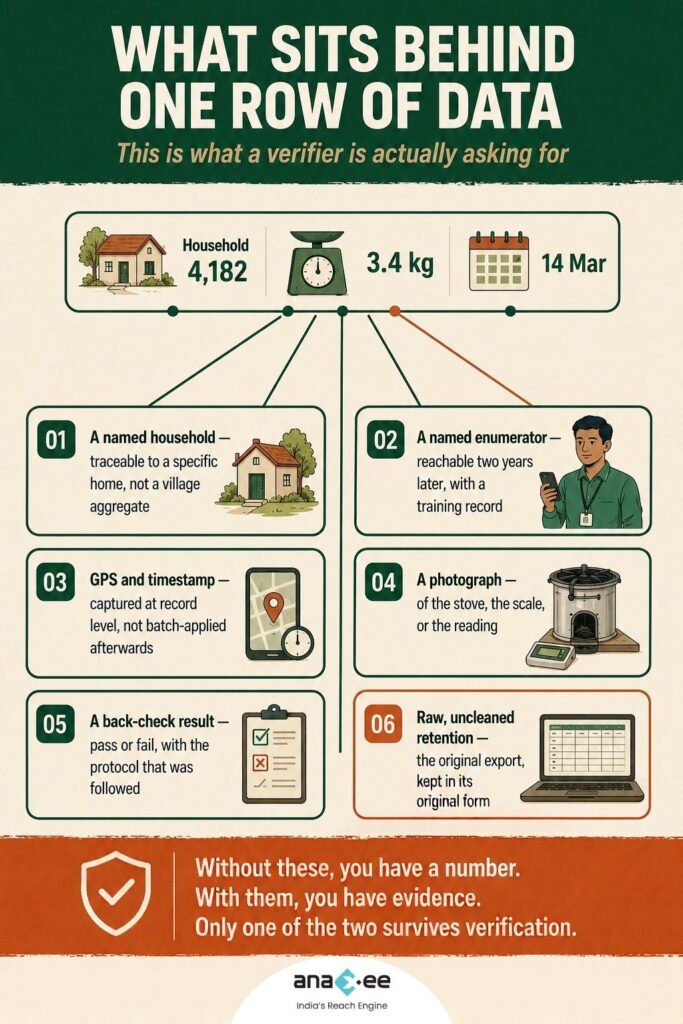
The real test of an MRV partner comes six months after fieldwork ends, when a validation body queries an inconsistency in row 4,182.
Can they retrieve the original record? Is there a photograph? Can they reach the enumerator who collected it? Is there an audit trail, or does the answer depend on someone’s memory?
Ask how long they retain raw data and in what form. Ask whether they’ve been through verification queries before and what the resolution looked like.
Three answers that should worry you
“We can do any district in India.” Nobody can, equally. A partner who acknowledges where they’re strong and where they’d subcontract is being more useful to you than one who claims uniform depth.
“Our app handles quality control.” Software catches some things — location, timing, obvious gaps. It does not catch an enumerator who sits outside the house and fills the form plausibly. Technology is a layer, not a system.
A price far below everyone else. Field data collection has a cost floor set by travel, time and people. A quote well under it is usually funded by shortcuts you’ll discover at verification.
The one thing worth paying more for
If you take a single thing from this: pay for verifiability, not for data.
Anyone can deliver you a filled spreadsheet. What you actually need is a spreadsheet where every row can be traced back to a specific household, on a specific date, visited by a named person, with evidence attached.
That’s what survives a verifier’s scrutiny. That’s what lets a ratings agency give you a defensible score. And in a market where cookstove and nature-based methodologies have both tightened significantly, it’s increasingly the difference between credits that sell and credits that sit.
The cheapest MRV partner is rarely the one whose data you can still defend two years later.
A short due-diligence checklist
Before you sign, get in writing:
- District-level coverage with headcount, for your specific geography
- The employment chain from your contract to the enumerator
- Training curriculum and refresher schedule
- Back-check percentage and failure protocol
- Raw data retention period and format
- A sample unedited export from a comparable project
- Named project references you’re allowed to call
- Escalation path and response time for verification queries
Any partner worth hiring will have all eight ready. The ones who don’t will tell you they’ll “share it after the contract.”
Anaxee’s Climate Command Centre delivers field MRV for carbon projects across India — baseline surveys, Kitchen Performance Tests, usage monitoring, plot-level agroforestry data and digital MRV — through a network of 40,000+ Digital Runners covering 540+ districts and 11,000+ pincodes, with a 125+ person in-house climate team. To discuss coverage in your project districts, book a conversation.