
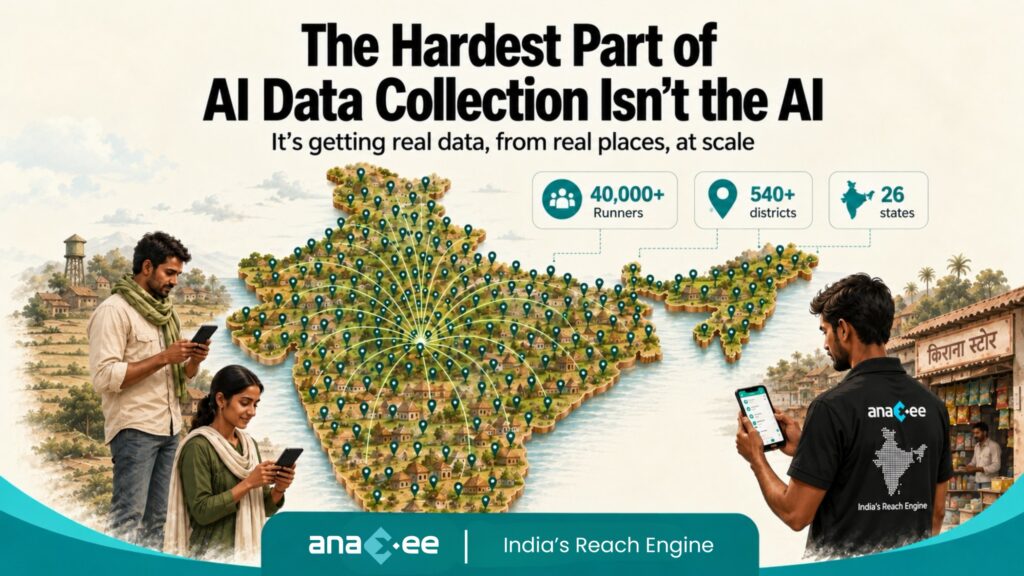

The Hardest Part of AI Data Collection Isn’t the AI
Ask an AI team what’s holding up their next model and you’ll rarely hear “the architecture.” More often it’s some version of this: we know exactly what data we need, we just can’t figure out how to actually go get it at the scale we need it.
That sentence hides an enormous amount of pain. Because collecting real-world data at scale isn’t really a modelling challenge — it’s an operations challenge. And operations is the part nobody puts on the slide.
What “collect a million data points” actually involves
Picture the real task behind a simple-sounding request: “Get us 100,000 voice samples across ten states, plus product photos from 5,000 rural shops, in the next six weeks.”
Now unpack it.
You need thousands of people, in the right places, at the same time. You need to recruit them, or already have them. You need to train every one of them to capture the data the exact same way, so a photo from Bihar and a photo from Karnataka are consistent enough to train on. You need to dispatch tasks, track who’s done what, and chase the ones who haven’t. You need to handle ten languages of instructions. You need to check the incoming data — because a meaningful chunk of it will be blurry, wrong, half-finished, or quietly gamed. And you need to do all of this without the whole thing collapsing into a spreadsheet nobody can read.
None of that is glamorous. All of it is the actual job. And it’s why so many promising datasets never get built: the team looks at the logistics, quietly reprioritises, and ships a model on whatever data was already lying around.
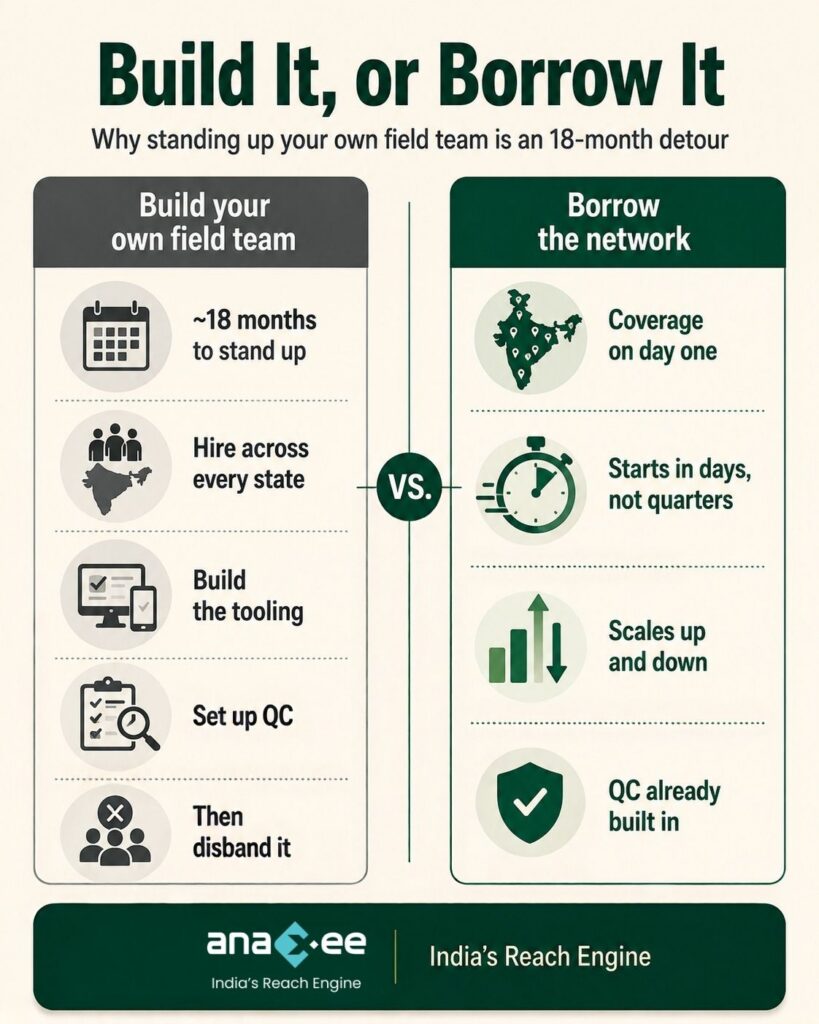
The build-it-yourself trap
The tempting move is to build your own field team. It feels controllable. It almost never is — at least not at speed.
Standing up an on-ground collection operation from zero means hiring across a subcontinent, training people you’ll never meet, setting up supervision, building the tooling to assign and track work, and creating a quality process that catches bad data before it costs you. Realistically that’s the better part of a year and a serious budget before your first clean batch lands. And the moment the project ends, you’re sitting on a large field team you no longer need.
For a one-off dataset, that’s a lot of overhead. For a team that needs data again and again as the model evolves, building and rebuilding that machine every time is a genuine drain.
The alternative isn’t to lower your ambitions. It’s to not build the machine at all — and borrow one that already runs.
Borrow the network instead of building it
This is the entire premise of Anaxee. The field operation you’d spend a year assembling already exists, and it’s already national in scale.
40,000+ Digital Runners. 540+ districts. 26 states. 11,000+ pincodes. That’s not a plan or a projection — it’s the live network, built since 2016 and already used by 350+ brands including Colgate, Mahindra, ITC and Pepsi for exactly this kind of large, distributed, on-ground work. For an AI team, it means the hardest, slowest, most expensive part of data collection is already done. You’re not hiring a field force. You’re pointing an existing one at your problem.
What that unlocks, in plain terms:
- Coverage on day one. Urban, rural, remote — the reach is already there. You’re not waiting to hire into a new region; there are already people in it.
- Speed. Because the network exists, collection starts in days, not after a quarter of recruitment. A task that spans ten states can go out to ten states at once.
- Consistency. Runners are guided to capture each data point the same way, so what comes back is comparable across regions instead of a patchwork you have to normalise by hand.
- Local fluency. Collectors speak the language and know the context, which means fewer misunderstood instructions and cleaner data at the source.
- Scale that flexes. Need a small pilot this month and a massive push next month? The same network handles both without you staffing up or laying off.
The unglamorous hero: quality control
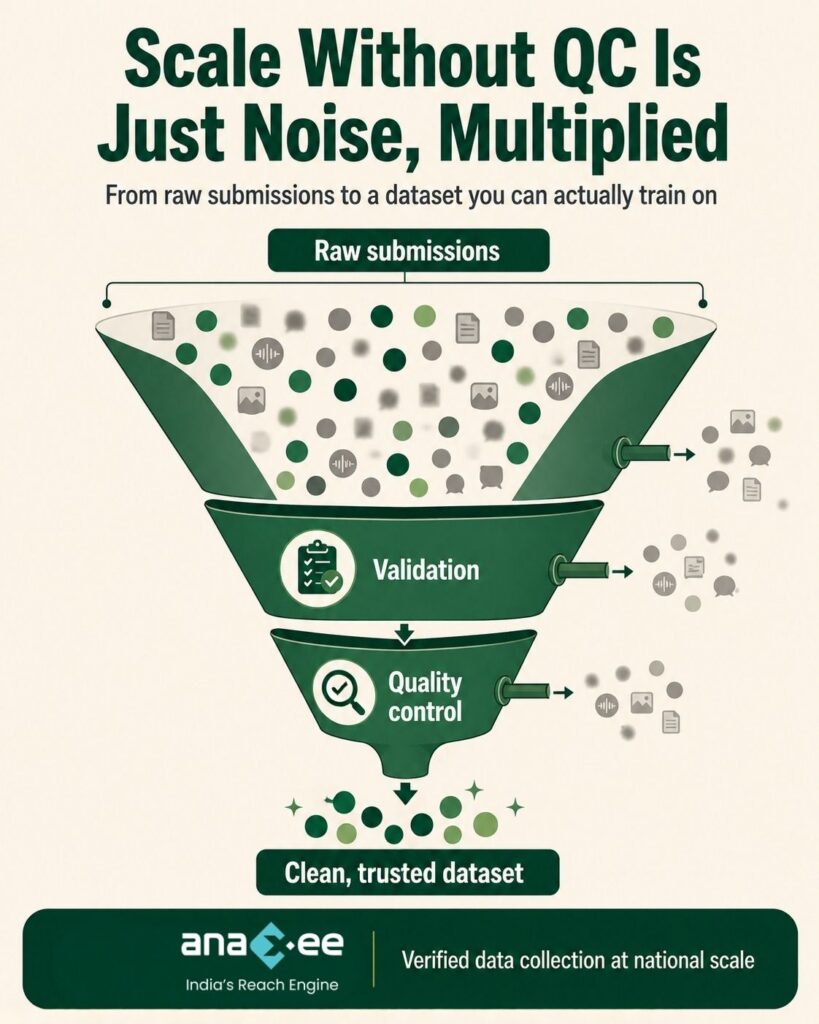
Here’s the part that separates a useful dataset from an expensive liability. Scale without verification isn’t an asset — it’s noise, multiplied.
When you gather data from tens of thousands of collectors, some of it will be wrong. That’s not cynicism, it’s arithmetic. The question is whether the wrong data gets caught before it reaches your training pipeline or after it has quietly dragged your model’s accuracy down. Catching it after is the expensive way to learn this lesson.
So verification isn’t a bonus step bolted on at the end — it’s built into how the collection runs. Submissions are validated, tasks are checked, and low-quality captures are filtered before they ever become “your dataset.” The goal isn’t to hand you the most rows. It’s to hand you rows you can actually train on without babysitting every one.
That’s the difference between receiving a lot of data and receiving data you trust. For an AI team, only the second one is worth anything.
The takeaway
The romance of AI is in the model. The reality is in the collection — and the collection is where most data projects quietly die. Not because the team wasn’t smart enough, but because gathering real-world data at scale is a logistics operation, and building that operation from scratch is a year-long detour most teams can’t afford to take.
You don’t have to take it. The network already exists. The reach, the languages, the last-mile coverage, the quality checks — all of it is already running, already proven, already national. Your job is to say what you need. Ours is to go collect it, verify it, and hand it back clean.
If the thing standing between you and a better model is how do we actually get this data — that’s not a wall. That’s just the part we’ve already built.
Tell us what you need collected, and where. We’ll handle the how. → Book a call