
The Training Data Your AI Needs Isn’t on the Internet
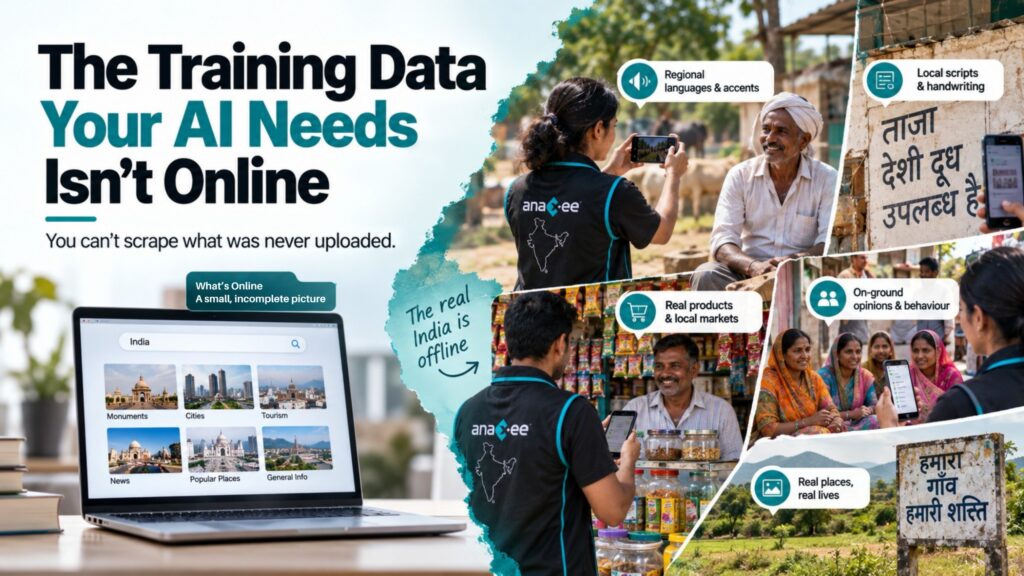
Try this. Go looking for a large, clean dataset of spoken Bundeli. Or handwritten Marathi shop signboards. Or the way people in rural Odisha actually describe a fever to a health worker. Or product feedback from someone who has bought shampoo his whole life but has never once left a review online.
You will not find it. Not because nobody thought to build it, but because the raw material was never uploaded in the first place. And you can’t scrape what was never put online.
This is the blind spot sitting underneath a huge amount of AI being built for this part of the world. Teams reach for the biggest available dataset, assume it’s representative, and only discover much later that “biggest available” and “representative” are two very different things.
The internet speaks a narrow slice of India
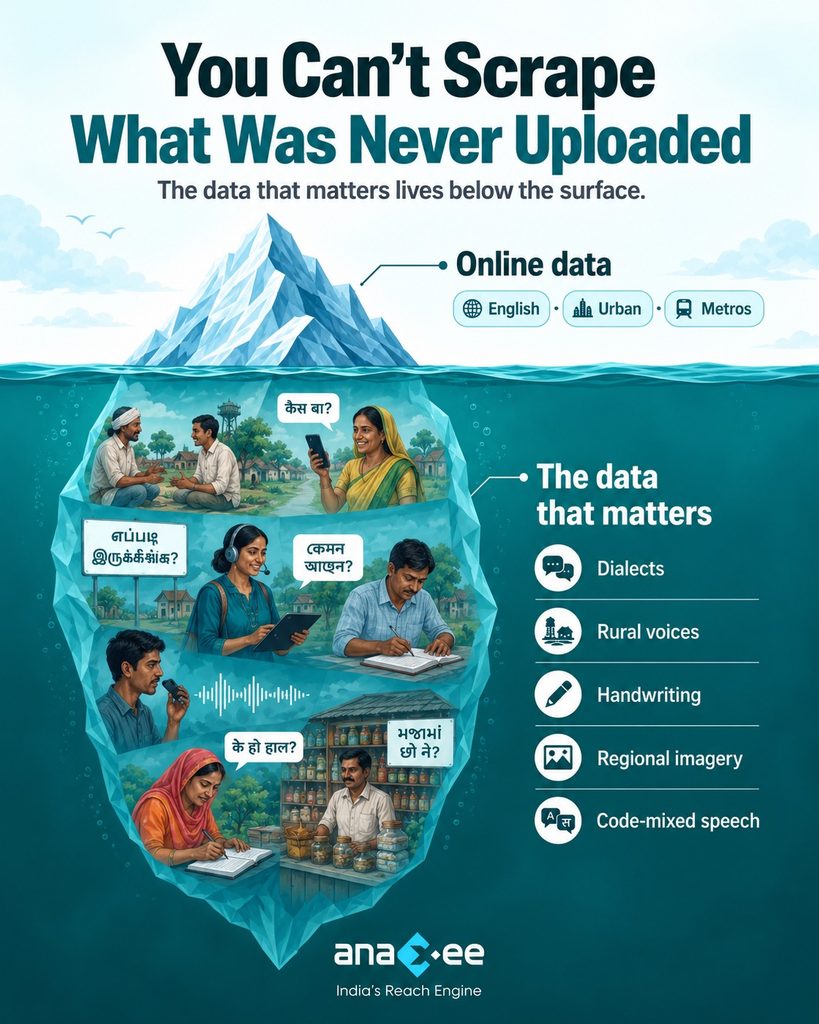
India has 22 official languages and hundreds of dialects on top of them. The digital record captures a sliver. English dominates. A handful of major languages get some coverage. Everything else — the dialects, the accents, the code-mixed speech people actually use at home — thins out fast the further you get from a metro.
So when a model learns from that digital record, it learns a narrow slice and mistakes it for the whole. It hears “Indian English” and pictures a call centre, not a farmer. It reads “Hindi” and assumes the polished textbook version, not the Hindi-plus-local-words-plus-English that a real conversation is made of. The model isn’t wrong on purpose. It simply never met the other 90% of the country.
For most global datasets, Bharat — small-town and rural India, hundreds of millions of people — is a rounding error. For anyone building AI meant to actually serve those users, it’s the entire point.
Why this data has to be collected, not found
The instinct is to treat missing data like a search problem — surely it’s out there somewhere, we just need to look harder. It isn’t. It’s a collection problem.
The speech you need doesn’t exist as a file. It exists in a person’s mouth, in a specific village, in a specific dialect, and someone has to be standing there with a phone to record it. The image you need isn’t in an image bank. It’s a real signboard on a real street, a real crop in a real field, a real kitchen shelf in a real home — and someone local has to go photograph it, the right way, with the right context noted.
This is the fork in the road for a lot of AI teams. One path is to keep stretching thin, biased, internet-scraped data and hope the model generalises. It usually doesn’t. The other path is to go and gather the real thing — which means having people, in those places, who can do it. That second path is where the actual competitive edge lives, because the data your rivals can’t scrape is the data that makes your model genuinely better.
The catch, of course, is that “have people in those places” is easy to say and brutally hard to build.
A network that already lives where the data lives
Unless it already exists. This is precisely what Anaxee is.
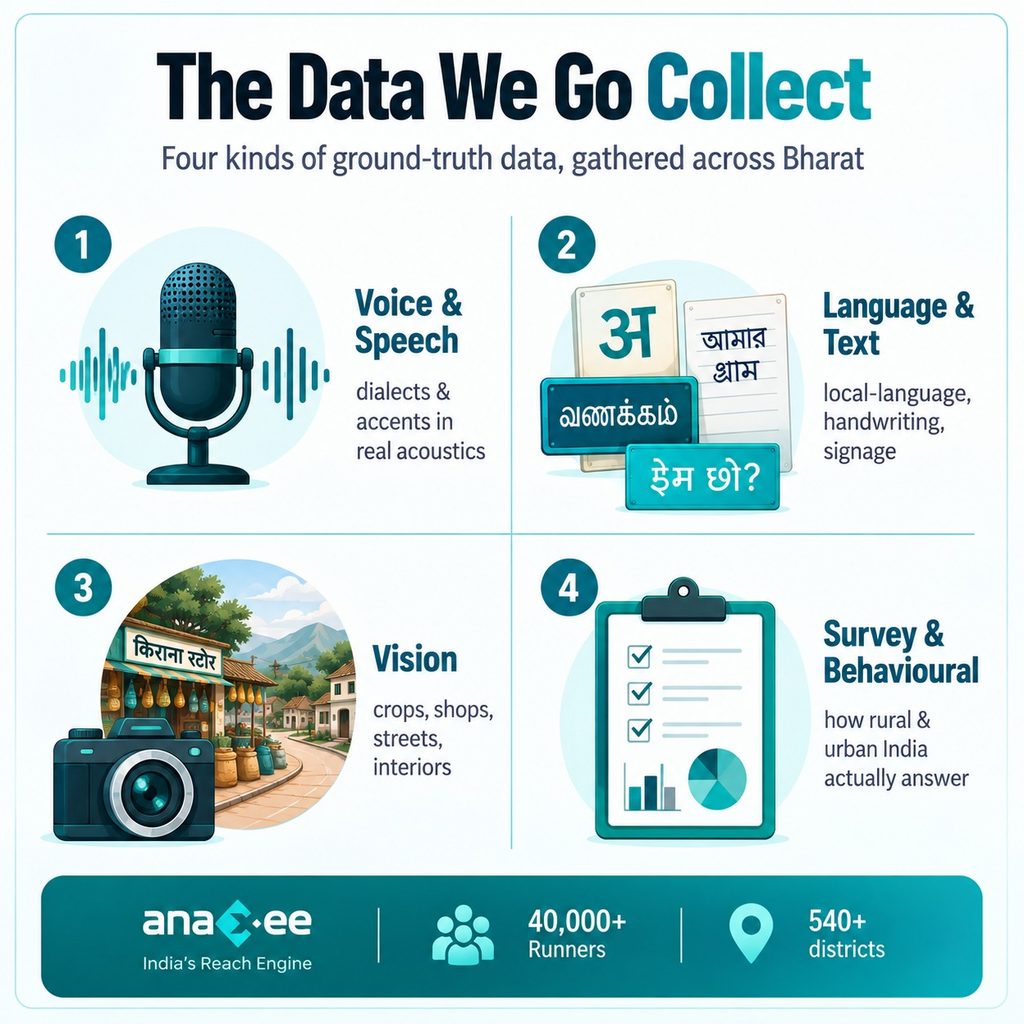
We call ourselves India’s Reach Engine, and the number that matters here is this: 40,000+ Digital Runners across 540+ districts, 26 states and 11,000+ pincodes. These aren’t operators sitting in one office. They’re people who live in the districts you’re trying to reach, who speak the languages you’re trying to capture, who can walk to the exact street, field, or household where your data is waiting.
For a model builder, that footprint quietly solves the hardest part of the problem. The dialect you couldn’t find online? There are Runners who speak it. The regional imagery no stock library carries? There are people who can shoot it in a day. The rural voices no dataset represents? They live next door to the people who can record them.
That’s the difference between wishing you had diverse data and being able to go collect it on demand:
- Voice and speech — spoken samples across languages, dialects and accents, recorded in the real acoustic mess of real places, not a silent booth.
- Language and text — local-language responses, handwriting, signage, and the code-mixed way people genuinely write and speak.
- Vision — real-world photos and video of products, crops, streets and interiors, captured with local context instead of studio polish.
- Survey and behavioural data — how people across urban and rural India actually answer, think and choose, gathered face to face.
Since 2016 this network has run ground-level work for 350+ brands — Colgate, Mahindra, ITC, Pepsi among them — so the machinery for large, distributed, verified collection is already in place. Pointing it at training data for AI is a new use of a proven engine, not a leap of faith.
Diversity you can’t fake
There’s a reason this is worth the effort rather than a shortcut around it. The variety in ground-collected data is exactly what makes a model robust. A speech model that has heard fifteen real accents handles the sixteenth far better than one raised on clean audio. A vision model that has seen crops in bad light, from odd angles, on cheap cameras, holds up in the field instead of only in the demo.
You cannot synthesise your way to that. Generated data can only remix what a model already knows; it can’t introduce the genuinely unfamiliar. The unfamiliar has to come from outside — from the real world, collected by someone who was actually there. That’s the input no competitor can copy, because it never existed as a downloadable file for anyone to copy in the first place.
The takeaway
If your AI is meant to work for all of India — or for any of the billions of people the internet under-records — then the most important data you need is, almost by definition, not online. It was never uploaded. It has to be collected, on the ground, by people who live there and speak the language.
That’s not a gap you can scrape your way out of. It’s one you collect your way out of. And collecting across the length and breadth of the country, in the right languages, with the noise filtered out — that’s the exact thing our network was built to do.
Tell us what your model can’t find online. We’ll show you how to go get it. → Book a call