

Biochar, Stubble Burning & Farmer Income: India’s Overlooked Carbon Removal Opportunity
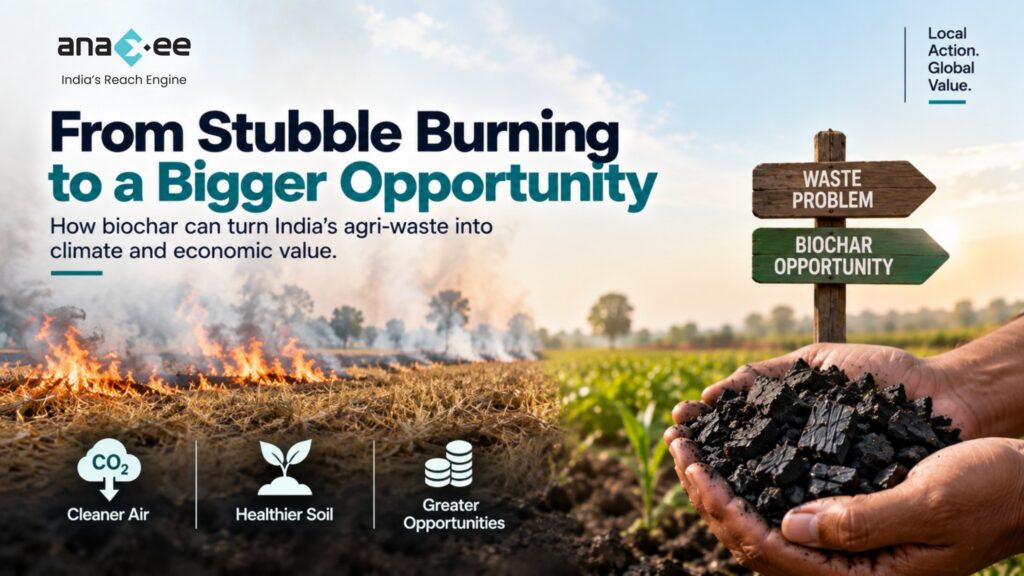
Short answer: Every year India burns roughly 92 million tonnes of crop residue in open fields — choking north India’s air and wasting a resource the global carbon market will pay for. Biochar flips that equation. Instead of burning stubble, farmers and project developers can convert it into a stable, carbon-rich material that locks CO₂ away for centuries, rebuilds soil, and earns durable carbon credits. At scale, studies estimate biochar could remove around 0.1 gigatonne of CO₂ a year in India, support over five lakh rural jobs, and turn a seasonal pollution crisis into farmer income. Here’s why India is uniquely placed to lead — and what it will actually take.
What does stubble burning actually cost India?
More than most balance sheets capture. India generates about 500 million tonnes of crop residue a year; roughly 140 million tonnes is surplus, and around 92 million tonnes is burned in the open. Punjab and Haryana alone torch over 20 million tonnes of paddy straw each season, in the narrow window between harvest and the next sowing.
The bill lands as hazardous winter air across the Indo-Gangetic plains, respiratory illness for millions, and the quiet loss of soil nutrients and microbes that burning destroys. Farmers don’t burn residue because they want to — they do it because it’s fast, cheap, and they’re rarely offered a better-paying alternative. That last part is the opening.
How does biochar turn crop residue into a climate solution?
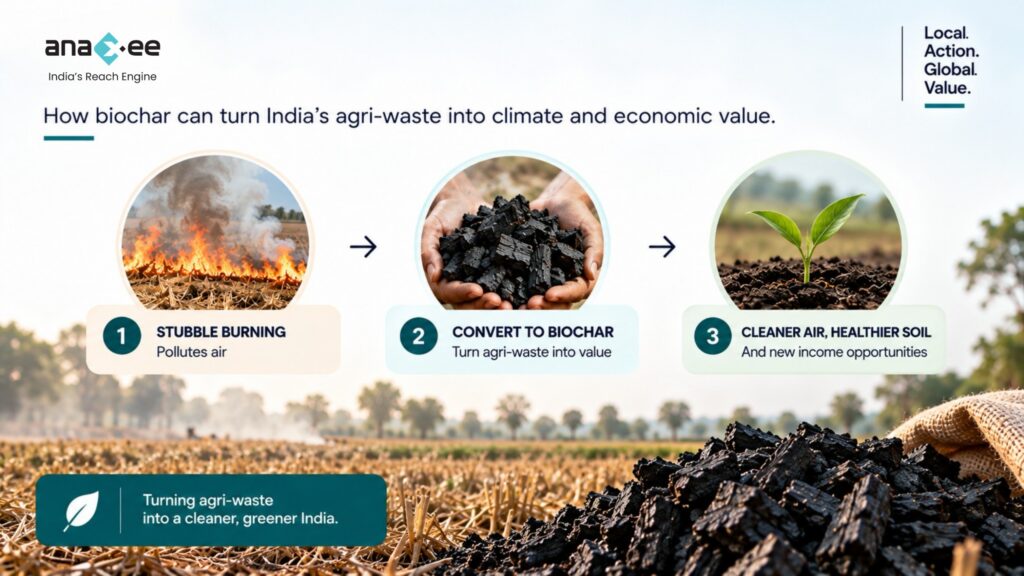
Instead of burning biomass (which dumps its carbon straight back into the air), pyrolysis heats it in a low-oxygen process that locks roughly half the carbon into a stable solid — biochar — that resists decomposition for hundreds to over a thousand years. The same stubble that would have become smoke becomes a durable carbon store.
And unlike most offsets, biochar is a genuine removal, not an avoidance — it pulls carbon out of the cycle rather than merely preventing a future emission. That’s why it now delivers close to 90% of the durable carbon-removal credits actually reaching global registries, and why serious net-zero buyers want it.
Why is this an economic opportunity, not just an environmental fix?
Because it pays at every level. The same tonne of residue can generate three kinds of value: a carbon credit sold to a global buyer, a soil amendment that lifts the farmer’s next harvest, and cleaner air for the whole region. Biochar has been shown to raise crop yields by 10–25% in nutrient-depleted soils and cut nitrous-oxide emissions — a greenhouse gas 273 times more potent than CO₂ — by 30–50%.
For a farmer, that means residue stops being waste to burn and starts being an input worth money. For India, it means a pollution problem converts into a rural income stream. That alignment of climate, soil and livelihood is exactly what makes biochar different from an abstract carbon scheme.
How much could biochar actually deliver for India?
The headroom is large. Using just 30–50% of India’s agricultural waste, researchers estimate the country could produce 15–26 million tonnes of biochar a year, removing on the order of 0.1 gigatonne of CO₂-equivalent annually. Decentralised, village-level production could create up to 5.2 lakh rural jobs. The syngas and bio-oil produced alongside can generate clean energy on top.
These are potential figures, not guarantees — they depend entirely on execution. But they show the scale of what’s sitting, quite literally, in India’s fields every harvest.
Why is India uniquely positioned to lead the biochar market?
Three advantages stack up. India has the feedstock — hundreds of millions of tonnes of residue a year, much of it currently burned. It has the lowest biochar production cost in the world, which matters in a market where buyers weigh price hard. And it offers something buyers increasingly pay a premium for: real co-benefits — farmer income, better soils, cleaner air — the social-impact story that a Direct Air Capture plant simply can’t tell.
Global buyers building credible net-zero portfolios want durable removals with development impact. India can supply exactly that, at a better price than most of the world. On paper, it’s one of the strongest biochar propositions anywhere.
So what’s holding it back?
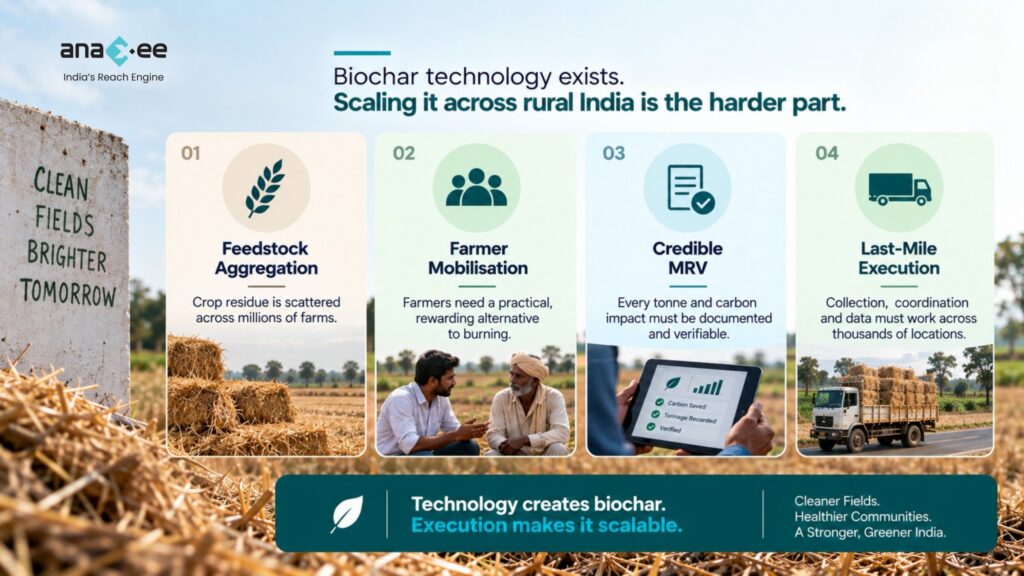
Execution, not potential. The barriers are consistent across the sector:
- Fragmented feedstock. Residue is spread across millions of small farms, available in short seasonal windows, with no reliable aggregation or pricing.
- MRV credibility. Weak monitoring and verification undermines trust with international buyers and scares off investment.
- Farmer awareness and mobilisation. Millions of farmers have never been offered biochar as an option, let alone paid for their residue.
None of these is a technology gap. Every one is a last-mile execution gap — reaching, organising, and building trust with dispersed rural communities, and producing data credible enough for a global market. Which is precisely the capability India has historically lacked at scale.
What does it take to scale biochar across rural India?
Four things, all on the ground: reach into the villages where the residue is; farmer mobilisation to turn a burning habit into a supply chain; feedstock aggregation that’s reliable and documented enough to satisfy auditors; and transparent, digital MRV across thousands of scattered sites. Get those right and the carbon, the income and the clean air follow. Miss them and even the best-funded project stalls.
If you’re a corporate, CSR programme or investor weighing a biochar-from-residue initiative, the execution layer is where it’s won or lost — worth a conversation early. Book a demo with Anaxee’s climate team →
Where Anaxee fits
This is the part India keeps getting stuck on — and it’s exactly what Anaxee was built for. As India’s Reach Engine, Anaxee runs the country’s largest last-mile field network — 40,000+ Digital Runners across 540+ districts, 26 states and 11,000+ pincodes — paired with a carbon-grade technology stack in its Climate Command Centre.
For a biochar-from-residue programme, that means one partner who can run the whole rural half of the equation:
- Farmer mobilisation and feedstock aggregation at national scale — turning scattered, seasonal residue into a reliable, documented, sustainably-sourced supply.
- Digital MRV built for audit — geo-tagged field data and transparent audit trails across thousands of sites, the credibility international buyers demand.
- Genuine community depth — the on-ground relationships that deliver farmer income and the co-benefit story, and keep a programme running season after season.
Anaxee doesn’t manufacture pyrolysis units or issue credits — it runs the reach, the mobilisation and the data that decide whether a biochar programme scales or stays a pilot. For a corporate CSR team, an agri-business or an impact investor, that’s the missing piece between a good idea and measurable impact on the ground.
If you want to turn India’s stubble into carbon removal and farmer income at scale, talk to the team that already operates in the villages where it happens. Book a demo → sales@anaxee.com
What corporates, CSR programmes and investors can do now
- Fund or offtake a biochar-from-residue programme in a high-burning region — climate impact and a clean-air story in one.
- Anchor it to farmer income, so the carbon value reaches the people burning the residue today.
- Insist on transparent MRV from day one — it’s what makes the impact real and the credits saleable.
- Start regional, prove it, then scale with an execution partner who already has rural reach.
India burns a fortune in its fields every winter. The technology to change that exists, the buyers exist, and the economics work. What’s been missing is the ground game — the ability to reach millions of farmers, aggregate what they’d otherwise burn, and prove the impact to the world. Close that gap, and biochar becomes one of the rare climate solutions that cleans the air, rebuilds the soil, pays the farmer, and removes carbon — all from the same tonne of stubble.
Frequently asked questions
How does biochar help with stubble burning in India? Instead of burning crop residue, farmers convert it into biochar through pyrolysis — locking away carbon for centuries, improving soil, and earning carbon credits, while cutting the air pollution open burning causes.
How much crop residue does India burn each year? India generates around 500 million tonnes of crop residue annually, with roughly 140 million tonnes surplus and about 92 million tonnes burned in open fields — Punjab and Haryana alone burn over 20 million tonnes of paddy straw.
Can farmers earn money from biochar? Yes. Farmers can be paid for residue that would otherwise be burned, and biochar applied to their fields can raise yields by 10–25% — turning a disposal problem into income and better harvests.
How much carbon could biochar remove in India? Estimates suggest using 30–50% of India’s agricultural waste could produce 15–26 million tonnes of biochar a year and remove around 0.1 gigatonne of CO₂-equivalent annually, alongside significant rural job creation.
Why is India well-suited to biochar carbon projects? It combines abundant, low-cost feedstock with strong social co-benefits — farmer income, cleaner air, better soils — which global buyers pay a premium for, making Indian biochar highly competitive.
What’s the main barrier to scaling biochar in India? Not technology, but last-mile execution — reliably aggregating dispersed feedstock, mobilising farmers, and building MRV credible enough for international carbon buyers.