

How to Start a Biochar Carbon Project in India (2026): A Step-by-Step Playbook
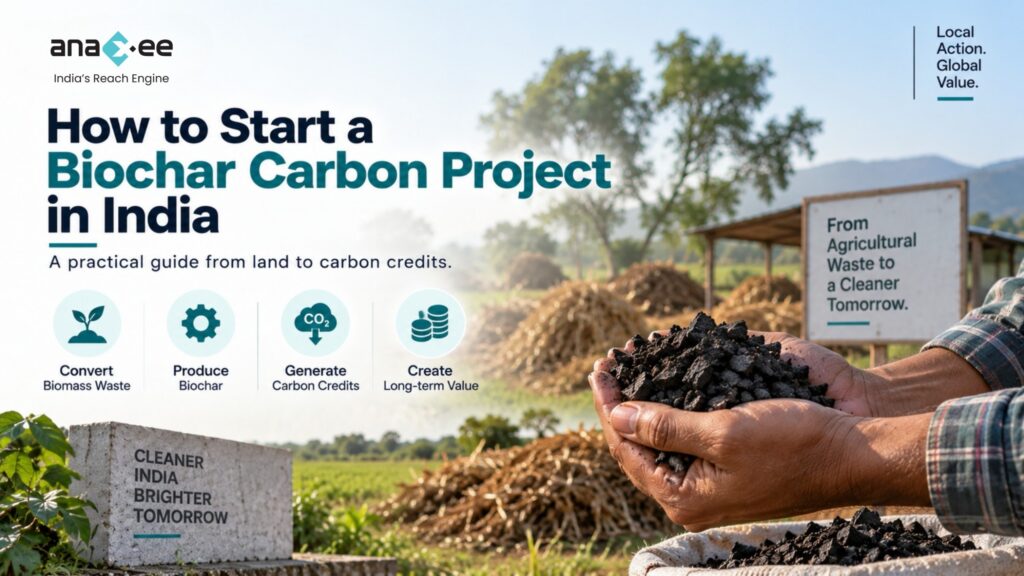
Short answer: To start a biochar carbon project in India, you lock down a steady supply of biomass feedstock (usually crop residue), convert it to biochar through pyrolysis, apply and store it durably, register under an approved methodology like Verra’s VM0044 or Puro.earth, run rigorous MRV, and sell the verified credits to net-zero buyers. India has the world’s lowest production cost and a feedstock base of roughly 500 million tonnes of crop residue a year. But two things decide whether your project scales or stalls — reliable feedstock aggregation and audit-proof MRV — and both are last-mile execution problems. Here’s the full playbook.
Why start a biochar project in India right now?
Because the fundamentals line up like almost nowhere else. India generates around 500 million tonnes of crop residue annually, with roughly 140 million tonnes surplus and about 92 million tonnes burned in the open every year — a feedstock supply that’s not just abundant but actively a problem someone will pay to solve. Punjab and Haryana alone burn over 20 million tonnes of paddy straw each season.
On top of that: Indian biochar is the cheapest durable carbon removal in the world to produce, buyer demand for durable removals is surging, and biochar already delivers close to 90% of the durable credits actually reaching registries. Convert even a third of India’s surplus residue and you’re looking at tens of millions of tonnes of biochar and an estimated 0.1 gigatonne of CO₂ removal potential a year. The opportunity is real. The execution is the hard part.
What do you actually need to run a biochar project?
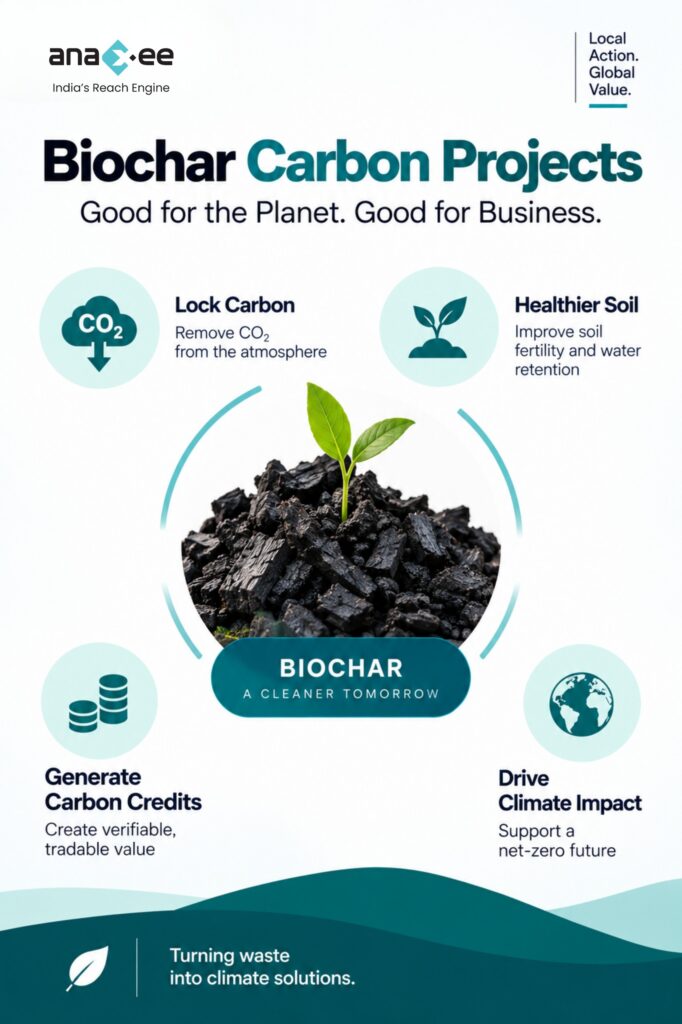
Six building blocks: a reliable feedstock supply, pyrolysis capacity to convert it, a durable application and storage route, an approved methodology and registry, a working MRV system, and buyers. Miss any one and the project doesn’t issue credits. Let’s take them in order.
Step 1: Lock down your feedstock supply
This is where most Indian projects quietly fail before they begin. Crop residue is abundant, but it’s spread across thousands of small, dispersed farms, available only in short post-harvest windows, and competing with other uses like fodder and fuel. You need to aggregate it reliably, season after season, and prove it was sustainably sourced — because diverting feedstock from legitimate existing uses (“leakage”) will cost you credits at verification.
In practice, feedstock is a rural logistics and farmer-relationship problem long before it’s a carbon problem. Projects that solve aggregation win; projects that assume the biomass will just show up don’t.
Step 2: Choose your production approach
Two broad routes:
- Artisanal / decentralised kilns — lower capital, village-level, suited to smaller projects and standards like CSI’s Artisan C-Sink. Easier to start, harder to standardise.
- Industrial pyrolysis units — higher capital, higher throughput and consistency, better suited to large offtake volumes.
Either way, the smart move is revenue stacking. A well-run biochar project doesn’t live on carbon credits alone — it layers credit sales, biochar sold as a soil amendment, waste tipping fees, and sometimes energy co-generation from the syngas and bio-oil. That diversification is what insulates producers from carbon-price swings and makes the unit economics work.
Step 3: Pick the right methodology and registry
Your credit is only as credible as the methodology behind it. The main options:
- Verra VM0044 — widely used, conservative lifecycle accounting, works for smallholders.
- Puro.earth Biochar Standard — the first dedicated biochar standard, now Nasdaq-owned, permanence-focused.
- Isometric — high scientific rigour and open data.
- Carbon Standards International (CSI) — artisanal kilns and Global South projects.
Two things to know for India specifically. First, the ICVCM has approved biochar methodologies (including VM0044 and Isometric) under its Core Carbon Principles — the credibility signal serious buyers now look for. Second — and this trips people up — biochar is not yet an approved methodology under India’s domestic CCTS Offset Mechanism, so Indian biochar projects today route through these international standards, not the CCTS registry. Plan your registry choice around your buyer.
Step 4: Build MRV that survives an audit
MRV — monitoring, reporting and verification — is the backbone of the whole thing. It’s both your biggest trust asset and a real cost. Buyers and auditors will check:
- Mass balance — biomass in versus biochar out, measured, not estimated.
- Lab stability testing — carbon content and H/C ratio to prove permanence.
- Digital MRV — geo-tagged field data, mobile capture, and audit trails across every project site.
Weak MRV is the single biggest reason Indian credits get discounted, delisted or rejected by international buyers. This is the stage where a project either earns a premium price or loses its issuance — and, like feedstock, it’s fundamentally a field-data problem across dispersed rural sites.
Step 5: Sell your credits
Certified credits are listed on your registry and sold to corporates chasing net-zero targets, climate funds, and CSR programmes. Biochar credits currently trade in the $100–250 per tonne range, with high-integrity, well-documented projects commanding $180–200+. The market is moving toward multi-year offtake agreements, so a strong project with credible MRV can lock in buyers — and revenue — before a single credit is issued. Your MRV quality, not just your tonnage, sets your price.
What makes Indian biochar projects fail?
Strip away the noise and it comes down to the two barriers documented across the sector:
- Feedstock procurement. No uniform pricing or reliable aggregation across scattered farms makes large-scale, sustainable sourcing hard — and unreliable supply kills project economics.
- Weak MRV. Inadequate monitoring and verification undermines credibility with international buyers and scares off investment.
Both are last-mile execution problems. Neither is solved by better pyrolysis technology. Which is exactly where the right on-ground partner changes the equation.
If feedstock aggregation or verifiable MRV is the piece you’re unsure about, that’s worth sorting before you commit capital. Book a demo with Anaxee’s climate team →
Where Anaxee fits
A biochar project’s two hardest stages — getting biomass reliably out of thousands of dispersed farms, and generating field data credible enough to survive an international audit — are precisely what Anaxee is built for. Anaxee runs India’s largest last-mile field network — 40,000+ Digital Runners across 540+ districts, 26 states and 11,000+ pincodes — with a carbon-grade technology stack in its Climate Command Centre.
For a project developer, that plugs in as the execution backbone:
- Feedstock aggregation at scale. Farmer mobilisation and residue sourcing across dispersed geographies, with the documentation to prove sustainable sourcing and avoid leakage claims.
- Digital MRV built for audit. Geo-tagged, mobile-first field data capture and audit trails across every project site — the ground truth that decides your issuance and your price.
- Community depth. On-ground relationships that deliver the farmer-income and co-benefit story buyers pay a premium for — and that keep a project running season after season.
Anaxee doesn’t sell you a pyrolysis reactor or a registry — it runs the distributed, on-the-ground half of the project that decides whether your credits get issued at all. Bring the technology and the methodology; Anaxee brings the reach and the data.
If you’re planning a biochar project in India and need feedstock and MRV handled at national scale, talk to the team that already operates on the ground. Book a demo → sales@anaxee.com
Your first-90-days checklist to launch
- Map your feedstock. Which residues, which districts, which seasons — and can you aggregate them reliably and sustainably?
- Choose production and methodology to match your scale and target buyer (VM0044, Puro, Isometric or CSI).
- Design MRV up front — geo-tagged, measured, methodology-aligned — not bolted on later.
- Model the full revenue stack, not just credits (soil sales, tipping fees, energy).
- Line up offtake early — a credible project can secure buyers before issuance.
India has the feedstock, the cost advantage and the buyer demand to become the world’s biochar workhorse. The projects that get there won’t be the ones with the fanciest reactors — they’ll be the ones that solved feedstock and MRV on the ground. Nail those two, and a biochar project turns waste that’s currently being burned into durable carbon removal, farmer income, and a genuinely bankable business.
Frequently asked questions
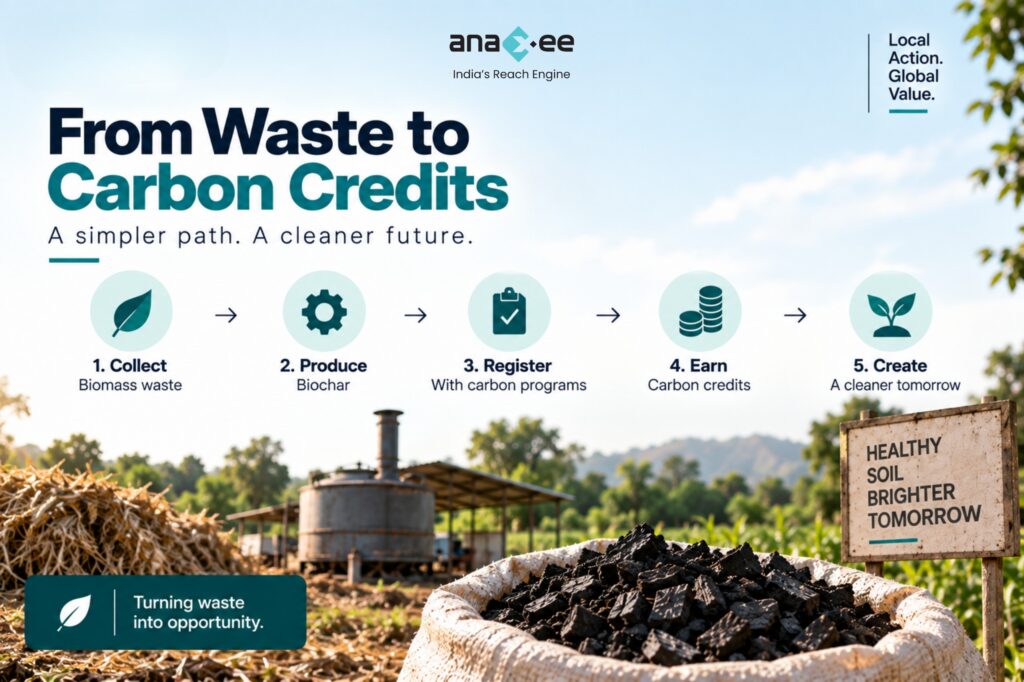
How do you start a biochar carbon project in India? Secure a sustainable biomass feedstock supply, convert it to biochar via pyrolysis, store it durably, register under an approved methodology like VM0044 or Puro.earth, run rigorous MRV, and sell the verified credits to net-zero buyers.
What feedstock is used for biochar in India? Mostly agricultural residue — rice husk, paddy straw, maize stalks, sawdust and manure. India generates around 500 million tonnes of crop residue a year, much of it currently burned.
Which methodology should an Indian biochar project use? International standards like Verra VM0044, Puro.earth, Isometric or CSI — biochar isn’t yet an approved methodology under India’s domestic CCTS Offset Mechanism, so projects route through these registries.
How much revenue can a biochar project earn? Credits trade at roughly $100–250 per tonne (high-integrity projects $180–200+), and well-run projects stack additional revenue from biochar soil sales, waste tipping fees and energy co-generation.
What are the biggest challenges for biochar projects in India? Reliably aggregating dispersed feedstock and building MRV strong enough to satisfy international buyers — both last-mile execution problems rather than technology ones.
Do biochar projects need MRV? Yes — monitoring, reporting and verification is essential. Weak MRV is the main reason credits get discounted or rejected, while strong digital MRV earns a premium price.