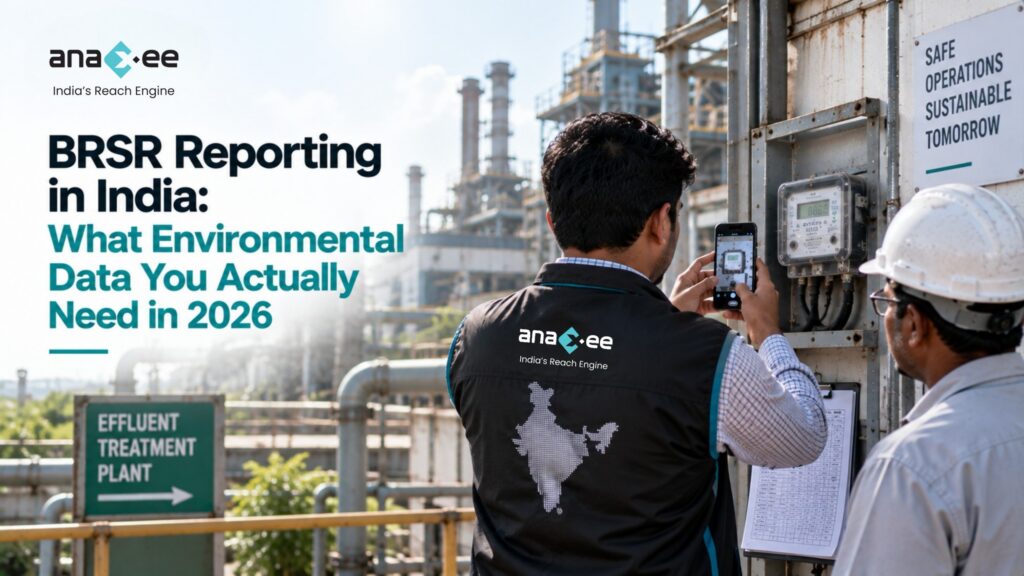

BRSR Reporting in India: What Environmental Data You Actually Need in 2026
Short answer: BRSR — Business Responsibility and Sustainability Reporting — is SEBI’s mandatory ESG disclosure for India’s top 1,000 listed companies. From FY 2026-27 (which began 1 April 2026), the entire top 1,000 now fall inside the BRSR Core reasonable-assurance net — the toughest part of the framework. And the thing that trips companies up isn’t understanding the rules; it’s producing the environmental data — GHG emissions, water, waste, energy — accurate and evidence-backed enough to survive third-party assurance. This is a data problem before it’s a reporting problem. Here’s exactly what’s required, and where most companies come up short.
(General information, not compliance advice — confirm specifics against SEBI’s circulars and your assurance provider.)
What is BRSR, and who has to comply in 2026?
BRSR is the ESG disclosure that India’s top 1,000 listed companies (by market capitalisation) must file within their annual report, under SEBI’s LODR Regulations. It’s been mandatory for that group since FY 2022-23, reporting performance against the nine principles of the National Guidelines on Responsible Business Conduct.
If your company is in the top 1,000, this isn’t optional — non-compliance carries penalties (₹2,000 per day under LODR, plus exchange sanctions and potential SEBI enforcement). And even if you’re not listed, you’re not necessarily insulated: as a supplier to a listed company, their reporting increasingly reaches into your data too. More on that below.
What’s the difference between BRSR and BRSR Core?
This distinction is where the real pressure sits. The full BRSR is largely self-reported disclosure across environmental, social and governance principles. BRSR Core is a focused subset of around 30 key performance indicators across nine attributes that must undergo independent third-party assessment or assurance before filing.
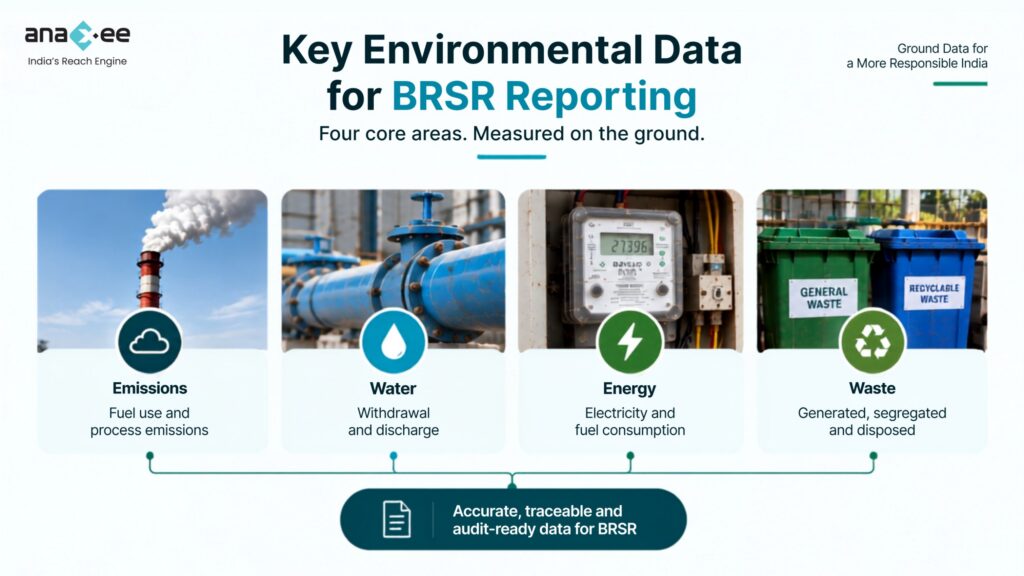
The environmental attributes inside BRSR Core are the ones this article focuses on: GHG emissions, water, waste and energy. (The others cover social and governance matters like gender diversity, wages and customer fairness.) These are the numbers that now need a verifier’s sign-off — not just your word.
Who’s in the assurance net, and when?
SEBI phased BRSR Core assurance in by market-cap tier:
- FY 2023-24 — top 150 listed entities
- FY 2024-25 — top 250
- FY 2025-26 — top 500
- FY 2026-27 — the full top 1,000 (this year, from 1 April 2026)
Your cohort is fixed by market cap on SEBI’s reference date, so a company that climbed the rankings can find itself newly in scope without changing anything about how it reports. If you’re anywhere near a tier boundary, that’s worth watching closely.
What environmental data does BRSR Core actually require?
Physical, measurable numbers — not narrative. Specifically:
- GHG emissions — Scope 1 and Scope 2 (and increasingly Scope 3), in tonnes of CO₂-equivalent, with intensity ratios.
- Water — withdrawal, consumption and discharge, by source, in kilolitres.
- Waste — generated, recovered and disposed, by type, in tonnes.
- Energy — total consumption and intensity, split by renewable and non-renewable.
Each of these has to be traceable to a source, consistent across your sites, and defensible under testing. Which is exactly why the reporting is easier said than done.
Why is “reasonable assurance” the hard part?
Because it’s a genuinely high bar — much higher than most companies expect. BRSR Core requires reasonable assurance, not the lighter “limited assurance” used elsewhere (the EU’s CSRD, for instance, started with limited). Reasonable assurance means extensive testing, larger sample sizes, evaluation of your internal controls, and a positive opinion from the provider — closer in rigour to a financial-statement audit than a quick review.
An analysis of large-cap FY 2024-25 filings found that every company that got its BRSR Core verified opted for full reasonable assurance. And here’s where programs fall over: the assurer doesn’t just want a number — they want the evidence and controls behind it. The companies that struggle are the ones that discover, three weeks before the assurer arrives, that nobody actually owns the water number, and the waste figures were estimated, and the supplier data doesn’t exist. Assurance rewards the ones who built the data plumbing quietly, in advance.
Are value-chain partners and suppliers on the hook too?
Partly — and the honest answer matters here. SEBI originally planned to pull the value chain in on a comply-or-explain basis, but in March 2025 it eased value-chain ESG disclosure to fully voluntary, and deferred mandatory value-chain assurance. Read quickly, that looks like a reprieve.
It isn’t one to lean on. The direction of travel is unambiguous — value-chain disclosure is widely expected to become mandatory within a few years, and listed companies are already asking their significant upstream and downstream partners (covering the bulk of their purchases and sales) for BRSR Core data now, voluntary or not. If you supply a top-1,000 listed company — including as a foreign supplier — the question isn’t whether you’ll be asked for verified environmental data, but when. Building that data capability early is far cheaper than scrambling under a future mandate.
Why do most companies struggle with BRSR environmental data?
Not because the indicators are unclear, but because the data is scattered, unowned and un-auditable. The recurring failure points:
- No single owner for physical metrics like water and waste, so numbers are pieced together at filing time.
- Estimates instead of measurements — fine until an assurer asks for evidence.
- Site and supplier data gaps — especially across dispersed plants, warehouses and vendors in Tier 2/3/4 India that head-office systems never reach.
- No audit trail linking a reported figure back to real, verifiable activity.
Reasonable assurance is designed to catch exactly these gaps. Closing them is a field-data problem long before it’s a reporting one.
What does audit-ready environmental data look like?
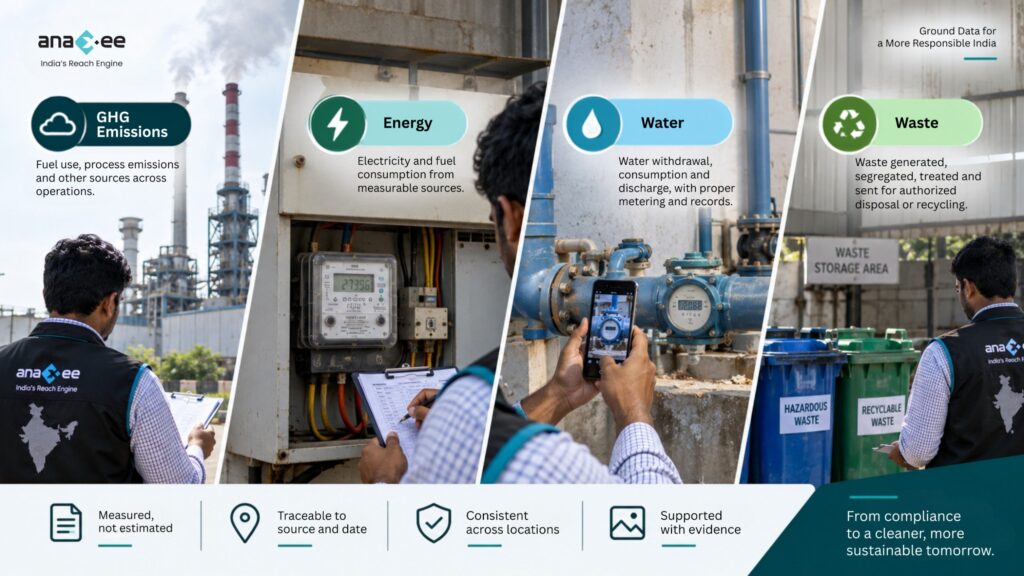
Four qualities: measured, not estimated; traceable to a source and a date; consistent across every site and supplier; and evidence-backed so it survives testing. Getting there means collecting primary data on the ground — at the plants, warehouses and supplier sites where water is drawn, waste is generated and energy is consumed — and documenting it in a way an assurer will accept. That’s the piece the software and the consultants can’t do for you.
If your weak point is the ground-level environmental data — especially across dispersed sites and suppliers — that’s worth sorting well before your assurer arrives. Book a demo with Anaxee’s team →
Where Anaxee fits
Anaxee won’t file your BRSR or provide your assurance opinion — those belong to your ESG team, your software and your accredited assurer. What Anaxee provides is the layer they all depend on: primary environmental data, collected and verified on the ground, through India’s largest last-mile field network — 40,000+ Digital Runners across 540+ districts, 26 states and 11,000+ pincodes.
For BRSR-driven environmental reporting, that means:
- Data from the sites and suppliers your systems can’t reach — water, waste, energy and emissions activity data across dispersed operations and value-chain partners deep in Tier 2/3/4 India.
- Audit-grade field evidence. Geo-tagged, documented, traceable data collection that stands up to the reasonable-assurance testing BRSR Core demands — the difference between a number an assurer accepts and one they flag.
- Value-chain reach. The feet-on-street to gather supplier-level data now, so you’re ready before value-chain disclosure turns mandatory.
Anaxee is the ground-truth layer beneath your BRSR filing — bridging your reporting team and the dispersed reality where your environmental data actually lives.
If your BRSR Core numbers depend on data from sites and suppliers you can’t easily see, talk to the team that operates on the ground at national scale. Book a demo → sales@anaxee.com
Your BRSR data-readiness checklist
- Confirm your cohort by market cap — the full top 1,000 are in the Core assurance net from FY 2026-27.
- Assign an owner to every environmental metric (GHG, water, waste, energy) — no orphan numbers.
- Replace estimates with measurements, with evidence attached, before the assurer arrives.
- Map your data gaps across sites and key suppliers — where would reasonable assurance fail today?
- Start value-chain data collection now, while it’s voluntary, so a future mandate isn’t a fire drill.
BRSR has quietly become one of the most demanding disclosure regimes in the world, and in 2026 it reaches the full top 1,000 at its toughest tier. The reporting itself is the easy half. The hard half — the half that decides whether your assurer signs off — is having environmental data that’s real, owned and evidence-backed. Companies that build that plumbing now will file with confidence. The ones treating it as a year-end scramble are about to learn how much a missing water number costs.
Frequently asked questions
What is BRSR reporting? BRSR (Business Responsibility and Sustainability Reporting) is SEBI’s mandatory ESG disclosure for India’s top 1,000 listed companies, filed in the annual report against the nine NGRBC principles, covering environmental, social and governance performance.
What is the difference between BRSR and BRSR Core? The full BRSR is largely self-reported disclosure; BRSR Core is a subset of around 30 KPIs across nine attributes that must undergo independent third-party assessment or reasonable assurance before filing.
Who needs BRSR Core assurance in 2026? The assurance requirement phased in by market cap — top 150 (FY 2023-24) through to the full top 1,000 from FY 2026-27, which began 1 April 2026. Your cohort is set by market-cap rank on SEBI’s reference date.
What environmental data does BRSR Core require? Physical metrics: GHG emissions (Scope 1/2, increasingly Scope 3) in tCO₂e, water withdrawal/consumption/discharge, waste generated and disposed, and energy consumption with renewable/non-renewable split — all with intensity ratios and audit evidence.
Are suppliers required to report ESG data under BRSR? Value-chain ESG disclosure was eased to voluntary in March 2025, with mandatory assurance deferred. But listed companies increasingly request BRSR Core data from significant suppliers now, and mandatory value-chain reporting is widely expected within a few years.
Why is BRSR Core assurance difficult? It requires reasonable assurance — a high bar involving extensive testing, control evaluation and a positive opinion, similar to a financial audit. The challenge is having primary, owned, evidence-backed data rather than estimates pieced together at filing time.