

Nature-Based Solutions: Turning Climate Risk Into Business Resilience
Short answer: For most companies, the most immediate climate risks aren’t abstract temperature targets — they’re physical disruptions: water shortages, crop failures, floods, heat stress, and supply interruptions that hit cost and continuity now. CDP has projected up to $120 billion in supply-chain environmental-risk costs, and nature risk is fast becoming a mandatory disclosure. Nature-based solutions — forest restoration, agroforestry, better land and water management — address those physical risks while delivering carbon benefits. They’re not just climate tools; they’re risk-mitigation assets. But they only pay off when they’re properly implemented and monitored on the ground. Here’s the business case, and what it takes to make it real.
Why is climate risk now a business risk, not an environmental one?
Because it’s showing up on the P&L. According to the IPCC and WEF, climate risks are no longer future projections — they’re unfolding now, as extreme weather, water stress and rising insurance costs threaten business continuity. CDP has projected environmental risks in supply chains could cost companies up to $120 billion. Europe is the fastest-warming continent, and global sourcing regions across Asia, Africa and the Americas face their own mix of heat stress, water scarcity, cyclones and ecosystem decline.
The consequences aren’t confined to one asset or location. In an interconnected economy, a drought in a sourcing region becomes a cost shock, a supplier delay, an insurance gap and a reputational problem — all at once. Climate risk has quietly become one of the strategic hotspots boards now weigh alongside geopolitics and trade.
What’s the difference between climate mitigation and resilience?
They’re two halves of the same job. Mitigation is cutting emissions to slow warming — essential, but it doesn’t protect you from the warming already locked in. Resilience (or adaptation) is adjusting your operations, assets and supply chains to withstand the impacts that are already arriving.
Most corporate climate strategy has focused on mitigation. But the physical risks are here now, which is why resilience has moved from a reactive term to a strategic asset — and why the smartest companies treat adaptation not just as a risk response, but as a source of long-term value.
What physical climate risks are hitting businesses right now?
They fall into two buckets:
- Acute risks — sudden events: floods, wildfires, cyclones, heatwaves that halt production, damage assets and break logistics.
- Chronic risks — slow pressures: water stress, soil degradation, declining crop yields and ecosystem loss that erode supply reliability and raise costs year after year.
For any business whose supply chain touches agriculture, water or land — food, textiles, consumer goods, materials — these aren’t edge cases. A supplier you think sits in a “medium water-stress” region may actually operate in a basin under extreme stress. Without granular, ground-level visibility, those risks stay hidden until they cost you.
How do nature-based solutions reduce business risk?
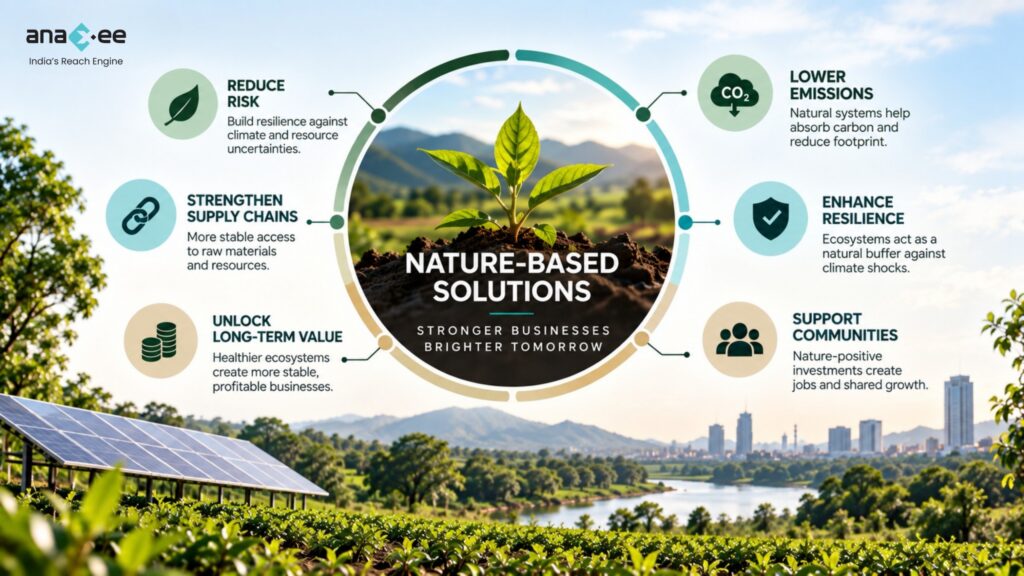
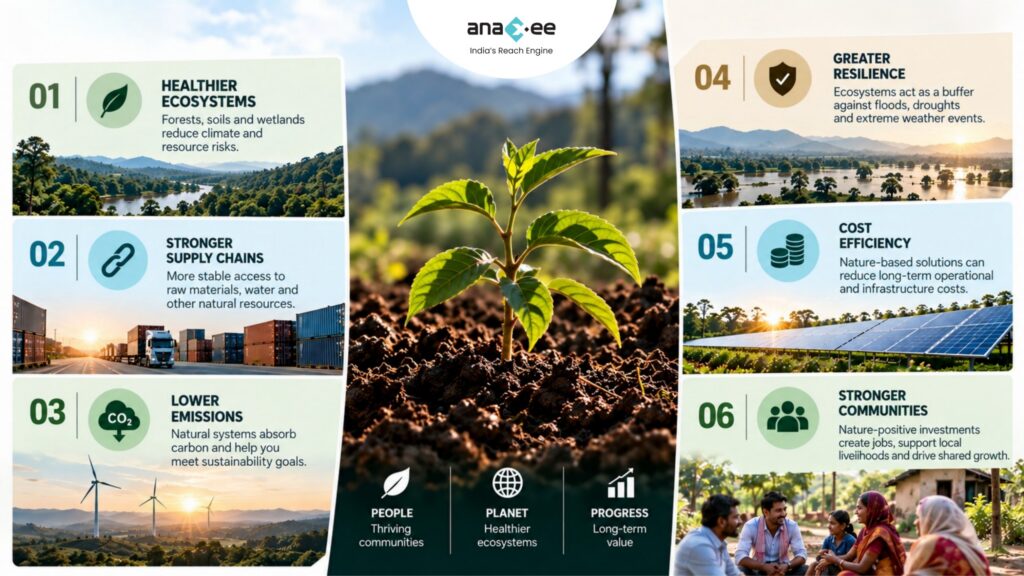
By repairing the natural systems your operations quietly depend on. These benefits rarely appear on a balance sheet, but their loss shows up fast in operational risk:
- Forests regulate water cycles and local temperature.
- Wetlands buffer floods.
- Healthy soils underpin agricultural productivity and yields.
- Agroforestry and better land management stabilise farm incomes and water retention across sourcing regions.
Restore these, and you’re not just generating carbon credits — you’re reducing the physical risk to your own supply chain. That dual return is what makes nature-based solutions a risk-mitigation asset, not a philanthropic line item. And it’s why SBTi’s 2026 net-zero standard explicitly recognises the near-term value of nature-based solutions, co-benefits included, alongside the longer-term push to durable removals.
Why is this becoming a disclosure obligation too?
Because investors and regulators now want nature risk measured, not assumed. The Taskforce on Nature-related Financial Disclosures (TNFD) extends the familiar TCFD approach to the ecosystems businesses depend on — water regulation, soil fertility, pollination — using its LEAP method (Locate, Evaluate, Assess, Prepare). The ISSB is developing a formal nature-related disclosure standard based on TNFD, with an Exposure Draft targeted for October 2026, and TNFD-aligned recommendations are being fed into the EU’s CSRD.
The direction of travel is clear: companies will increasingly have to show where they depend on and impact nature, and what they’re doing about it — supported by evidence and governance, not aspiration. Which raises a hard question most companies can’t yet answer well: where is your ground-level nature data going to come from?
What’s the catch with nature-based solutions?
They only deliver durable value when they’re implemented and monitored properly. Poorly designed projects fail communities, ecosystems and buyers alike — and a resilience investment that quietly underperforms is worse than none, because you’ve priced in protection you don’t actually have.
High-integrity nature solutions require long-term engagement, local participation, transparent data and continuous monitoring — elements that can’t be retrofitted after the fact. And the single biggest practical barrier is data: assessing risk and impact at the supplier and landscape level, across dispersed rural geographies, is exactly where visibility runs out. Spatial models help, but decision-ready resilience needs real observation on the ground.
What does it take to make NbS actually deliver resilience?
Four things, all local: reach into the sourcing regions where your risk and your impact actually sit; community participation so projects hold up over time; transparent, continuous monitoring rather than a one-off assessment; and granular field data you can feed into both your resilience planning and your disclosures. Get those right and nature-based solutions become a genuine hedge against physical risk. Miss them and you’ve bought a story, not a safeguard.
If your supply chain runs through rural India — or anywhere the ground-level nature data runs thin — that visibility gap is worth closing before it costs you. Book a demo with Anaxee’s climate team →
Where Anaxee fits
This is Anaxee’s core territory. As India’s Reach Engine, it runs the country’s largest last-mile field network — 40,000+ Digital Runners across 540+ districts, 26 states and 11,000+ pincodes — paired with digital MRV through its Climate Command Centre. For a company managing physical climate risk in Indian supply chains, that delivers three things at once:
- On-ground NbS implementation — agroforestry, regenerative agriculture, improved land and water practices — that rebuild the soil, water and farm-income resilience your sourcing depends on, while generating carbon.
- Granular field and landscape data — the supplier- and community-level observation that resilience planning and TNFD-style nature disclosure need, from the dispersed geographies where that data is hardest to get.
- Continuous, verifiable monitoring — long-term engagement and audit-grade MRV, so the resilience you invest in keeps being real, not just true on paper.
Anaxee isn’t a risk-analytics platform or a disclosure consultant. It’s the on-ground execution-and-data layer that turns a nature-based resilience strategy from a map into measurable action — bridging Indian communities and the corporates, investors and verifiers who depend on that ground being sound.
If you want nature-based resilience you can measure and defend — not just report — talk to the team that operates in the regions where your risk actually lives. Book a demo → sales@anaxee.com
Your climate-resilience checklist
- Map your physical exposure — which sourcing regions, suppliers and assets face acute and chronic climate risk?
- Find the data gaps — where are you relying on coarse assumptions instead of ground-level observation?
- Prioritise NbS where risk and impact overlap — the watersheds and landscapes your supply chain depends on.
- Build monitoring in from day one — resilience is continuous, not a one-time assessment.
- Align it with disclosure — TNFD/ISSB direction means your resilience work and your reporting should draw on the same verified data.
Climate risk stopped being a sustainability-team concern and became a business-continuity one. Nature-based solutions are among the few responses that pay twice — cutting carbon and cutting physical risk — but only when they’re built and monitored properly on the ground. The companies treating them as measurable, verifiable resilience assets will be the ones still delivering when the next drought, flood or disclosure deadline arrives. The ones treating them as a reporting checkbox will find out, the hard way, that a story isn’t a safeguard.
Frequently asked questions
Why is climate change a business risk, not just an environmental one? Because physical impacts — water stress, floods, heat, crop failure — now directly threaten operations, supply chains and costs. CDP has projected up to $120 billion in supply-chain environmental-risk costs, and these risks are unfolding now, not in the future.
How do nature-based solutions build business resilience? They restore the natural systems businesses depend on — forests regulate water, wetlands buffer floods, healthy soils underpin agriculture — reducing physical risk to supply chains while also delivering carbon benefits.
What is the difference between climate mitigation and adaptation? Mitigation cuts emissions to slow warming; adaptation (resilience) adjusts operations and supply chains to withstand impacts already occurring. Companies need both.
What is TNFD and why does it matter? The Taskforce on Nature-related Financial Disclosures extends climate-style disclosure to nature dependencies like water and soil. With an ISSB nature standard in development and CSRD alignment underway, companies increasingly must assess and disclose nature-related risk.
Do nature-based solutions actually work as risk mitigation? Yes, but only when implemented and monitored properly — with long-term engagement, local participation, transparent data and continuous monitoring. Poorly designed projects fail to deliver the resilience they promise.
Why is ground-level data important for climate resilience? Because supplier- and landscape-level risk is often hidden without granular observation. Decision-ready resilience and credible nature disclosure both depend on real, verifiable field data from the geographies where risk sits.