
How to Do Environmental Costing: A Step-by-Step Implementation Guide (2026)
Short answer: To do environmental costing, you map your product or service lifecycle, break each stage into activities, and quantify the environmental impact of each activity in physical units — GHG emissions, non-GHG emissions, water, waste and biodiversity impact. ICMAI’s Holistic Environmental Costing (HEC) framework structures this by combining life-cycle costing with activity-based costing. Understanding the framework is the easy part. The real work is setting up reliable data collection and quantifying impacts you can actually defend. Here’s the practical path from zero to your first environmental-cost statement.
What framework should you use?
Start with ICMAI’s Holistic Environmental Costing (HEC) framework, published in its 2025 Guidance Note on Environmental Costing. It borrows two ideas cost accountants already know — life-cycle costing (cradle-to-grave) and activity-based costing — and applies them to environmental impact instead of rupees. It measures across five categories (GHG emissions, non-GHG emissions, water, waste, biodiversity) and organises data across three layers: operations, management and reporting.
You don’t need to reinvent anything. If you want the conceptual mechanics in depth, see our explainer on how the HEC framework works. This guide is about doing it. (For the underlying idea of environmental cost vs impact, our environmental costing guide covers the basics.)
Before you start: what to put in place
Three quick decisions save weeks later:
- Scope and boundary. One product line, one facility, or the whole company? Start narrow — a single product or plant — and expand once the method works.
- Owners. Assign a named owner to each of the five impact categories. Orphaned data is the number one reason costing stalls.
- Units. Agree the physical units up front — tCO₂e, kilolitres, tonnes, absolute pollutant units — so nothing gets recorded two different ways.
With that settled, the HEC method runs in three core steps. Here’s how to execute each.
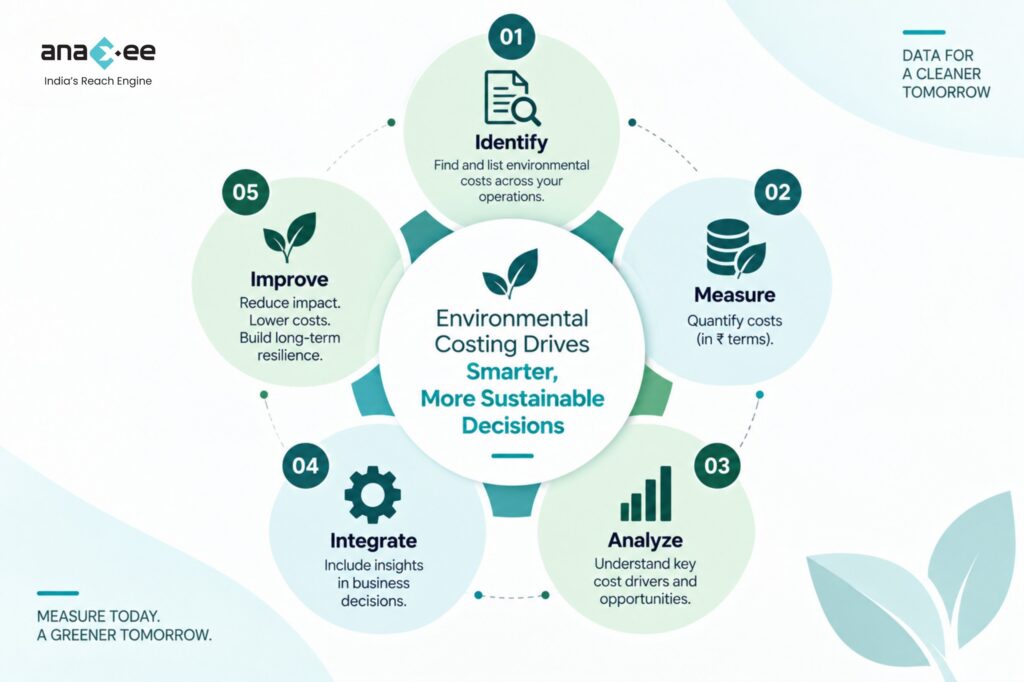
Step 1: Map your lifecycle
List the stages your product or service passes through — typically design, production, use and disposal — and note where environmental impact occurs at each.
Crucially, start at design, not production. Design decisions (energy efficiency, recycled materials, whether a product can be repaired or reused) lock in a large share of lifetime impact before anything is manufactured. Then follow the chain outward: raw materials and suppliers, your own operations, how customers use the product, and what happens at end of life. This cradle-to-grave view is what separates real environmental costing from just measuring your own four walls.
Step 2: Break each stage into activities
Now decompose each lifecycle stage into the specific activities that actually generate impact — the activity-based costing logic. This is where vague becomes measurable:
- Production → diesel/genset use, factory cooling, machining, packaging.
- Operations → electricity, water withdrawal, effluent, solid waste.
- Use → energy or fuel the product consumes in the customer’s hands.
- Disposal → landfill, recycling, emissions at end of life.
The finer the breakdown, the more precisely you can attribute impact — and the easier it becomes to find the hotspots worth fixing.
Step 3: Collect the activity data (the step that makes or breaks it)
Every activity you listed needs real numbers behind it: litres of diesel, kilolitres of water, kWh of energy, tonnes of waste, quantities of raw material. This is where most environmental-costing efforts quietly fail — not on method, but on data.
The trap is estimating instead of measuring. Estimates are fine for a rough first pass, but they collapse the moment anyone (an assurer, an investor, your own board) asks for evidence. And the hardest data to get is rarely at head office — it’s at dispersed plants, warehouses and, above all, suppliers, often in parts of the country your systems never reach. Getting primary, documented, traceable activity data from those places is a field-logistics problem long before it’s an accounting one. Plan for it deliberately, because it’s the step that determines whether your whole environmental-cost statement holds up.
If ground-level activity data — across your sites and suppliers — is the step you’re unsure how to resource, that’s worth solving before you build the rest. Book a demo with Anaxee’s team →
Step 4: Quantify environmental costs in physical units
Convert each activity’s raw data into its environmental cost using recognised conversion factors:
- Fuel and energy → tCO₂e via emission factors
- Process outputs → NOx/SOx/PM in absolute units
- Water → kilolitres withdrawn, consumed, discharged
- Waste → tonnes by type and disposal route
- Land and sourcing → biodiversity impact indicators
Then compute intensity ratios (impact per unit of output or revenue) — these are what make results comparable over time and against peers, and what disclosure frameworks ask for.
Step 5: Assign, aggregate, and build the statement
Assign each quantified cost back to its activity and stage, then roll everything up — by activity, by lifecycle stage, and by the five impact categories. The output is an environmental-cost statement: a structured picture of what your operations “cost” the environment, with the hotspots visible.
Because the HEC approach mirrors cost-accounting logic and produces structured, evidence-linked data, the same statement supports both limited and reasonable assurance and maps cleanly to BRSR, GRI, ISSB and CDP — so you build once and report many times.
Step 6: Use it — don’t just file it
The point isn’t the report; it’s the intelligence. A good environmental-cost statement drives:
- Efficiency — hotspots show where resource leakage and waste are costing you.
- Risk — rising water intensity or inconsistent waste flags operational and regulatory exposure early.
- Reporting — audit-ready inputs for BRSR and investor disclosures.
- Access — green-finance eligibility and customer/supply-chain requirements.
Treat it like financial costing: something you run continuously and manage from, not a once-a-year filing exercise.
What are the most common environmental-costing mistakes?
- Estimating instead of measuring — the fastest way to fail assurance.
- Carbon tunnel vision — tracking only GHGs and ignoring water, waste and biodiversity.
- Stopping at your own walls — skipping supplier (Scope 3) and product-use impacts.
- No data ownership — numbers assembled in a panic at reporting time.
- Un-auditable data — figures with no trail back to real, verifiable activity.
Every one of these traces back to the same root: weak data collection. Which is exactly where to concentrate your effort — and your budget.
Where Anaxee fits
The framework, the emission factors and the statement you can build in-house or with a cost-accounting partner. The step that defeats most companies — collecting primary, verifiable activity data across dispersed operations and suppliers — is where Anaxee comes in.
Anaxee runs India’s largest last-mile field network — 40,000+ Digital Runners across 540+ districts, 26 states and 11,000+ pincodes — purpose-suited to exactly Step 3:
- Primary activity data from anywhere. Water, waste, energy, fuel and material data captured on the ground at plants, warehouses and supplier sites your systems can’t reach.
- Measured, not estimated. Real field readings and documentation that replace the guesswork assurers reject.
- Audit-grade and traceable. Geo-tagged, evidence-linked data collection that stands up under reasonable-assurance testing and maps straight into your environmental-cost statement.
Anaxee isn’t your cost accountant or your ESG software — it’s the data-collection engine that feeds them, turning a well-designed environmental-costing method into numbers you can actually stand behind.
If your environmental costing keeps stalling at the data step, talk to the team that collects it on the ground at national scale. Book a demo → sales@anaxee.com
Your environmental-costing starter checklist
- Pick a narrow scope — one product or plant — for your first pass.
- Assign owners and units for all five impact categories before collecting anything.
- Map lifecycle → activities using the HEC structure.
- Resource data collection properly, especially for suppliers and remote sites — it’s the make-or-break step.
- Quantify in physical units, compute intensities, and build a statement you can reuse across BRSR, GRI, ISSB and CDP.
- Run it continuously and manage from the hotspots.
Environmental costing isn’t a CSR exercise — it’s management intelligence, built the same disciplined way you build financial costing. The method is well-defined and the framework is ready. What decides whether it works is whether you can put real, verifiable numbers behind every activity. Get the data right, and everything downstream — reporting, assurance, efficiency, strategy — gets easier.
Frequently asked questions
How do you do environmental costing? Map your product or service lifecycle, break each stage into activities, collect real activity data, and quantify the impact of each activity in physical units (GHG, non-GHG, water, waste, biodiversity) — then aggregate into an environmental-cost statement. ICMAI’s HEC framework structures the process.
What is the HEC framework? The Holistic Environmental Costing framework from ICMAI’s 2025 Guidance Note. It combines life-cycle costing and activity-based costing to measure environmental impact across five categories and three layers (operations, management, reporting).
What are the steps of the HEC framework? Three core steps: lifecycle mapping (design, production, use, disposal), activity-based breakdown of each stage, and assigning quantified environmental costs to each activity.
What data do you need for environmental costing? Primary activity data — fuel and energy use, water withdrawal and discharge, waste generated, materials, and process emissions — measured (not estimated) across your operations and, ideally, your suppliers, with evidence attached.
What’s the hardest part of environmental costing? Collecting reliable, verifiable activity data across dispersed sites and suppliers. Most efforts fail on data, not method — estimates don’t survive assurance, and remote or supplier data is hard to reach.
Can environmental costing be used for BRSR? Yes. A structured environmental-cost statement produces the evidence-backed GHG, water, waste and energy data BRSR Core needs, and maps to GRI, ISSB and CDP as well.