
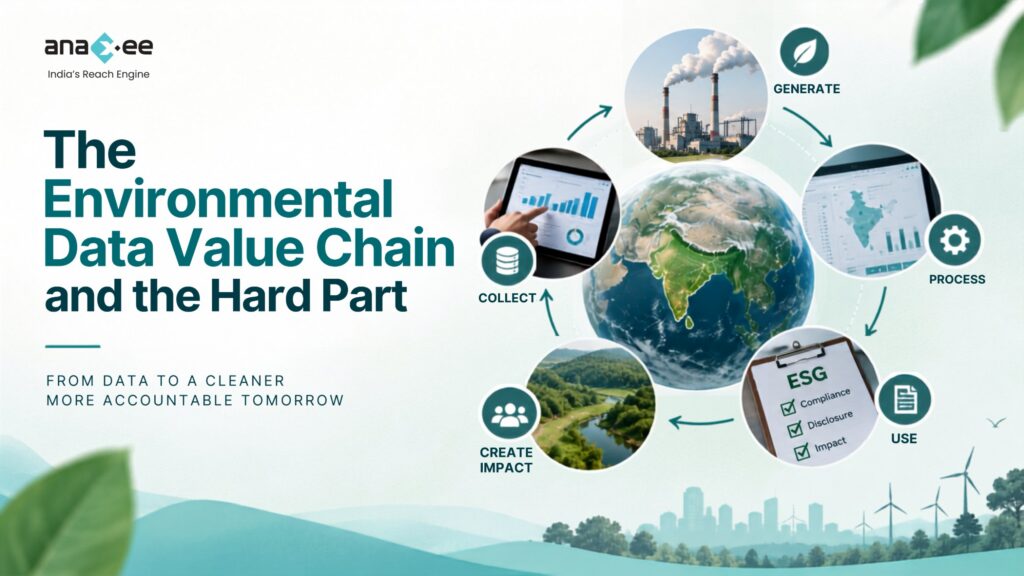

Why Environmental Data Is the Hard Part — Measuring Impact Across India’s Value Chains
Short answer: The hardest part of any environmental report, carbon footprint or costing exercise isn’t the framework or the math — it’s getting the data. And that’s because most of your environmental impact doesn’t sit inside your own walls. On average, around 75% of a company’s carbon footprint — often 70–90% — lives in its value chain, in suppliers who frequently don’t measure their own emissions, water or waste. CDP puts supply-chain emissions at roughly 11 times a company’s own operations. So the numbers you most need are the ones you control least: scattered across hundreds of suppliers and sites, often in places your systems never reach. Here’s why that’s the real bottleneck — and what actually fixes it.
Why is getting environmental data so hard?
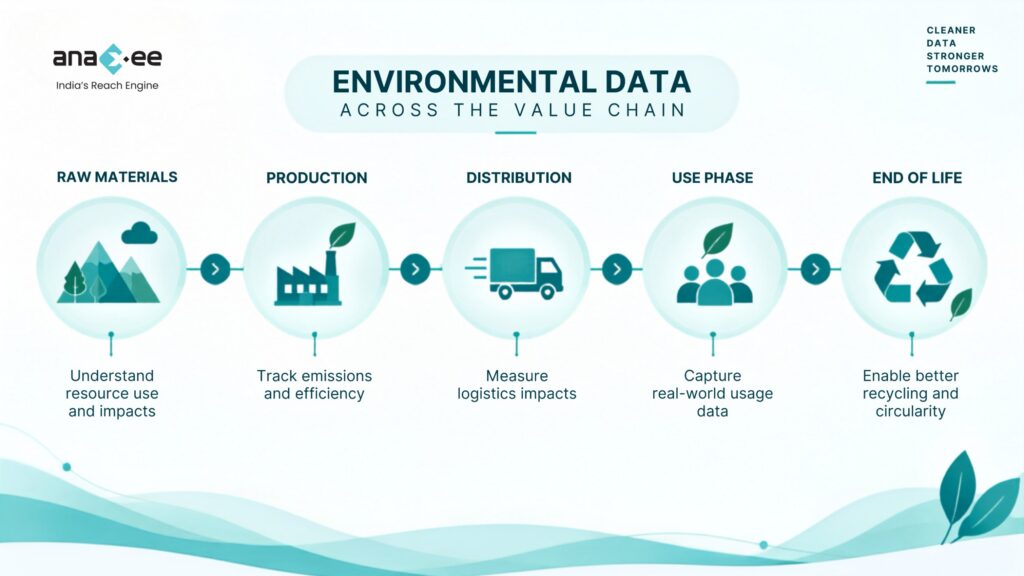
Because the data lives in other companies. Your own operations — the part you can meter and manage — are usually the small share of your total footprint. The majority sits upstream and downstream: in the factories that make your inputs, the logistics that move them, the way customers use your product, and what happens at its end of life.
That’s the structural problem. You can have the perfect framework, the right emission factors and a capable team, and still be stuck — because the activity data you need is sitting in a supplier’s records three tiers down your chain, and that supplier may not measure it at all.
How much of your impact is actually in your value chain?
More than most companies assume. According to recent analysis, Scope 3 emissions make up around 75% of a typical organisation’s total footprint, and for many the figure is 70–90% or higher — FMCG companies often sit at 80–95%, and sectors like financial services and capital goods regularly exceed 90%. CDP’s analysis of over 23,000 corporate disclosures found supply-chain emissions average 11.4 times a company’s own Scope 1 and 2 emissions, reaching 25:1 in some sectors.
And it’s not just carbon. Water, waste and biodiversity impacts follow the same pattern — concentrated in raw-material production and processing, far from head office. If you only measure your own four walls, you’re measuring the small end of the problem.
Why don’t spend-based estimates cut it anymore?
For years, companies filled the value-chain gap with spend-based estimates — multiply how much you spent with a supplier by an industry-average emissions factor and call it done. It’s quick, and it’s increasingly not good enough.
The bar is rising fast. The GHG Protocol’s 2026 Scope 3 revision proposes a 95% coverage floor with data-quality tiers, pushing companies off crude proxies toward primary, supplier-specific data (final standards are expected in 2027). India’s BRSR Core demands reasonable assurance — a near-audit standard estimates won’t survive. And CSRD, California’s SB 253 and ISSB adoption across dozens of countries all point the same way. An estimate is fine until someone asks for evidence; then it’s a liability. The direction is unmistakable: measured beats modelled, and it’s becoming mandatory.
What makes supplier environmental data so difficult?
Everything about it. Surveys put it starkly — 79% of companies say supplier data is their single biggest environmental-reporting challenge. The reasons compound:
- Suppliers don’t measure. Many, especially smaller ones, simply don’t track their own emissions, water or waste, and lack the systems to.
- The data is scattered. It lives across hundreds or thousands of suppliers, in different formats, to different standards.
- Chasing it doesn’t scale. Emails and spreadsheets to a long supplier tail produce low response rates and unreliable numbers.
- It has to be verifiable. Under a reasonable-assurance or 95%-coverage regime, the data needs an evidence trail, not a self-reported guess.
This is why value-chain data defeats otherwise well-run programs. It’s not an analytical problem. It’s a reach-and-collection problem.
Why is this especially hard in India?
Because Indian value chains run deep into places conventional data collection can’t follow. Behind a listed company sit layers of suppliers, processors, contract units, farms and MSMEs spread across Tier 2/3/4 towns and villages — many without the systems, the English-language reporting capacity, or the incentive to track environmental data.
You can’t fix that from a dashboard or a supplier-portal email. Reaching a small processing unit in a district town, or a cluster of farms supplying raw material, and getting real measured data out of them, requires people on the ground who speak the language and can build the trust to collect it. That reach gap is exactly why so much Indian value-chain data is either missing or estimated — and why closing it is a logistics capability, not a software feature.
What does good environmental data actually require?
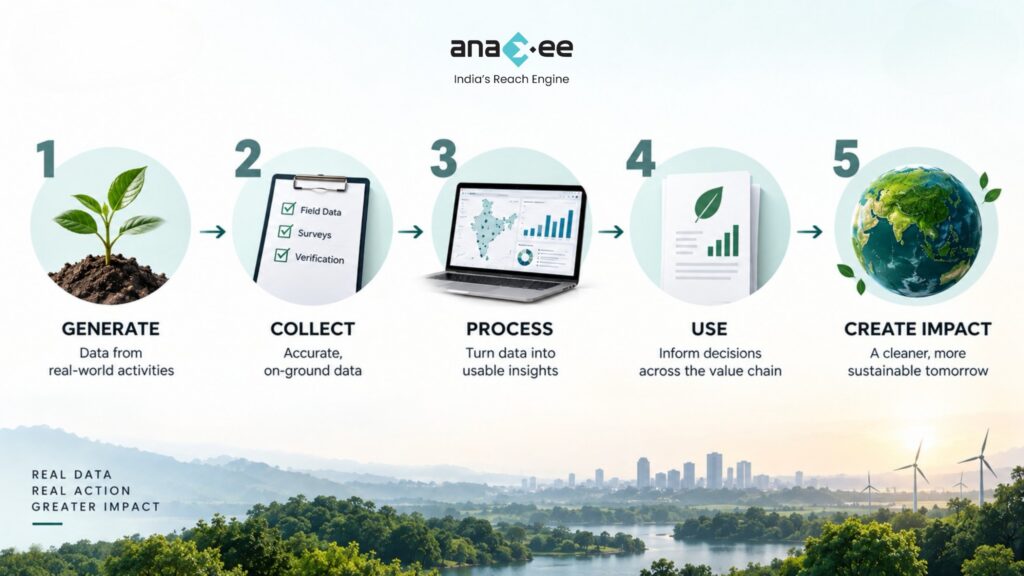
Four things, and estimates deliver none of them: it must be primary (from the actual supplier or site, not an industry average), measured (real readings, not modelled), traceable (linked to a source and a date), and verifiable (able to survive assurance). Getting there means going to where the impact happens — the supplier sites, the processing units, the fields — and collecting the numbers directly, with documentation.
That’s the unglamorous work that decides whether your footprint, your BRSR filing or your environmental-cost statement holds up. And it’s precisely the step companies are least equipped to do at scale.
If value-chain data is the wall your environmental reporting keeps hitting, that’s worth solving at the source. Book a demo with Anaxee’s team →
How do you actually close the data gap?
Three moves that work:
- Focus where it matters. You don’t need data from every supplier — concentrate on the highest-impact ones, which typically account for the bulk of your footprint.
- Collect primary data at the source. Replace spend-based proxies with real, measured activity data from those suppliers and sites.
- Build the evidence trail as you go, so the data is assurance-ready, not something you scramble to defend later.
The first two are strategy. The third is discipline. All three depend on one capability most companies don’t have in-house: the reach to get to dispersed suppliers and collect verifiable data from them.
Where Anaxee fits
This is Anaxee’s core purpose. As India’s Reach Engine, it runs the country’s largest last-mile field network — 40,000+ Digital Runners across 540+ districts, 26 states and 11,000+ pincodes — built to reach exactly the dispersed suppliers, sites and communities where your value-chain data actually lives.
For environmental data, that means:
- Primary data from anywhere in your chain. Measured emissions, water, waste and energy data collected on the ground at supplier and processing sites across Tier 2/3/4 India — the places portals and emails never reach.
- Measured, not estimated. Real field readings that replace spend-based proxies, so your numbers stand up as the coverage bar rises toward 95%.
- Audit-grade and traceable. Geo-tagged, documented data with an evidence trail that survives BRSR reasonable assurance and maps into CDP, CSRD, ISSB and your environmental-cost statement.
Anaxee isn’t a carbon-accounting platform or a reporting tool — it’s the collection engine that feeds them the one thing they can’t generate themselves: verifiable, primary environmental data from deep in the value chain.
If your environmental reporting keeps stalling on supplier and site data, talk to the team that collects it on the ground at national scale. Book a demo → sales@anaxee.com
Your data-gap checklist
- Map where your impact really sits — assume most of it is in your value chain, not your operations.
- Identify your highest-impact suppliers and sites — that’s where to concentrate collection.
- Audit your data quality — how much of your footprint is currently spend-based estimate versus measured?
- Plan for primary data at the source, especially for dispersed and hard-to-reach suppliers.
- Build the evidence trail now, ahead of the 95% coverage floor and reasonable-assurance demands.
Every environmental framework — BRSR, environmental costing, CSRD, CDP — eventually runs into the same wall: the data. And the hardest, most valuable data is the primary, verifiable kind from deep in a value chain that most systems can’t reach. The companies that solve collection at the source will report with confidence as the rules tighten. The ones still relying on estimates are building on numbers that won’t hold. Measurement, in the end, is the moat.
Frequently asked questions
Why is Scope 3 / value-chain data so hard to collect? Because it lives in other companies — suppliers, logistics partners and customers — many of whom don’t measure their own emissions, water or waste. On average around 75% of a company’s footprint is in its value chain, so the most important data is the least controlled.
How much of a company’s footprint is in its value chain? Typically 70–90%, and often higher — CDP found supply-chain emissions average about 11.4 times a company’s own operational emissions, reaching 25:1 in some sectors.
Why aren’t spend-based estimates good enough? They’re low-accuracy proxies, and the bar is rising — the GHG Protocol’s 2026 Scope 3 revision proposes a 95% coverage floor, and standards like BRSR Core demand reasonable assurance that estimates can’t pass.
What’s the difference between primary and estimated environmental data? Primary data is measured directly from the actual supplier or site; estimated data is modelled from industry averages or spend. Primary, verifiable data is what survives assurance and rising coverage requirements.
Why is value-chain data especially hard to collect in India? Indian value chains extend deep into Tier 2/3/4 towns and villages, through suppliers, MSMEs and farms that often lack tracking systems — reaching them and collecting verifiable data requires people on the ground, not portals.
How can companies improve their environmental data quality? Focus on the highest-impact suppliers, collect primary measured data at the source rather than relying on estimates, and build an evidence trail so the data is assurance-ready.