

CBAM in 2026: What the EU’s Carbon Border Tax Really Costs Indian Exporters — and How to Protect Your Margins
Short answer: The EU’s Carbon Border Adjustment Mechanism (CBAM) entered its definitive, paying phase on 1 January 2026. If you export steel, aluminium, cement, fertiliser, hydrogen or electricity to the EU, your buyers now face a carbon charge tied to the emissions embedded in your goods — and they’re pushing that cost straight back to you through lower prices and hard demands for verified data. Indian iron & steel exports to the EU have already dropped by roughly a third. Here’s the uncomfortable truth: CBAM won’t be won by the lowest-carbon exporters. It’ll be won by the ones who can prove their carbon numbers with verified, plant-level data — instead of getting stuck with the EU’s punitive default values.
That last sentence is the whole game. Let’s unpack why.
What is CBAM, in one minute?
CBAM is the EU’s carbon border tax. It puts the same carbon price on imported goods that EU producers already pay under the EU Emissions Trading System — so a European steelmaker paying for its emissions isn’t undercut by an import made somewhere with looser climate rules. The EU calls the problem it’s fixing “carbon leakage.”
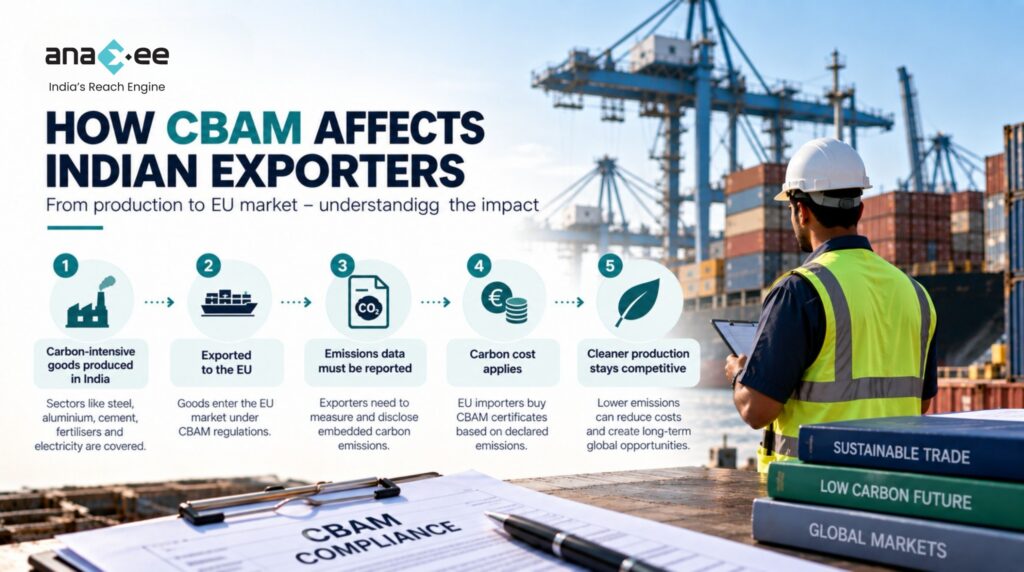
Mechanically: your EU customer (the importer) must buy CBAM certificates covering the carbon embedded in your product, priced at the EU carbon rate. You don’t pay the EU directly — but you feel it, because that cost changes what your buyer is willing to pay you, and whether they keep buying from you at all.
Is CBAM actually charging money now, or still just reporting?
Charging. CBAM ran as a reporting-only exercise from October 2023 through the end of 2025. Since 1 January 2026 it’s been in its definitive phase — the one with financial teeth.
One nuance worth knowing so you don’t misread the deadline: the first formal CBAM declaration and certificate surrender for 2026 imports falls due in 2027, not this month. But don’t let that lull you into waiting. EU buyers are already pricing the carbon cost into their sourcing decisions and demanding firmer emissions data before they commit to volumes — which is exactly why Indian shipments have already softened well ahead of any certificate being surrendered. The market moved before the paperwork did.
Which Indian exports are hit hardest?
CBAM covers six categories: iron & steel, aluminium, cement, fertiliser, electricity and hydrogen — plus some downstream steel items like screws and bolts. India ships roughly €8–9 billion of CBAM-covered goods to the EU each year, and the exposure is heavily concentrated in iron, steel and aluminium.
The damage isn’t hypothetical. India’s steel and aluminium exports to the EU fell about 24% in a single year (roughly $7.7bn to $5.8bn, FY24 to FY25), with iron & steel alone down around a third — largely because EU buyers started pricing in the carbon cost and pushing for cleaner data before the definitive phase even began. If you’re in these sectors, this is a right-now revenue issue, not a 2030 planning slide.
How much does CBAM actually cost?
Two numbers frame it.
First, the certificate price: it tracks the EU carbon market, and the first quarterly CBAM certificate price landed at €75.36 per tonne of CO₂ for Q1 2026. Multiply that by the tonnes of carbon embedded in a shipment and you get the charge riding on your goods.
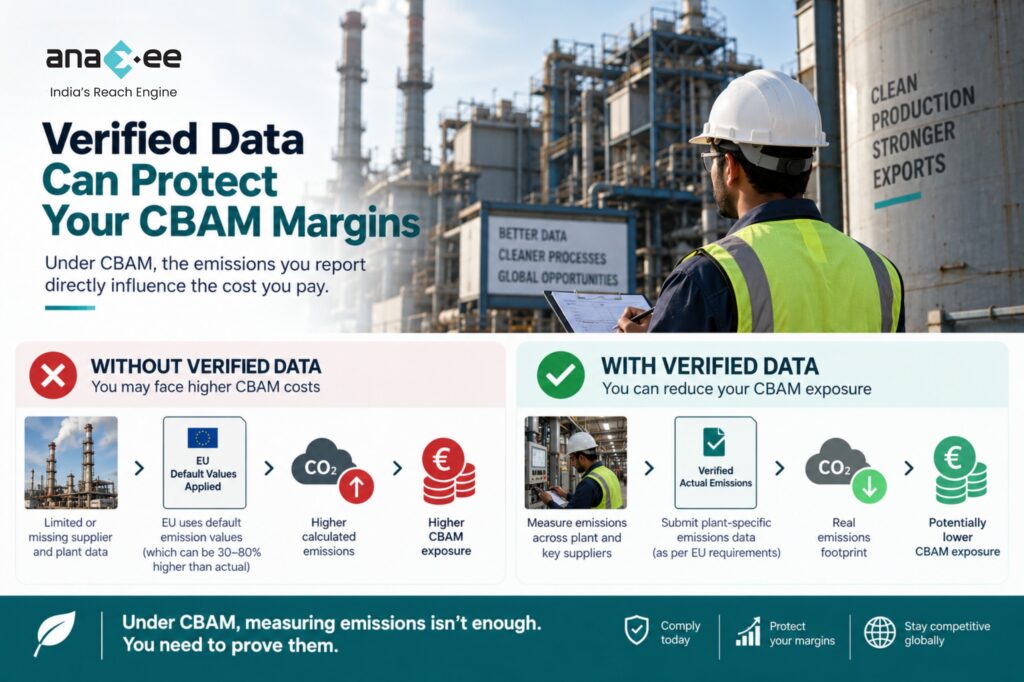
Second — and this is the one that hurts — the default values. If you can’t supply verified, actual emissions data, EU authorities apply default values that are deliberately set at the high end of each sector’s range. Analysts estimate those defaults can run 30–80% above a plant’s real emissions, and that Indian steel and aluminium exporters could face effective price cuts of 15–22% just to absorb the hit. In other words: bad data is taxed harder than dirty production. An efficient plant that can’t prove its numbers pays more than a dirtier one that can.
Why verified data is the whole game
Sit with that last point, because it flips the usual assumption. Under CBAM, the penalty isn’t only for emitting — it’s for not being able to prove what you emit. Every CBAM conversation with an EU buyer eventually reaches the same request: installation-level embedded emissions, calculated to EU methodology, with evidence behind every number.
For a large integrated plant, that’s a metering-and-accounting project. But for exporters whose carbon story runs through a dispersed web of suppliers — scrap sources, ancillary units, captive power, raw-material vendors scattered across the country — the hard part is getting primary, verifiable data out of places that were never set up to report it. That’s not a software problem. That’s a feet-on-the-ground problem. Hold that thought too.
Can a domestic carbon price lower your CBAM bill?
Yes — and this is where CBAM connects to India’s own carbon market. CBAM allows a deduction for a carbon price already paid in the country of origin. So as India’s Carbon Credit Trading Scheme (CCTS) matures into a real, verifiable domestic carbon price, the carbon you effectively pay for at home can be netted off what your EU buyer owes at the border.
The catch is the same one, again: you can only claim that deduction with clean, documented, verifiable data. (If you want the full picture of how CCTS itself works and who it covers, that’s the subject of our companion guide on CCTS compliance for business.)
What can you actually do to cut CBAM exposure?
The exporters getting ahead of this are doing five things:
- Measure at the source. The majority of your carbon is determined upstream — in raw materials, power and process — not at final assembly. You can’t manage what you haven’t measured.
- Escape the default values. Build verified, plant- and supplier-level embedded-emissions data so EU importers use your real numbers, not the punitive defaults.
- Decarbonise where it’s cheapest first — energy efficiency, cleaner power, higher recycled content.
- Strengthen the wider carbon story with credible, high-integrity offset and community projects that back a genuine net-zero position (not paper credits that won’t survive scrutiny).
- Get your CCTS house in order so the domestic-carbon-price deduction actually works for you.
Notice that four of those five run on the same fuel: trustworthy field data.
Where Anaxee fits
Anaxee won’t file your CBAM declaration — that’s your compliance team’s or a verifier’s job, and anyone claiming otherwise is overselling. What Anaxee does run is the layer underneath all of it: India’s largest last-mile field network — 40,000+ Digital Runners across 540+ districts, 26 states and 11,000+ pincodes — paired with a carbon-grade technology stack in its Climate Command Centre.
For a CBAM-exposed exporter, that translates to three concrete things:
- Primary data from the places software can’t reach. Field-level energy and emissions audits, and supplier-level data collection across dispersed, hard-to-reach units — the raw, verifiable inputs your CBAM (and CCTS deduction) numbers have to be built on. This is exactly the gap that leaves exporters stuck with default values.
- Digital MRV that holds up under audit. Mobile-first capture, geo-tagged evidence and digital audit trails — the difference between a number an EU verifier accepts and one they reject.
- High-integrity offsets for the net-zero half of the story. Anaxee has deployed 125,000+ improved cookstoves (Gold Standard / CCP-labelled) and runs agroforestry projects under the VM0047 methodology — real, community-backed credits that strengthen a decarbonisation position instead of denting it.
Think of it as the ground truth your carbon compliance stands on.
If your CBAM numbers depend on data from suppliers and sites your systems can’t easily see, that’s worth a conversation before the next reporting cycle. Book a demo with Anaxee’s climate team →
Your 90-day CBAM readiness checklist
- Quantify your exposure. Which of your EU-bound products are CBAM-covered, and what’s the embedded-carbon estimate on each?
- Audit your data gaps. Where would you be forced onto default values today because you can’t verify actual emissions — especially across suppliers?
- Map your upstream. Identify the raw materials, power and process steps driving most of your embedded carbon.
- Stand up field-level measurement now, for both your own sites and key suppliers — not in the month before you report.
- Line up your CCTS deduction so your domestic carbon price actually reduces the border charge.
CBAM has quietly rewritten the rules of exporting to Europe. Carbon is now embedded in every tonne you ship, and the exporters who win aren’t the ones with the cleanest slides — they’re the ones who can put verified numbers behind every claim. Get the data right, and CBAM shifts from a margin threat into a moat your less-prepared competitors can’t cross.
If verified, field-level carbon data is the piece you’re missing, talk to the team that already operates on the ground at national scale. Book a demo → sales@anaxee.com
Frequently asked questions
What is CBAM and when did it start charging? CBAM is the EU’s carbon border tax on imported goods. It ran as reporting-only from October 2023 and entered its definitive, financially binding phase on 1 January 2026, with the first certificate surrender for 2026 imports due in 2027.
Which products does CBAM cover? Iron & steel, aluminium, cement, fertiliser, electricity and hydrogen, plus some downstream steel products. Coverage is set to widen toward 2030.
How does CBAM affect Indian exporters if EU importers are the ones who pay? The importer buys the certificates, but the cost flows back to you through lower prices and buyer demands for verified emissions data. Indian steel and aluminium exports to the EU have already fallen sharply as a result.
What are CBAM default values and why do they matter? If you can’t provide verified actual emissions data, the EU applies default values set at the high end of each sector’s range — often well above real emissions. Verified data is the only way to avoid paying more than you should.
Can Indian companies reduce CBAM costs through CCTS? Yes. CBAM allows a deduction for a carbon price already paid at home, so a maturing CCTS carbon price can offset part of the border charge — provided the data supporting it is verifiable.
How can exporters lower their CBAM exposure? Measure emissions at the source, build verified plant- and supplier-level data to escape default values, decarbonise upstream, and back a credible net-zero position with high-integrity offsets.