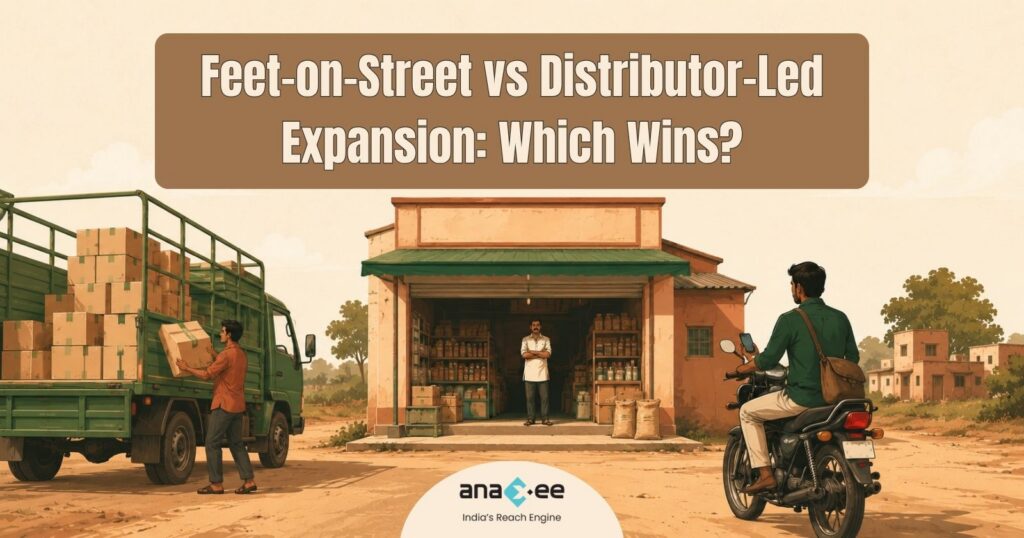

Feet-on-Street vs. Distributor-Led Expansion: Which Model Wins in Bharat?
Every brand planning a push into smaller Indian markets ends up in the same meeting.
One side wants to appoint distributors and move fast. The other wants boots on the ground and real control. Both sides have good arguments. The decision usually gets made by whoever is more senior in the room, or by whichever model the last company someone worked at happened to use.
That’s a bad way to decide something this expensive. Here’s a better one.
What each model actually gives you
Strip away the slide decks and the two models are answering different questions.
Distributor-led answers: how do I get my product physically available in this market without building anything?
Feet-on-street answers: how do I make sure my product actually sells once it’s there?
Those are not the same problem, and most failed expansions come from solving the wrong one.
Where distributor-led genuinely wins
Let’s be fair to it, because a lot of brand-side writing treats distributors as an obstacle. They’re not.
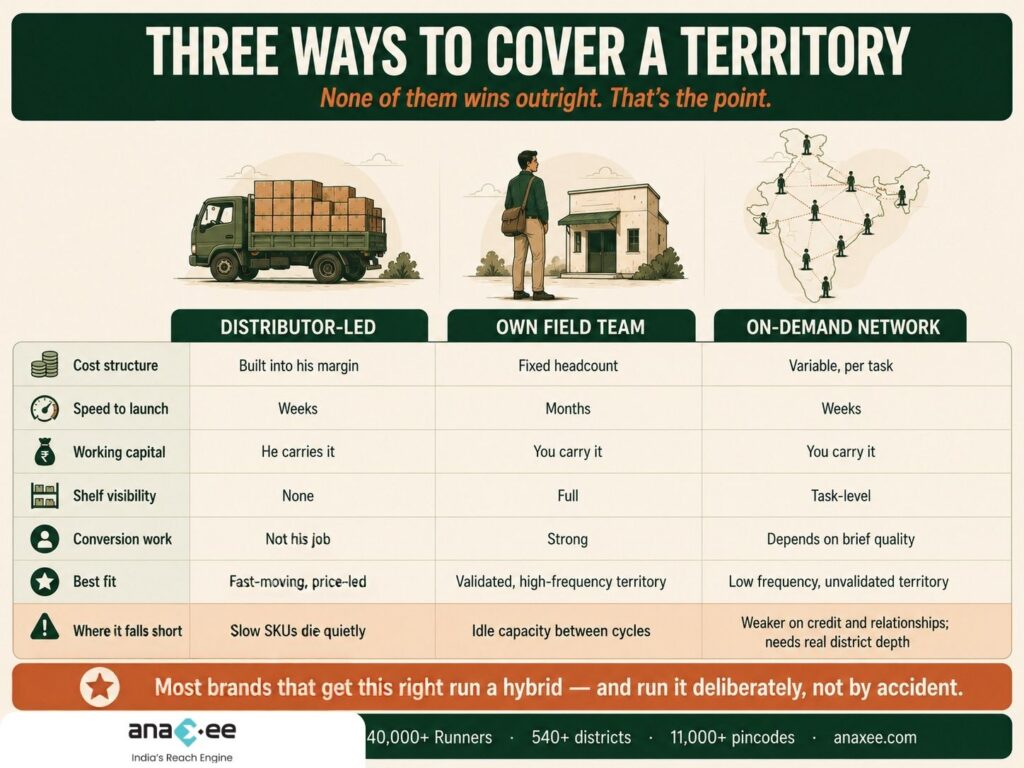
Working capital. A distributor funds your stock. He carries the inventory, extends credit to retailers, and absorbs the payment cycle. For a growing brand, that’s not a small favour — it’s the difference between expanding and not expanding.
Existing relationships. He’s been selling to those retailers for fifteen years. He knows who pays and who doesn’t. That trust is not something your new field executive can build in a quarter.
Speed. You can be present in a new state in weeks. Building your own coverage takes months.
Local credit judgement. He knows which shop is about to go under. You don’t, and you’d learn it the expensive way.
If your product moves fast, sells itself, and competes primarily on availability and price — distributor-led is usually the right answer. Don’t overthink it.
Where distributor-led quietly fails
The model breaks in a specific and predictable set of conditions.
New categories. If the retailer needs to be explained the product before he’ll stock it, the distributor won’t do that work. He’s not paid to educate. He’s paid to rotate.
Slow-moving SKUs. Your product competes for his working capital against 200 others. If yours turns slower, it loses — every time, quietly.
Zero visibility. Primary sales tell you what he bought. They tell you nothing about what sold through. Brands routinely discover a year’s worth of “growth” was stock sitting in a godown.
No shelf control. You have no idea whether your display is up, your pricing is right, or a competitor’s scheme has taken your slot.
The failure mode is subtle. Numbers look fine for two or three quarters. Then reorders slow, and by the time anyone investigates, the season is gone and nobody can reconstruct what went wrong.
Where feet-on-street wins
Your own field presence buys you three things distributors can’t sell you.
Information. What’s on the shelf, what competitors are running, what retailers are complaining about. In low-frequency categories, this is often worth more than the orders themselves.
Conversion work. Somebody has to convince a hardware shop in a small town to stock a brand he’s never heard of. That’s persuasion, demonstration and follow-up. It’s field work.
Brand control. Display, pricing discipline, retailer training, scheme communication. All of it needs a person who works for you.
The cost is real though. Fixed headcount, hiring in territories you don’t know, attrition, supervision, and idle capacity between visit cycles. In a low-frequency category, a permanent field executive can be genuinely underutilised for weeks at a time — and you pay anyway.
The third option most brands skip
There’s a middle path that’s become practical in the last few years, and it doesn’t get discussed enough: variable, on-demand field coverage.
The idea is straightforward. Instead of hiring permanent staff or handing everything to a distributor, you use a distributed network of trained field personnel who execute specific tasks on a per-task basis — verify outlets, onboard retailers, audit shelves, deliver samples, capture data — in the districts you specify, for the cycles you need.
You keep the distributor for stock, credit and logistics. You get independent eyes on the shelf without carrying headcount.
For non-FMCG brands with quarterly or half-yearly visit cycles, this often works better than either pure model — because the fundamental problem with own-FOS in these categories isn’t quality, it’s utilisation. You’re paying for a full year to get eight weeks of useful work.
Five questions that actually decide it
Forget the models for a minute and answer these.
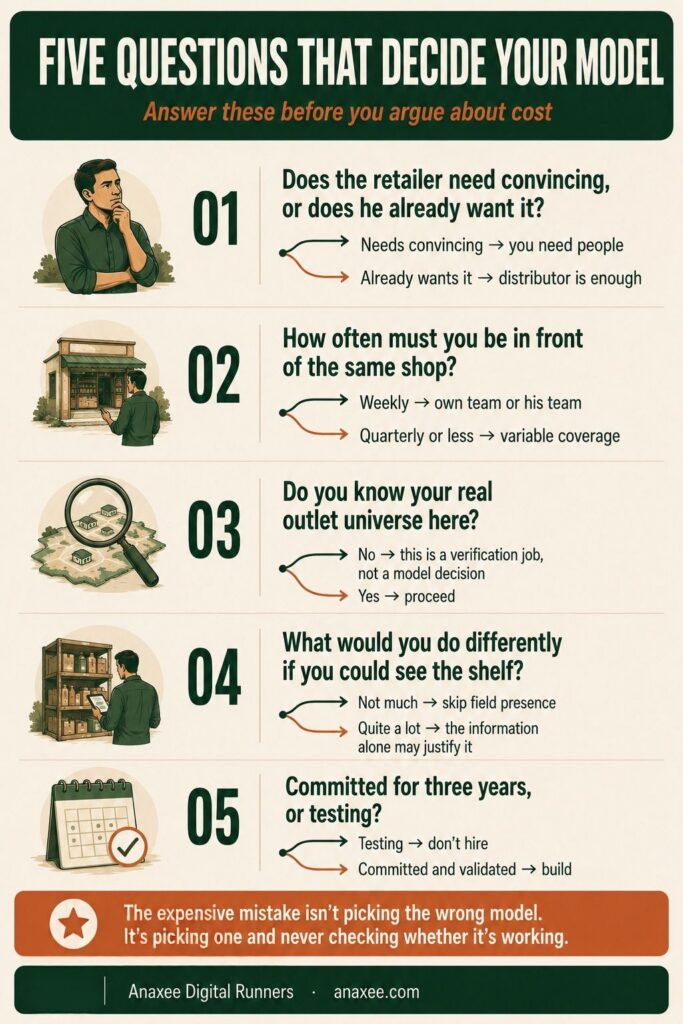
1. Does the retailer need to be convinced, or does he already want it? Needs convincing → you need people. Already wants it → distributor is enough.
2. How often do you need to be in front of the same shop? Weekly → own team or distributor’s team. Quarterly or less → variable coverage almost always wins on cost.
3. Do you know your real outlet universe in this territory? If no, you’re not choosing a distribution model yet. You’re choosing a verification exercise. Do that first.
4. What decisions would you make differently if you could see the shelf? If the honest answer is “not many,” you don’t need field presence. If it’s “quite a few,” the information alone may justify the spend.
5. Are you committed to this territory for three years, or testing it? Testing → don’t hire. Committed and validated → build.
The mistake almost everyone makes
Comparing the models on cost per visit.
Cost per visit makes distributor-led look free and feet-on-street look expensive, because the distributor’s cost is buried inside his margin and yours sits in a salary line.
Compare on cost per active, reordering retailer instead. Once you do that, distributor-led in a low-conviction category stops looking cheap — because a large share of your “coverage” consists of shops that were stocked once and never reordered.
That’s the number that decides whether a territory pays back. Everything else is a proxy.
So which one wins?
Neither, as a general rule. That’s the honest answer.
Fast-moving, established category, weekly cycles, price-driven → distributor-led, with light audit coverage on top.
New category, low frequency, needs conviction at the counter, unvalidated territory → variable field coverage first, then decide where to build permanent presence based on what you learn.
Most brands that get this right end up running a hybrid, and running it deliberately rather than by accident. The distributor moves the box. Somebody independent tells you what happened to it.
The expensive mistake isn’t picking the wrong model. It’s picking one and then never checking whether it’s working.
Anaxee runs variable, on-demand retail coverage for non-FMCG brands across 540+ districts and 11,000+ pincodes, through a network of 40,000+ Digital Runners — retailer verification, onboarding, shelf audits and last-mile distribution, without adding fixed headcount. If you’re weighing your options for a new territory, book a conversation with our team.