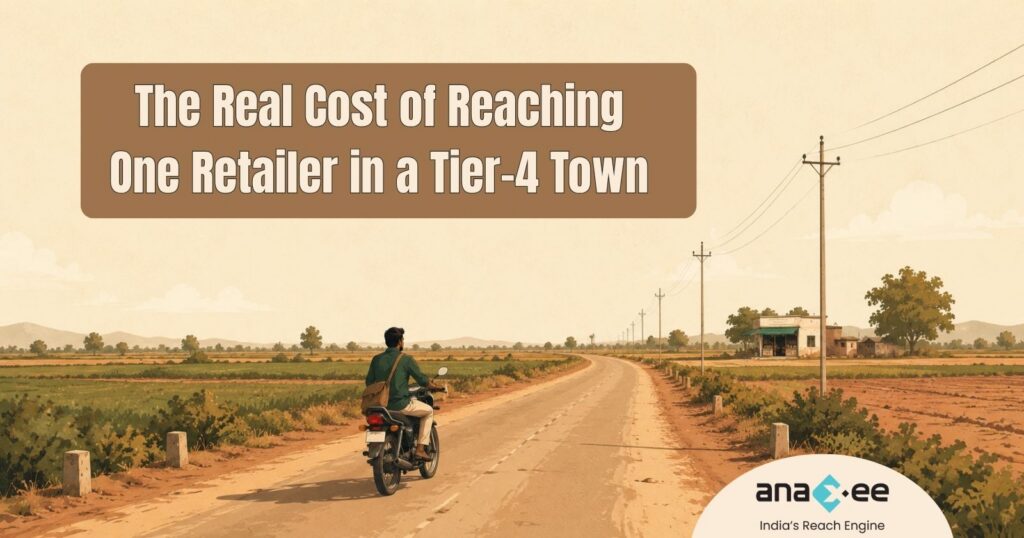

The Real Cost of Reaching One Retailer in a Tier-4 Town
Ask five sales heads what it costs their company to put a person in front of one retailer in a small town, and you’ll get five confident answers. Usually round numbers. Usually wrong.
It’s not that nobody’s tracking it. It’s that most companies track the wrong version of it — total field cost divided by total visits — which quietly hides the number that actually decides whether an expansion works.
This post breaks the number apart. Not to give you a benchmark to copy, but to give you the arithmetic to run on your own data.
Why nobody publishes this number
Two reasons.
Agencies don’t publish it because pricing transparency kills negotiating room. Brands don’t publish it because most of them can’t isolate it — field cost sits tangled up with salaries, travel reimbursements, distributor margins and a “sales overhead” line that nobody has fully audited since 2021.
So the number floats around as folklore. Somebody says “about ₹150 a visit” in a meeting, everyone nods, and a rollout plan gets built on it.
Let’s take it apart properly.
The four buckets
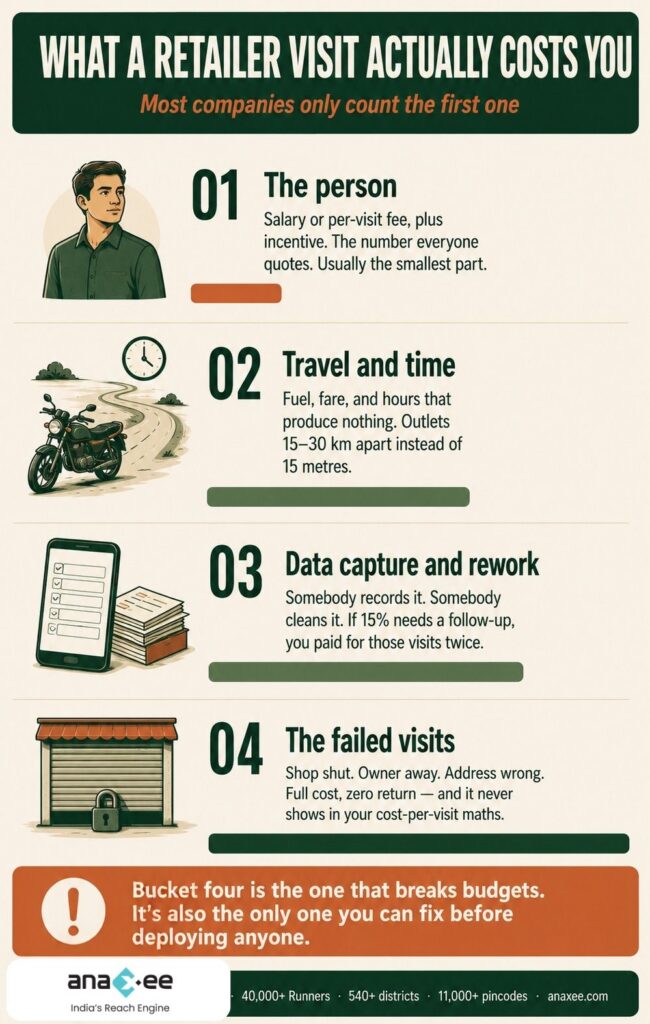
Every retailer visit costs you four things. Most companies only count the first one.
Bucket 1: The person
Salary or per-visit fee, plus incentive. This is the number everyone quotes, and it’s usually the smallest part of the real total.
Bucket 2: Travel and time
This is where small towns get expensive.
In a dense urban market, a field executive walks between outlets. Ten shops in a kilometre. In a tier-4 belt, outlets are scattered across villages and small market clusters, sometimes 15 to 30 kilometres apart.
So you’re paying for fuel or fare, and you’re paying for hours that produce nothing. A day that yields 25 productive visits in a city might yield 8 in a rural cluster. Same salary. One-third the output.
Bucket 3: Data capture and rework
Somebody has to record what happened. Somebody else has to clean it, chase the blanks, and re-verify what looks off.
If your team is filling forms on paper or WhatsApp, add a real cost for the back-office hours spent turning that into something usable. If 15% of entries need follow-up, you’re paying for those visits twice.
Bucket 4: The failed visits
The one that breaks budgets.
Shop shut. Owner out. Address wrong. Shop closed down two years ago and nobody updated the list. In fresh territories with unverified data, a strike rate of 60–70% is common. Sometimes worse.
Every failed visit costs full travel and full time and returns nothing. And it doesn’t appear anywhere in your cost-per-visit calculation, because it wasn’t a visit.
Running the arithmetic
Here’s the shape of the calculation. The numbers below are illustrative — plug in your own.
Say a field executive costs ₹22,000 a month, works 24 days, and you add ₹4,000 in travel. Total monthly cost: ₹26,000.
Metro scenario: 25 outlets a day × 24 days = 600 attempted visits. Strike rate 90% = 540 productive visits. Cost per productive visit: ₹48
Tier-4 scenario: 8 outlets a day × 24 days = 192 attempted visits. Strike rate 65% = 125 productive visits. Cost per productive visit: ₹208
Now add data cleaning and rework — say 10% loaded on top. You’re at roughly ₹230.
That’s close to five times the metro number, using the same salary.
And here’s the part that matters more than the number itself: if you planned the rollout using the metro figure, you budgeted for 540 visits and you’re going to get 125. The plan wasn’t slightly optimistic. It was off by a factor of four.
The number you should actually be tracking
Cost per visit is a useful diagnostic. It’s a terrible decision metric.
The metric that should sit in your expansion model is cost per active retailer — what you spend to get one shop stocked, selling, and reordering.
Because a visit isn’t the outcome. A stocking retailer is.
If it takes an average of three visits to convert a new outlet, and 40% of the ones you convert never place a second order, your real cost per active retailer is several multiples of your cost per visit. That’s the number that tells you whether the territory pays back.
Most brands never compute it, which is why rural expansions get approved on optimistic maths and killed on real results.
Why the cheapest model is often the most expensive
Three ways to get coverage, roughly.
Own field team. Best control, best data, highest fixed cost. Makes sense in territories you’ve already validated and intend to stay in for years. Makes very little sense in a territory you’re testing.
Local agency or contractor. Lower fixed cost, faster to start. Quality varies a lot by geography, and verification is your problem. You often end up paying again to check what you were told.
Distributed on-demand network. Variable cost, coverage without headcount, no idle time between cycles. Works well for low-frequency categories and for territories you’re still evaluating. Requires a partner with real depth in the specific districts you care about — otherwise you’re just buying a subcontracting chain with extra steps.
The trap is choosing on quoted rate. A ₹120-per-visit vendor with a 50% strike rate and unverified data is more expensive than a ₹250-per-visit option that lands 90% and gives you photographs. You’ll just find out six months later.
How to bring the number down
Four levers, in rough order of impact.
Clean your list first. Verifying which outlets actually exist before you deploy is the cheapest thing on this list and the one with the biggest effect. It attacks bucket four directly, and bucket four is the one doing the damage.
Cluster geographically. Route planning around market days and outlet density can lift daily coverage meaningfully without changing anything else.
Load more work into each visit. If a single visit captures the order, the stock position, a shelf photo and a retailer registration, your cost per data point drops even if cost per visit doesn’t move.
Match visit frequency to category reality. Not every outlet deserves the same cycle. Your top 20% by volume might justify monthly contact; the tail might justify twice a year. Uniform frequency is comfortable and wasteful.
The short version
The cost of reaching a retailer in a small town is not a small multiple of your metro cost. It’s often four to five times higher, and the difference comes mostly from travel time and failed visits — not from wages.
Budget with the real number and rural expansion is a reasonable, workable business case. Budget with the metro number and you’ll conclude the market doesn’t work, when what didn’t work was the spreadsheet.
Run the arithmetic on your own territories. It’s usually an uncomfortable afternoon and a much better plan.
Anaxee provides on-demand retail coverage across 540+ districts and 11,000+ pincodes through a network of 40,000+ Digital Runners — outlet verification, retailer onboarding, shelf audits and last-mile distribution support, billed per task rather than per headcount. To work out what coverage would cost in your specific districts, talk to our team.