

Short answer: India’s Carbon Credit Trading Scheme is no longer a policy paper — it’s live. Around 490 companies across seven of the nine notified energy-intensive sectors now carry legally binding emission-intensity targets, the first compliance cycle is underway, and Carbon Credit Certificate (CCC) trading is expected to open on India’s power exchanges around late 2026. If you run a plant, export to the EU, or manage sustainability for either, carbon now sits on your ledger as a real cost or a real asset. The companies building clean carbon data early will pay smaller penalties, sell surplus credits, and clear EU customs faster than the ones scrambling later.
That’s the whole story in a paragraph. Below is what it means for you, sector by sector, plus the one problem that quietly decides whether CCTS costs you money or makes you some.
What is the Carbon Credit Trading Scheme, in plain language?
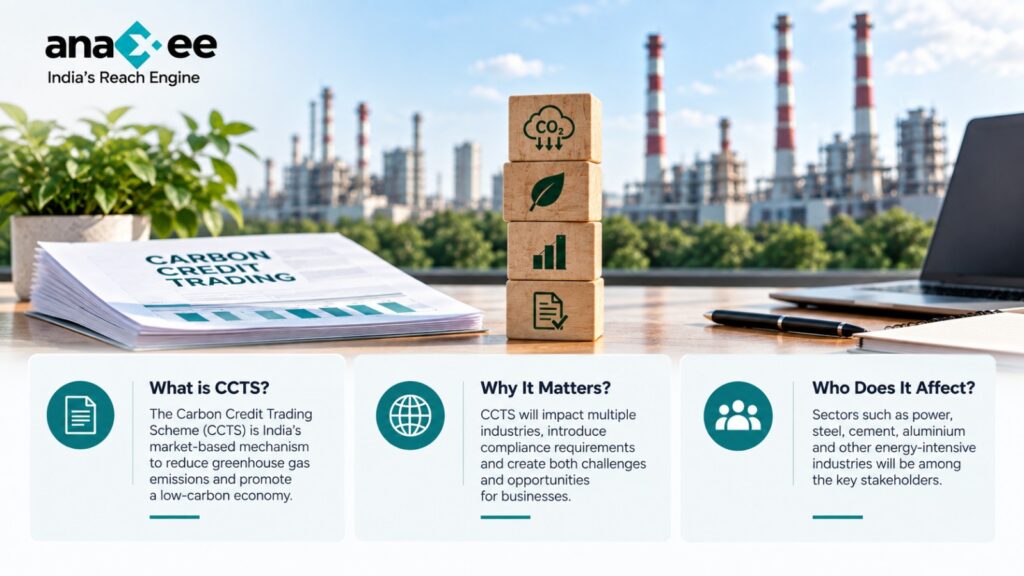
CCTS is India’s first compliance carbon market. Instead of capping total emissions, it sets a greenhouse gas emission-intensity target — tonnes of CO₂ per unit of product — for each covered facility. Beat your target and you earn Carbon Credit Certificates you can sell. Miss it and you buy CCCs to cover the gap, or you pay a penalty of twice the market price of what you fell short by.
It runs on the Energy Conservation (Amendment) Act, 2022, with the Bureau of Energy Efficiency (BEE) as market administrator. If you’ve lived through the PAT scheme, the machinery will feel familiar — CCTS is essentially PAT growing up from “save energy” into “price carbon.”
The design choice matters: intensity targets, not hard caps, let output grow as long as you get cleaner per unit. Good for a growing economy. But it puts enormous weight on one thing — your ability to prove your intensity with verified data. Hold that thought.
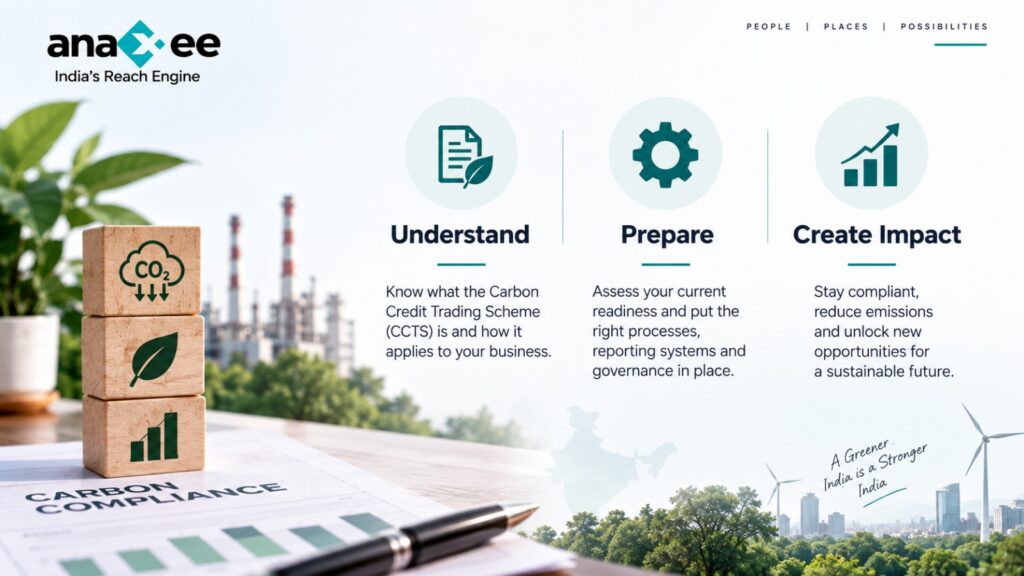
Is CCTS actually live, or still coming?
Live. Here’s where things stand in 2026:
- Emission-intensity targets are notified for compliance years FY 2025–26 and FY 2026–27, using FY 2023–24 as the baseline. Year-two targets are steeper than year-one.
- The first four sectors — aluminium, cement, chlor-alkali, and pulp & paper — were notified in October 2025; petroleum refining, petrochemicals, and textiles followed in January 2026.
- The first compliance reporting cycle for FY 2025–26 has already run, with verified emissions data due to BEE-accredited verifiers.
- CCC trading is expected to open on regulated power exchanges around late 2026.
The takeaway for a sustainability or compliance head: this is a legal obligation with a live clock, not a future planning item.
Which companies does CCTS cover?
Roughly 490 obligated entities in the first cycle, across nine energy-intensive sectors: power, iron & steel, cement, aluminium, fertiliser, pulp & paper, petroleum refining, petrochemicals, and textiles. The named heavyweights already in scope include UltraTech, Ambuja and ACC in cement; JSW Steel, Tata Steel and SAIL in steel; and Hindalco in aluminium. Targets are set plant-by-plant against each facility’s own baseline — so two cement lines can carry very different numbers.
If your company is on that list, your obligation is already running. If it isn’t, keep reading — the next section is for you.
Why should businesses outside the notified sectors care?
Two reasons.
First, CCTS expands. PAT started with a handful of sectors and grew cycle by cycle; CCTS is built to do the same. Building your measurement foundation before a mandate lands is far cheaper than building it under deadline pressure. The companies that treat 2026 as prep time will not be the ones paying rush premiums in 2028.
Second, the voluntary offset window is open to almost everyone. CCTS includes a domestic offset mechanism with approved methodologies covering renewables, energy efficiency, green hydrogen, clean cooking, mangrove restoration and afforestation. That means a company outside the compliance list can generate credits — from a rural cookstove programme, an agroforestry project, a regenerative-agriculture effort — and sell them into the market or use them against a net-zero pledge. Compliance for some; opportunity for others.
How does CBAM raise the stakes for exporters?
If you export steel, aluminium, cement or fertiliser to the EU, the Carbon Border Adjustment Mechanism (CBAM) moved from reporting-only into its financial phase in January 2026. EU importers of your goods now have to buy CBAM certificates against the carbon embedded in what you ship.
Here’s the part that connects directly to CCTS: CBAM allows a deduction for a carbon price already paid in the country of origin. So a robust domestic carbon price — exactly what CCTS is building — can shrink your EU bill. And because CBAM is phasing out default emission values in favour of actual embedded-emissions data, you’ll need airtight facility-level carbon accounting regardless of whether CCTS covers you yet. Early carbon data stops being a compliance chore and becomes an export advantage.
What’s the hardest part of CCTS compliance? (It isn’t the policy.)
It’s the data.
CCTS lives or dies on Measurement, Reporting and Verification (MRV). Your targets are intensity-based, your penalties are calculated to the tonne, your CBAM deduction depends on provable numbers, and your credits are only as valuable as the audit trail behind them. Yet a lot of Indian operations — especially mid-tier plants and anything with a rural or distributed footprint — still run on patchy emission-factor data and manual, hard-to-verify monitoring.
This is where most carbon strategies stall. Not on understanding the scheme, but on generating field-level data credible enough to survive a third-party verifier and, if you’re issuing offsets, a global standard like Gold Standard or Verra. Carbon pricing is a data-plumbing problem long before it’s a policy problem.
If you’re mapping where your verified numbers — or your offset credits — are going to come from, that’s a conversation worth having early. Book a demo with Anaxee’s climate team →
How can businesses turn CCTS from a cost into an advantage?
The companies that come out ahead do three things: they measure early, they cut where it’s cheap, and they build a pipeline of high-integrity offset credits — the kind buyers actually trust. That last point is where the market is separating winners from the rest. As scrutiny of low-quality credits rises, credits backed by real, community-level, independently verifiable projects command better prices and hold their value.
Generating those credits at scale — across thousands of villages, thousands of households, thousands of trees — is an on-ground execution problem. And that’s a specific, unglamorous strength that not many players have.
Where Anaxee fits: the last-mile data and offset-execution layer
Anaxee runs India’s largest last-mile field network — 40,000+ Digital Runners across 540+ districts, 26 states and 11,000+ pincodes — paired with a technology stack built for carbon work through its Climate Command Centre. For CCTS-era carbon strategies, that combination does three things:
- High-integrity offset projects, executed on the ground. Anaxee has deployed 125,000+ improved cookstoves (Gold Standard / CCP-labelled) and runs agroforestry projects under the VM0047 methodology — the exact kind of community-driven, verifiable credits the CCTS offset window and voluntary buyers are looking for.
- Digital MRV that survives an audit. Mobile-first field data capture, drone-based tree counting, biomass and baseline surveys, and digital audit trails that reduce double-counting risk — turning scattered rural activity into registry-grade data.
- Reach into the places carbon projects actually happen. Clean cooking, afforestation and regenerative agriculture don’t happen in boardrooms. They happen in villages, and Anaxee already operates there at national scale.
For an obligated entity, that means a credible source of offset credits and field data. For a carbon project developer or CSO, it means an execution-and-verification partner who can go from baseline survey to issued credit. Either way, it’s the plumbing between a carbon strategy on paper and one that clears verification.
What should you do in the next 90 days?
A short, honest checklist:
- Map your position. Are you an obligated entity, an EU exporter, a project developer, or all three? Your first move differs for each.
- Find your data gaps. Where does your current emissions or project data fall short of what a BEE-accredited verifier — or a global standard — would accept?
- Model your CBAM exposure if you export to the EU, and check how a domestic carbon price offsets it.
- Lock in an offset pipeline if you’re chasing net-zero or want to sell surplus credits — the credible-credit shortage is only going to widen.
- Pilot your MRV now, not in the month before a deadline.
Carbon pricing in India has stopped being a debate. The cost of carbon is going to show up on your ledger one way or another — as a certificate you buy, an EU import charge, or a credit you sell. Which of those it becomes depends on how good your carbon data is, and how early you built it.
If offsets or last-mile carbon data are on your 2026 roadmap, talk to the team that’s already executing these projects at national scale. Book a demo → sales@anaxee.com
Frequently asked questions
Is CCTS mandatory in India? Yes, for notified entities. Companies in the covered energy-intensive sectors carry legally binding emission-intensity targets, and missing them triggers a penalty of twice the market price of the shortfall. The voluntary offset side is open to non-obligated organisations too.
Which sectors are covered under CCTS? Nine to start: power, iron & steel, cement, aluminium, fertiliser, pulp & paper, petroleum refining, petrochemicals and textiles — with the framework built to expand to more sectors over time.
What is the penalty for CCTS non-compliance? A financial penalty of roughly twice the average Carbon Credit Certificate market price for every unit of emission-intensity shortfall — on top of still having to make good the gap.
How is CCTS different from PAT? PAT rewarded energy-efficiency improvements; CCTS directly prices greenhouse-gas emission intensity and creates a tradeable carbon certificate. CCTS is effectively the next evolution of PAT, and PAT sectors are being transitioned into it.
Does CBAM affect Indian companies that aren’t covered by CCTS? Yes. If you export CBAM-covered goods (like steel, aluminium, cement or fertiliser) to the EU, you’re exposed regardless of CCTS status — and you’ll need actual embedded-emissions data as default values are phased out.
How can a company generate carbon credits in India? Through the CCTS offset window or the voluntary market, using approved methodologies — for example clean cookstoves, afforestation/agroforestry, or renewable energy. The credits must be backed by verifiable, third-party-checked project data to hold their value.