
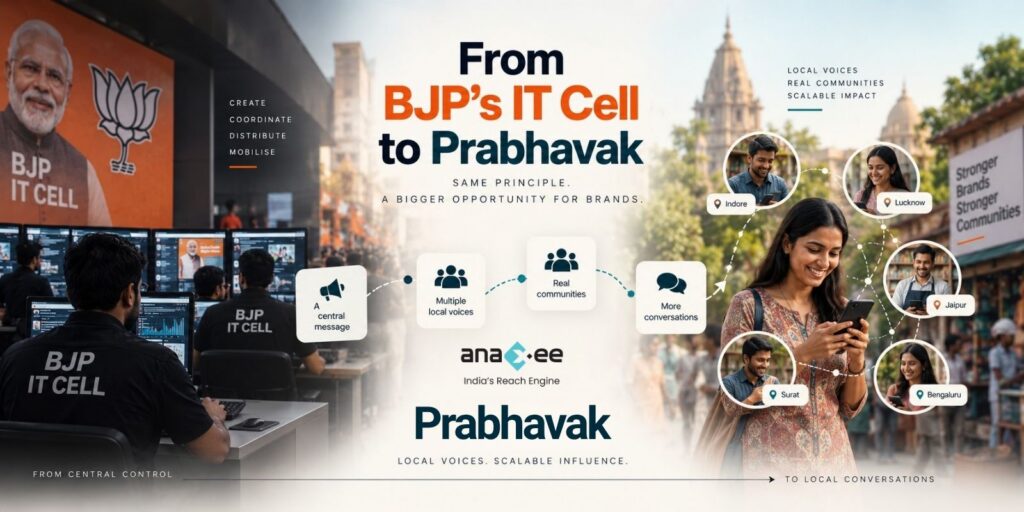

From BJP’s IT Cell to Prabhavak: How Local Networks Can Take a Brand Campaign Further
Here is a marketing problem that looks simple until you actually try to solve it:
How do you take one message and make it relevant to thousands of different local communities?
You can buy ads.
You can work with celebrities.
You can hire influencers.
You can run social media campaigns.
But scale and local relevance rarely come together easily.
The bigger your campaign becomes, the easier it is for the message to feel generic.
And the more local you make it, the harder it can become to scale.
This is where networks become interesting.
One of the most talked-about examples in India is the BJP’s IT and social-media network.
Not because brands should copy a political organisation.
But because it demonstrates a principle marketers should pay attention to:
A central message can become much more powerful when it has a distributed network to carry it.
That is also the thinking behind Prabhavak.
Start With the Network, Not the Advertisement
Most marketing campaigns start with a message.
A company decides:
This is what we want people to know.
Then comes the creative.
Then the media plan.
Then distribution.
It usually looks like this:
Brand → Message → Media → Audience
The model works.
But it has one major limitation.
The brand is doing most of the talking.
Now change the model.
Brand → Local Voice → Community → Conversation
Suddenly, the campaign has more ways to travel.
The brand still owns the message.
But the distribution becomes human.
That distinction matters.
What the BJP IT Cell Shows Us About Distribution
Over the years, reporting on the BJP’s digital operations has repeatedly highlighted its focus on building communication networks below the central level.
In Delhi, for example, reporting has described ward-level coordinators, WhatsApp groups and volunteers connecting central social-media activity with local workers.
In Maharashtra, the BJP’s IT structure was described as having state, regional and district levels, with volunteers trained to carry campaign communication down to the booth level.
Other reporting has documented similar efforts around WhatsApp and booth-level networks in different states. In Karnataka, for instance, the BJP trained volunteers to operate thousands of WhatsApp groups as part of its campaign infrastructure.
The details vary by election and by state.
But the underlying architecture is familiar:
Central coordination + local distribution.
That is the part marketers should notice.
Why Centralised Marketing Has a Ceiling
Imagine a brand launching a product across 100 districts.
The central marketing team creates one campaign.
The same creative goes everywhere.
The same headline.
The same video.
The same message.
It is efficient.
But does the same message make sense in exactly the same way everywhere?
Probably not.
A customer in Jaipur may have a different concern from a customer in a small town in Uttar Pradesh.
A retailer in Indore may talk about a product differently from a consumer in Guwahati.
A local community may respond to a campaign because of something that never appeared in the original brief.
This is where local voices become useful.
They don’t necessarily change the brand’s message.
They add local context to it.
The Network Is the Missing Layer
Think of a normal campaign as a two-layer system:
Layer 1: The Brand
Creates the message.
Layer 2: The Audience
Receives the message.
Prabhavak introduces another layer:
Layer 2: Local Voices
Carry the message into relevant communities.
Layer 3: Communities
See, discuss and respond to it.
The structure becomes:
Brand → Prabhavak Network → Local Voices → Communities → Conversations
That middle layer is where the interesting work happens.
So, How Does Prabhavak Work?
The idea behind Prabhavak is deliberately simple.
A brand has a campaign.
Prabhavak connects that campaign with a network of verified local voices.
Those people can then help take the campaign into the communities they are part of.
The process can be thought of in five steps.
1. The Brand Creates the Campaign
It starts with the brand.
What are you launching?
Who are you trying to reach?
Which locations matter?
What should people know?
The campaign remains brand-led.
Prabhavak doesn’t replace the marketing strategy.
It adds a distribution layer to it.
2. Find the Right Local Voices
The next question isn’t:
“Who has the most followers?”
It is:
“Who has relevance in this community?”
That is an important difference.
A person with 10,000 highly relevant local followers may be more useful for a particular campaign than someone with a much larger but completely unrelated audience.
This is why local influence needs to be looked at differently from celebrity influence.
The value is not only in audience size.
It is in proximity, relevance and context.
3. Verify the Network
A network only becomes useful when brands can trust the people inside it.
That means verification matters.
Prabhavak is designed around verified local voices rather than simply opening a campaign to anyone who wants to participate.
This creates a more structured network for brands.
The goal is simple:
Less random reach. More relevant local distribution.
4. Activate the Campaign
Once the right local voices are identified, the campaign can move beyond the brand’s own channels.
A campaign can enter different locations.
Different communities.
Different conversations.
Instead of one central account doing all the talking, multiple local voices can help carry the same campaign.
This is where scale starts to become interesting.
5. Let the Conversation Travel
This is the part traditional advertising cannot completely control.
Someone sees the campaign.
Someone shares it.
Someone discusses it.
Someone asks a question.
Someone recommends it.
Someone sends it to another group.
The campaign begins to move.
Not only because the brand pushed it.
But because people carried it.
That is the real value of a network.
This Is Not About Turning Brands Into Political Campaigns
This distinction is important.
Prabhavak is not a political platform.
The BJP IT Cell is being discussed here as a communication and distribution case study, not as a model for political persuasion.
The useful lesson is the architecture:
central strategy + distributed people + local communication + feedback
A brand can use the same broad network principle without copying political messaging, political objectives or political content.
The network is the lesson.
Not the politics.
Why This Can Be Powerful for Brands
Consider a consumer brand entering 50 new districts.
The central team can create one national campaign.
But imagine also having verified local voices in those markets.
Now the brand has people who can help introduce the campaign to local audiences.
The brand gets:
Scale from the network.
Relevance from the local voice.
Context from the community.
Conversation from the people.
That’s a much richer model than simply buying another impression.
Prabhavak vs Traditional Influencer Marketing
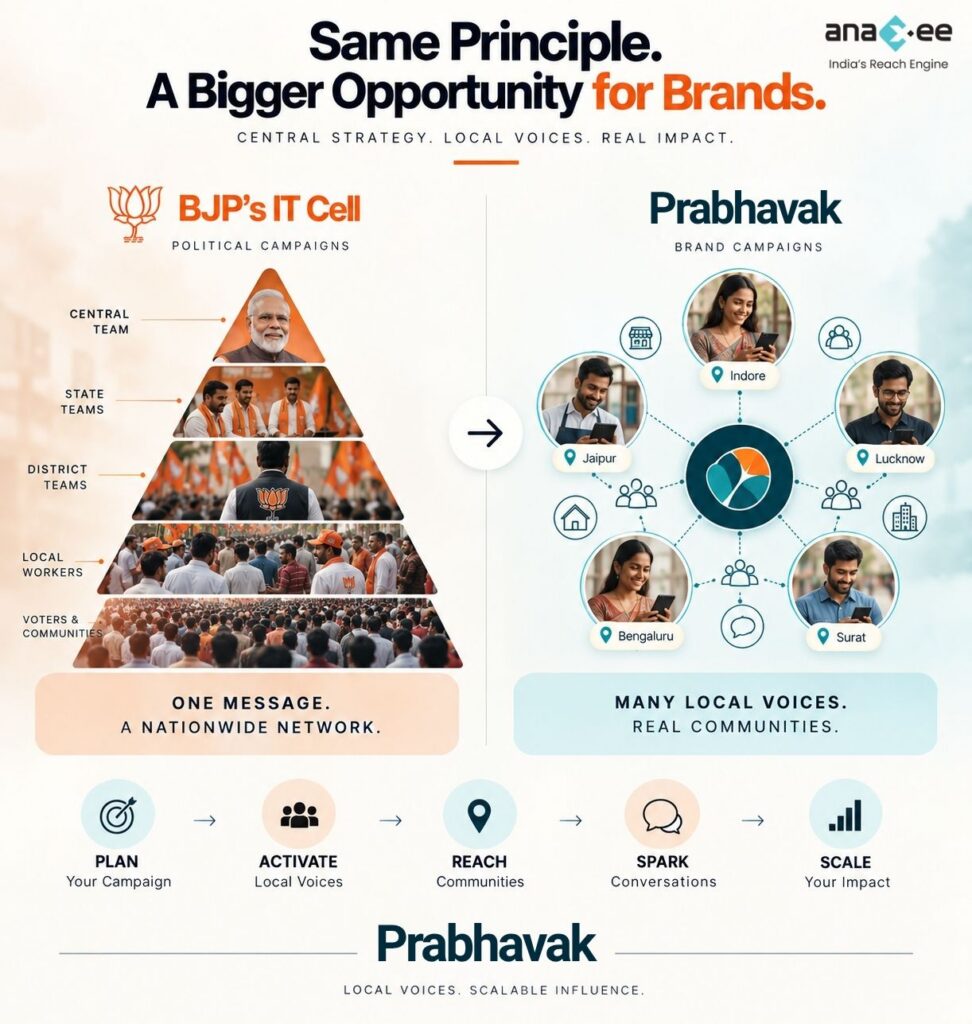
There is another important distinction.
Traditional influencer marketing often starts with:
“Which influencer should we hire?”
A network approach starts with:
“Which markets and communities do we need to reach?”
That changes the entire planning process.
Instead of finding one big creator, a brand can think about a network of relevant voices across multiple locations.
For example:
| Traditional Influencer Approach | Local Network Approach |
|---|---|
| Find one large creator | Find relevant local voices |
| Focus on follower count | Focus on relevance + locality |
| One large audience | Multiple connected communities |
| One campaign placement | Distributed campaign activation |
| Broad visibility | Local visibility + conversation |
Neither model is automatically better.
They solve different problems.
If your goal is celebrity awareness, a celebrity may be exactly what you need.
If your goal is local penetration across multiple markets, a distributed network becomes much more interesting.
The Real Advantage: Scale Without Losing the Human Layer
This is perhaps the biggest opportunity.
Brands have become very good at scale.
They can reach millions of people in a few hours.
What they often struggle with is making that scale feel personal.
Local networks help bridge that gap.
The campaign can remain centrally planned.
But its presence becomes distributed.
That creates an interesting combination:
Central control.
Local relevance.
Distributed influence.
And that is exactly where Prabhavak sits.
From One Campaign to Many Conversations
Think about the journey.
It starts with one campaign.
Then:
1 Brand Message
↓
Multiple Local Voices
↓
Multiple Communities
↓
Multiple Conversations
↓
More Opportunities for Influence
That is the network effect.
The campaign isn’t necessarily becoming bigger because the advertisement became better.
It becomes bigger because more people have a role in carrying it.
The Future of Local Marketing Is Not Just More Ads
India is not one audience.
It is thousands of markets, languages, communities, neighbourhoods and social circles.
A national campaign can reach them.
But reaching them and connecting with them are two different things.
The next generation of local marketing will need to solve both.
And that means brands will increasingly need more than media.
They will need networks.
Networks of people who understand their communities.
Networks that can activate locally.
Networks that can make a central campaign feel closer to home.
The Big Lesson From BJP’s IT Cell
If there is one thing marketers can take away from studying the BJP’s IT and social-media infrastructure, it is this:
Don’t think only about how your message gets distributed. Think about who distributes it.
The difference is enormous.
A media plan asks:
“Where will our message appear?”
A network strategy asks:
“Who will carry our message into the community?”
That is a completely different question.
And it leads to a completely different marketing model.
That’s What Prabhavak Is Building
Prabhavak takes the idea of distributed local communication and builds it for brands.
Verified local voices.
Real communities.
Scalable campaign activation.
The brand creates the message.
The network helps it travel.
And somewhere between the two, advertising becomes conversation.
Because the goal isn’t simply to make your campaign visible in another city.
The goal is to make it relevant there.
Don’t just broadcast your campaign. Build a network around it.
Frequently Asked Questions
What is Prabhavak?
Prabhavak is a network of verified local voices designed to help brands activate campaigns across local communities and markets.
How is Prabhavak different from traditional influencer marketing?
Traditional influencer marketing often focuses on individual creators and audience size. Prabhavak is designed around a distributed network of verified local voices, with an emphasis on locality, relevance and community-level reach.
What can brands learn from the BJP IT Cell?
From a marketing perspective, the key lesson is distributed communication: a centrally planned message can be carried through networks of people operating at local levels. Reporting on BJP digital operations has documented such structures across different elections and states.
Is Prabhavak a political marketing platform?
No. The BJP IT Cell is referenced in this article as a communication-network case study. Prabhavak is positioned as a network for commercial brand campaigns and local marketing.
Why do brands need local influencers?
Local voices can provide proximity, context and relevance that broad advertising may not provide on its own. They can help brands introduce campaigns within specific communities and markets.
Can a local influencer network work alongside paid advertising?
Yes. A local network does not need to replace paid advertising. It can complement advertising by adding human distribution, local context and community-level conversations.
Final Thought
The most interesting thing about a network is not how many people are inside it.
It is how far one idea can travel through those people.
That is the lesson worth taking from the BJP’s IT Cell.
And that is the opportunity Prabhavak is bringing to brands:
One campaign.
Many local voices.
Many communities.
More conversations.
Because sometimes, the best way to make your brand heard isn’t to speak louder.
It’s to give your message more people to carry it.
Disclaimer: This article references the BJP’s IT and social-media operations solely as a communication and marketing case study. It does not imply political affiliation, endorsement or association between Prabhavak/Anaxee and the BJP.