

How to Generate Carbon Credits in India (2026-2027): A Practical Playbook for Project Developers
Short answer: You generate a carbon credit in India by running a project that measurably reduces, removes or avoids greenhouse-gas emissions — agroforestry, clean cookstoves, renewable energy, biogas — registering it under an approved methodology, and having the results independently verified so every verified tonne of CO₂ becomes a tradeable credit. In 2026 you have two routes: India’s new domestic CCTS Offset Mechanism (government-certified, live and expanding) and the established international voluntary market (Verra, Gold Standard). The hard part was never the paperwork. It’s producing field data credible enough that buyers trust your credits — and pay a premium for them.
Here’s the practical version of how that works, and where most projects quietly go wrong.
What exactly is a carbon credit, and how do you “generate” one?
A carbon credit is one tonne of CO₂-equivalent that your project kept out of the atmosphere — verified, certified, and issued as a tradeable unit you can sell. You don’t “make” credits; you earn them by proving impact against a baseline.
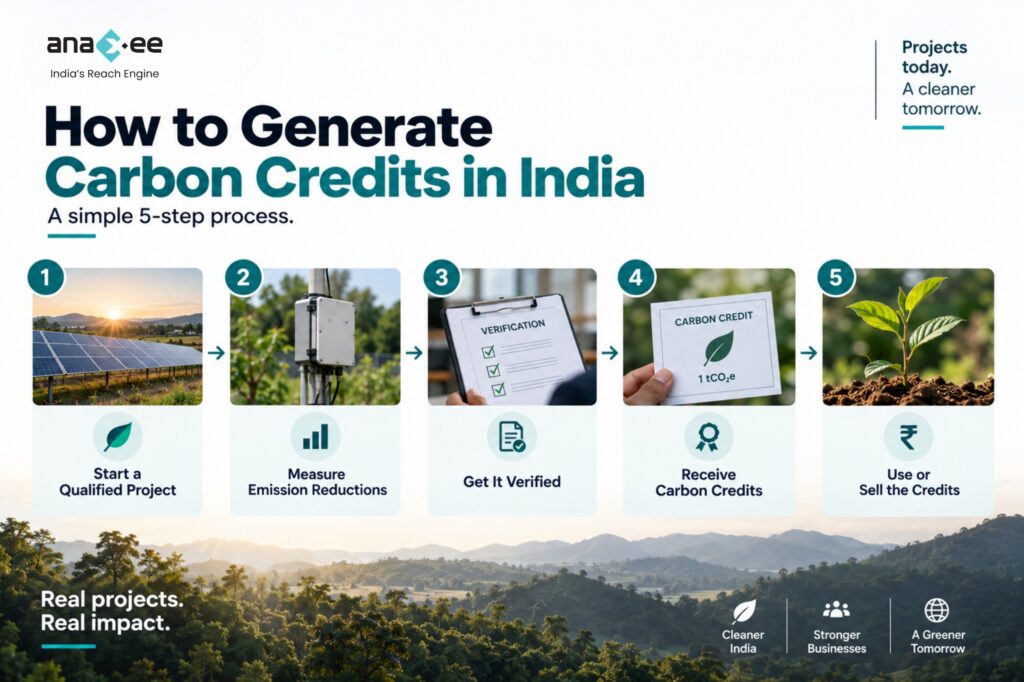
The lifecycle is the same almost everywhere: design the project → set a credible baseline (what would have happened without you) → implement → measure, report and verify the emission reductions → get a third party to certify them → receive credits in a registry → sell them. Every stage rests on the one before it, and the whole thing is only as strong as your data. Weak data at the baseline stage quietly caps the value of everything downstream.
What are the two ways to generate credits in India in 2026?
Route 1 — India’s domestic CCTS Offset Mechanism. Alongside the CCTS compliance market, India launched a voluntary Offset Mechanism under the Indian Carbon Market framework, now being operationalised in 2026. It lets non-obligated players — farmers, forestry projects, waste and energy developers — register projects and earn Carbon Credit Certificates (CCCs), issued through the Grid-India registry. It’s a government-certified standard, distinct from Verra or Gold Standard. As of early 2026, nine methodologies have been notified and 40-plus entities have already registered or submitted projects.
Route 2 — the international voluntary carbon market. India is one of the world’s largest suppliers of voluntary credits, with 5,000+ projects across standards like Verra (VCS) and Gold Standard. This is the mature route, with deep buyer demand from global corporates — and the standards most net-zero buyers already recognise.
Which you choose depends on your buyer. Selling to Indian obligated companies or domestic voluntary buyers? Lean toward the CCTS route. Selling to global corporates with existing net-zero commitments? The international standards still carry the most weight. Many serious developers keep an eye on both.
Which projects actually qualify?
Under the CCTS Offset Mechanism, Phase 1 covers six broad sectors: energy, industry, agriculture, waste handling & disposal, forestry, and transport. The approved methodologies so far include renewable energy (including hydro and pumped storage), green hydrogen, industrial energy efficiency, landfill methane recovery, mangrove afforestation & reforestation, renewable energy with storage, offshore wind, and compressed biogas — with more being added over time.
On the international side, the menu is broader and well-trodden: improved cookstoves, agroforestry and afforestation/reforestation (for example under Verra’s VM0047), regenerative agriculture, biogas, and more. If your project sits in forestry, agriculture or clean energy touching rural communities, you almost certainly have a viable pathway — the question is which standard and methodology fit your buyer and your evidence.
How does the Offset Mechanism actually work for a non-obligated developer?
In practice: you register your project, establish a baseline, run an MRV process against approved methodology, get it verified, and receive CCCs in the registry that you can then sell. Those credits can go to voluntary buyers — corporates meeting net-zero pledges — and, subject to eligibility rules still being finalised, potentially to obligated companies topping up their compliance.
On price: early estimates put CCCs in a band of roughly ₹250–1,500 per tonne, depending heavily on sector, quality and demand. That spread is the whole story of this market — and it’s decided less by which project you run than by how well you can prove it.
What’s a carbon credit worth — and why do some sell for far more?
Two credits can each represent one tonne of CO₂ and sell for wildly different prices. The difference is integrity. After years of headlines about over-credited, unverifiable offsets, buyers have become sharp: they now pay a premium for credits backed by real measurement, genuine additionality, durable permanence, and visible community benefit — and they discount or refuse the rest.
The market benchmark for this is the ICVCM’s Core Carbon Principles (CCP) label. A CCP-labelled or Gold-Standard-grade credit isn’t just cleaner conscience — it’s a better price and a faster sale. Which means the value of your project is set at the point where most developers under-invest: the data and the ground truth.
Why do most carbon projects fail or under-deliver?
Rarely because of the science, and rarely because of the policy. They stumble on execution and evidence:
- Shaky baselines and thin data. If you can’t rigorously establish what would have happened anyway, verifiers cut your issuance — or reject it.
- MRV that doesn’t survive audit. Manual, un-geotagged, un-auditable records get discounted or thrown out.
- No community depth. Projects run at communities instead of with them lose the co-benefits — and the trust — that high-integrity buyers pay for.
- Distance. Real projects happen across thousands of scattered farms, households and forest plots. Reaching them, again and again, for baseline and monitoring, is a logistics problem most developers underestimate.
Every one of those is a last-mile execution problem long before it’s a carbon problem. Which is the crux of where to invest.
What makes a credit “high-integrity” and bankable?
Four things buyers now check: real, verifiable MRV (measured, not estimated); additionality (it wouldn’t have happened without the carbon finance); permanence (the reductions last); and genuine community co-benefits (livelihoods, health, biodiversity — not just tonnes). Nail these and your credits command the top of the price band and sell fast. Miss them and you’re stuck at the bottom, or unsold.
If you’re weighing a carbon project and want to know whether it can clear that bar — and what it takes to reach issued, sellable credits — that’s a conversation worth having early. Book a demo with Anaxee’s climate team →
Where Anaxee fits: from baseline survey to issued credit
This is where a last-mile network stops being a nice-to-have and becomes the difference between a project that issues high-integrity credits and one that doesn’t. Anaxee runs India’s largest last-mile field network — 40,000+ Digital Runners across 540+ districts, 26 states and 11,000+ pincodes — with a carbon-grade technology stack in its Climate Command Centre. And it has the track record to prove it works:
- 125,000+ improved cookstoves deployed — Gold Standard / CCP-labelled, exactly the high-integrity tier buyers now pay a premium for.
- Agroforestry projects under the VM0047 methodology — with drone-based tree counting and biomass assessment for defensible measurement.
- Digital MRV built for audit — mobile-first, geo-tagged, community-level data capture with digital audit trails that reduce double-counting risk.
For a project developer, that means one partner who can take a project through its hardest, most distributed stages: baseline surveys across thousands of sites, ongoing monitoring, community mobilisation, and verification-ready data — the ground truth that decides your issuance and your price. Proven today in the international voluntary market, and positioned to execute domestic CCTS offset projects as those methodologies expand.
Put simply: policy and standards set the rules; Anaxee runs the part where credits are actually earned.
Your first-90-days checklist to start a carbon project
- Match project to buyer. Decide whether you’re selling into the domestic CCTS market, the international VCM, or both — it shapes your methodology.
- Pressure-test your baseline. Can you credibly prove additionality and a defensible counterfactual? If not, fix that first.
- Design MRV up front, not after the fact — geo-tagged, auditable, methodology-aligned.
- Build community depth in, because co-benefits are where the premium lives.
- Line up verification-ready evidence so issuance isn’t cut at the finish line.
India’s carbon market has stopped being a someday story. Between a live domestic offset mechanism and deep international demand, the pathways to generate credits are open now. The developers who’ll win aren’t the ones with the most projects — they’re the ones whose credits buyers trust on sight. And that trust is built in the field, one verified tonne at a time.
If you’re planning a carbon project and want a partner who can execute it from baseline to issued credit at national scale, talk to the team that’s already done it. Book a demo → sales@anaxee.com
Frequently asked questions
How do you generate carbon credits in India? Run a project that reduces, removes or avoids emissions — like agroforestry, clean cookstoves or renewable energy — register it under an approved methodology, and have the results independently verified. Each verified tonne of CO₂ becomes a tradeable credit.
What is the CCTS Offset Mechanism? It’s India’s government-certified voluntary carbon market under the CCTS, letting non-obligated players register projects and earn Carbon Credit Certificates through the Grid-India registry. It went live in 2026 and is expanding its approved methodologies.
Can I sell carbon credits from India internationally? Yes. India is one of the world’s largest voluntary-market suppliers, with thousands of projects under standards like Verra and Gold Standard that global corporate buyers recognise.
How much is a carbon credit worth in India? It varies widely by project type, quality and demand — early CCC estimates sit around ₹250–1,500 per tonne — with high-integrity, CCP-labelled credits commanding the top of the range.
What makes a carbon credit high-integrity? Real verifiable MRV, genuine additionality, durable permanence, and clear community co-benefits — the qualities the ICVCM’s Core Carbon Principles benchmark checks, and the ones buyers now pay a premium for.
Why do carbon projects fail to issue the credits they expect? Usually because of weak baselines and un-auditable field data, not the science — verifiers cut issuance when the evidence doesn’t hold up, which is why rigorous MRV and on-ground execution matter most.