


Should Your Company Buy Biochar Carbon Credits? A 2026-2027 Buyer’s Guide
Short answer: If you need durable, defensible carbon removals for a net-zero target, biochar is the most practical option on the market in 2026. It’s the only durable-removal pathway available at real scale today, it delivered close to 90% of all durable CDR credits issued last year, and at roughly $100–250 per tonne it costs a fraction of direct air capture. The catch: biochar quality varies enormously, and a credit is only ever as good as the measurement behind it. Here’s when biochar makes sense, what it should cost, how to dodge the greenwashing risk — and why India is one of the smartest places to source it.
What are biochar carbon credits, in plain terms?
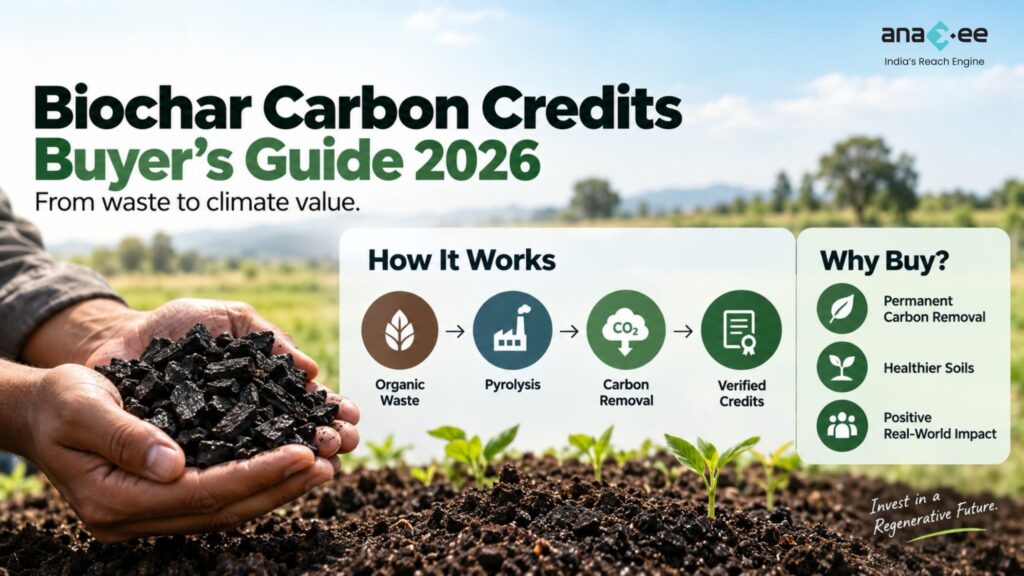
Biochar is charcoal made from biomass — crop residue, wood waste, manure — heated in a low-oxygen process called pyrolysis. Roughly half the carbon in that biomass gets locked into a stable solid that resists decomposition for hundreds to over a thousand years, instead of rotting or burning and returning to the air.
That distinction matters for your net-zero claim. Most cheap credits are avoidance — they stop an emission that might have happened. Biochar is removal — it takes carbon that’s already in the atmosphere and stores it. Under strict frameworks like the Oxford Principles and SBTi, durable removals are the credits that actually count toward true net zero. One biochar credit equals one tonne of CO₂ durably removed.
Why are so many net-zero buyers choosing biochar in 2026-2027?
Because it’s the durable removal you can actually buy today. In the first half of 2025, biochar made up around 89% of all durable CDR credits genuinely delivered into registries — not promised, delivered. Every other durable pathway is either earlier in its cost curve or still scaling.
The reason is simple: biochar uses existing technology, existing feedstock and existing supply chains. Buyers can verify the carbon, certify the permanence, and take delivery in months, not years. That’s why anchor buyers like Microsoft, Frontier, Stripe and Shopify have poured hundreds of millions into it — and why the smart move for most corporate portfolios is to secure supply now, before demand tightens further.
How much do biochar carbon credits cost?
The average biochar credit traded around $164 per tonne in 2025, up roughly 25% in two years — and the market generally sits in a $100–250 per tonne band. Put that next to direct air capture at $450–$1,000+ and biochar’s appeal for a real removal budget is obvious.
Two things are worth knowing before you buy:
- Quality now sets price. High-integrity projects with strong MRV command $180–200+, while weak-documentation projects are being repriced down or delisted. You get what you pay for — and increasingly, you only pay for what you can verify.
- The market is shifting to offtakes. Buyers are locking in multi-year supply agreements rather than buying spot, to secure volume at today’s prices. If biochar is in your strategy, waiting rarely makes it cheaper.
And one geographic edge: Indian biochar is among the lowest-cost durable removal available globally — roughly €105–150 (about $115–165) per tonne — without sacrificing the co-benefits buyers value. More on why that matters below.
Are biochar credits actually credible?
Yes — when they’re built right. Biochar’s credibility rests on three things registries care about: additionality, durability and measurability. The permanence is genuinely long (100–1,000+ years), and the science is well established.
The methodologies have matured, too. The ICVCM has approved biochar methodologies under its Core Carbon Principles — including Verra’s VM0044 and Isometric’s biochar standard — which is the strongest third-party signal a removal type can get. Puro.earth (now majority-owned by Nasdaq) runs a dedicated biochar standard as well. In short: the rails exist to buy biochar with confidence.
But — and this is the whole point of a buyer’s guide — the average credit isn’t automatically a good one.
What’s the real risk when buying biochar credits?
Integrity. The gap between a high-integrity biochar credit and a greenwashing liability has never been wider. The failure modes buyers get burned by:
- Weak MRV — estimates instead of measured data, so the tonnes can’t be trusted.
- Non-additionality — the project would have happened anyway, meaning your money didn’t cause any real removal.
- Over-crediting — optimistic assumptions about carbon content or permanence that inflate the tonnage.
- Leakage — feedstock quietly diverted from other legitimate uses (like fodder or soil).
When a project’s documentation doesn’t hold up, registries delist or reprice it — and the reputational risk lands on the buyer, not the seller. Which is why your due diligence should focus less on the registry logo and more on the ground truth underneath it.
How do you tell a high-integrity biochar credit from a risky one?
Run every prospective purchase through five checks:
- Strong digital MRV. Is impact measured with field data, geo-tagging and lab-verified stability tests — or estimated from a spreadsheet?
- An approved, conservative methodology (VM0044, Isometric, Puro, CSI) with proper permanence testing.
- Genuine additionality — clear evidence the carbon finance made the project happen.
- Real co-benefits — soil health, farmer income, biodiversity — documented, not just claimed.
- Independent verification and, ideally, a third-party quality rating (e.g. Sylvera-style project ratings).
Notice that the first and most decisive of these is field-level MRV — which is exactly where sourcing geography starts to matter.
Why India is a smart place to source biochar removals
India pairs three things buyers want: abundant agricultural residue (hundreds of millions of tonnes a year), the lowest production cost for biochar globally, and deep social co-benefits — farmer income, better soils, cleaner air. For a buyer building an SBTi-aligned portfolio, Indian biochar can deliver durable tonnes and a genuine development story, at a better price than German or North American supply.
The one thing India-sourced credits have historically lacked isn’t carbon — it’s verifiable, last-mile data. Feedstock and projects are spread across thousands of villages and farms that are hard to reach, monitor and audit consistently. Solve that, and Indian biochar becomes one of the most attractive durable removals on the market. Which is precisely the gap Anaxee closes.
Where Anaxee fits
Anaxee isn’t a registry or a verifier, and it won’t sell you a logo. What it operates is the layer that decides whether an Indian biochar credit is trustworthy or not: on-ground execution and last-mile digital MRV, backed by India’s largest field network — 40,000+ Digital Runners across 540+ districts, 26 states and 11,000+ pincodes, run through its Climate Command Centre.
For a buyer, that translates to three things you actually care about:
- Verifiable ground truth. Field-level data capture — feedstock sourcing, geo-tagged evidence, application and monitoring — collected across dispersed rural projects, so the tonnes you buy are the tonnes that exist.
- Transparency that survives audit. Digital MRV with audit trails that reduce over-crediting and leakage risk — the documentation that keeps a credit from being repriced or delisted after you’ve bought it.
- Access to high-integrity Indian supply, with co-benefits built in. Community-rooted projects that deliver the farmer-income and soil story alongside the carbon.
If you’re sourcing durable removals and want Indian biochar you can defend to your auditor and your board, that’s the conversation to have.
Want to see how transparent, verifiable Indian biochar sourcing actually works — or explore an offtake? Book a demo with Anaxee’s climate team →
Your biochar buying checklist
- Decide your durable-removal allocation for this reporting cycle — and don’t leave it to spot-buying at year-end.
- Insist on measured MRV, not estimates, and ask to see the field data.
- Confirm an approved methodology and independent verification for every credit.
- Weigh sourcing geography — India offers durable tonnes, real co-benefits and the best price, if the MRV is solid.
- Lock supply via offtake if biochar is core to your strategy, before prices climb further.
Biochar has quietly become the workhorse of the durable-removal market — scalable today, affordable, and permanent enough to count. The only question left for a serious buyer isn’t whether to include it, but how to buy it without inheriting someone else’s integrity risk. Get the MRV right, source it well, and biochar becomes one of the most defensible climate investments on your books.
If you want durable Indian biochar removals backed by verifiable, last-mile data, talk to the team that runs the ground operations at national scale. Book a demo → sales@anaxee.com
Frequently asked questions
What are biochar carbon credits? They’re carbon removal credits — each one represents a tonne of CO₂ pulled from the atmosphere and locked into stable biochar for hundreds to over a thousand years, verified under an approved methodology and issued on a registry.
How much does a biochar carbon credit cost in 2026-2027? Generally $100–250 per tonne, with an average around $164 in 2025. High-integrity, well-documented projects command $180–200+, while Indian biochar is among the lowest-cost durable removals globally.
Are biochar credits better than avoidance credits? For a genuine net-zero claim, yes — biochar removes carbon rather than avoiding an emission, and durable removals are what strict frameworks like SBTi and the Oxford Principles increasingly require.
Is biochar a reliable carbon removal method? It’s the most-delivered durable removal on the market, backed by ICVCM-approved methodologies. Reliability comes down to the individual project’s MRV, additionality and verification — which is what buyers should scrutinise.
Why buy biochar credits from India? India offers abundant feedstock, the lowest global production cost, and strong social co-benefits — durable tonnes plus a genuine development story, provided the field-level data is verifiable.
What’s the biggest risk when buying biochar credits? Integrity risk — weak MRV, over-crediting or non-additionality can get a project delisted or repriced, leaving the buyer exposed. Strong measurement and independent verification are the safeguards.