

Chemist Database Verification in India: A Practical Guide for Pharma Companies
A pharmaceutical company’s field operations depend on more than an accurate doctor database. Information about chemists and pharmacy outlets can also play an important role in understanding retail coverage, mapping outlet locations and maintaining reliable field data.
Thank you for reading this post, don't forget to subscribe!Yet chemist databases can become inconsistent over time. The same outlet may appear under different names, addresses may be incomplete, contact details may be outdated, and a pharmacy may move or cease operating without the master record being updated.
These issues become more difficult to manage when outlet information is collected by different teams, across multiple regions or through separate systems.
Chemist database verification in India helps pharmaceutical companies check whether their outlet records are sufficiently accurate, complete and current for their intended business use.
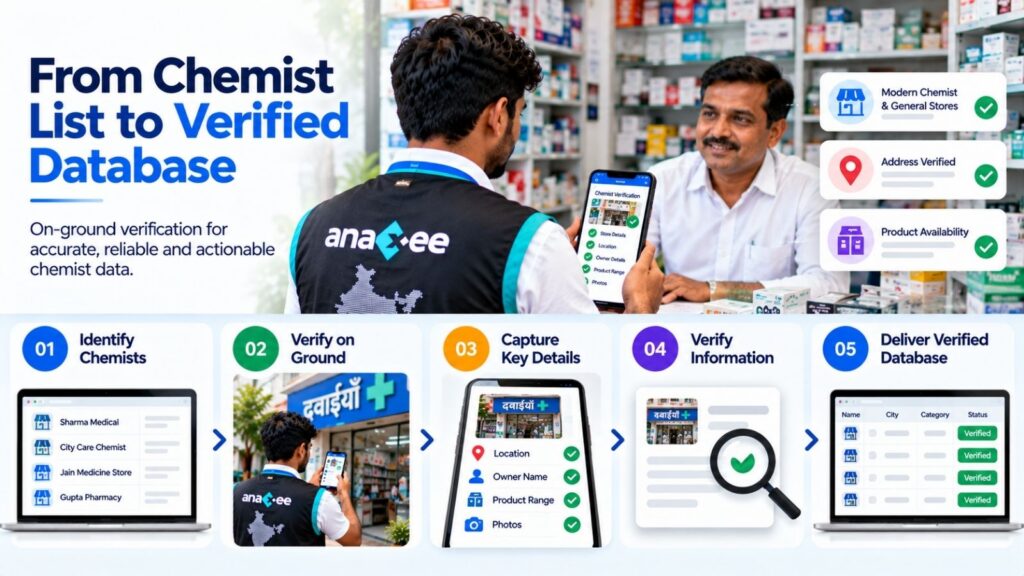
Depending on the project scope, this may include verifying outlet names and addresses, capturing GPS coordinates, recording available licence or business details where authorised, identifying possible duplicate records and documenting unresolved cases.
This guide explains how to plan chemist database verification, what information to check, how outlet mapping works and how to assess data quality before scaling a project.
What Is Chemist Database Verification?
Chemist database verification is the process of checking the information recorded about pharmacy or chemist outlets against appropriate available evidence.
The purpose is to establish whether a record represents the intended outlet and whether the required information is reliable enough for the company’s operational needs.
Depending on the approved scope, verification may include:
- Chemist or pharmacy outlet name.
- Shop or establishment address.
- GPS coordinates of the outlet.
- Contact details, where appropriate and available.
- Outlet operating status, based on the agreed verification method.
- Relevant licence or business details, where authorised.
- Duplicate or conflicting outlet records.
- Evidence and status of the verification outcome.
The exact fields depend on the project objectives. A mapping project may prioritise accurate location data, while a master-data cleanup project may focus more heavily on duplicate detection, standardised names and consistent outlet identifiers.
Verification should not be confused with a full regulatory inspection or an independent legal determination of a pharmacy’s compliance. Those activities require different methods, authority and evidence.
Why Do Pharmaceutical Companies Need Chemist Database Verification?
1. Outlet information changes over time
A pharmacy may move to a different location, change its name, update its contact information or stop operating. If the master database is not updated, the original record can become misleading.
Periodic verification can help identify these changes and establish when the information was last checked.
2. Duplicate outlets distort database quality
The same pharmacy may be entered more than once because of differences in spelling, abbreviations, shop names or address formats.
For example, an outlet might be recorded under its registered business name in one system and a shorter shop name in another. These records may refer to the same outlet, but the name similarity alone is not sufficient proof.
Chemist database deduplication can flag potential matches for review before records are merged.
3. Incomplete addresses make outlets difficult to locate
A partial address or locality name may not reliably identify a specific shop. This can create uncertainty when field teams need to find the correct outlet.
Address validation and GPS mapping can help connect a database record with a more precise physical location.
4. Inconsistent data weakens outlet mapping
If different teams follow different data collection rules, the resulting database may contain inconsistent names, locations and verification statuses.
Standardised forms, agreed field definitions and quality-control procedures can improve consistency across regions.
5. Reliable outlet data supports better planning
Accurate outlet information can support geographic analysis, territory planning and a clearer view of the outlets represented in a company’s database.
However, verified outlet data does not by itself establish product availability, sales performance or commercial relationships. Those conclusions require the relevant additional information and authorised methods.
Which Chemist Database Fields Should Be Verified?
The verification plan should identify the minimum information needed to meet the business objective.
| Data field | What to check | Why it matters |
|---|---|---|
| Outlet name | Recorded name and visible or otherwise authorised reference details | Supports identification and matching |
| Outlet address | Street, locality, landmark and other relevant location details | Helps distinguish and locate outlets |
| GPS coordinates | Whether the coordinates correspond to the intended outlet location | Supports mapping and location analysis |
| Contact details | Relevant contact information, where collection is appropriate | Supports data maintenance |
| Operating status | Whether the outlet could be verified as operating under the agreed method | Helps identify outdated records |
| Licence details | Applicable fields where accessible and authorised | Supports record completeness; does not alone establish compliance |
| GST details | Relevant business details where available and lawfully collected | May support matching and business-record validation |
| Verification status | Verified, discrepancy found, unresolved or follow-up required | Makes data quality visible |
| Evidence reference | Reference to authorised supporting evidence | Supports review and traceability |
Not every field will be available for every outlet. A reliable process should record missing or inaccessible information honestly rather than filling gaps with assumptions.
Licence and GST information should be collected or checked only where the project has a legitimate purpose and appropriate access. The scope should specify whether such details are self-reported, observed, checked against an authorised source or independently validated.
Chemist Mapping vs Chemist Database Verification
These terms are related, but they do not mean exactly the same thing.
Chemist database verification focuses on checking whether the information in existing records is accurate and sufficiently complete.
Chemist mapping focuses on associating outlets with geographic locations and organising that information for spatial or operational use.
A chemist mapping project may involve locating outlets, capturing GPS coordinates, standardising addresses and identifying outlets that appear in one area.
A verification project may go further by checking whether the outlet matches the source record and documenting discrepancies.
Many projects need both activities. However, the required output should be defined before fieldwork starts so that the team knows whether it is expected to locate outlets, validate existing records, identify potential duplicates or complete all three tasks.
A Six-Step Process for Chemist Database Verification
Step 1: Audit the existing outlet database
Review the available data before assigning outlets to field teams.
Identify missing addresses, inconsistent names, duplicate candidates, incomplete identifiers and records with insufficient location information.
Standardise common fields where possible while preserving the original values for traceability.
Expected output: A baseline view of the outlet database and the main categories of data-quality issues.
Step 2: Define the verification protocol
Agree on what each field team must check and what evidence is acceptable.
The protocol should specify:
- Required outlet fields.
- Geographic coverage.
- How to handle outlets with similar names.
- Whether GPS coordinates are mandatory.
- What qualifies as a verified outlet.
- How inaccessible or closed outlets should be recorded.
- Which licence or business details may be collected.
- Quality-control and acceptance criteria.
Without clear definitions, different field teams may produce results that are difficult to compare.
Expected output: A consistent fieldwork and quality-assurance standard.
Step 3: Plan outlet visits by geography
Group outlets into practical geographic clusters, taking account of distances, access conditions and expected verification effort.
Prioritise records with incomplete addresses, uncertain locations, conflicting details or high importance to the project’s stated objective.
The plan should also account for local language requirements and the possibility that an outlet may be closed or difficult to locate during the first visit.
Expected output: A fieldwork plan with defined coverage, priorities and follow-up rules.
Step 4: Verify outlets in the field
Field teams should use structured forms to record the results consistently.
Depending on the approved scope, a visit may include:
- Checking whether the outlet at the stated location can be identified.
- Confirming the outlet name and address.
- Capturing GPS coordinates.
- Recording specified contact or business details where appropriate.
- Checking available licence information if authorised.
- Documenting discrepancies between the source record and the field result.
- Recording why an outlet could not be verified.
Photographs should be collected only when appropriate, authorised and necessary for the task.
A field visit should not automatically be treated as a successful verification. If the team cannot identify the intended outlet, the result should reflect that limitation.
Expected output: Structured outlet-level findings with clear verification statuses.
Step 5: Apply quality control and resolve discrepancies
Submitted forms should be reviewed for completeness, consistency and compliance with the agreed evidence standards.
Quality checks may include:
- Missing required fields.
- Inconsistent outlet names or addresses.
- Coordinates that appear inconsistent with the reported location.
- Potential duplicate outlets.
- Conflicts between source and field information.
- Missing evidence where evidence is required.
- Records incorrectly marked as verified.
Possible outcomes include:
- Verified: Required checks passed.
- Discrepancy found: Field information differs from the source record.
- Unable to verify: The intended outlet could not be confirmed.
- Follow-up required: More information or another visit is needed.
- Duplicate suspected: The outlet may overlap with another record and requires review.
Expected output: A quality-checked database with unresolved cases clearly separated from accepted records.
Step 6: Reconcile and maintain the outlet master
Compare the field results with the original database and identify the corrections that need to be approved.
Potential duplicates should be reviewed before merging. Where outlets have different locations or cannot be reliably matched, preserve their separate identities until sufficient evidence is available.
Establish an ongoing update process for new outlets, address changes, duplicate candidates and records that require rechecking.
Expected output: A more reliable outlet master and a documented process for maintaining it.
Why GPS-Based Chemist Mapping Matters
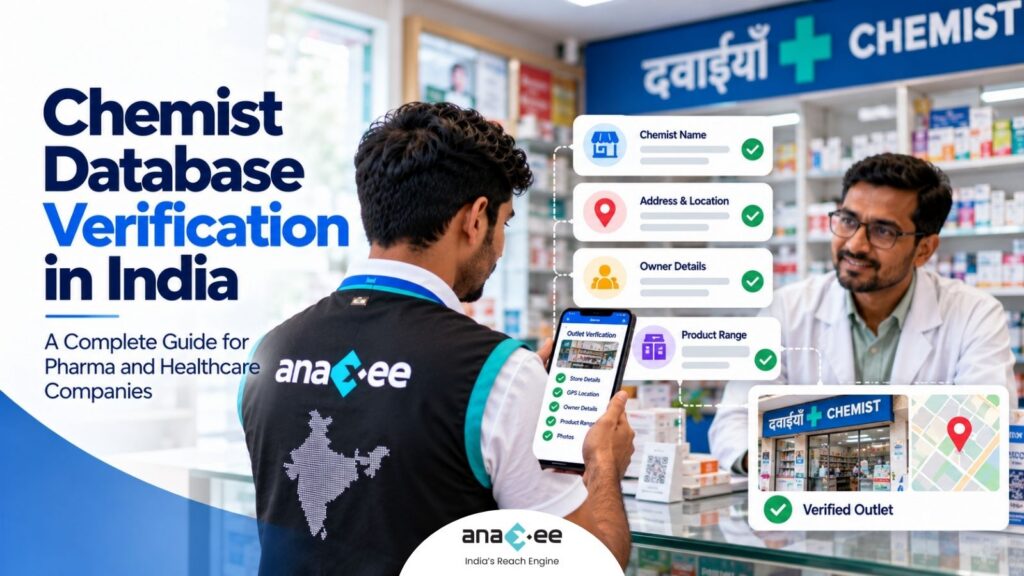
GPS mapping connects an outlet record to geographic coordinates. This can make it easier to map the outlets in a database and assess their geographic distribution.
When captured and checked appropriately, coordinates can support:
- Mapping of verified outlet locations.
- Identification of potential address-location mismatches.
- Geographic coverage analysis.
- Territory-level planning.
- Clustering outlets for future field visits.
- Reviewing the distribution of records across selected areas.
However, GPS coordinates do not independently prove an outlet’s legal identity, licence status or commercial activity. A coordinate may identify a building or location without confirming every detail in the database.
For this reason, GPS mapping should be combined with the other checks required by the project.
How Should Companies Measure Chemist Verification Quality?
A large number of outlet visits is not enough to demonstrate that a project has produced a reliable database.
Companies should agree on measurable indicators before fieldwork begins.
| Metric | What it measures |
|---|---|
| Verification completion rate | Share of assigned outlets with a submitted result |
| Acceptance rate | Share of submitted records that pass agreed quality checks |
| Address discrepancy rate | Frequency of differences between source and field address information |
| GPS completeness | Share of applicable records with usable coordinates |
| Duplicate-resolution rate | Share of reviewed duplicate candidates with a documented decision |
| Evidence compliance | Share of records meeting the agreed evidence requirements |
| Unresolved-record rate | Share of records that could not be confirmed |
| Cost per accepted record | Relevant project cost divided by accepted records |
The distinction between completion and acceptance is important. A team may submit results for every assigned outlet, but some results may still be incomplete, unsupported or inconsistent.
Similarly, a low unresolved-record rate is not necessarily a sign of high quality if teams are marking uncertain records as verified. Status definitions and evidence requirements should be reviewed alongside the numbers.
Common Challenges in Large-Scale Chemist Mapping
Inconsistent outlet names
A pharmacy’s registered name, signboard name and database name may differ. Matching should consider the available evidence rather than relying on a name alone.
Incomplete addresses
Some records may include only a locality, landmark or partial street address. Additional investigation may be needed to identify the correct outlet.
Outlets in dense commercial areas
Several pharmacies may operate close to one another. GPS coordinates and address checks need to be sufficiently precise to distinguish between neighbouring outlets.
Inaccessible or closed outlets
A shop may be temporarily closed, operating at different hours or no longer present at the stated location. The protocol should distinguish between an unsuccessful visit and a confirmed inactive outlet.
Geographic and language differences
Large projects can involve different travel requirements, address conventions and languages. These factors should be reflected in staffing, planning and cost estimates.
Licence and business-data limitations
Licence or GST details may not be available at the location or may require an authorised method of checking. Missing information should be recorded as unavailable or unverified rather than treated as confirmed.
A representative pilot can help assess these challenges and establish realistic expectations before a wider rollout.
Can Chemist Mapping Be Combined With Doctor Database Verification?
Yes, if the project scope and operational design support both activities.
Some pharmaceutical companies may want to improve doctor records and chemist outlet information as part of a broader field-data programme. Combining the work can potentially reduce duplicated planning effort in selected areas, but it does not mean every doctor and chemist should automatically be visited in the same trip.
The two datasets have different verification requirements. A doctor record may require professional and practice-location checks, while a chemist record may require outlet identity, address and authorised business-detail checks.
Before combining the work, define:
- The required fields for each record type.
- Whether the same field teams can perform both tasks.
- The geographic relationship between doctor and chemist locations.
- Separate acceptance criteria for each dataset.
- How the two datasets will be stored and reconciled.
- How the cost and productivity of combined visits will be measured.
This makes it possible to evaluate the combined approach on actual results rather than assuming it will automatically be cheaper or faster.
How Anaxee Digital Runners Can Support Chemist Database Projects
Anaxee Digital Runners can support on-ground data collection and location verification for pharmaceutical projects, subject to the agreed scope, geographic requirements and permissions.
Depending on the approved protocol, a chemist verification project may include outlet visits, structured collection of outlet details, GPS-based location capture, authorised photographs and backend quality checks.
The project should begin with a clear definition of what constitutes an accepted outlet record. This helps align field execution, evidence collection, quality control and commercial expectations.
Before scaling a large project, the client and field operations partner should agree on:
- The source database and fields to be verified.
- Geographic coverage and language requirements.
- The method for handling duplicate or ambiguous outlets.
- Evidence requirements and verification statuses.
- Rules for inaccessible outlets and follow-up visits.
- Quality-control procedures and acceptance thresholds.
- Data access, retention and permitted uses.
- Reporting requirements and cost per accepted record.
Start with a representative pilot
A pilot should cover a realistic mix of outlet types, address quality and geographic conditions.
Measure the number of outlets successfully located, the share of records accepted after quality control, the nature of discrepancies, the frequency of follow-up visits and the cost per accepted record.
If doctor verification is also part of the intended programme, measure its performance separately. This will help determine whether combining the activities is operationally worthwhile.
Planning a chemist mapping or outlet verification project in India?
Schedule a discussion with Anaxee Digital Runners to discuss your data, geography and pilot requirements.
Data Privacy and Responsible Fieldwork
Chemist database projects should have a defined purpose and an approved list of fields to collect.
Before work begins, establish how records and supporting evidence will be accessed, transferred, stored and retained. Collect only the information needed for the agreed objective.
Licence and business details should be handled according to the project’s authorisations and permitted methods. Photographs and contact information should be collected only when justified by the task and managed appropriately.
The verification process should not collect patient information or introduce unrelated data collection. Clear field instructions and access controls help maintain a focused and accountable process.
Frequently Asked Questions
1. What is chemist database verification in India?
It is the process of checking whether pharmacy or chemist outlet records contain sufficiently accurate and complete information for a defined business purpose. It may include outlet names, addresses, GPS coordinates and other authorised fields.
2. What is the difference between chemist mapping and chemist verification?
Mapping focuses on associating outlets with geographic locations. Verification checks whether the outlet record matches the available real-world information. A project may require either activity or both.
3. Can GPS coordinates confirm a pharmacy’s identity?
GPS coordinates help identify a physical location, but they do not independently establish the legal identity of an outlet or confirm its licence status. Other appropriate checks may be needed.
4. Can drug licence and GST details be included in verification?
They may be included when relevant to the project’s purpose and when collection or checking is authorised. The verification report should specify how each field was checked and distinguish confirmed information from unavailable or unverified details.
5. How can duplicate chemist records be identified?
Potential duplicates can be flagged by comparing outlet names, addresses, coordinates and other appropriately available identifiers. Similarity should trigger review, not automatic merging, because different outlets may have similar names or operate close to one another.
6. How should a company measure the success of chemist mapping?
Useful indicators include verification completion, acceptance rate, address discrepancies, GPS completeness, duplicate-resolution outcomes, evidence compliance and cost per accepted record. The measures should be defined before fieldwork begins.
7. Can chemist mapping and doctor verification be done in one project?
They can be included in a broader field-data programme if the operational plan supports both. Each dataset should have its own verification rules and quality criteria, and the benefits of combined visits should be tested in a pilot.
Conclusion
Chemist database verification is not simply a matter of adding pharmacy locations to a spreadsheet. It is a structured process for checking outlet information, identifying discrepancies, validating locations and documenting which records meet the agreed quality standard.
For pharmaceutical companies, combining appropriate data cleaning, field verification, GPS mapping and quality control can create a more dependable outlet database for the intended operational use.
The strongest projects define success before fieldwork begins, preserve uncertain cases rather than making unsupported assumptions, and measure results using accepted records instead of visit counts alone.
Need support with chemist mapping or outlet verification in India?
Connect with Anaxee Digital Runners to discuss your project scope and pilot requirements.