
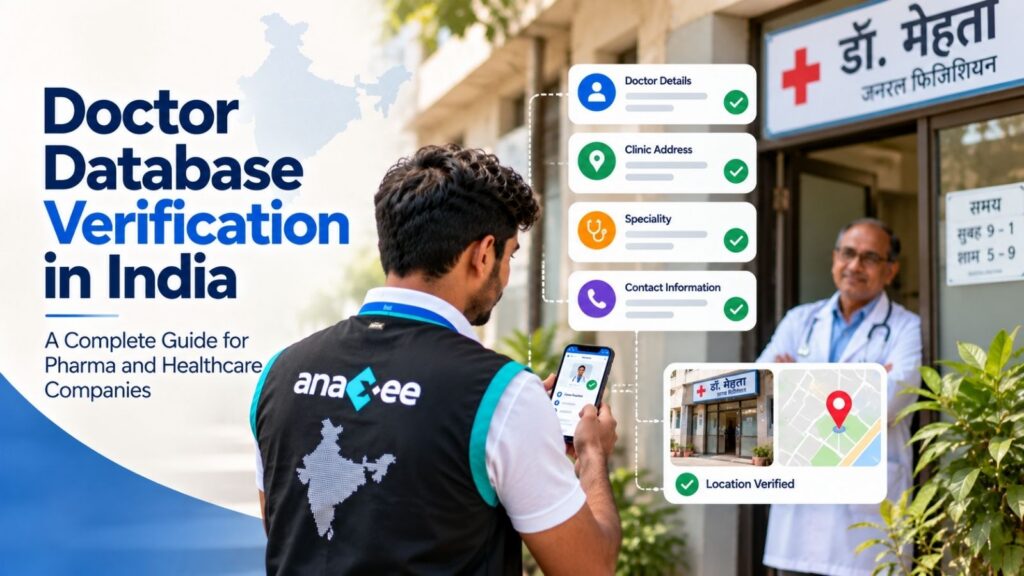

Doctor Database Verification in India: A Practical Guide
A pharmaceutical company can have thousands of doctor records in its database and still struggle to answer a basic question: How many of those records accurately reflect the doctor’s current professional details and practice location?
Thank you for reading this post, don't forget to subscribe!A doctor may have changed clinics. An address may be incomplete. The same medical professional may appear under different names, or a record may contain outdated information that has never been rechecked.
These issues become harder to manage when a doctor master is maintained across multiple divisions, teams or systems.
Doctor database verification in India helps pharmaceutical companies assess whether selected records match the available real-world information. Depending on the project requirements, verification can involve checking professional details, confirming practice addresses, recording GPS coordinates, documenting discrepancies and reviewing evidence collected during field visits.
This guide explains how to plan a doctor database verification project, what information to validate, how to measure quality and how to prepare for a larger rollout.
What Is Doctor Database Verification?
Doctor database verification is the process of checking whether the information recorded about a medical professional is accurate, sufficiently complete and suitable for its intended business use.
The verification process may cover:
- Doctor name and relevant professional details.
- Specialty, where included in the approved scope.
- Clinic, hospital or practice address.
- Practice location and GPS coordinates.
- Clinic operating hours, where available.
- Duplicate or conflicting records.
- Outdated or incomplete information.
- Evidence supporting the verification outcome.
The exact checks depend on the purpose of the database and the fields that need to be validated.
For example, a database intended to support medical representative visit planning may place greater emphasis on practice locations and clinic timings. A master-data cleanup project may focus more heavily on identity matching, duplicate records and conflicting fields.
Verification should begin with a clear definition of what a valid record means for the project. Without that definition, teams may collect large amounts of data without knowing whether the results meet the business requirement.
Why Pharma Companies Need Doctor Database Verification
1. Doctor information changes over time
Medical professionals may move between clinics, change their consultation schedules or practise at multiple locations. A record that was correct when created may no longer be accurate.
Periodic verification can help identify such changes and establish when information was last checked.
2. Inconsistent records complicate database management
Different teams may enter the same doctor’s details using different spellings, abbreviations or address formats. These inconsistencies can make matching and reporting difficult.
Database cleaning and deduplication can identify likely overlaps, while verification helps assess whether the underlying details are correct.
3. Incomplete addresses create operational uncertainty
A locality name or partial address may not be enough for a field representative to locate a practice reliably. Location verification and GPS coordinates can provide additional context when collected accurately and appropriately.
4. Unverified information can weaken territory planning
Territory allocation and visit planning depend partly on the quality of the location information available. Incorrect coordinates or outdated practice details can make operational plans less reliable.
Verification improves the information available for planning, although actual productivity also depends on factors such as territory design, doctor availability and field-force processes.
5. Large databases need consistent quality standards
When a project spans multiple regions, field teams and languages, differences in data collection can lead to inconsistent outputs.
A standard verification protocol, structured forms and quality checks help make the results more comparable across locations.

Which Doctor Database Fields Should Be Verified?
The fields selected for verification should reflect the intended use of the database. Collecting every possible detail is not automatically better.
| Data field | What to check | Why it matters |
|---|---|---|
| Doctor name | Spelling and consistency with the available reference | Supports record matching and identification |
| Professional details | Relevant fields included in the approved scope | Helps assess record completeness |
| Specialty | Whether the recorded classification is consistent with the verification rules | Supports segmentation and reporting |
| Clinic or hospital name | Whether the stated practice location can be confirmed | Helps distinguish between practice locations |
| Practice address | Location details and reported discrepancies | Supports reliable navigation |
| GPS coordinates | Whether coordinates correspond to the intended location | Helps validate geospatial information |
| Clinic hours | Available consultation or operating hours, where appropriate | Supports visit planning |
| Verification status | Whether the record is verified, discrepant or unresolved | Makes data quality visible |
| Evidence reference | Link or identifier for authorised supporting evidence | Supports quality review and traceability |
Fields such as professional registration numbers should be checked only where appropriate, available and authorised. Their presence, format and permitted use should be defined in the project protocol.
The objective is to collect enough information to make a reliable verification decision—not to accumulate unnecessary personal data.
A Six-Step Process for Doctor Database Verification in India
A structured process makes it easier to manage quality, resolve exceptions and estimate the effort required for a larger programme.
Step 1: Define the verification objective
Start by identifying what the company needs the verified database to support.
Is the objective to correct clinic addresses, validate a doctor master, investigate potential duplicates, improve location mapping or prepare data for field-force planning?
The objective determines which fields should be checked and what evidence is acceptable.
Document the following before field activity begins:
- Fields to be verified.
- Required evidence for each field.
- Geographic coverage.
- Rules for handling multiple practice locations.
- Definition of a completed record.
- Conditions for marking a record as unresolved.
- Quality-control and acceptance criteria.
Expected output: A clear verification protocol and an agreed definition of an accepted record.
Step 2: Audit and prepare the source database
Review the existing database before assigning records to field teams.
Identify missing addresses, inconsistent name formats, likely duplicates, incomplete fields and records that lack sufficient location information.
Standardise fields where possible and preserve the original source values so that changes remain traceable.
Potential duplicates should be identified before field allocation where practical. Otherwise, the same doctor may be visited multiple times because the source records were not reconciled.
Expected output: A prepared dataset with clear priorities and documented data gaps.
Step 3: Prioritise records for field verification
Not every record necessarily requires the same level of investigation.
Prioritisation can consider:
- Missing or incomplete practice addresses.
- Conflicting information across records.
- Uncertain duplicate matches.
- Records important to the intended operational use.
- Geographic clusters that can be visited efficiently.
- Records that have not been verified for a defined period.
A risk-based approach can help direct effort towards records where additional evidence is most valuable. The prioritisation rules should be agreed with the client rather than left to individual field teams.
Expected output: A fieldwork plan organised around geography, record priority and verification requirements.
Step 4: Conduct structured field visits
Field teams should work from a standard form that defines what to check and how to record the result.
Depending on the approved scope and permissions, a visit may involve:
- Checking whether the stated practice location can be found.
- Confirming the available professional and clinic details.
- Recording the actual address or the discrepancy found.
- Capturing GPS coordinates for the relevant practice location.
- Recording available clinic hours.
- Taking a clinic photograph where authorised and necessary.
- Marking records that cannot be verified and documenting the reason.
Field teams should not guess missing details or mark a record as verified simply because a location exists.
If a doctor practises at several locations, the result should reflect the agreed data model. One doctor identity may need to be linked to multiple practice-location records rather than forcing all details into a single address field.
Expected output: Structured verification results with documented exceptions.
Step 5: Apply backend quality control
Submitting a completed form is not the same as passing quality control.
The verification process should include checks for missing fields, inconsistent entries, implausible coordinates, incomplete evidence and conflicts between the source record and field findings.
Where authorised evidence is collected, reviewers should assess whether it supports the reported outcome. Records that fail quality checks should be returned for correction or assigned an appropriate exception status.
Useful status categories may include:
- Verified: The required checks passed.
- Discrepancy found: The field result differs from the source database.
- Unable to verify: The required information could not be confirmed.
- Follow-up required: Additional investigation is needed.
- Duplicate suspected: The record may overlap with another entry and needs review.
These categories should be defined before launch. A project should not treat every submitted record as successfully verified.
Expected output: A quality-checked dataset with clear outcomes and an auditable exception trail.
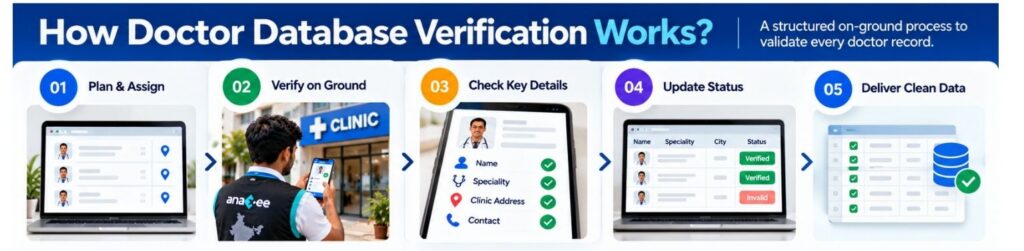
Step 6: Reconcile the database and plan ongoing updates
Once verification is complete, compare the results against the original database.
Identify which fields need correction, which records may require merging, and which cases need additional review. Changes should follow the client’s approval and master-data governance process.
Preserve source values and verification history where required so that users can understand what changed and why.
Finally, establish rules for future updates. These may include how new records are created, how potential duplicates are flagged, how field corrections are approved and when selected records should be reverified.
Expected output: A reconciled database and a repeatable process for maintaining data quality.
Why GPS Geotagging Matters in Doctor Verification
GPS geotagging associates a record or verification event with geographic coordinates. In doctor database projects, this can help distinguish between a written address and a location that has been checked in the field.
When captured accurately and in accordance with the project’s protocol, coordinates can support:
- Mapping of verified practice locations.
- Identification of possible location mismatches.
- Territory-level data analysis.
- Planning of field visits.
- Reviewing the geographic distribution of records.
However, coordinates alone do not prove a doctor’s identity or professional status. A GPS point may identify a building or general location without confirming that the doctor practises there.
Geotagging should therefore be treated as one part of a broader verification process, alongside the appropriate checks and evidence for each record.
How Should Companies Measure Doctor Verification Quality?
The number of records visited or forms submitted is not enough to assess the success of a project.
A better evaluation combines coverage, accuracy, evidence quality, unresolved cases and cost.
Consider tracking the following measures:
| Metric | What it tells you |
|---|---|
| Verification completion rate | Share of assigned records for which a result was submitted |
| Acceptance rate | Share of submitted records that passed the agreed quality checks |
| Address discrepancy rate | Frequency of differences between source and field address details |
| Location-data completeness | Share of applicable records with usable coordinates |
| Evidence compliance | Share of records meeting the required evidence standard |
| Unresolved-record rate | Share of records that could not be confirmed |
| Duplicate-confirmation rate | Share of suspected duplicates resolved through review |
| Cost per accepted record | Total relevant project cost divided by records accepted under the agreed criteria |
These measures should be defined before fieldwork begins. For example, the completion rate and acceptance rate are not interchangeable: a team can submit results for every assigned record while a significant portion still fails quality checks.
The cost-per-accepted-record metric is especially useful when comparing project approaches, provided the scope, geography, evidence requirements and acceptance criteria are comparable.
What Challenges Affect Large-Scale Doctor Verification?
Geographic spread
A project across multiple states may involve different travel distances, clinic density and access conditions. These factors influence field productivity and the time required to complete visits.
Language and local context
Field teams may need to communicate in local languages and understand local address conventions. The required language coverage should be assessed during project planning rather than assumed.
Incomplete or ambiguous source data
An inaccurate address or a name with multiple possible matches can make it difficult to identify the intended record. Some cases may require additional client information or follow-up.
Clinic access and availability
A clinic may be closed during the visit, the doctor may be unavailable or the location may have changed. Such cases need a documented follow-up process rather than an unsupported verification result.
Inconsistent evidence
If different field teams follow different standards for photographs, coordinates or form completion, the final dataset may be difficult to compare and audit.
Changing information after verification
A record can become outdated after a successful visit. The project should record when verification occurred and establish how updates will be managed.
A representative pilot can help expose these challenges before the programme is scaled across a large geography.
How Anaxee Digital Runners Can Support Doctor Database Verification
Anaxee Digital Runners can support pharmaceutical companies with structured on-ground data collection and field verification, subject to the agreed project scope and operational requirements.
Depending on the approved protocol, the work may include practice-location visits, collection of specified doctor and clinic details, GPS-based location capture, authorised photographs, structured data submission and backend quality checks.
A well-defined process is important because the value of fieldwork depends on the quality and usability of the results—not just the number of visits completed.
Before starting a large engagement, the client and field operations partner should agree on:
- The source data and verification fields.
- Geographic and language requirements.
- The evidence required for each status.
- Rules for failed visits and unresolved records.
- Quality-control and acceptance criteria.
- Data access, retention and permitted uses.
- Reporting frequency and escalation procedures.
- The commercial basis for accepted records and follow-up work.
Start with a representative pilot
A pilot can test whether the proposed verification method works under real operating conditions.
Select records that reflect the intended geography, data quality and range of verification challenges. Measure field completion, acceptance rates, discrepancy patterns, follow-up effort and cost per accepted record.
Use those results to refine the field protocol and rollout plan before committing to a larger programme.
Planning a doctor database verification project in India?
Schedule a discussion with Anaxee Digital Runners to discuss your verification scope, geography and pilot requirements.
Data Privacy and Responsible Fieldwork
Doctor database verification should be conducted using a defined purpose, approved fields and appropriate permissions.
Before data collection starts, establish who can access the information, which evidence may be captured, how records will be transferred and stored, and how long project data will be retained.
Collect only information necessary for the approved objective. Photographs, identifiers and location information should be handled according to the agreed protocol and applicable requirements.
Field teams should not collect patient information or record conversations unless that activity has been separately authorised and the necessary consent and legal review requirements have been addressed. If the project only requires clinic-location verification, those additional forms of data collection should not be introduced.
These safeguards help keep the verification process focused, controlled and appropriate to the business purpose.
Frequently Asked Questions
1. What is doctor database verification in India?
It is the process of checking whether doctor records contain accurate and sufficiently complete information for a defined purpose. Depending on the scope, it may include professional details, clinic addresses, location coordinates and documented discrepancies.
2. How is doctor database verification different from deduplication?
Verification checks whether selected data fields reflect the available real-world information. Deduplication identifies multiple records that may refer to the same doctor. The processes complement each other, but neither automatically replaces the other.
3. Does doctor database verification always require a physical visit?
No. Some fields may be checked using authorised digital or documentary sources. Physical visits may be appropriate when location details or other real-world information cannot be reliably confirmed through the available data.
4. What is GPS-based doctor verification?
It involves capturing or checking the geographic coordinates associated with a practice location. Coordinates can support location validation, but they do not independently prove a doctor’s identity or professional status.
5. How long does a doctor database verification project take?
The timeline depends on the number and distribution of records, source-data quality, required fields, access conditions, evidence standards and quality-control requirements. A pilot can provide a more defensible estimate than a record count alone.
6. How can pharmaceutical companies assess a field verification partner?
Assess the partner against the required geography, language capabilities, field protocol, evidence quality, backend quality control, exception handling, reporting and cost per accepted record. A representative pilot helps validate these factors before scaling.
7. How often should a doctor database be reverified?
There is no single interval suitable for every database. Reverification frequency should reflect how quickly the information changes, how the data is used, the cost of errors and the company’s update policy. Material discrepancies can also trigger targeted follow-up.
Conclusion
Doctor database verification is most useful when it produces information that pharmaceutical teams can trust and act on.
A structured programme starts with a clear objective, prepares the source database, prioritises records, collects field results using consistent rules, applies quality control and documents unresolved cases. GPS coordinates and supporting evidence can strengthen the result when they are appropriate to the task.
For large-scale projects, a representative pilot helps establish realistic expectations around field productivity, data quality and cost before expansion.
The goal is not simply to verify more records. It is to produce more reliable records, with clear evidence, transparent exceptions and a process for keeping the database current.
Connect with Anaxee Digital Runners to discuss a doctor database verification pilot.