

Tier-3 and Tier-4 Retail Distribution in India: What Actually Breaks at Scale
A brand that sells beautifully in Indore can sell almost nothing in Khargone.
Not because the demand isn’t there. It usually is. Something breaks between the plan and the shop counter, and most brands find out about it two quarters too late, when the sales review asks why the numbers from the new territory look like a typo.
If you sell a non-FMCG product — auto parts, paint, hardware, agri-inputs, building material, consumer durables — you’ve probably lived through some version of this. The playbook that worked in metros and tier-2 towns gets copied downward. And it quietly falls apart.
Here’s what actually breaks, and why.
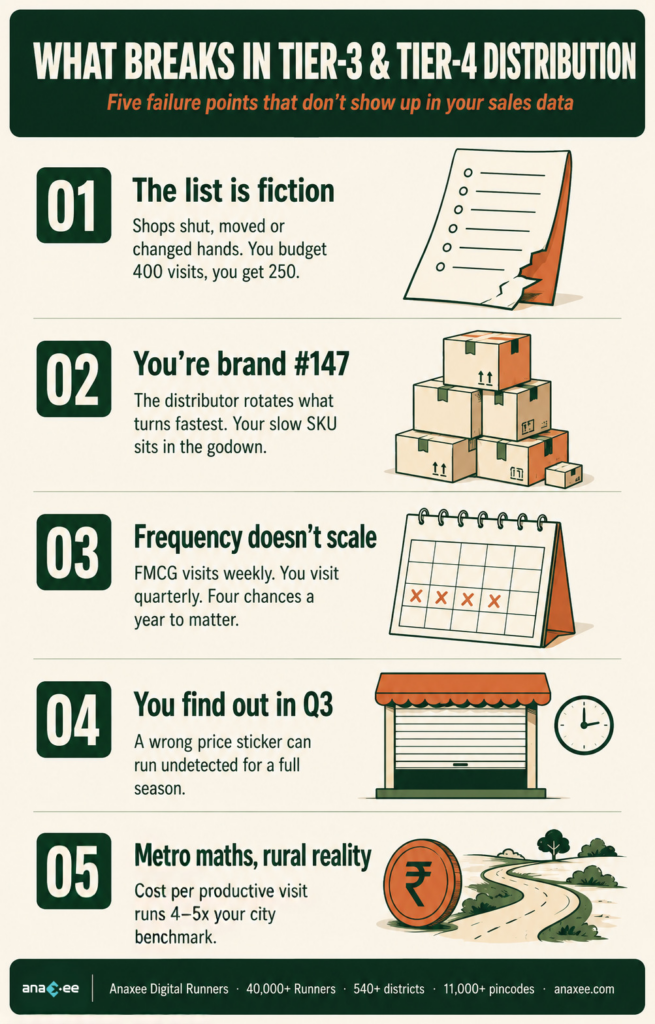
1. Your retailer list is older than your product
Almost every rural expansion starts with a list. From an old distributor. From a market research report. From a sales guy who covered the region in 2019.
By the time your team reaches the ground, a good chunk of that list is fiction. Shops have shut. Shops have moved two lanes over. The owner’s son now runs it under a different name. The number on file belongs to someone who sold the business three years ago.
The number that matters isn’t how many retailers are on your list. It’s how many your team can actually stand in front of.
And in smaller towns, the gap between those two numbers is wide. A team that budgets for 400 outlet visits often gets 250 real conversations. Everything downstream — targets, incentives, forecasts — is built on a number that was never true.
2. The distributor has 200 brands. You are number 147.
Distributor-led expansion is the default because it’s the cheapest way to look present in a new market. Appoint a distributor, book primary sales, mark the territory as covered.
The problem is that his incentive and yours are not the same thing.
He makes money on rotation. Fast-moving stock, quick payment cycles, low headache. If your product is new, slow-moving, or needs the retailer to be convinced before he buys, it sits at the back of the godown. It’s not sabotage. It’s arithmetic. He has finite working capital and finite attention, and he’ll put both where they turn fastest.
So your primary sales look fine for two quarters. Then the reorder doesn’t come, and nobody can tell you whether the stock sold through or is still sitting in a warehouse in Dewas.
This is the single most common way brands fool themselves about rural traction.
3. Low-frequency categories can’t buy attention the FMCG way
FMCG solved distribution with frequency. A biscuit salesman walks into the same shop every week. Fifty touchpoints a year. Relationship, visibility, and stock correction all get handled through sheer repetition.
You don’t have that.
If you sell tyres or tractor parts or waterproofing chemicals, your natural visit cycle might be once a quarter. Maybe twice a year. That’s four to eight chances a year to matter to a retailer who is being visited weekly by twenty other brands.
Most brands respond by trying to visit more often, which blows up the cost. The better response is to make each visit carry more weight — collect stock data, fix the display, train the counter staff, capture a photo, register the retailer on your loyalty programme — all in one go. Fewer visits, denser visits.
Very few field teams are set up to do this. They’re set up to take an order and leave.
4. You find out about problems three months late
Ask a national sales head what’s happening on the shelf in Betul right now and you’ll usually get a version of “I’ll check with the RSM.”
That’s the real gap. Not effort — visibility.
In a metro, a problem surfaces fast. Someone notices. In a tier-4 town, a wrong price sticker, a competitor’s display taking your slot, or a distributor pushing your SKU to the bottom shelf can run undetected for an entire season.
By the time it shows up in the sales data, you’ve lost the quarter and you still don’t know the cause. Was it pricing? Availability? Competitor scheme? A retailer who was never actually stocked in the first place? Sales data tells you what happened. It almost never tells you why.
5. The cost of a visit doesn’t scale the way you assume
Here’s the part that catches finance teams off guard.
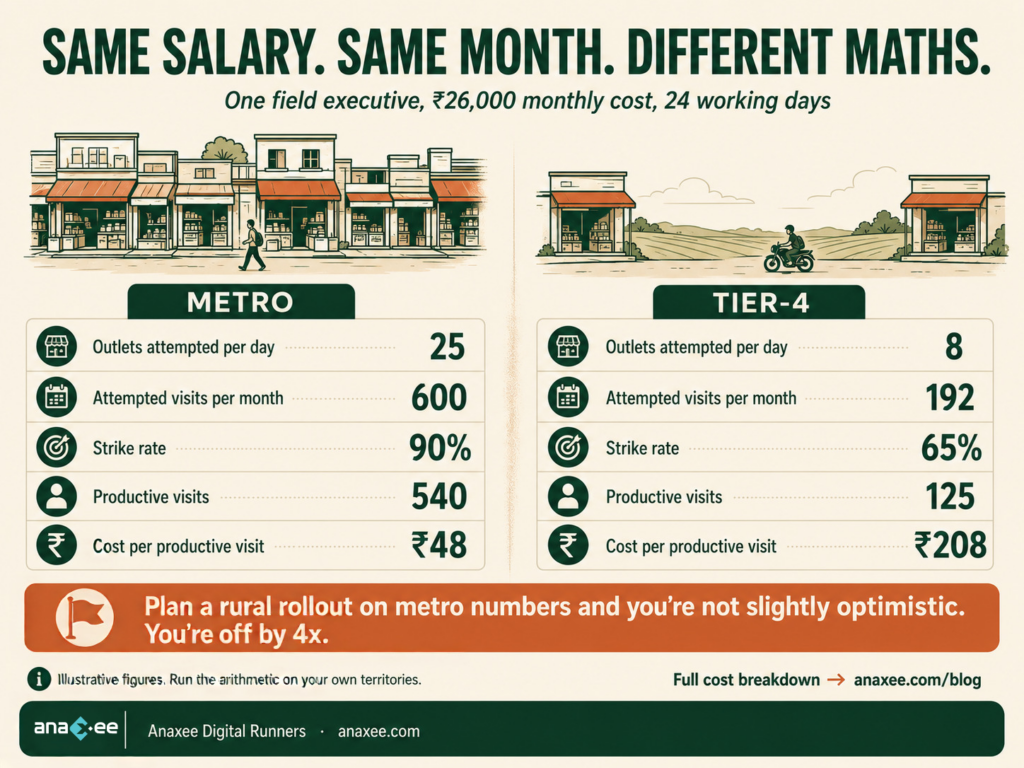
Reaching a retailer in Pune costs one number. Reaching a retailer in a town of 40,000 people costs considerably more — not because labour is expensive there, but because of travel time, low outlet density, and failed visits.
In a metro, a field executive covers 25 to 30 outlets a day within a few kilometres. In a scattered rural belt, the same executive might manage eight, with two hours of travel between clusters and a real chance that the shop is shut or the owner is at a wedding.
So the cost per productive visit can be three to five times higher than your metro benchmark. Brands that budget rural expansion using metro cost assumptions run out of money halfway through the rollout and conclude the market doesn’t work.
The market works. The cost model was wrong.
What actually holds up at scale
None of this means tier-3 and tier-4 markets aren’t worth it. They’re where the growth is. But the approaches that survive contact with the ground tend to share a few things.
Verify before you plan. Confirm which shops exist, who runs them, and what they currently stock — before you set targets. A verified base of 200 outlets is worth more than a paper list of 600.
Measure sell-through, not just sell-in. Primary sales are a comfort blanket. Secondary movement is the truth. If you can’t see it, you’re managing blind.
Make each visit do four jobs. Order, stock check, visibility check, retailer capture. If your team is only taking orders, your cost per visit is buying you a quarter of what it should.
Use variable capacity instead of fixed headcount. Hiring permanent field staff for a territory you haven’t validated is how expansion budgets die. Get coverage first, build permanent presence where the numbers justify it.
Get proof, not reports. Photographs, geo-tagged check-ins, timestamped data. Not because you don’t trust your team, but because “covered” means very different things to different people.
The bottom line
Rural distribution doesn’t fail because rural India doesn’t buy. It fails because brands carry metro assumptions into markets that behave nothing like metros — same visit economics, same trust in the distributor, same reporting lag — and then read the resulting numbers as a demand problem.
It’s usually an information problem wearing a demand problem’s clothes.
Start with what’s actually on the ground. The strategy gets much easier after that.
Anaxee runs on-demand retail coverage through a network of 40,000+ Digital Runners across 540+ districts and 11,000+ pincodes in India — retailer verification, shelf audits, onboarding and last-mile distribution support for non-FMCG brands. If you’re planning an expansion into tier-3 and tier-4 markets, book a conversation with our team.