


How to Verify 75,000 Doctors Across India: A Practical Guide for Pharma Companies
Imagine your company has a database of 75,000 doctors spread across India.
Thank you for reading this post, don't forget to subscribe!The list contains names, clinic addresses, specialties, and contact details. Your medical representatives use it to plan their visits. Sales teams depend on it for territory planning. Managers use visit reports to understand field activity.
But how confident are you that the information is still correct?
Some doctors may have moved to another clinic. Some may have changed their practice timings. Others may have retired, changed specialties or stopped practising at the listed location. A few records may be duplicated, incomplete or difficult to locate.
These problems are not always obvious when you look at a spreadsheet.
That is why doctor database verification in India needs more than a quick review of names and phone numbers. It needs a defined process for checking records, capturing evidence, reviewing quality and identifying information that remains uncertain.
For a database containing 75,000 doctors, the challenge is not simply visiting every location. It is completing the work consistently across different states, cities, towns and localities—and producing a final dataset that the business can actually use.
Here is a practical way to approach it.
1. Define what “verified” actually means
Before assigning field teams, decide what your company wants to confirm.
This sounds obvious, but it is one of the most important steps in a large verification project.
Does a verified record mean that the doctor’s name matches? That the clinic address exists? That the doctor currently practises at that location? Or that every important field has been checked?
These are different levels of verification.
For example, a fieldworker may reach the correct building but find that the doctor is unavailable. The address may be correct, but the doctor’s current practice status remains unconfirmed.
Similarly, a clinic receptionist may confirm that a doctor practises there, but may not be able to verify every detail in the company’s database.
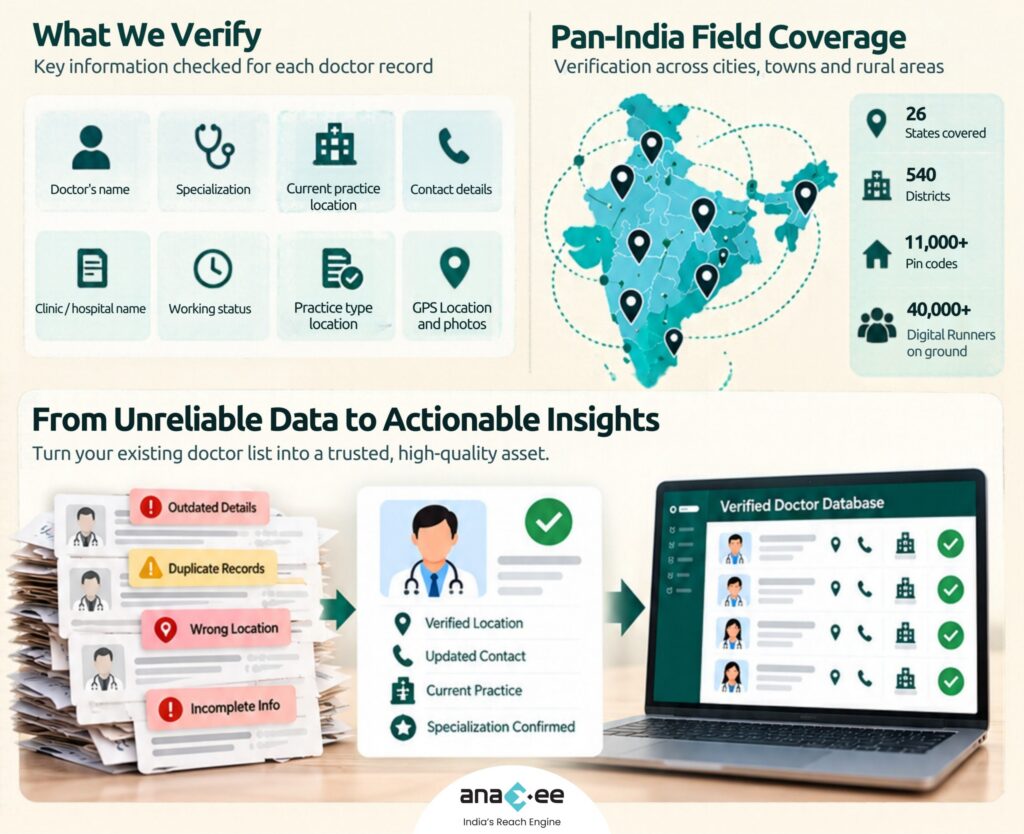
A practical verification specification should define the fields to be checked, such as:
- Doctor’s name and relevant professional details.
- Specialty, where it can be reliably confirmed.
- Clinic or hospital name.
- Current practice location and address.
- Whether the doctor is practising at the listed location.
- Relevant contact information, where permitted and feasible.
- Duplicate or potentially duplicate records.
- Evidence supporting the verification result.
Not every field will be verifiable in every situation. That is precisely why the project needs clear rules.
The key principle: Do not label a record “verified” merely because someone attempted a visit. Verification should mean that the agreed checks were completed and supported by appropriate evidence.
2. Clean the database before sending people into the field
A large field operation can become unnecessarily expensive if the input data is poorly structured.
Before starting visits, review the database for common problems:
- Missing or incomplete addresses.
- Different spellings of the same doctor’s name.
- Duplicate entries.
- Inconsistent specialty names.
- Missing locality, city or PIN code.
- Invalid or incomplete contact information.
- Multiple clinic locations recorded against the same doctor.
This preparation helps identify records that may need additional research before a field visit can be planned.
It also helps group records geographically. If several doctors are listed at the same hospital or medical complex, the team may be able to verify them during one coordinated visit rather than treating each record as an entirely separate journey.
However, a shared location does not automatically mean every doctor can be verified in one visit. The process must still confirm each relevant record individually.
Cleaning the database first reduces avoidable effort and creates a clearer starting point for measuring the quality of the original list.
3. Choose the right verification method
Not every record requires the same approach.
The method should depend on the verification objective, the quality of the available information and the level of confidence required.
Physical field verification
A field visit can help establish whether the listed clinic or hospital exists and whether the doctor is associated with that location.
Depending on the agreed scope and what can be reliably confirmed, the fieldworker may capture location evidence, visit details and the verification outcome.
Physical verification can be particularly useful when the purpose is to independently check actual practice locations rather than simply reconfirm information already present in a database.
But fieldwork has limitations. The doctor may not be present during the visit. Clinic timings may be inaccurate. A facility may be temporarily closed. Local directions may be incomplete.
These cases need a defined follow-up process rather than an automatic assumption that the record is wrong.
Phone-based verification
Phone calls can help confirm selected details, clarify directions or establish suitable visiting hours.
They may be useful before a physical visit or as a follow-up when a fieldworker cannot complete verification at the location.
However, a phone confirmation should not be treated as equivalent to physical verification when the project specifically requires independent confirmation of the practice location.
Digital and public-source checks
Where reliable sources are available, they can help validate selected details or identify inconsistencies before fieldwork.
The reliability and freshness of each source should be considered. Information appearing online is not necessarily current.
For large projects, a combination of methods may be appropriate—but the final report should clearly distinguish how each record was verified.
4. Build a field plan around geography, not just record count
Verifying 75,000 doctors across India is a coordination challenge as much as a data collection task.
A list may contain doctors concentrated in major cities, doctors spread across smaller towns and doctors in locations that require substantial travel. Two projects with the same number of records can therefore have very different field costs and completion times.
Start by grouping records by state, district, city and locality wherever the available data supports it.
Then assess:
- Number of records in each location.
- Distance between verification points.
- Concentration of doctors in hospitals or medical complexes.
- Quality of address information.
- Availability of field resources.
- Expected revisit requirements.
- Local access constraints and operating hours.
This produces a more realistic deployment plan than dividing the total record count by a standard daily target.
For example, a team may be able to check several nearby clinics in one locality but complete far fewer visits in an area where addresses are dispersed.
Daily productivity should therefore be estimated by geography and tested during a pilot. A single national productivity assumption can create misleading timelines and budgets.
5. Use a pilot to test the assumptions
Before launching a nationwide operation, conduct a pilot across a small but representative selection of locations.
The pilot should include different operating conditions—for example, a dense urban area, a smaller city and a more geographically dispersed territory, depending on the actual database.
The purpose is not merely to show that fieldwork can be completed. It is to test the project design.
Measure:
- How many records can be completed per fieldworker per day.
- How often addresses are incomplete or incorrect.
- How many doctors are confirmed at the listed location.
- How often the doctor is unavailable or the result remains inconclusive.
- How much time is spent travelling between locations.
- How frequently repeat visits are needed.
- How much time is required for data review and correction.
- How often the collected evidence fails quality checks.
These results help answer the questions that matter for budgeting and execution.
Is the proposed productivity target realistic? Are the input addresses sufficiently reliable? Does the project need more pre-field research? Are some locations likely to require additional effort?
A pilot converts assumptions into observed operating data.
It also gives the client and verification partner an opportunity to refine the process before committing to the full rollout.
6. Capture evidence, not just a status update
A spreadsheet that says “visited” does not necessarily prove that a doctor’s record has been verified.
For that reason, evidence collection should be designed into the field workflow from the beginning.
Depending on the project requirements, evidence may include:
- GPS coordinates associated with the visit.
- Date and time of the verification activity.
- A structured result selected from predefined categories.
- Relevant location photographs, where appropriate and permitted.
- Notes explaining discrepancies or unresolved cases.
- A record of the checks completed.
Photographs and location data must be collected with appropriate regard for privacy, facility rules and the agreed scope. Images should not expose patients, patient records or other unnecessary personal information.
Evidence also needs to be reviewed. A GPS coordinate alone does not establish that the correct doctor was verified, and a photograph of a building does not prove that every doctor listed at that building currently practises there.
The strength comes from combining the evidence with the specific checks required for each record.
7. Establish quality control before scaling
Quality assurance should not be postponed until the end of the project.
A large verification operation needs a clear review process while work is underway.
A practical quality framework can include:
Automated checks: Identify missing mandatory fields, invalid formats, duplicate records and inconsistent entries.
Evidence review: Check whether the submitted evidence supports the reported result and meets the agreed requirements.
Exception review: Send ambiguous or contradictory cases for additional review rather than forcing them into a confirmed or incorrect category.
Sample rechecks: Independently recheck a defined sample of completed records to assess the reliability of the field process.
Correction workflow: Record what was rejected, why it was rejected and whether the issue was corrected.
The client and service provider should agree on acceptance criteria before work starts. For example, they should specify which fields are mandatory, what evidence is required and how disagreements will be resolved.
This makes quality measurable rather than subjective.
It also creates a way to identify recurring problems. If a particular region has a high rate of incomplete addresses, the team can investigate the cause and adjust its approach instead of discovering the issue after the project is finished.
8. Treat unresolved records as a separate outcome
One common mistake in large data projects is to force every record into a simple “verified” or “not verified” category.
In practice, a fieldworker may reach the correct location but find the doctor unavailable. The clinic may be closed. The address may be insufficient to locate the premises. Local staff may not be able to confirm the doctor’s current association with the facility.
These outcomes mean different things.
A more useful reporting structure may distinguish between:
- Verified: The agreed checks were completed successfully.
- Discrepancy found: The information differs from the observed or confirmed information.
- Unable to verify: The available evidence was insufficient to confirm the record.
- Doctor unavailable: The visit was attempted, but the required confirmation could not be completed.
- Address issue: The listed location could not be reliably identified.
- Repeat visit required: Further action is needed under the agreed rules.
The precise categories should be tailored to the project.
This distinction is commercially important. An attempted visit is not the same as a completed verification, and an unresolved record is not automatically a false record.
A transparent exception report tells management what is known, what needs attention and where further effort may be justified.
9. Make the final dataset useful for business decisions
The end product should be more than a collection of field reports.
The client should receive a structured dataset that can be reconciled with the original master list and used by the relevant teams.
Depending on the agreed scope, the delivery may include:
- Original record identifier.
- Original and updated field values.
- Verification outcome.
- Evidence references.
- Date of verification.
- Reason for discrepancies or unresolved outcomes.
- Quality-control status.
- Repeat-visit status, where applicable.
Maintaining a link to the original record is especially important. Without it, the client may struggle to understand which records changed or how the verified information relates to existing systems.
The reporting dashboard should also show progress and quality together. A high number of completed visits means little if a large share of records fails the agreed quality checks.
Useful indicators include completion rate, confirmed-record rate, discrepancy rate, unresolved-record rate, evidence acceptance rate, recheck results and cost per accepted verification.
These measures help management evaluate both execution and the usefulness of the final data.
10. Budget for verified outcomes, not just field activity
The cost of a nationwide verification project depends on several factors:
- Number of records and geographic distribution.
- Quality of the initial database.
- Verification method and evidence requirements.
- Expected productivity and travel time.
- Number of repeat attempts.
- Backend review and quality-control requirements.
- Reporting, reconciliation and final delivery.
- Any additional activities, such as medical-store mapping.
A price based only on the number of visits or fieldworker days may not capture the full scope of the work. On the other hand, a per-record price is not meaningful unless both sides agree on exactly what constitutes an accepted record.
A sound commercial model defines the deliverable clearly.
For instance, it should explain the difference between an attempted visit, a completed verification, a record with a discrepancy and an unresolved case. It should also state how repeat attempts and quality-related corrections will be handled.
The goal is not to make field productivity irrelevant. It is to connect the operating cost to an agreed, measurable result.
That is why pilot data matters. It helps the client and service provider build a budget around observed conditions rather than optimistic assumptions.
11. What about medical-store mapping?
Some pharma projects also require verification or mapping of nearby chemists and medical stores.
This can create additional value by helping the business understand the local healthcare ecosystem. However, it should be treated as a defined workstream rather than assumed to be automatically included in every doctor visit.
The extra effort depends on the number of stores to be mapped, the information required, their proximity to verified clinics, the time needed to collect each record and the level of evidence expected.
A pilot can test whether store mapping can be completed efficiently alongside doctor verification in the selected areas.
The project specification should clarify which fields are required for each store, how duplicate locations will be handled and whether the task requires only location mapping or additional verification.
Bundling related activities may improve efficiency in some locations, but that benefit should be measured rather than assumed to be the same everywhere.
12. How Anaxee can support large-scale verification
For a project spanning multiple states and thousands of records, coordination, consistent data capture and quality control are central to delivery.
Anaxee Digital Runners Pvt Ltd can support field-based data collection and verification through a structured workflow designed around defined tasks, evidence capture, review and organised data delivery.
The exact workflow should be configured around the client’s objectives. Before rollout, both sides should agree on the verification fields, evidence standards, geographic coverage, exception categories, quality thresholds and reporting requirements.
The process should then be tested in a pilot, refined using actual operating results and scaled with regular quality monitoring.
The objective is not simply to report how many locations were visited. It is to provide the client with a clearer view of which doctor records were confirmed, which require correction and which still need attention.
That distinction matters when the database supports field planning, territory management and other business decisions.
Final thoughts
Verifying 75,000 doctors across India is achievable only when the project is designed around the realities of the data and the field operation.
Start by defining what verification means. Clean the input list. Choose the right verification methods. Plan by geography. Test productivity in a pilot. Capture appropriate evidence. Review quality continuously. Report unresolved records honestly. Deliver a dataset that can be traced back to the original master list.
Most importantly, measure the result—not just the activity.
A large number of completed visits does not automatically mean a reliable doctor database. The real outcome is a set of records whose status is clear, whose changes are traceable and whose limitations are visible.
If your organisation is planning a doctor database audit or a large-scale healthcare data verification project, a practical first step is to assess the existing data and run a controlled pilot before committing to a nationwide rollout.
Planning a doctor database verification project?
Discuss your requirements with Anaxee and explore a practical approach to field verification, evidence capture and data quality.
Book a conversation with Anaxee