

Why Pharmaceutical Companies Need an Independent Doctor Database Audit
Let’s start with a simple question.
Thank you for reading this post, don't forget to subscribe!If your pharmaceutical company has a master database of 75,000 doctors, how would you know whether those 75,000 records are still accurate?
You could ask your medical representatives.
You could ask regional managers to review their territories.
You could check the CRM for missing fields and duplicate entries. You could even ask the sales team to confirm that the database has been updated.
These are all useful steps.
But there is one important difference between reviewing information submitted by your field team and independently checking what is happening on the ground.
The first tells you what your internal system reports. The second helps you establish whether that information matches reality.
For a pharmaceutical company that spends heavily on doctor engagement, this difference matters.
The doctor database influences visit planning, territory management, sales reporting and decisions about where the field force should spend its time. If the underlying information is outdated, even a well-run sales process can face avoidable problems.
That is why an independent doctor database audit deserves a place in the conversation.
The problem is not necessarily your MRs
Whenever someone suggests independently verifying a doctor database, an obvious concern may arise.
Does this mean the company does not trust its medical representatives?
Not necessarily.
MRs play an important role in maintaining relationships with doctors. They often have valuable local knowledge, understand clinic schedules and know when a practitioner has changed locations.
Their field updates are an essential part of the business.
However, maintaining a doctor database and independently auditing it are two different activities.
An MR has several responsibilities. They must plan visits, engage with doctors, communicate product information, meet targets and maintain relationships across a territory.
Database maintenance is only one part of that job.
Some changes may be reported immediately. Others may take time to reach the system. Certain records may be difficult to confirm. Different representatives may also follow different methods when updating information.
These are normal challenges in a large, distributed operation.
The issue is that when the same process is responsible for maintaining the database and confirming that the database is accurate, management may not have a truly independent view of data quality.
An independent audit is not an accusation against the field team. It is a way to check whether the company’s information is reliable.
That distinction is important.
Why internal reports may not tell the whole story
Imagine a company that operates across several states.
Each MR manages a territory. Each territory contains a list of doctors, with expected visit frequencies and contact details.
At the end of the month, the sales team reviews its coverage reports.
The reports show how many calls were completed, which doctors were visited and where targets were achieved.
Everything may look reasonable.
But those reports cannot, by themselves, establish that every doctor record is current.
A completed visit may confirm that the doctor was present at a particular clinic on a particular date. It does not automatically confirm that the address will remain correct six months later.
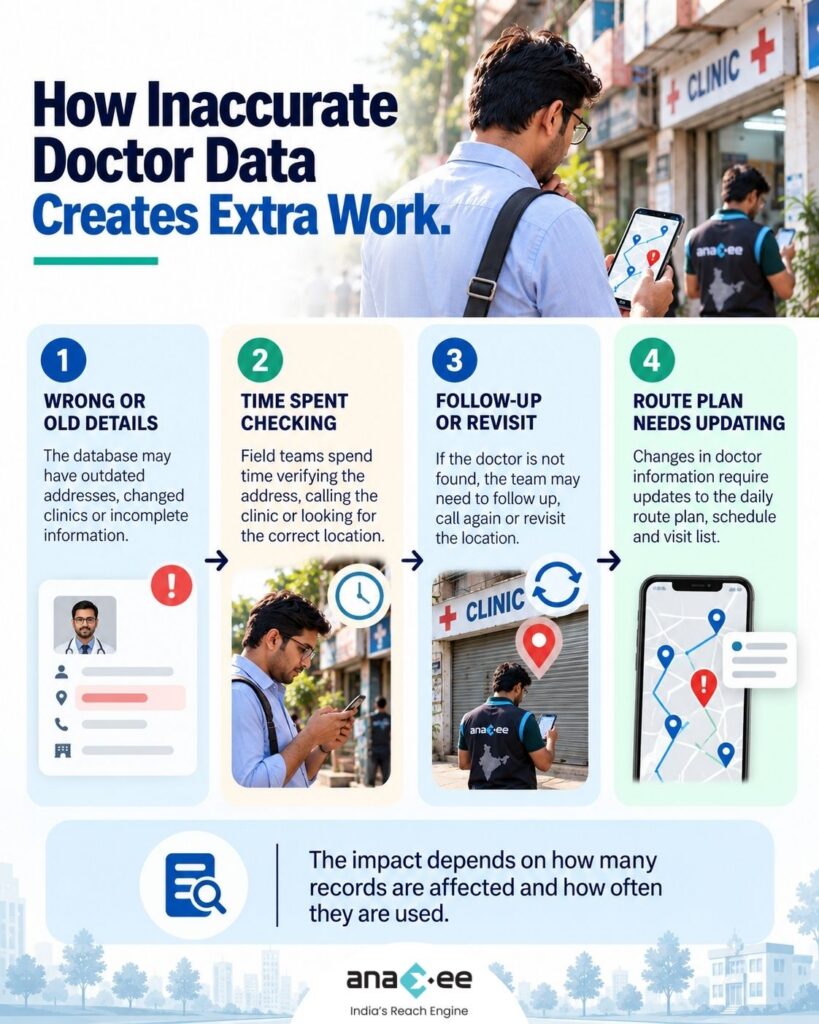
A record may have been updated in the CRM without supporting evidence. A duplicate may remain in the system because nobody has reviewed the two entries together. A doctor may have shifted to a new clinic while the old location remains active.
The reporting system may be working exactly as designed while still relying on incomplete information.
This is why data quality needs its own checks.
The question is not simply whether the team has submitted its reports. It is whether the company has a reliable way to confirm the facts that matter.
What exactly should an independent audit check?
A useful audit starts with a clear scope.
Simply asking a field worker to visit a clinic and mark a record as verified is not enough. The company needs to define what verification means and what evidence is required.
Depending on the client’s needs, an independent doctor database audit can cover several areas.
1. Doctor identity
Does the practitioner match the name and other identifying details in the master database?
This helps identify incorrect entries and records that may require further investigation.
2. Clinic location
Does the clinic exist at the recorded address?
A location check can help identify incorrect addresses, relocated practices and records that need updating.
3. Practice status
Is the clinic operating at the time of verification? Has the doctor moved, stopped practising at that location or become unavailable for confirmation?
It is important to distinguish between a clinic that is temporarily closed and one that has permanently shut down.
4. Speciality and practice details
Do the recorded speciality and other agreed details match the information available through the verification process?
This can help improve segmentation and reduce errors in the master database.
5. Duplicate records
Do multiple records refer to the same practitioner?
The audit should also distinguish between a duplicate doctor and a genuine situation in which one doctor practises at multiple clinics.
6. Evidence and verification date
What evidence supports the result, and when was it collected?
A timestamp, location information, appropriate photographs and structured responses can make the verification process more transparent.
The exact evidence required will depend on the project scope and the applicable privacy and consent requirements.
7. Unresolved records
What happens when a doctor cannot be found, a clinic cannot be confirmed or the available information is insufficient?
These records should be marked for further investigation rather than automatically classified as invalid.
The purpose of an audit is to establish the facts, including the facts that remain uncertain.
Why a standard process matters across India
A nationwide doctor database presents a different challenge from a list covering one city.
In a large urban market, several clinics may be located within a relatively small area. In a smaller town or rural market, reaching one clinic may require considerable travel.
The original database may also vary in quality across territories.
Some records may have complete addresses and current contact details. Others may contain incomplete location information or old clinic names.
If every field worker follows a different approach, the resulting data may be difficult to compare.
One person may accept a verbal confirmation. Another may require a photograph. A third may mark a record as inactive after an unsuccessful visit.
Even if everyone is working in good faith, the final dataset may contain inconsistent results.
An independent audit should therefore establish common definitions, standard questions, clear evidence requirements and a consistent way to classify outcomes.
It should also include training, quality checks and a process for reviewing unusual or disputed cases.
This is particularly important when the findings will be used by senior management to compare regions or assess the condition of the national database.
Physical verification, telephone checks or a combination?
Not every doctor record needs the same verification method.
A company may be able to confirm some information through existing records, reliable public information or direct contact with a clinic.
Other cases may require a physical visit.
For example, a telephone call may help confirm that a doctor has moved to a new clinic. But where the address itself is uncertain, a physical visit may provide stronger evidence that the location exists and corresponds to the record.
Likewise, an online listing may provide a useful starting point, but it may not establish that a clinic is currently operating.
A practical verification programme can combine different methods according to the level of evidence required.
The important point is to define the rules before the work begins.
A record verified through a telephone call should not automatically be treated as equivalent to a record confirmed through a physical location check if the client requires physical evidence.
Clear categories allow the company to understand what has been verified and what additional work may still be needed.
Why a pilot can be more useful than a large promise
Suppose your company wants to verify 75,000 doctors across India.
Before committing to the full exercise, it is worth understanding what the actual work will involve.
How many records have complete addresses? How many doctors can be confirmed on the first attempt? How often are clinics found at the recorded location? How much additional work is needed when a doctor has shifted?
These questions affect both the budget and the execution plan.
A pilot can help answer them.
The sample should be designed to reflect the relevant mix of states, cities, smaller towns, specialities and territories. If the purpose is to estimate national data quality, the sampling method should support that objective. If the purpose is to test field operations, the pilot should also cover the different conditions that runners are likely to encounter.
The pilot should measure more than the number of visits completed.
Useful measures include:
- Percentage of records confirmed against the agreed criteria.
- Percentage requiring correction.
- Percentage identified as potential duplicates.
- Percentage remaining unresolved.
- Average attempts required per record.
- Field productivity by geography.
- Quality rejection and rework rates.
- Cost per record for each agreed verification method.
These findings can help the company decide how to scale the project and where additional resources are needed.
They also prevent both sides from relying on assumptions about productivity, data quality or the difficulty of verification.
What happens after the audit?
An audit is only valuable if the company can act on its findings.
Once the results have been reviewed, the company can update confirmed addresses, resolve duplicates, correct agreed fields and flag records requiring additional attention.
It can also establish a process for keeping the database current.
For example, new doctors could be verified before being added to the master list. Changes in clinic location could trigger an update. Periodic reviews could identify records that have not been confirmed for a defined period.
The company can also retain the verification date and evidence status, making it easier to distinguish recently checked information from older records.
Over time, this can improve the quality of the data used for territory planning, CRM reporting and future analytics.
The objective is not to create a perfect database that never changes. Doctors move, clinics open and close, and practices evolve.
The objective is to create a database with a clear process for checking, correcting and maintaining information.
Why Anaxee can be part of this process
An independent audit requires more than people who can travel to clinics.
It requires a clear field workflow, consistent data capture, suitable verification evidence, quality review and structured delivery of the results.
Anaxee Digital Runners works with distributed field execution and digital data collection, helping businesses gather information from locations that cannot be understood through desk research alone.
For a pharmaceutical company, a verification programme can be designed around the existing doctor master list, agreed verification criteria, required evidence and geographic scope.
Depending on the requirement, the process can include physical clinic verification, location evidence, structured data capture, backend quality checks and organised reporting. Clinic mapping and nearby medical store mapping can also be included when they serve a defined business objective.
The right scope depends on the company’s needs. A pilot can establish the practical field requirements and help determine the most suitable approach for the full database.
Anaxee’s role is to help make the process measurable, consistent and auditable, so that the client receives more than a collection of field reports.
The result should be information that the company can review, correct and use.
The question every pharmaceutical leader should ask
Your medical representatives already provide valuable information about their territories.
Your CRM already stores doctor details. Your sales managers already review coverage and performance.
But when was the last time your company independently checked whether the doctor master database still reflects ground reality?
If the answer is unclear, that does not automatically mean the database is poor. It means the company may need a better way to measure its current condition.
That is the starting point for a useful audit.
It allows management to move beyond assumptions, understand the actual quality of its data and decide where improvements will make the greatest difference.
Better doctor data will not solve every sales challenge. But it can give the organisation a stronger foundation for the decisions it makes every day.
Want to Know What Your Doctor Database Is Really Telling You?
If your company maintains thousands of doctor records across multiple territories, an independent audit can help you understand which records are current, which need correction and which require further investigation.
Anaxee can help you explore a practical approach to doctor verification, clinic mapping and large-scale ground-level data collection.
Let’s discuss your existing database, the evidence you need and how a pilot could help establish the right approach.
Book a Conversation with Anaxee
The first step is not to assume your database is wrong. It is to find out how much you can trust it.