

Blended Finance in India: Why It Matters, Where It Breaks, and What Needs to Change
Introduction: Blended Finance—Overused Word, Underused Tool
Walk into any climate conference today and you’ll hear one phrase on repeat: blended finance. It often gets described as the silver bullet that will unlock billions for climate action. But scratch the surface, and the gap between what people say blended finance can do and what it is actually doing in India becomes obvious.
The panel discussion from the Development Impact Finance Forum (DIFF) captured this contradiction perfectly. On one hand, blended finance is positioned as the tool that can de-risk climate-smart agriculture, circular textiles, low-carbon livelihoods, and new materials. On the other hand, practitioners openly admit that Indian regulations don’t really allow blended finance, most transactions are too customized to scale, and the impact measurement foundations are still weak.
This blog cuts through the noise.
Instead of cheerleading the concept, it examines:
- Where blended finance truly works
- Where it fails in the Indian context
- Why execution breaks down
- How regulations are the biggest bottleneck
- What India needs to fix if it actually wants blended finance to scale
Let’s start with the basics—where blended finance is genuinely the right tool.
1. Where Blended Finance Actually Fits: Real Use Cases, Not Abstract Narratives
Most conversations about blended finance sound theoretical. This panel was refreshing because the examples were real and grounded in field-level experience.
1.1 When Philanthropic Capital Helps a Business Become Investable
Ankur (Upaya Social Ventures) made an important point:
Philanthropic capital should not subsidize doomed projects.
It should go to enterprises that:
- Have a real path to profitability
- Need time or risk-sharing to get there
- Are operating in markets that are socially and environmentally important
- Face early-stage barriers traditional capital won’t touch
His textile recycling example is a textbook case.
Case: Textile Recycling in South India
India’s textile waste ecosystem is broken:
- Waste collected in the South often travels to Panipat for recycling
- The logistics alone create a carbon-negative loop
- The technology is fragmented, and market linkages are unreliable
- Investors don’t trust the business model yet
Upaya and Laudes Foundation used outcome-based financing:
If entrepreneurs met social, climate, and business outcomes,
→ the cost of capital dropped
→ eventually to zero.
This allowed facilities to:
- Take the “leap of faith”
- Prove viability
- Prepare for commercial investment within a year
This is blended finance used correctly—as a bridge to investability, not a permanent subsidy.
1.2 When the Market Exists, but the Value Chain Doesn’t Move Together
Valerie (Canopy) brought an important global perspective.
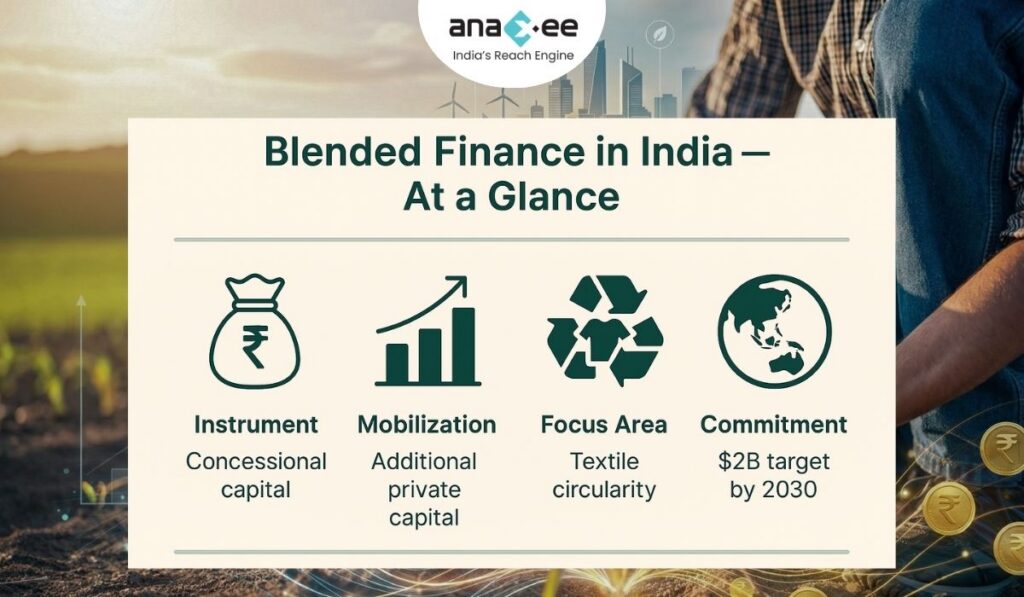
India is uniquely positioned to build a $2 billion alternative cellulose ecosystem, using agricultural residues (wheat straw, bagasse, etc.) to replace forest fiber in paper and textiles.
But the problem is structural:
- Farmers need micro-capital to aggregate feedstock
- Mills need concessional debt to modernize machinery
- Brands need assurance of sustainable supply
- Innovators need early-stage risk capital
These players will not move unless they move together.
Blended finance in this case becomes a coordinating mechanism, not just a funding tool. It builds confidence across:
- Technology providers
- Buyers
- Mills
- Farmers
- Investors
India already built 10 million tons of recycled fiber capacity in five years—one of the fastest expansions globally. That demonstrates an industrial capability that many other markets lack.
So if any country can execute a multi-player blended finance platform for alternative cellulose, it’s India.
1.3 When Access to Credit for Farmers Needs Risk-Sharing
Agri-finance in India is messy:
- Rural credit penetration is still patchy
- NBFCs borrow at high rates
- They pass this cost to farmers
- Banks meet priority sector quotas reluctantly
- Smallholder-focused startups struggle to get reasonably priced debt
Rabo Foundation’s work shows a simple truth:
If lenders get cheaper capital, farmers get cheaper capital.
But there’s a catch.
If the concessional rate doesn’t trickle down, you end up subsidizing the NBFC—not the farmer.
India’s repeated failures in credit transmission make this a genuine risk.
This is why blended finance structures must be designed with hard accountability mechanisms, not trust-based assumptions.
2. The Myths That Need to Die: What Blended Finance Cannot Do
A large part of the discussion dismantled some common misconceptions.
2.1 Blended Finance Cannot Turn a Bad Borrower into a Good One
A guarantee is not magic.
Abhishek (Gawa Capital) gave clear examples:
Banks often ask for:
- 100% guarantee
- Full collateral
- Personal guarantees
- And still charge extra for guarantee fees
When the guarantee ends?
They stop lending.
This exposes a flawed assumption:
“If we provide risk-sharing, banks will permanently enter the sector.”
In reality:
Banks treat it as a temporary detour.
They participate only as long as someone else absorbs the risk.
Once the blended layer goes away, they return to their comfort zone.
This is not moral failure.
It is simply institutional DNA.
Private lenders do not rewire themselves because a pilot demanded it.
2.2 Technical Assistance Alone Does Not Change Lender Behavior
Abhishek’s second point cut even deeper:
Many blended finance programs overestimate the impact of:
- Training programs
- Capacity building
- Toolkits
- Awareness workshops
Most lenders do not change behavior unless there is direct financial incentive.
TA may equip them with knowledge, but it does not shift their risk-return calculus.
This is why dozens of TA-heavy sanitation, livelihoods, and climate-smart agri programs in the last decade failed to move the needle.
2.3 Scaling Is Not Automatic—It Must Be Designed
Everyone agrees scaling is desirable.
But blended finance often suffers from a scale fetish:
- Programs try to go large too soon
- Structures remain bespoke
- Ticket sizes are too small to justify the structuring cost
- Impact measurement adds cost and friction
- Investors lose patience
Blended finance does not scale simply because the concept is attractive.
It scales when:
- Multiple players co-invest
- Regulations are supportive
- Impact measurement is cost-effective
- Templates are repeatable
- The sector itself is scalable
India’s fragmented industries make replicability difficult unless deliberate standardization happens.
3. The Harsh Truth: India’s Regulations Don’t Allow Real Blended Finance
This was the most blunt but important insight from the panel:
“You can’t do blended finance in India. We are talking theory.”
Here’s why:
3.1 SEBI regulations restrict structured returns
Preferred distributions, tranching, and credit-enhancement structures are mostly prohibited except under narrow conditions.
DFIs qualify—but philanthropies do not.
This defeats the point because philanthropies are the risk-taking layer blended finance depends on.
3.2 FEMA and FCRA create barriers
If an NGO lends money at below-market rates, it may legally be considered a grant.
That triggers FCRA rules and limits creative structuring.
3.3 Guarantees are under scrutiny
Even vanilla credit guarantees are facing regulatory tightening.
3.4 No national framework for blended finance
Countries like Kenya, Indonesia, and even Brazil have begun creating:
- Green guarantee facilities
- Concessional debt windows
- Sovereign-backed risk facilities
India still treats it like an ad-hoc innovation.
Until regulations evolve, blended finance in India remains:
- Slow
- Expensive
- Legally complex
- Underutilized
4. Can Government Guarantees Solve This? Only If Execution Fixes Itself
Participants agreed that India has historically used government guarantees—but mostly for bailouts or state borrowing.
The problem was not the idea.
It was the execution:
- States delayed payments
- Processes were bureaucratic
- Guarantees didn’t build long-term creditworthiness
- Banks reverted to old norms
Still, there is opportunity.
India already has strong guarantee institutions like:
- CGTMSE (MSMEs)
- CGFMU (Mudra loans)
A green carve-out within these schemes could accelerate:
- Green MSME transition
- Clean energy adoption
- Energy-efficient machinery upgrades
- Circular economy innovations
The mechanism exists.
What’s missing is a climate lens.
5. NGOs and CSR Money Can Still Play a Role—But Not Through Pure Blended Finance
The panel was realistic:
NGOs will not receive blended finance directly.
But they can influence deal flow:
CSR-backed NGO partnerships can:
- Build trust in communities
- Pre-identify beneficiaries
- Reduce acquisition cost for climate enterprises
- Support last-mile implementation
This is valuable when blended finance money wants to reach:
- Small farmers
- Low-income workers
- MSMEs
- Remote geographies
NGOs act as enabling partners, not fund recipients.
6. So What Needs to Change? A Roadmap for India
This is where the discussion converged.
Blended finance can work in India, but only if the system is redesigned.
6.1 Build a National Blended Finance Framework
India needs a regulatory sandbox that allows:
- Tranching
- First-loss capital
- Risk-sharing facilities
- Outcome-based payments
- Flexible concessional instruments
Without waiting for ad-hoc exemptions.
6.2 Government Must Use Its Balance Sheet More Strategically
Not for bailouts—but for climate objectives:
- A sovereign green guarantee facility
- A climate transition credit fund for MSMEs
- State-level risk pools for climate-resilient infrastructure
These changes would unlock billions from private investors.
6.3 Standardize Templates
Blended finance fails when every deal is bespoke.
India needs:
- Standard risk-sharing templates
- Standard impact measurement frameworks
- Pre-approved transaction structures
- Pooling mechanisms for small-ticket deals
This reduces transaction cost dramatically.
6.4 Build Capacity Across Banks, NBFCs, and MSMEs
Training should not be superficial.
It should be linked to tangible incentives—cheaper refinancing, lower risk weights, or guarantee fee reductions.
6.5 Clarify Impact Measurement Rules
Impact measurement today is expensive and inconsistent.
India needs:
- Unified metrics
- Digital-first monitoring
- Independent verification frameworks
- Outcome certificates integrated with finance
This is where Anaxee’s Climate Infrastructure (Tech for Climate) has a clear role to play with dMRV, last-mile execution, and data transparency.
7. Why This Matters Now: The Climate Investment Gap Is Not Waiting
India needs USD 170 billion per year in climate investment.
Actual flows are barely USD 44 billion.
The gap is too large for public or private capital alone.
Blended finance is one of the few realistic middle paths.
But unless India:
- Fixes regulations
- Reduces transaction costs
- Encourages risk-sharing
- Builds scalable templates
- Brings banks into the design stage
…blended finance will remain where it is today:
a concept with massive potential, but limited real-world deployment.
Conclusion: Blended Finance Must Evolve from Buzzword to Execution Tool
The panel captured something important:
Blended finance is not a panacea—but neither is it optional.
Used well, it can:
- Move markets (like textile recycling and alternative cellulose)
- Enable high-risk innovation (climate-smart agri, circularity, green MSMEs)
- Reduce lending rates for smallholder farmers
- Create investable businesses in emerging climate sectors
Used poorly, it becomes:
- A subsidy trap
- A bureaucratic exercise
- A pilot that never scales
- A misaligned risk-sharing tool
India stands at an inflection point.
The ingredients exist—market demand, willing innovators, large anchor buyers, a strong philanthropic ecosystem, and an urgent climate agenda.
What’s missing is regulatory modernization and system-level coordination.
If India gets this right, blended finance can finally move from panel discussions to actual climate transformation.