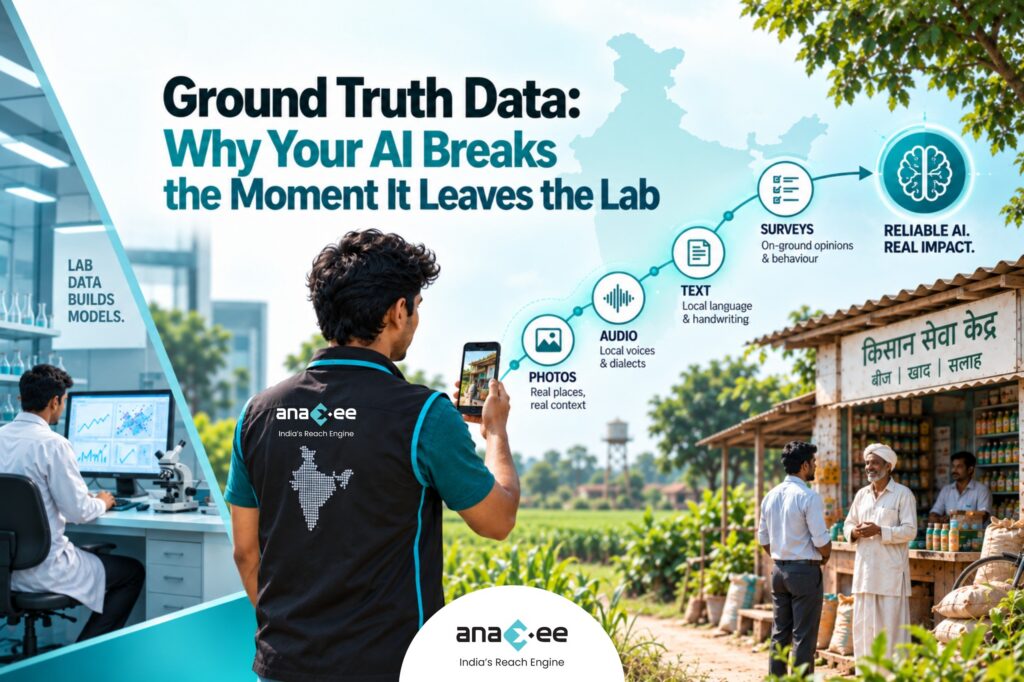

Ground Truth Data: Why Your AI Breaks the Moment It Leaves the Lab
There’s a moment every AI team quietly dreads. The model scores beautifully on the test set. The demo goes off without a hitch. Everyone claps. And then it ships — and somewhere out in the real world, it starts making calls that make no sense at all.
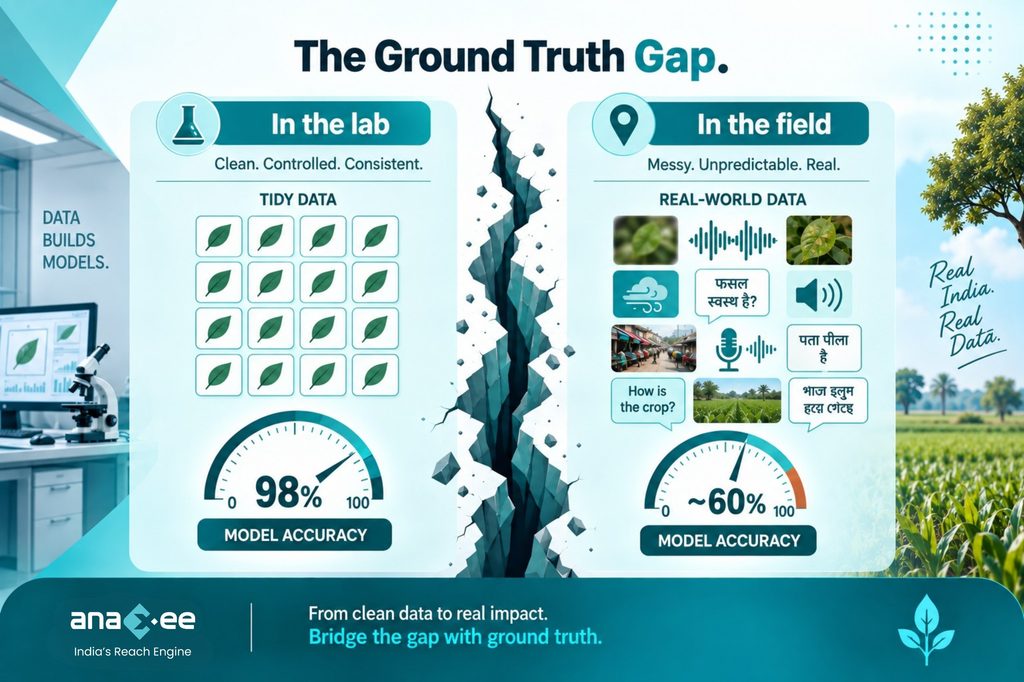
A crop-disease classifier that nails every textbook image can’t recognise the same blight on a phone photo taken at dusk in a cotton field. A voice assistant that handles clean studio English gives up the moment a shopkeeper in Indore speaks half in Hindi, half in English, with a ceiling fan whirring in the background. The model didn’t suddenly get worse. It just met reality for the first time.
That gap has a name. It’s the distance between the data you trained on and the ground truth — the actual, messy, unglamorous conditions where your model has to earn its keep. And closing that gap is the difference between a system that impresses investors and one that survives contact with an actual user.
The internet is not the world
Most training data starts life the same way: scraped, licensed, or bought off the shelf. It’s convenient, it’s cheap, and it’s already sitting there. The problem is what it quietly leaves out.
The internet is a lopsided mirror. It over-represents English, cities, younger users, and anyone with a good camera and a data plan. It barely notices a farmer in Betul, a weaver in Bhagalpur, or a kirana owner who has never typed a review in his life. When your model learns from that mirror, it inherits every blind spot baked into it — and then confidently applies those blind spots to people the data never really saw.
Synthetic data has the same trap wearing a smarter suit. You can generate a million variations of a scene, but you can only generate the variations you already know how to imagine. The accent you’ve never heard, the way a specific district labels a specific pest, the lighting in a real village market at 6 pm — none of that comes out of a model. It has to be collected, by someone standing right there.
That’s the whole idea behind ground truth. Not the data that was easy to find, but the data that reflects the world your model will actually work in.
Why “just collect more data” is harder than it sounds
Here’s where most teams hit a wall. Everyone agrees they need real-world data. Almost nobody has a clean way to go get it.
Because collecting ground truth at any serious scale isn’t a data problem first — it’s a logistics problem wearing a data problem’s clothes. You need real humans in real places. You need them to speak the local language, understand the local context, and follow instructions precisely across thousands of collection points at once. You need photos shot the right way, audio recorded clearly, forms filled correctly, and someone checking all of it before it ever touches your pipeline.
Do that in one city and it’s a project. Do it across an entire country, in a dozen languages, in places that don’t show up neatly on a map — and it becomes the kind of operation that swallows eighteen months and a hiring spree before you’ve labelled a single row.
This is exactly the wall that stops good AI teams from shipping. Not the modelling. The gathering.
What a human network on the ground actually changes
This is where Anaxee comes in, and it’s worth being precise about what we are.
We’re India’s Reach Engine — a network of over 40,000 Digital Runners spread across 540+ districts, 26 states, and 11,000+ pincodes. These are real people who live where your data lives. They speak the languages your users speak. They know the difference between how a thing is said in a metro and how it’s said three hours off the highway. Since 2016, this network has done ground-level work for 350+ brands, including names like Colgate, Mahindra, ITC and Pepsi — which means the muscle for large-scale, verified, on-the-ground collection is already built. It doesn’t have to be invented for your project.
For an AI team, that changes the maths completely. Instead of building a field operation from scratch, you plug into one that already reaches the last mile. Need audio samples of a specific dialect from a specific belt of districts? There are people there. Need thousands of real product photos shot in real homes and real shops, not stock studios? There are people there too. Need a survey run across rural and urban respondents at the same time, with answers that reflect how people genuinely think rather than how a scraped dataset assumes they do? Same network, same day.
And because the collectors are local, the data comes back with the texture your model is starving for — the accents, the code-mixing, the odd lighting, the regional quirks. The exact things the internet forgot to record.
Quality is a process, not a promise
Scale on its own can be dangerous. A thousand collectors gathering the wrong thing quickly just gives you a thousand times the mess. So the part that matters as much as reach is verification.
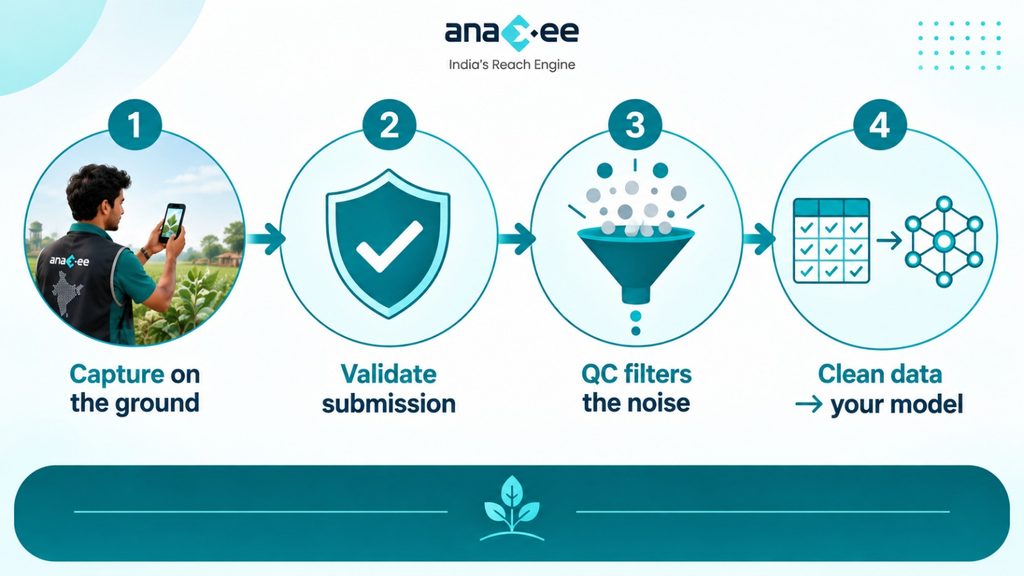
Every collection task moves through checks before it counts — Runners are guided on how to capture each data point, submissions are validated, and quality control catches the noise before it reaches you. The point isn’t just to hand you a large pile of data. It’s to hand you data you can actually trust to train on, with the rough edges filtered out and the real-world signal left in.
That’s the quiet difference between a dataset that lifts your model’s accuracy and one that silently poisons it.
The takeaway
Your model is only ever as honest as the data behind it. You can have the sharpest architecture in the room, but if it learned from a lopsided mirror, it will make lopsided decisions the moment it meets a real person — and it’ll do it with total confidence, which is the worst part.
Ground truth is how you fix that. Real data, from real environments, gathered by real people who understand the place. That’s not a nice-to-have layered on top of a good model. It is the good model.
If you’re building AI that has to work across India — or anywhere the internet forgot to look — that’s the exact gap we exist to close.
Talk to us about your data. Tell us what your model needs to see, hear, or read, and we’ll tell you how our network can go get it. → Book a call